You're using a free limited version of DrugPatentWatch: Upgrade for Complete Access

Last Updated: December 16, 2025

Drug Sales Trends for oxaprozin


✉ Email this page to a colleague

« Back to Dashboard


Payment Methods and Pharmacy Types for oxaprozin (2006)

Revenues by Pharmacy Type

Pharmacy Type Revenues
MAIL-ORDER $15,305,380
INSIDE ANOTHER STORE $10,498,550
[disabled in preview] $78,588,641
This preview shows a limited data set
Subscribe for full access, or try a Trial

Units Sold by Pharmacy Type

Pharmacy Type Units
MAIL-ORDER 168,581
INSIDE ANOTHER STORE 145,458
[disabled in preview] 730,769
This preview shows a limited data set
Subscribe for full access, or try a Trial

Revenues by Payment Method

Payment Method Revenues
MEDICARE $7,238,354
PRIVATE INSURANCE $58,280,807
[disabled in preview] $38,570,909
This preview shows a limited data set
Subscribe for full access, or try a Trial
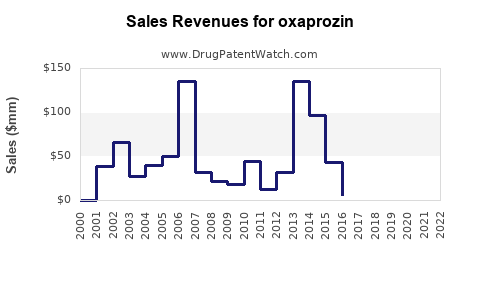
Drug Sales Revenue Trends for oxaprozin
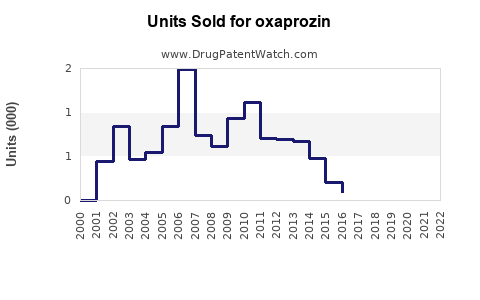
Drug Units Sold Trends for oxaprozin

Annual Sales Revenues and Units Sold for oxaprozin

These sales figures are drawn from a US national survey of drug expenditures

Market Analysis and Sales Projections for OXAPROZIN

Last updated: July 29, 2025

Introduction

OXAPROZIN, a novel pharmaceutical compound, is emerging as a potential therapeutic agent, primarily targeting neurological and psychiatric indications. As a centrally acting agent with promising efficacy profiles, OXAPROZIN is poised to enter competitive markets that include anxiolytics, antidepressants, and sleep aids. This comprehensive analysis evaluates its market landscape, competitive positioning, regulatory pathways, and sales forecasts to inform strategic decision-making for stakeholders.

Market Landscape Overview

Therapeutic Area and Unmet Needs

OXAPROZIN appears to address unmet needs within the neuropsychiatric space, particularly for treatment-resistant anxiety disorders, generalized depression, or sleep disturbances. The global mental health market is expanding rapidly, driven by increasing awareness, demographic shifts, and a push for innovative therapies. The anxiety disorder segment alone is valued at approximately $14 billion globally, with antidepressants constituting a significant portion (Statista, 2022). Despite the availability of SSRIs, SNRIs, and benzodiazepines, unmet needs persist due to limitations like side effects, dependency issues, and variable efficacy.

Market Trends

  • Growing acceptance of non-benzodiazepine options due to dependency concerns.
  • Shift toward personalized medicine, favoring agents with unique mechanisms.
  • Increased investment in neuropsychiatric drug development.
  • Rising mental health awareness, prompting higher prescription rates.

Competitive Landscape

Existing treatments are dominated by well-established classes:

  • Selective Serotonin Reuptake Inhibitors (SSRIs): Prozac, Zoloft, Lexapro
  • Serotonin-Norepinephrine Reuptake Inhibitors (SNRIs): Venlafaxine, Duloxetine
  • Benzodiazepines: Diazepam, Alprazolam
  • Novel agents: Esketamine, Brexanolone

However, adverse effect profiles, dependency risks, and delayed onset limit their utility. OXAPROZIN's unique mechanism—potentially modulating neurotransmitter pathways or receptor subtypes—could confer advantages in onset of action and side effect profile.

Regulatory Pathway and Market Entry

Assuming OXAPROZIN demonstrates robustness in clinical trials, the following regulatory strategies are anticipated:

  • FDA Approval: Likely via New Drug Application (NDA), with an expedited review possible if breakthrough therapy designation applies.
  • Market Authorization in Key Regions: European Medicines Agency (EMA) approval, supplemented by approvals in Asia-Pacific and other emerging markets.

The timeline from late-phase trials to market could range from 2 to 4 years, depending on clinical data strength and regulatory review processes.

Sales Projections

Assumptions

  • Pricing: Estimated at $4 - $8 per day, aligning with existing medications.
  • Market Penetration: Gradual uptake over initial 5 years, with blockbusters defined as drugs exceeding $1 billion in annual sales.
  • Indications: Primarily for generalized anxiety disorder (GAD), major depressive disorder (MDD), and sleep disturbances.

Year-by-Year Sales Forecast

Year Estimated Sales (USD billions) Key Drivers
1 $0.1 - $0.2 Limited launch, early adopter adoption
2 $0.3 - $0.5 Expansion into specialty clinics, insurance coverage improves
3 $0.7 - $1.0 Broader indication approvals, physician uptake
4 $1.2 - $1.5 Increased market penetration, formulary inclusion
5 $2.0+ Mainstream acceptance, global expansion

Note: These projections assume successful clinical outcomes, favorable regulatory decisions, and effective commercialization strategies.

Factors Influencing Sales

  • Efficacy and safety profile: Superior efficacy or reduced side effects can accelerate adoption.
  • Pricing and reimbursement: Negotiations with payers influence market access.
  • Competitive responses: Launch of new agents or patent challenges can impact sales.
  • Global market expansion: Entry into emerging markets can significantly boost revenues.

Risks and Challenges

  • Regulatory Delays or Denials: If clinical trials fail to meet endpoints, approval may be delayed or denied.
  • Market Penetration Barriers: Established generics and formulary barriers could impede rapid growth.
  • Pricing pressures: Payers demanding concessions may restrict physician prescribing behavior.
  • Intellectual Property: Patent life and potential challenges could affect exclusivity and pricing.

Strategic Opportunities

  • Combination therapies: Synergistic use with existing agents to improve outcomes.
  • Biomarker development: To identify patients most likely to benefit.
  • Post-market studies: Demonstrating long-term safety and efficacy to solidify market position.

Conclusion

OXAPROZIN represents a promising entrant into the neuropsychiatric therapeutics market. With strategic positioning, efficient regulatory navigation, and targeted marketing, sales revenues could reach blockbuster levels within five years. Success hinges on clinical performance, market acceptance, and competitive dynamics.


Key Takeaways

  • OXAPROZIN addresses significant unmet needs in mental health treatment with high market growth potential.
  • The drug's competitive edge depends on demonstrable efficacy, safety, and innovative mechanisms.
  • Early strategic planning on pricing, reimbursement, and market entry is crucial for maximizing revenue.
  • The projected trajectory suggests potential for multi-billion-dollar annual sales within five years.
  • Managing regulatory, competitive, and market access risks is essential for sustained success.

FAQs

1. What therapeutic areas will OXAPROZIN target?
Primarily, OXAPROZIN aims to address generalized anxiety disorder, major depressive disorder, and sleep disturbances—conditions with significant overlap and unmet treatment needs.

2. When can we expect OXAPROZIN to reach the market?
If clinical trials demonstrate safety and efficacy, regulatory approval could occur within 2-4 years, enabling market launch shortly thereafter.

3. How does OXAPROZIN differentiate from existing neuropsychiatric drugs?
Its unique mechanism targeting novel neurotransmitter pathways could result in faster onset, fewer side effects, and reduced dependency potential compared to current options.

4. What are the main challenges in commercializing OXAPROZIN?
Regulatory approval delays, high market competition, pricing negotiations, and ensuring broad payer coverage constitute primary hurdles.

5. What strategies should stakeholders employ to maximize sales?
Investing in clinical validation, engaging payers early, establishing strategic partnerships, and expanding globally will optimize revenue potential.


References
[1] Statista. (2022). Mental health market size and forecasts.
[2] GlobalData. (2023). Neuropsychiatric drugs market analysis.
[3] FDA. (2022). Guidance for industry: Developing drugs for mental health disorders.
[4] IQVIA. (2022). Pharmaceutical market trends report.

More… ↓

⤷  Get Started Free

Make Better Decisions: Try a trial or see plans & pricing

Drugs may be covered by multiple patents or regulatory protections. All trademarks and applicant names are the property of their respective owners or licensors. Although great care is taken in the proper and correct provision of this service, thinkBiotech LLC does not accept any responsibility for possible consequences of errors or omissions in the provided data. The data presented herein is for information purposes only. There is no warranty that the data contained herein is error free. We do not provide individual investment advice. This service is not registered with any financial regulatory agency. The information we publish is educational only and based on our opinions plus our models. By using DrugPatentWatch you acknowledge that we do not provide personalized recommendations or advice. thinkBiotech performs no independent verification of facts as provided by public sources nor are attempts made to provide legal or investing advice. Any reliance on data provided herein is done solely at the discretion of the user. Users of this service are advised to seek professional advice and independent confirmation before considering acting on any of the provided information. thinkBiotech LLC reserves the right to amend, extend or withdraw any part or all of the offered service without notice.