Share This Page
Drug Sales Trends for lamotrigine
✉ Email this page to a colleague
Payment Methods and Pharmacy Types for lamotrigine (2006)
Revenues by Pharmacy Type
Units Sold by Pharmacy Type
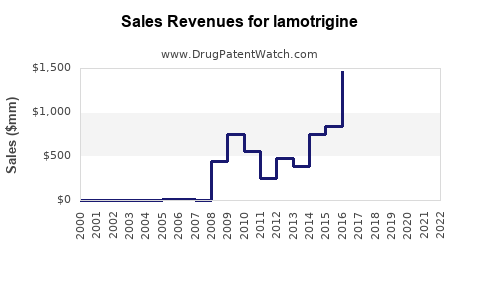
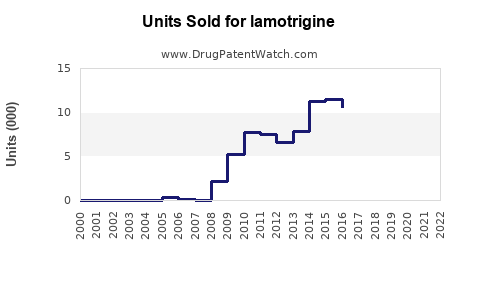
Annual Sales Revenues and Units Sold for lamotrigine
| Drug Name | Revenues (USD) | Units | Year |
|---|---|---|---|
| LAMOTRIGINE | ⤷ Start Trial | ⤷ Start Trial | 2022 |
| LAMOTRIGINE | ⤷ Start Trial | ⤷ Start Trial | 2021 |
| LAMOTRIGINE | ⤷ Start Trial | ⤷ Start Trial | 2020 |
| >Drug Name | >Revenues (USD) | >Units | >Year |
Lamotrigine Market Analysis and Sales Projections, 2025-2030
Lamotrigine is a mature, genericized antiseizure and bipolar-disorder medicine with durable demand but limited pricing power. The market is driven by epilepsy prevalence, long-term maintenance use, broad generic availability, and continued prescribing of branded or authorized-generic products in selected markets. Global annual medicine sales are estimated at approximately $650 million to $950 million in 2025, with value likely declining modestly through 2030 as generic price pressure offsets prescription growth.
Lamotrigine has limited near-term patent risk because core composition-of-matter and immediate-release product protection expired years ago. The principal commercial risks are reimbursement compression, substitution among generic manufacturers, supply interruptions, and competition from newer antiseizure medicines.
What is lamotrigine used for?
Lamotrigine is an oral sodium-channel modulator marketed for epilepsy and bipolar I disorder maintenance treatment.
| Indication | Commercial relevance | FDA status |
|---|---|---|
| Partial-onset seizures | High | Approved |
| Primary generalized tonic-clonic seizures | Moderate | Approved |
| Seizures associated with Lennox-Gastaut syndrome | Moderate | Approved |
| Bipolar I disorder maintenance | High | Approved |
| Acute bipolar depression | Limited | Not approved as an acute treatment |
| Major depressive disorder | Off-label or investigational use | Not an FDA-approved indication |
The original branded product, Lamictal, was developed and commercialized by GlaxoSmithKline. Immediate-release lamotrigine tablets, chewable dispersible tablets, and orally disintegrating tablets are now available from multiple generic manufacturers. Extended-release lamotrigine was marketed as Lamictal XR and is also exposed to generic competition.
The medicine has a long treatment duration. Patients with epilepsy often remain on therapy for years, while bipolar patients may use lamotrigine as chronic maintenance treatment. This persistence supports stable unit demand even as average selling prices decline.
How large is the lamotrigine market?
Public companies generally do not report lamotrigine revenue as a separate line item. The market estimate below is therefore an analytical range rather than a directly reported industry total.
Estimated global lamotrigine medicine sales
| Year | Estimated global sales | Main market condition |
|---|---|---|
| 2023 | $700 million-$1.0 billion | Mature generic market |
| 2024 | $675 million-$975 million | Continued price erosion |
| 2025 | $650 million-$950 million | Stable demand, lower net prices |
| 2026 | $635 million-$930 million | Generic substitution expands |
| 2027 | $620 million-$915 million | Volume growth partly offsets price decline |
| 2028 | $610 million-$900 million | Mature market equilibrium |
| 2029 | $600 million-$890 million | Limited branded contribution |
| 2030 | $590 million-$880 million | Low-single-digit annual value decline |
The projection assumes:
- Global prescription volume growth of approximately 1% to 3% annually.
- Average net price erosion of approximately 3% to 6% annually.
- No major withdrawal of lamotrigine from a large market.
- Continued availability of immediate-release and extended-release generics.
- No major new indication that materially expands the treated population.
- Stable use in epilepsy and bipolar maintenance treatment.
The resulting market profile is volume-stable but value-declining. A higher-growth scenario would require broader use in bipolar disorder, improved diagnosis of epilepsy, or increased use in low- and middle-income markets. A downside scenario would involve supply disruptions, more aggressive tender pricing, or substitution by newer antiseizure drugs.
What are the main lamotrigine sales drivers?
Epilepsy prevalence and chronic treatment
Epilepsy is the largest demand base for lamotrigine. The World Health Organization estimates that epilepsy affects approximately 50 million people globally, although treated prevalence varies significantly by country and healthcare access level (World Health Organization, 2024).
Lamotrigine is used across several seizure types and is established in clinical guidelines. Demand is supported by:
- Long-term maintenance treatment.
- Use in adolescents and adults.
- Broad formulary acceptance.
- Availability in multiple dosage forms.
- Use when weight gain, sedation, or metabolic effects are concerns with other medicines.
Bipolar maintenance treatment
Lamotrigine has a differentiated position in bipolar I maintenance because of its role in reducing depressive relapse risk. It is less useful for acute mania and is not approved as an acute treatment for bipolar depression.
The bipolar segment supports prescription volume but does not create strong pricing power. Most patients can receive generic tablets, and treatment guidelines generally list multiple alternatives, including lithium, quetiapine, lurasidone, and valproate-related therapies.
Generic access
Generic lamotrigine is the central market driver. The FDA has approved multiple generic products in immediate-release tablet, chewable/dispersible, orally disintegrating, and extended-release forms. Generic competition has reduced average prices while expanding access (FDA, 2024a).
What is the competitive landscape for lamotrigine?
Lamotrigine competes in two different markets: chronic antiseizure therapy and bipolar maintenance therapy.
| Competitor | Primary overlap | Commercial position |
|---|---|---|
| Levetiracetam | Epilepsy | Strong generic competitor; broad use and simple titration |
| Carbamazepine | Epilepsy | Older generic alternative |
| Oxcarbazepine | Epilepsy | Generic alternative for focal seizures |
| Valproate | Epilepsy and bipolar disorder | Broad efficacy, but safety and reproductive-risk concerns |
| Topiramate | Epilepsy | Generic; also used in migraine prevention |
| Lacosamide | Epilepsy | Newer product with generic competition emerging |
| Gabapentin | Epilepsy and off-label pain | Large generic market, but different clinical profile |
| Lithium | Bipolar disorder | Low-cost maintenance alternative |
| Quetiapine | Bipolar disorder | Strong generic competitor |
| Lurasidone | Bipolar depression and schizophrenia | Branded and generic competition varies by market |
Lamotrigine’s main competitive advantages are its established efficacy, generic affordability, relatively favorable weight and metabolic profile, and broad physician familiarity. Its disadvantages include slow dose titration, clinically important rash risk, and drug interactions, particularly with valproate and enzyme-inducing antiseizure medicines.
What is the FDA regulatory status of lamotrigine?
Lamotrigine is an FDA-approved small-molecule drug available through the abbreviated new drug application pathway for generic versions.
The FDA labeling includes a boxed warning for serious skin rashes, including Stevens-Johnson syndrome and toxic epidermal necrolysis. The risk is associated with rapid dose escalation, higher starting doses, and concomitant valproate use. This warning affects prescribing, titration, patient monitoring, and product switching considerations (FDA, 2023).
The FDA-approved product categories include:
- Immediate-release tablets.
- Chewable dispersible tablets.
- Orally disintegrating tablets.
- Extended-release tablets.
The extended-release formulation can reduce dosing frequency and may support adherence. Its commercial differentiation is limited because generic extended-release products are available or have entered the market in several jurisdictions.
What patents protect lamotrigine products?
The core lamotrigine patent estate is effectively expired in the United States and other major markets.
| Patent category | Commercial status |
|---|---|
| Lamotrigine compound patent | Expired |
| Immediate-release tablet patents | Expired |
| Lamictal indication patents | Expired or no longer commercially decisive |
| Chewable/dispersible formulations | Expired or exposed to generic competition |
| Extended-release formulation patents | Historical protection; generic competition has materially reduced risk |
| Manufacturing patents | Potentially relevant at supplier level, but not a broad barrier to finished-dose competition |
Lamotrigine is listed in the FDA Orange Book through approved reference products and associated product information, but Orange Book listing does not create current market exclusivity for the active ingredient. The relevant commercial question is whether a specific formulation or dosage presentation retains enforceable, unexpired claims. For the dominant immediate-release market, generic entry has already occurred.
The practical patent conclusion is that lamotrigine is not an exclusivity-driven asset. Its economic value depends on manufacturing efficiency, supply reliability, distribution, and portfolio scale.
When did lamotrigine lose exclusivity?
Lamictal immediate-release products lost meaningful U.S. market exclusivity in the late 2000s. Generic lamotrigine approvals and launches followed the expiration of key product protection.
Lamictal XR retained a later formulation-based commercial position, but extended-release protection does not restore exclusivity for the overall lamotrigine market. Immediate-release products remain widely substitutable, and the extended-release segment is also exposed to generic competition.
There is no commercially meaningful new chemical entity exclusivity period remaining for lamotrigine. Pediatric exclusivity, orphan exclusivity, or other regulatory extensions do not materially change the current market outlook.
What is the Paragraph IV challenge risk for lamotrigine?
Current Paragraph IV risk is low as a strategic concern because the principal generic entry events occurred years ago.
Historically, generic applicants could challenge listed patents through Paragraph IV certifications. Those challenges were relevant to launch timing for Lamictal and Lamictal XR. The current market has moved beyond the initial patent litigation cycle, with multiple generic products available.
Future Paragraph IV activity could still arise around:
- A newly approved modified-release product.
- A novel fixed-dose combination.
- A delivery technology.
- A narrow formulation patent.
- A new indication supported by a separate method-of-use patent.
Such activity would affect a specific product, not the mature lamotrigine market as a whole.
What is the biosimilar risk for lamotrigine?
Lamotrigine has no biosimilar risk because it is a chemically synthesized small molecule, not a biologic.
The relevant competitive category is generic substitution. Generic manufacturers do not need to establish biosimilarity. They submit abbreviated applications demonstrating pharmaceutical equivalence and bioequivalence to the reference product, subject to FDA requirements.
This creates a lower regulatory barrier than in biologic markets. The commercial result is greater manufacturer participation, faster price erosion, and lower long-term branded retention.
How strong is the lamotrigine patent estate?
The patent estate is weak from a branded-product investment perspective and moderate from a formulation-management perspective.
| Patent factor | Assessment |
|---|---|
| Composition-of-matter protection | Very weak; expired |
| Immediate-release product protection | Very weak |
| Extended-release protection | Limited residual relevance |
| Method-of-use protection | Limited practical value |
| Manufacturing know-how | Moderate for cost and quality control |
| Regulatory exclusivity | None of material commercial importance |
| Barriers to generic entry | Low |
| Litigation leverage | Low |
Manufacturing know-how may still matter. Lamotrigine requires control of impurity profiles, particle properties, content uniformity, dissolution, and supply-chain consistency. These factors can create operational barriers but generally do not prevent a capable generic manufacturer from entering.
What sales scenarios are most likely through 2030?
Base case
The base case assumes stable treated-patient numbers, modest growth in epilepsy diagnosis, and continued generic price erosion.
- 2025 sales: $650 million-$950 million.
- 2030 sales: $590 million-$880 million.
- Five-year compound annual growth: approximately negative 1% to negative 2%.
Upside case
The upside case assumes stronger diagnosis and treatment in emerging markets, durable bipolar-maintenance use, and limited disruption from competing antiseizure drugs.
- 2025 sales: $900 million-$1.0 billion.
- 2030 sales: $900 million-$1.1 billion.
- Five-year compound annual growth: approximately 0% to 2%.
Downside case
The downside case assumes aggressive generic tender pricing, manufacturing interruptions, greater use of levetiracetam and newer medicines, and weaker branded retention.
- 2025 sales: $600 million-$700 million.
- 2030 sales: $450 million-$600 million.
- Five-year compound annual growth: approximately negative 4% to negative 6%.
Which companies are positioned in the lamotrigine market?
The market includes the original brand owner, large generic manufacturers, regional suppliers, and contract manufacturers. Companies with established generic portfolios may compete through scale rather than product differentiation.
Key commercial groups include:
- GlaxoSmithKline, through the historical Lamictal franchise.
- Teva Pharmaceutical Industries.
- Viatris.
- Sandoz.
- Sun Pharmaceutical Industries.
- Dr. Reddy’s Laboratories.
- Zydus Lifesciences.
- Hikma Pharmaceuticals.
- Cipla.
- Regional manufacturers supplying national tenders.
Manufacturer rankings vary by country, channel, dosage form, and tender cycle. No single company has durable global control of lamotrigine because the product is widely genericized.
What generic launch scenarios exist for lamotrigine?
The most likely generic market scenarios are:
- Continued immediate-release price erosion as manufacturers compete for pharmacy and payer volume.
- Stable or modestly growing unit demand from chronic epilepsy and bipolar treatment.
- Periodic supply shifts when a major manufacturer exits or changes capacity.
- Limited premium retention for orally disintegrating or extended-release formats.
- Increased tender competition in public healthcare systems.
- Regional shortages that temporarily improve pricing for suppliers with available inventory.
Generic entry is unlikely to produce a sudden market collapse because demand is recurring and diversified. The more likely outcome is gradual value erosion with periodic volatility by dosage strength and country.
What licensing deals affect lamotrigine?
Lamotrigine is unlikely to generate material new licensing activity as a standalone active ingredient. The original strategic value came from development and commercialization of Lamictal, not from current patent licensing.
Potential transactions would more likely involve:
- Portfolio acquisitions containing lamotrigine and other mature products.
- Regional distribution agreements.
- Generic supply and manufacturing contracts.
- Authorized-generic arrangements.
- Hospital or government tender supply agreements.
A new standalone licensing deal would require a differentiated product, such as a novel delivery system, combination therapy, or indication supported by meaningful clinical evidence. The conventional tablet market offers limited economic rationale for royalty-bearing licensing.
What is the investment outlook for lamotrigine?
Lamotrigine is a defensive generic pharmaceutical asset rather than a growth product.
The investment case is strongest for manufacturers that have:
- Low-cost active pharmaceutical ingredient access.
- Reliable regulatory compliance.
- Broad global registration coverage.
- Multiple dosage forms.
- Strong hospital and retail distribution.
- Capacity to manage periodic shortages.
- A diversified generic portfolio that reduces dependence on one product.
The investment case is weak for a company relying on premium pricing, patent exclusivity, or a branded relaunch. Revenue growth is unlikely without a new formulation, indication, or geographic expansion.
Key takeaways
- Lamotrigine is a mature, genericized medicine used mainly for epilepsy and bipolar I maintenance.
- Estimated global medicine sales are approximately $650 million-$950 million in 2025.
- Base-case sales are likely to decline modestly through 2030 because generic price erosion exceeds prescription growth.
- The core patent estate is expired and does not provide meaningful current exclusivity.
- Paragraph IV and branded litigation risk are low compared with newer medicines.
- Biosimilar risk does not apply; generic substitution is the relevant threat.
- Competitive strength comes from clinical familiarity, chronic use, affordability, and broad dosage-form availability.
- Manufacturing reliability and distribution are more important than patent ownership.
- The strongest commercial opportunities are in efficient generic production, regional tenders, and differentiated modified-release or adherence-oriented products.
FAQs about lamotrigine market sales and competition
Is lamotrigine still a commercially important drug?
Yes. Lamotrigine remains commercially important because epilepsy and bipolar maintenance treatment require long-term therapy. Its importance is reflected in prescription volume rather than high product pricing.
Does Lamictal still generate significant revenue?
Lamictal retains brand recognition and some branded sales, but generic substitution has sharply reduced its economic position relative to the pre-generic period. Most market value now sits with generic manufacturers and distributors.
Can a new company obtain exclusivity for a lamotrigine product?
A company could obtain product-specific protection for a novel formulation, delivery system, or qualifying new indication. It would not regain exclusivity over conventional lamotrigine tablets.
Is lamotrigine a high-growth pharmaceutical market?
No. Lamotrigine is primarily a stable-volume, low-growth market. Revenue growth would require geographic expansion, increased diagnosis, or meaningful product differentiation.
What is the largest commercial risk for lamotrigine suppliers?
The largest risks are price compression, loss of formulary position, manufacturing disruption, regulatory observations, and substitution by other antiseizure or bipolar-maintenance medicines.
References
- U.S. Food and Drug Administration. (2023). Lamictal (lamotrigine) prescribing information.
- U.S. Food and Drug Administration. (2024a). Drugs@FDA: FDA-approved drugs and generic lamotrigine products.
- U.S. Food and Drug Administration. (2024b). Approved drug products with therapeutic equivalence evaluations: Orange Book.
- World Health Organization. (2024). Epilepsy. https://www.who.int/news-room/fact-sheets/detail/epilepsy
- GlaxoSmithKline. (2009). Annual report 2008: Lamictal product and commercial information.
- National Institute for Health and Care Excellence. (2022). Bipolar disorder: Assessment and management. NICE guideline CG185.
More… ↓
