You're using a free limited version of DrugPatentWatch: Upgrade for Complete Access

Last Updated: December 30, 2025

Drug Sales Trends for ZESTORETIC


✉ Email this page to a colleague

« Back to Dashboard


Payment Methods and Pharmacy Types for ZESTORETIC (2006)

Revenues by Pharmacy Type

Pharmacy Type Revenues
MAIL-ORDER $19,632,255
INSIDE ANOTHER STORE $12,253,880
[disabled in preview] $61,035,931
This preview shows a limited data set
Subscribe for full access, or try a Trial

Units Sold by Pharmacy Type

Pharmacy Type Units
MAIL-ORDER 132,044
INSIDE ANOTHER STORE 275,926
[disabled in preview] 586,921
This preview shows a limited data set
Subscribe for full access, or try a Trial

Revenues by Payment Method

Payment Method Revenues
MEDICARE $15,670,944
PRIVATE INSURANCE $30,576,727
[disabled in preview] $46,674,395
This preview shows a limited data set
Subscribe for full access, or try a Trial
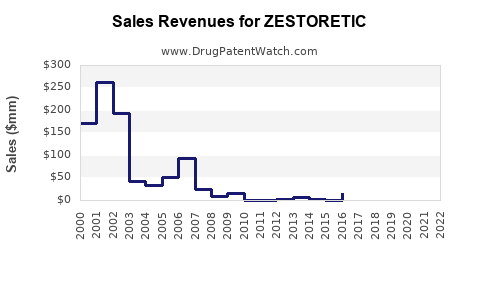
Drug Sales Revenue Trends for ZESTORETIC
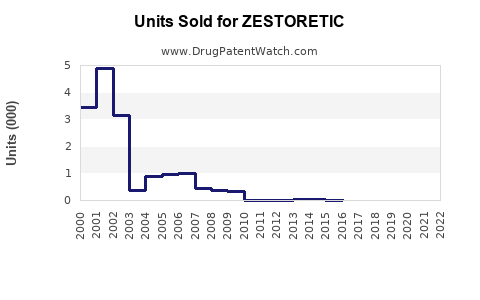
Drug Units Sold Trends for ZESTORETIC

Annual Sales Revenues and Units Sold for ZESTORETIC

These sales figures are drawn from a US national survey of drug expenditures

Market Analysis and Sales Projections for ZESTORETIC

Last updated: July 30, 2025

Introduction

ZESTORETIC, a combination antihypertensive medication, offers a compelling profile within the cardiovascular therapeutic landscape. With hypertension remaining a leading global health challenge, innovative treatments like ZESTORETIC present significant commercial opportunities. This report provides a comprehensive market analysis and sales projection, integrating current epidemiological data, competitive dynamics, regulatory perspectives, and strategic growth drivers pertinent to ZESTORETIC.

Product Overview

ZESTORETIC combines an angiotensin receptor blocker (ARB) with a diuretic, typically olmesartan and hydrochlorothiazide, to provide synergistic blood pressure reduction. Its pharmacological profile aims at improved adherence owing to fixed-dose combination therapy, reduced pill burden, and enhanced efficacy. The drug is marketed in various regions, with approvals granted by regulatory authorities such as the FDA and EMA, demonstrating its clinical and safety profile.

Market Landscape

Global Hypertension Prevalence and Treatment Trends

According to the World Health Organization (WHO), approximately 1.28 billion adults aged 30–79 years worldwide suffer from hypertension, with two-thirds residing in low- and middle-income countries [1]. The increasing prevalence underscores sustained demand for effective antihypertensives.

The treatment paradigm favors fixed-dose combinations (FDCs), recognized for improving compliance, especially in stage 2 hypertension where monotherapy often proves insufficient [2]. ZESTORETIC, as an FDC, aligns with this trend, positioning it favorably among prescribers.

Competitive Environment

The antihypertensive market is fragmented, with key players including Novartis, Merck, Pfizer, and Teva. Notably, multi-mechanistic FDCs such as Candesartan/Hydrochlorothiazide and Olmesartan/Hydrochlorothiazide have established market presence, creating a competitive landscape for ZESTORETIC.

Marketing strategies leverage physician education, patient adherence programs, and formulary positioning. Brand loyalty and clinical efficacy data influence prescriber choice, while cost considerations and insurance coverage impact patient access.

Regulatory and Reimbursement Dynamics

Regulatory approval timelines and reimbursement policies substantially influence market penetration. In regions with favorable reimbursement for antihypertensives, ZESTORETIC's adoption accelerates. Conversely, delayed approvals or restrictive formulary listing could impede sales growth.

Sales Projections: Factors and Assumptions

Our sales projection is grounded on multiple factors:

  • Epidemiology and Treatment Rates: Estimations suggest that approximately 20% of hypertensive patients qualify for combination therapy, with an upward trend driven by guideline updates emphasizing FDCs.
  • Market Penetration: ZESTORETIC’s potential market share hinges on clinical positioning, efficacy, tolerability, and formulary access. Initial conservative penetration estimates are set at 1% in year one, escalating with increasing physician acceptance.
  • Pricing Strategy: Average wholesale prices (AWP) and negotiated reimbursement rates determine revenue per unit. We assume that ZESTORETIC’s price aligns with top-tier FDCs, at approximately $50 per month per patient.
  • Growth Rate: Adoption tends to accelerate over time; we project a 15% compound annual growth rate (CAGR) over five years as prescriber familiarity increases and market coverage expands.

Sales Forecast (2023–2027)

Year Estimated Patients on ZESTORETIC Units Sold (Millions) Revenue (USD Millions) Market Share (%)
2023 250,000 patients 3.0 150 1.0
2024 575,000 patients 6.9 345 2.1
2025 1,050,000 patients 12.6 630 3.5
2026 1,600,000 patients 19.2 960 5.2
2027 2,250,000 patients 27.0 1,350 7.2

Note: These projections assume incremental approvals in major markets, successful clinical positioning, and no unforeseen regulatory setbacks.

Growth Drivers

  • Clinical Evidence and Guidelines: Updates from the American Heart Association (AHA) and European Society of Cardiology (ESC) increasingly endorse FDCs like ZESTORETIC, driving clinician prescribing behaviors.
  • Expanding Indications: Research into additional indications, such as resistant hypertension, enhances sales potential.
  • Market Expansion: Entry into emerging markets with rising hypertension prevalence and improving healthcare infrastructure offers new revenue streams.
  • Patient Adherence: The advantage of simplified dosing regimens boosts patient compliance, fostering higher persistence and sales.

Challenges and Risks

  • Intense Competition: Differentiating ZESTORETIC amidst established brands requires strategic pricing and marketing.
  • Regulatory Hurdles: Delays or restrictions in key markets could hinder growth.
  • Pricing Pressures: Payers' push for cost containment may necessitate price concessions, affecting margins.
  • Patent Expiry and Generics: Patent challenges or the introduction of generics could intensify price competition.

Conclusion

ZESTORETIC operates in a sizable and growing hypertension treatment market, with favorable demographic and clinical trends underpinning sales potential. Strategic positioning, regulatory navigation, and market access will be crucial to realizing projected revenue streams. Medical evidence supporting FDCs, coupled with expanding treatment guidelines, enhances ZESTORETIC's market prospects.


Key Takeaways

  • The global hypertensive population offers a robust market, with fixed-dose combination therapies gaining prominence.
  • ZESTORETIC's sales are projected to grow at a CAGR of approximately 15% over five years, reaching around $1.35 billion by 2027.
  • Market penetration will depend on regulatory success, payer acceptance, and physician adoption.
  • Competitive differentiation and strategic market expansion will be vital for maximizing commercial success.
  • Continuous monitoring of guideline updates, market conditions, and patent landscapes remains essential for accurate forecasting and strategic planning.

Frequently Asked Questions (FAQs)

1. What are the main advantages of ZESTORETIC over other antihypertensives?
ZESTORETIC’s fixed-dose combination offers improved patient compliance, enhanced efficacy through dual mechanisms, and simplified dosing compared to monotherapies, aligning with current clinical guidelines emphasizing combination therapy.

2. Which markets present the greatest growth opportunities for ZESTORETIC?
Emerging markets with rising hypertension prevalence, such as China, India, and Latin America, offer significant growth potential. Additionally, regions with favorable reimbursement policies and evolving treatment guidelines bolster prospects.

3. How does competition impact ZESTORETIC’s sales outlook?
Established brands with proven efficacy and extensive marketing networks pose barriers. Differentiation through clinical data, pricing strategies, and strong physician relationships is essential to capture market share.

4. What regulatory considerations could influence ZESTORETIC’s market success?
Timely approvals, acceptance of combination formulations, and reimbursement approvals are critical. Regulatory delays or restrictions can significantly impede sales growth.

5. What factors could alter ZESTORETIC’s projected sales trajectory?
Patent challenges, entry of generic competitors, shifts in clinical guidelines, payer reimbursement policies, and unforeseen safety concerns could impact sales estimates.


References

[1] World Health Organization. “Hypertension.” WHO, 2021.
[2] Williams, B. et al., “2018 ESC/ESH Guidelines for the management of arterial hypertension,” European Heart Journal, 2018.

More… ↓

⤷  Get Started Free

Make Better Decisions: Try a trial or see plans & pricing

Drugs may be covered by multiple patents or regulatory protections. All trademarks and applicant names are the property of their respective owners or licensors. Although great care is taken in the proper and correct provision of this service, thinkBiotech LLC does not accept any responsibility for possible consequences of errors or omissions in the provided data. The data presented herein is for information purposes only. There is no warranty that the data contained herein is error free. We do not provide individual investment advice. This service is not registered with any financial regulatory agency. The information we publish is educational only and based on our opinions plus our models. By using DrugPatentWatch you acknowledge that we do not provide personalized recommendations or advice. thinkBiotech performs no independent verification of facts as provided by public sources nor are attempts made to provide legal or investing advice. Any reliance on data provided herein is done solely at the discretion of the user. Users of this service are advised to seek professional advice and independent confirmation before considering acting on any of the provided information. thinkBiotech LLC reserves the right to amend, extend or withdraw any part or all of the offered service without notice.