Drug Sales Trends for VIGAMOX
Payment Methods and Pharmacy Types for VIGAMOX (2006)
Revenues by Pharmacy Type
Units Sold by Pharmacy Type
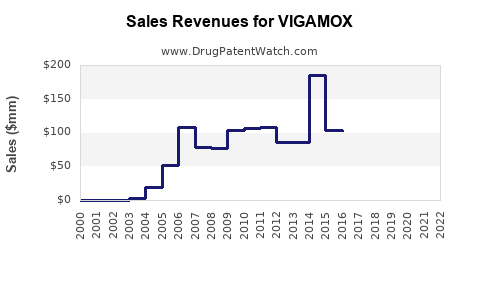
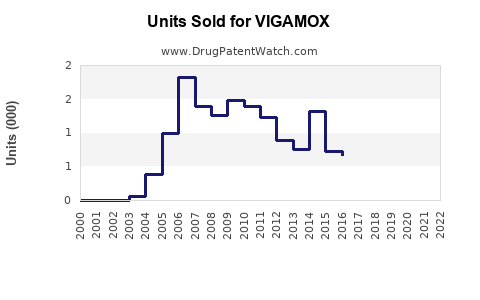
Annual Sales Revenues and Units Sold for VIGAMOX
| Drug Name | Revenues (USD) | Units | Year |
|---|---|---|---|
| VIGAMOX | ⤷ Start Trial | ⤷ Start Trial | 2022 |
| VIGAMOX | ⤷ Start Trial | ⤷ Start Trial | 2021 |
| VIGAMOX | ⤷ Start Trial | ⤷ Start Trial | 2020 |
| VIGAMOX | ⤷ Start Trial | ⤷ Start Trial | 2019 |
| >Drug Name | >Revenues (USD) | >Units | >Year |
Vigamox Market Analysis, Sales Projections, Patent Status, and Generic Competition
Vigamox is the branded ophthalmic formulation of moxifloxacin hydrochloride 0.5%, marketed primarily by Alcon for bacterial conjunctivitis. Its commercial profile is mature and declining: generic moxifloxacin ophthalmic solution has removed most U.S. pricing power, while Alcon retains demand from prescribers, hospitals, pharmacies, and patients who prefer the branded product. Public financial disclosures do not report Vigamox revenue separately.
A reasonable base-case model places global Vigamox net sales in the low tens of millions of dollars annually, with a continued decline through 2028. Generic moxifloxacin ophthalmic products are the principal competitive threat. No biosimilar risk applies because Vigamox is a small-molecule ophthalmic drug, not a biologic.
What is Vigamox and how is it used?
Vigamox contains moxifloxacin hydrochloride, a fluoroquinolone antibiotic formulated as a sterile ophthalmic solution at 0.5% concentration. The U.S. product is indicated for bacterial conjunctivitis caused by susceptible organisms. The labeled regimen is generally one drop in the affected eye three times daily for seven days. [1]
| Product attribute | Vigamox profile |
|---|---|
| Active ingredient | Moxifloxacin hydrochloride |
| Dosage form | Sterile ophthalmic solution |
| Strength | 0.5% |
| U.S. brand holder | Alcon |
| Initial FDA approval | 2003 |
| Primary indication | Bacterial conjunctivitis |
| Prescription status | Prescription drug in the United States |
| Drug class | Fluoroquinolone antibiotic |
| Product type | Small-molecule ophthalmic drug |
| Biosimilar exposure | None |
Moxifloxacin is also used in ophthalmology through generic products and off-label in some perioperative or ocular-infection settings. Those uses do not necessarily generate revenue for the Vigamox brand.
What is the current Vigamox market position?
Vigamox operates in a commoditized ophthalmic antibiotic market. The principal demand drivers are bacterial conjunctivitis incidence, ophthalmologist and optometrist prescribing, urgent-care utilization, institutional purchasing, and availability through retail pharmacies.
The brand competes with:
- Generic moxifloxacin ophthalmic solution.
- Besifloxacin ophthalmic suspension, sold as Besivance.
- Gatifloxacin ophthalmic products.
- Ciprofloxacin ophthalmic products.
- Ofloxacin ophthalmic products.
- Tobramycin and tobramycin-dexamethasone products.
- Combination antibiotic-steroid products used when clinically appropriate.
Generic moxifloxacin has the closest product profile because it matches Vigamox in active ingredient, strength, dosage form, and principal indication. Besivance competes more directly for branded ophthalmology prescriptions but has a different formulation and dosing profile.
How does Vigamox compare with Besivance and generic moxifloxacin?
| Product | Active ingredient | Formulation | Competitive position | Main commercial risk |
|---|---|---|---|---|
| Vigamox | Moxifloxacin 0.5% | Ophthalmic solution | Established branded product | Generic substitution and price erosion |
| Generic moxifloxacin | Moxifloxacin 0.5% | Ophthalmic solution | Direct substitute | Low price and formulary preference |
| Besivance | Besifloxacin 0.6% | Ophthalmic suspension | Branded fluoroquinolone alternative | Prescriber switching and payer controls |
| Zylet and similar products | Antibiotic plus corticosteroid | Ophthalmic suspension or solution | Used when inflammation is also treated | Different clinical positioning |
| Ciprofloxacin ophthalmic | Ciprofloxacin | Ophthalmic solution or ointment | Older low-cost alternative | Resistance and tolerability considerations |
Vigamox retains commercial value through brand recognition, established prescribing habits, Alcon’s ophthalmology distribution infrastructure, and availability in markets where generic substitution is less complete. Those advantages do not support historical branded pricing in the U.S.
What are Vigamox sales and revenue projections?
Alcon does not separately disclose Vigamox revenue in its public reporting. The company reports larger ophthalmic pharmaceutical categories and regional results rather than individual mature products. As a result, a precise historical revenue series is not publicly available.
The following projection is an analyst scenario, not company guidance. It assumes continued generic penetration, stable underlying demand for topical ophthalmic antibiotics, limited price increases, and gradual erosion of branded prescriptions.
Vigamox modeled global net sales
| Year | Bear case | Base case | Bull case |
|---|---|---|---|
| 2023 | $18 million | $30 million | $45 million |
| 2024 | $16 million | $27 million | $41 million |
| 2025 | $14 million | $24 million | $38 million |
| 2026 | $12 million | $21 million | $35 million |
| 2027 | $10 million | $18 million | $32 million |
| 2028 | $8 million | $16 million | $29 million |
The base case implies a compound annual decline of approximately 8% from 2024 through 2028. The bear case assumes faster generic substitution, lower branded reimbursement, and reduced prescriber preference. The bull case assumes stronger international branded demand and slower generic uptake outside the United States.
What assumptions drive the Vigamox sales forecast?
The projection depends on five commercial variables:
- Generic substitution: The largest factor is the percentage of prescriptions filled with generic moxifloxacin rather than Vigamox.
- Net price: Gross list price is less relevant than payer-reimbursed and pharmacy-acquisition economics.
- International mix: Some countries maintain stronger branded demand or have slower generic penetration.
- Prescriber behavior: Ophthalmologists may continue prescribing Vigamox based on familiarity, product availability, or institutional protocols.
- Market size: Bacterial conjunctivitis is a large-volume but generally short-duration treatment market with limited patient persistence.
Vigamox is unlikely to regain peak-era revenue without a new indication, a differentiated delivery system, or a meaningful change in reimbursement policy.
When did Vigamox lose exclusivity?
Vigamox’s core U.S. market exclusivity has expired. The product was approved in 2003, and generic moxifloxacin ophthalmic products subsequently entered the U.S. market. FDA-approved generic competition means that the product no longer has meaningful regulatory exclusivity as a commercial defense.
Moxifloxacin’s underlying small-molecule and product-related patent protection is also no longer a practical barrier to generic entry. Any remaining patent rights would need to be evaluated through the current FDA Orange Book and relevant patent records, but they do not prevent the established generic market from operating.
What is the Orange Book status of Vigamox?
The FDA Orange Book identifies approved drug products, reference listed drugs, patent information, and regulatory exclusivity where applicable. Vigamox is an older reference product with approved generic equivalents. Its commercial position is therefore based on brand demand rather than current Orange Book exclusivity. [2]
The relevant regulatory conclusion is:
- Vigamox is a reference listed drug.
- Generic moxifloxacin ophthalmic solution has been approved through the ANDA pathway.
- No current regulatory exclusivity is expected to block additional generic competition.
- Any remaining listed patent information should be checked against the FDA’s current Orange Book database before a litigation or launch decision.
What patents protect Vigamox?
The commercially important patent estate for Vigamox has expired or no longer prevents ordinary generic competition. The original intellectual-property position included patents covering moxifloxacin chemistry and related pharmaceutical compositions. Those patents were filed decades before the current market and have reached the end of their enforceable life under ordinary U.S. patent-term rules.
No active patent position is known to provide Vigamox with durable U.S. market exclusivity comparable to a newer branded ophthalmic drug. Potentially relevant rights could still include:
- Product-specific formulation claims.
- Manufacturing-process claims.
- Foreign patents with different expiration dates.
- Patent rights covering alternative concentrations or delivery systems.
- Trademark rights protecting the Vigamox name.
Trademark protection does not prevent generic moxifloxacin from entering the market under a different name. A generic manufacturer must meet FDA requirements for pharmaceutical equivalence, bioequivalence where applicable, quality, sterility, and manufacturing controls. [3]
Are there Paragraph IV challenges to Vigamox?
Paragraph IV litigation was relevant during the period when generic manufacturers first sought approval of moxifloxacin ophthalmic products. The commercial consequence of those challenges has already occurred: generic products are approved and marketed.
For current investment analysis, the more important issue is not a new Paragraph IV event against Vigamox. It is the possibility of additional ANDA approvals, pricing competition among generic manufacturers, and continued substitution away from the branded product.
A new Paragraph IV filing would have limited strategic value unless it targeted a newly listed patent covering a distinct Vigamox formulation or delivery system. The legacy 0.5% ophthalmic solution does not present a strong remaining exclusivity case.
What generic entry risks exist for Vigamox?
Generic entry risk is high and ongoing. The main risks are commercial rather than legal:
- Pharmacy-level automatic substitution.
- Payer preference for lower-cost generic products.
- Reduced branded reimbursement.
- Generic manufacturer discounting.
- Institutional procurement based on unit cost.
- Limited clinical differentiation between the brand and generic solution.
- Physician movement toward newer agents or combination products.
Generic manufacturers can also compete through supply reliability. In ophthalmology, temporary shortages of sterile products can shift demand back toward branded products, but these events are generally episodic and do not create durable franchise value.
Does Vigamox face biosimilar risk?
No. Vigamox is a small-molecule drug and is not regulated as a biologic under the biosimilar pathway. Its competitive exposure is to generic drugs approved under the abbreviated new drug application process, not to biosimilars under section 351(k) of the Public Health Service Act.
This distinction matters because generic substitution for an ophthalmic solution can be more direct than biosimilar substitution for a biologic. The relevant barriers are sterile manufacturing, product quality, regulatory approval, and market access rather than clinical interchangeability studies typical of biologic competition.
What manufacturing and intellectual-property barriers remain?
Sterile ophthalmic manufacturing is a real operational barrier, but it is not a strong long-term moat for Vigamox. Manufacturers must control:
- Sterility assurance.
- Particulate contamination.
- Container-closure integrity.
- Preservative performance where applicable.
- Fill-finish quality.
- Stability throughout shelf life.
- Manufacturing-site compliance.
These requirements can delay new entrants or create temporary supply shortages. They do not preserve premium pricing once multiple approved generic suppliers are available.
The most durable brand assets are Alcon’s distribution relationships, ophthalmology sales infrastructure, product recognition, and manufacturing reliability. Those assets support residual sales but do not restore exclusivity.
What licensing deals affect Vigamox?
No major current licensing transaction is publicly associated with Vigamox that materially changes its forecast. The product is part of Alcon’s established ophthalmic pharmaceutical portfolio. Alcon became an independent eye-care company after its separation from Novartis in 2019. [4]
The absence of a new licensing event reduces the likelihood of a near-term commercial reset. A transaction involving Vigamox would more likely be a portfolio divestiture, regional rights transfer, or mature-brand licensing deal than a growth investment.
What is the FDA regulatory status of Vigamox?
Vigamox is an FDA-approved prescription ophthalmic antibiotic. Its regulatory risk is relatively low because the product has a long marketing history and an established safety and efficacy record. The principal regulatory risks are:
- Labeling changes related to antimicrobial stewardship.
- Manufacturing observations or product-quality events.
- Sterility failures.
- Supply interruptions.
- Changes in prescribing guidance for uncomplicated conjunctivitis.
The market may also be affected by efforts to reduce unnecessary antibiotic prescribing for viral or self-limited conjunctivitis. Such efforts would reduce volume across the entire topical ophthalmic antibiotic category.
What generic launch scenarios should investors expect?
Base-case scenario
Generic moxifloxacin maintains a dominant share of U.S. prescriptions. Vigamox remains available through Alcon and retains a small branded segment supported by physician familiarity and selected payer coverage. Global sales decline at a high-single-digit annual rate.
Bear-case scenario
Additional generic suppliers intensify price competition. Payers remove branded coverage, pharmacies substitute automatically, and Alcon reduces promotional investment. U.S. branded sales fall faster than international sales.
Bull-case scenario
Generic supply disruptions, stronger branded preference in international markets, or renewed ophthalmologist promotion slows the decline. The brand remains commercially relevant but does not return to exclusivity-era revenue.
How strong is the Vigamox patent estate?
The patent estate is weak as a current commercial defense. Its primary value is historical. The product has:
- No meaningful remaining U.S. regulatory exclusivity.
- Expired or commercially exhausted core patent protection.
- Direct generic equivalents.
- No biologic complexity.
- Limited formulation differentiation.
- A mature indication with modest switching costs.
Vigamox’s residual value is therefore operational and commercial, not patent-driven.
Key Takeaways
- Vigamox is Alcon’s branded moxifloxacin 0.5% ophthalmic solution.
- U.S. generic competition is established and represents the main source of revenue erosion.
- Alcon does not separately report Vigamox sales.
- A modeled 2024 global net-sales range is approximately $16 million to $41 million, with a $27 million base case.
- Base-case sales decline approximately 8% annually through 2028.
- Vigamox has no biosimilar risk because it is a small-molecule drug.
- Core patent and regulatory exclusivity have expired or no longer prevent generic competition.
- Sterile manufacturing creates execution barriers but does not provide a durable pricing moat.
- The brand’s remaining value depends on physician familiarity, distribution, supply reliability, and international demand.
- The most probable outcome is gradual mature-brand decline rather than a sharp discontinuation.
Frequently Asked Questions
Is Vigamox still under patent protection?
The core patent protection that once supported Vigamox exclusivity has expired or no longer prevents approved generic competition. Current Orange Book records should be reviewed for any formulation-specific listing before a transaction or litigation decision.
Is generic moxifloxacin as effective as Vigamox?
FDA-approved generic moxifloxacin ophthalmic products are required to meet applicable standards for pharmaceutical equivalence and quality. Clinical use may still be influenced by preservative systems, packaging, availability, and physician preference.
Who manufactures Vigamox?
Vigamox is associated with Alcon, a global eye-care company that markets ophthalmic pharmaceutical products, surgical products, and vision-care products.
Can Vigamox sales increase despite generic competition?
A temporary increase is possible through supply disruptions, international growth, or stronger brand preference. A sustained increase would require a meaningful new indication, differentiated formulation, or major change in market access.
Is Vigamox used after eye surgery?
Moxifloxacin ophthalmic products are used in some ophthalmic surgical and perioperative settings, but the specific indication, dosing, and prescribing practice depend on the physician and applicable labeling. Such use does not by itself create new patent exclusivity for Vigamox.
References
- U.S. Food and Drug Administration. (2003). Vigamox (moxifloxacin hydrochloride ophthalmic solution) prescribing information.
- U.S. Food and Drug Administration. (n.d.). Approved drug products with therapeutic equivalence evaluations: Orange Book.
- U.S. Food and Drug Administration. (n.d.). Generic drug facts.
- Alcon, Inc. (2019). Annual report and company separation materials.
- National Library of Medicine. (n.d.). DailyMed: Vigamox moxifloxacin hydrochloride ophthalmic solution.
More… ↓
