Drug Sales Trends for VALTREX
Payment Methods and Pharmacy Types for VALTREX (2006)
Revenues by Pharmacy Type
Units Sold by Pharmacy Type
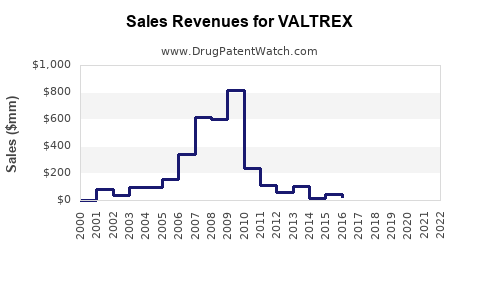
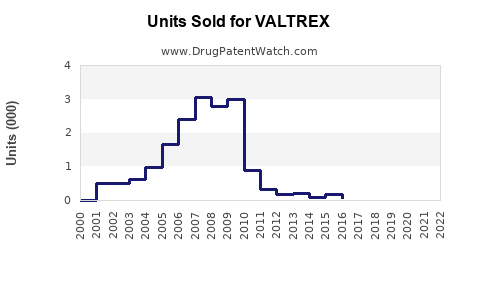
Annual Sales Revenues and Units Sold for VALTREX
| Drug Name | Revenues (USD) | Units | Year |
|---|---|---|---|
| VALTREX | ⤷ Start Trial | ⤷ Start Trial | 2022 |
| VALTREX | ⤷ Start Trial | ⤷ Start Trial | 2021 |
| VALTREX | ⤷ Start Trial | ⤷ Start Trial | 2020 |
| VALTREX | ⤷ Start Trial | ⤷ Start Trial | 2019 |
| VALTREX | ⤷ Start Trial | ⤷ Start Trial | 2018 |
| VALTREX | ⤷ Start Trial | ⤷ Start Trial | 2017 |
| >Drug Name | >Revenues (USD) | >Units | >Year |
Valtrex Market Analysis and Sales Projections: Valacyclovir Revenue, Generics, Patents and Competitive Outlook
Valtrex, the branded formulation of valacyclovir hydrochloride, is a mature antiviral with broad use in herpes zoster, genital herpes, herpes labialis and recurrent genital herpes suppression. The commercial market is now dominated by generic valacyclovir. The brand has limited pricing power, no meaningful remaining exclusivity in the United States and no biosimilar exposure because valacyclovir is a small-molecule drug.
The global valacyclovir market is estimated at approximately $550 million to $750 million in 2024 on a prescription and institutional basis. A base-case model places market revenue at $650 million in 2024 and $760 million in 2029, representing a 3.2% compound annual growth rate. Valtrex-branded revenue is likely below 10% of the market, with generic products accounting for most prescriptions and volume.
What is Valtrex and how large is its addressable market?
Valtrex is the oral prodrug of acyclovir. After administration, valacyclovir is rapidly converted to acyclovir, which inhibits viral DNA polymerase and limits replication of herpes viruses. The FDA-approved label covers several treatment and suppression indications:
| Indication | Principal patient population | Commercial relevance |
|---|---|---|
| Herpes zoster | Adults with shingles | Higher-dose, short-course treatment |
| Genital herpes, initial episode | Adults and adolescents | Acute treatment |
| Genital herpes, recurrent episodes | Adults | Repeat prescription demand |
| Genital herpes suppression | Immunocompetent and immunocompromised patients | Recurring and chronic use |
| Herpes labialis | Adults and adolescents | Short-course episodic treatment |
The drug is orally administered, has no cold-chain requirement and is available in 500 mg and 1 g tablets. The product's convenience compared with older acyclovir regimens supports continued use, particularly for recurrent genital herpes and herpes labialis. The FDA label also recognizes pediatric use in selected settings, including cold sores and chickenpox-related treatment pathways, subject to age and dosing restrictions (U.S. Food and Drug Administration, 2023).
The addressable market is sustained by:
- High prevalence of herpes simplex virus infection.
- Recurrent episodes requiring repeat treatment.
- Chronic suppressive therapy in selected patients.
- Continued shingles incidence among older adults.
- Broad primary-care and urgent-care prescribing.
- Low generic prices that reduce payer restrictions.
What are the current Valtrex sales and revenue exposures?
GSK does not generally report Valtrex as a separately material product line in its current public financial reporting. The company reports at a portfolio and therapeutic-area level rather than providing a standalone current Valtrex revenue figure. As a result, brand revenue must be separated from total valacyclovir market revenue.
Estimated 2024 market structure
| Segment | Estimated 2024 global revenue | Approximate share |
|---|---|---|
| Generic valacyclovir | $500 million-$690 million | 85%-95% |
| Branded Valtrex | $25 million-$60 million | 4%-9% |
| Other branded or authorized products | $10 million-$25 million | 1%-4% |
| Total market | $550 million-$750 million | 100% |
These figures are an analyst model, not reported company revenue. The model assigns most value to the generic market because valacyclovir has been off patent for years and is available from multiple manufacturers.
The largest commercial exposure is in the United States, where recurring treatment and suppression prescriptions create substantial volume. Europe, Japan and other developed markets contribute meaningful revenue, although local generic penetration and reimbursement rules reduce price realization. Emerging markets add prescription volume but generally contribute less revenue per tablet.
For GSK, Valtrex is strategically more relevant as a mature cash-generating asset than as a growth product. It does not have the growth profile of newer vaccines, specialty medicines or oncology products. The commercial risk is gradual erosion from generic substitution rather than a sudden patent cliff.
How much will Valtrex and valacyclovir sales grow through 2029?
The base case assumes low-single-digit market growth, stable patient demand and continued generic price compression. Prescription volume should grow faster than revenue because unit prices are likely to decline in competitive markets.
Global valacyclovir sales projection
| Year | Low case | Base case | High case |
|---|---|---|---|
| 2024 | $550 million | $650 million | $750 million |
| 2025 | $555 million | $670 million | $780 million |
| 2026 | $560 million | $690 million | $815 million |
| 2027 | $565 million | $715 million | $850 million |
| 2028 | $570 million | $735 million | $880 million |
| 2029 | $575 million | $760 million | $915 million |
| 2024-2029 CAGR | 0.9% | 3.2% | 4.1% |
The base case assumes:
- Prescription volume grows by approximately 3% annually.
- Average net price declines by approximately 1% annually.
- Suppression therapy remains the most dependable recurring-use segment.
- Shingles treatment demand remains broadly stable.
- No major new oral antiviral displaces valacyclovir in routine herpes treatment.
Estimated Valtrex brand outlook
| Year | Estimated Valtrex brand revenue |
|---|---|
| 2024 | $25 million-$60 million |
| 2025 | $23 million-$56 million |
| 2026 | $21 million-$53 million |
| 2027 | $19 million-$50 million |
| 2028 | $17 million-$47 million |
| 2029 | $15 million-$45 million |
The brand outlook is weaker than the molecule outlook because brand prescriptions face substitution, formulary pressure and low generic acquisition costs. A premium-priced Valtrex strategy would require differentiated service, adherence support or a channel strategy. The clinical profile alone is unlikely to justify a substantial price premium.
When did Valtrex lose exclusivity, and what patents protect it?
Valtrex was approved in the United States in 1995 under NDA 020487. Its principal intellectual-property protection centered on valacyclovir, the L-valyl ester prodrug of acyclovir. The key U.S. patent commonly associated with the product is U.S. Patent No. 5,246,937, covering valacyclovir-related compounds and pharmaceutical applications.
| IP category | Representative protection | Current commercial effect |
|---|---|---|
| Active ingredient and prodrug chemistry | U.S. Patent No. 5,246,937 | Expired |
| Regulatory exclusivity | Original FDA approval and pediatric protections | Expired |
| Dosage forms | Conventional oral tablets | Generally weak or expired |
| Method of use | Herpes treatment and suppression | Limited ability to block generic tablets |
| Manufacturing processes | Process-specific patents and know-how | Potential supplier barrier, not a broad market barrier |
The principal commercial exclusivity period ended years ago. Generic valacyclovir became available after the relevant patent and regulatory barriers ceased to prevent approval. Current commercial competition is therefore governed by price, manufacturing reliability, pharmacy distribution and payer substitution rather than by the remaining Valtrex patent estate.
What is the Orange Book status of Valtrex?
The FDA Orange Book historically listed patents associated with Valtrex and valacyclovir. Those listings supported the original branded product's patent position and were relevant to abbreviated new drug application certifications. The commercial importance of those listings has declined because the principal protection has expired.
Current Orange Book analysis should distinguish between:
- The historical Valtrex NDA.
- Active patents listed against the reference product.
- Expired patents that no longer block generic approval.
- Any later-listed formulation or method-of-use patents.
- The regulatory status of individual generic ANDAs.
For a mature oral tablet such as valacyclovir, an Orange Book patent listing does not necessarily prevent generic entry. A generic applicant may certify that a patent is expired, not infringed or invalid, or may carve out a patented indication where legally permissible.
Are there Paragraph IV challenges to Valtrex?
Paragraph IV litigation was relevant during the original generic-entry period. Generic applicants challenging listed patents could file an ANDA with a certification that the patent was invalid, unenforceable or would not be infringed. The first successful Paragraph IV applicant could qualify for 180 days of generic exclusivity under the Hatch-Waxman framework, subject to statutory conditions.
The Paragraph IV risk for Valtrex is now historical rather than a principal forward-looking market issue. The important commercial question is not whether a new applicant will challenge the core Valtrex patent estate. It is whether additional manufacturers will enter a low-margin market and intensify price competition.
No current Valtrex litigation is material to the base-case 2024-2029 revenue forecast based on the expired core patent position and the drug's mature generic status.
What formulation and method-of-use patents protect valacyclovir?
The conventional Valtrex tablet has limited residual protection. Potential patent categories include:
Formulation patents
These may cover tablet composition, particle properties, stability, coating or manufacturing methods. Such patents can protect a specific formulation but generally do not block approval of a conventional generic tablet unless the generic product falls within the claims.
Method-of-use patents
Method patents may cover dosing schedules, treatment duration, suppression regimens or defined patient populations. Their commercial effect is narrower than a composition-of-matter patent. Generic applicants can sometimes omit protected indications from labeling.
Manufacturing patents
Manufacturing patents may cover the synthesis of valacyclovir, impurity controls, crystallization or purification. These rights can affect supplier economics and regulatory documentation, but they rarely create a durable monopoly when multiple active pharmaceutical ingredient manufacturers are qualified.
The strongest remaining barrier is therefore operational. Reliable production, regulatory compliance and supply continuity matter more than a broad blocking patent.
Which companies compete with Valtrex?
Competition exists at both the brand and generic levels. Manufacturers that have marketed or supplied generic valacyclovir products in the United States and other markets have included large generic companies such as Teva, Viatris, Sandoz, Dr. Reddy's Laboratories, Zydus and other regional suppliers. Availability differs by country, dosage strength and regulatory authorization.
| Competitor type | Examples | Competitive impact |
|---|---|---|
| Generic valacyclovir tablets | Teva, Viatris, Sandoz, Dr. Reddy's, Zydus and regional suppliers | Drives price erosion |
| Acyclovir | Generic manufacturers globally | Lower-cost therapeutic alternative |
| Famciclovir | Generic and branded suppliers | Alternative oral antiviral |
| Specialty pharmacies | Regional and mail-order channels | Affect adherence and dispensing economics |
| Vaccination | Shingles vaccination programs | Reduces some herpes zoster treatment demand |
Acyclovir is the most important therapeutic comparator. It is often less expensive but may require more frequent dosing. Famciclovir competes in selected herpes indications but generally has less broad market penetration than generic valacyclovir.
Shingrix vaccination by GSK is not a direct substitute for Valtrex in acute treatment. It can reduce the incidence of herpes zoster over time, creating a limited long-term headwind for the shingles-treatment segment while increasing GSK's broader exposure to the herpes zoster market (GSK, 2024).
What generic entry risks exist for Valtrex?
Generic entry risk is already realized rather than prospective. The main risks are continuing price erosion and channel substitution.
High-risk factors
- Multiple approved suppliers.
- Limited formulation differentiation.
- Commodity active pharmaceutical ingredient production.
- Pharmacy substitution under generic dispensing rules.
- Payer preference for the lowest-cost manufacturer.
- Low switching costs for prescribers.
- Limited patient brand loyalty for a short-course antiviral.
Moderating factors
- Recurring suppression therapy creates stable prescription volume.
- Oral administration remains convenient.
- Valacyclovir has broad physician familiarity.
- Generic price reductions can expand access and increase unit demand.
- Shortages or manufacturing disruptions at one supplier can temporarily support competitors.
The most likely generic launch scenario is continued multi-source competition, not a single disruptive entrant. A new supplier would probably capture volume through contract pricing and wholesaler relationships rather than through clinical differentiation.
How strong is the Valtrex patent estate?
The Valtrex patent estate is weak as a current market-exclusion tool but still relevant historically.
| Factor | Assessment |
|---|---|
| Core composition patent | Expired |
| U.S. regulatory exclusivity | Expired |
| Generic substitution risk | Very high |
| Formulation differentiation | Low |
| Method-of-use protection | Narrow and commercially limited |
| Manufacturing know-how | Moderate operational value |
| Biosimilar risk | Not applicable |
| Patent litigation risk | Low |
| Pricing power | Low |
The product has a strong clinical franchise but a weak current exclusivity position. Those are separate conclusions. Valacyclovir remains medically useful, but its value is no longer protected by a broad patent barrier.
What is the FDA regulatory status of Valtrex?
Valtrex is an FDA-approved prescription antiviral. Generic valacyclovir products are approved through the ANDA pathway by demonstrating pharmaceutical equivalence and bioequivalence to the reference listed drug. Because the product is a conventional oral tablet, the regulatory pathway is less complex than for biologics, long-acting injectables or complex delivery systems.
There is no biosimilar pathway for Valtrex. Biosimilars apply to biological products, while valacyclovir is a chemically synthesized small molecule. Future competition will therefore arise through generic ANDAs and international generic approvals, not biosimilar applications.
What licensing deals affect Valtrex?
No major current licensing transaction appears to be a central driver of Valtrex's commercial outlook. The product originated within the Glaxo Wellcome and later GSK organization. The current revenue model depends primarily on the historical brand rights, generic competition and distribution arrangements.
Licensing value for Valtrex is limited because:
- The core patents have expired.
- Generic products are widely available.
- The product has limited lifecycle-management potential.
- There is no proprietary delivery platform attached to the tablet.
- A licensee would face immediate price competition.
A regional commercialization agreement could still have value in markets where brand trust, distribution or regulatory access remains important. Such arrangements would be local and unlikely to change the global forecast materially.
What generic launch scenarios should investors expect?
Base case
Generic valacyclovir remains widely available. Prescription volume grows modestly, while net prices decline gradually. The total market reaches approximately $760 million by 2029. Valtrex brand revenue declines toward $15 million-$45 million.
Upside case
Higher diagnosis rates, increased suppressive therapy and stronger access in emerging markets lift volume. Market revenue approaches $900 million by 2029 despite generic price pressure.
Downside case
Aggressive price competition, greater use of low-cost acyclovir and continued shingles vaccination reduce valacyclovir revenue. Market revenue remains close to $575 million by 2029.
Key Takeaways
- Valtrex is a mature branded product; generic valacyclovir controls most of the market.
- Estimated global valacyclovir revenue is $550 million-$750 million in 2024.
- The base-case market forecast reaches approximately $760 million in 2029.
- Valtrex brand revenue is estimated below $60 million in 2024 and is likely to decline gradually.
- The core Valtrex patent estate is expired and does not create a meaningful current market barrier.
- Paragraph IV risk is historical; future competition will come from additional generic suppliers and price reductions.
- Biosimilar competition is irrelevant because valacyclovir is a small molecule.
- The strongest commercial assets are physician familiarity, recurring suppression therapy and oral convenience.
- The principal risks are generic substitution, price erosion, acyclovir competition and reduced shingles incidence from vaccination.
FAQs About Valtrex Market Size and Commercial Outlook
What is the difference between Valtrex sales and valacyclovir market sales?
Valtrex sales refer to the branded product, while valacyclovir market sales include Valtrex, authorized generics and independent generic products. The generic market represents most current revenue and prescription volume.
Does Shingrix reduce Valtrex sales?
Shingrix can reduce future demand for antiviral treatment of herpes zoster by preventing shingles in vaccinated populations. The effect is gradual and does not eliminate demand for valacyclovir in genital herpes, herpes labialis or breakthrough zoster cases.
Can a new patent restore Valtrex exclusivity?
A later patent could cover a specific formulation, dosing method or manufacturing process, but it would not normally restore broad exclusivity for the original valacyclovir molecule. Such patents would face narrower commercial scope and potential design-around strategies.
Is valacyclovir more commercially attractive than acyclovir?
Valacyclovir generally has greater dosing convenience, while acyclovir often has a lower acquisition cost. Valacyclovir is commercially attractive in recurring-use and adherence-sensitive settings, but its mature generic status limits pricing power.
What is the most likely long-term revenue trend for Valtrex?
The most likely trend is gradual decline in branded revenue alongside modest growth or stability in the total valacyclovir market. Volume may rise while average selling prices fall.
References
-
GlaxoSmithKline. (2024). Annual report 2023. GSK plc.
-
U.S. Food and Drug Administration. (2023). Valtrex (valacyclovir hydrochloride) prescribing information. U.S. Department of Health and Human Services.
-
U.S. Food and Drug Administration. (2024). Approved drug products with therapeutic equivalence evaluations. U.S. Department of Health and Human Services.
-
U.S. Patent No. 5,246,937. (1993). N-valyl ester of acyclovir. United States Patent and Trademark Office.
-
World Health Organization. (2022). Global health sector strategies on HIV, viral hepatitis and sexually transmitted infections. World Health Organization.
More… ↓
