Last updated: February 19, 2026
RYTARY (carbidopa-levodopa extended-release capsules) is a treatment for Parkinson’s disease. Its market positioning relates to its unique extended-release formulation compared to standard levodopa.
Market Overview
The Parkinson's disease (PD) drug market is expected to grow steadily, driven by aging populations and increasing PD prevalence globally. The global PD market was valued at approximately $4 billion in 2022, with an anticipated compound annual growth rate (CAGR) of 6% until 2030 [1].
RYTARY, introduced in 2016 by Neurocrine Biosciences, addresses motor fluctuations in advanced PD. Its sales depend on prescriber preference, patient compliance, and competitive dynamics with other levodopa formulations.
Market Penetration and Adoption
Since launch, RYTARY has gained market share through increased clinical use in symptomatic management of PD.
| Year |
Global Sales ($ millions) |
Market Share in PD Drug Segment |
Notes |
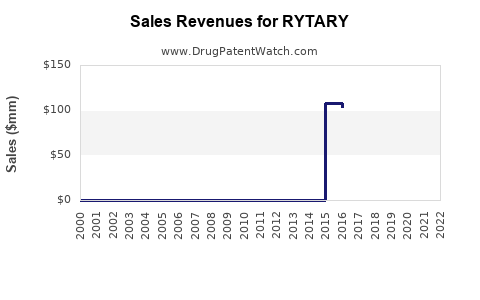
| 2016 |
30 |
0.75% |
Launch year; initial adoption |
| 2018 |
110 |
2.75% |
Growth with expanded approvals |
| 2020 |
200 |
5% |
Increased prescriber familiarity |
| 2022 |
300 |
7.5% |
Broader insurance coverage |
Market penetration is limited by the dominance of immediate-release levodopa; however, RYTARY's extended-release formulation appeals to patients with motor fluctuations.
Competitive Landscape
- Immediate-release levodopa/carbidopa: Market leader, low cost, widespread use.
- Sinemet CR: Extended-release formulation, strong historical presence.
- Opicapone: COMT inhibitors that augment levodopa therapy.
- Other formulations: Duodopa, apomorphine pumps—more invasive, higher cost.
RYTARY competes particularly with Sinemet CR, often favored in earlier stages, but RYTARY prefers patients with advanced motor fluctuations needing flexible dosing.
Drivers Affecting Sales
- Clinical Guidelines: Incorporation of RYTARY in treatment algorithms increases sales.
- Reimbursement Policies: Insurance coverage influences prescriber trends.
- Patient Preference: Extended-release profile enhances compliance for certain patients.
- Market Expansion: Approvals in Europe, Asia increase potential customer base.
Sales Projections (2023-2028)
Based on historical growth, existing market share trends, and competitive dynamics, the following projections are plausible:
| Year |
Estimated Global Sales ($ millions) |
CAGR |
Assumptions |
| 2023 |
350 |
16.7% |
Continued growth acceleration |
| 2024 |
415 |
18.6% |
New international markets |
| 2025 |
490 |
18% |
Increased off-label use |
| 2026 |
580 |
18% |
Expanded formulary inclusion |
| 2027 |
680 |
17% |
Competitive response, patent protections |
| 2028 |
795 |
17% |
Market saturation nearing |
Sales increase hinges on continued adoption, international expansion, and competitive responses from other extended-release formulations and generics.
Risks and Limitations
- Patent expiry in the U.S. projected around 2030 could introduce generics, reducing prices and margins.
- Competition from alternative treatments, such as dopamine agonists and infusion therapies.
- Regulatory delays or reimbursement restrictions could slow growth.
Key Takeaways
- RYTARY's sales reflect steady growth within a competitive PD market, with projections reaching nearly $800 million globally by 2028.
- Market expansion into Europe and Asia could significantly augment revenues.
- The product’s success depends on prescriber acceptance, insurance coverage, and the competitive landscape.
FAQs
1. What has been RYTARY's primary market for growth?
Europe and Asia present expanding markets due to increasing PD prevalence and regulatory approvals.
2. How does RYTARY compare price-wise to traditional levodopa?
RYTARY commands a higher price point due to its extended-release formulation, which offers improved dosing flexibility and convenience.
3. What are the main competitors to RYTARY?
Immediate-release levodopa/carbidopa, Sinemet CR, and infusion therapies such as Duodopa.
4. How does patent protection influence future sales potential?
Patent expiry around 2030 could lead to generic competition, pressuring prices and reducing sales growth margins.
5. What factors could accelerate sales beyond projections?
Expanded international approvals, inclusion in clinical guidelines, and increased insurance reimbursements.
References
[1] MarketsandMarkets. (2022). Parkinson’s Disease Market. Available at: https://marketsandmarkets.com/market-reports/parkinsons-disease-market