Share This Page
Drug Sales Trends for MODAFINIL
✉ Email this page to a colleague
Payment Methods and Pharmacy Types for MODAFINIL (2006)
Revenues by Pharmacy Type
Units Sold by Pharmacy Type
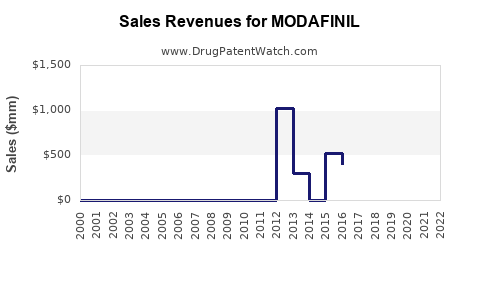
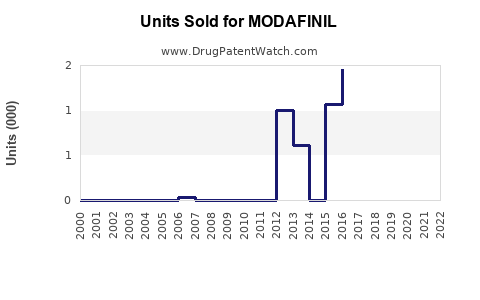
Annual Sales Revenues and Units Sold for MODAFINIL
| Drug Name | Revenues (USD) | Units | Year |
|---|---|---|---|
| MODAFINIL | ⤷ Start Trial | ⤷ Start Trial | 2022 |
| MODAFINIL | ⤷ Start Trial | ⤷ Start Trial | 2021 |
| MODAFINIL | ⤷ Start Trial | ⤷ Start Trial | 2020 |
| MODAFINIL | ⤷ Start Trial | ⤷ Start Trial | 2019 |
| MODAFINIL | ⤷ Start Trial | ⤷ Start Trial | 2018 |
| MODAFINIL | ⤷ Start Trial | ⤷ Start Trial | 2017 |
| >Drug Name | >Revenues (USD) | >Units | >Year |
Modafinil Market Analysis, Sales Projections, Patent Status, and Generic Competition
Modafinil is a mature, genericized central nervous system stimulant with declining branded revenue, stable medical demand, and limited patent protection. The U.S. market is dominated by generic modafinil, while branded Provigil has lost its exclusivity. Commercial growth is likely to remain low single digit, driven by diagnosis rates, adherence, and geographic expansion rather than pricing power.
A reasonable base-case projection places the global prescription modafinil market at approximately $350 million to $500 million in 2025, rising to roughly $400 million to $650 million by 2030. The range reflects major differences in market definitions, including whether analysts count only regulated prescription sales or also online and nonmedical channels.
What is modafinil and how is it used?
Modafinil is a wakefulness-promoting drug marketed originally as Provigil by Cephalon, later acquired by Teva Pharmaceutical Industries. In the United States, the FDA-approved indications are:
- Narcolepsy
- Obstructive sleep apnea-related excessive sleepiness
- Shift work sleep disorder
The approved tablet strengths are 100 mg and 200 mg. The FDA label states that modafinil improves wakefulness but does not treat the underlying airway obstruction in obstructive sleep apnea. Patients must continue primary treatment for the airway disorder, such as continuous positive airway pressure therapy.[1]
Modafinil is a Schedule IV controlled substance in the United States because of abuse and dependence risks.[2]
Modafinil product and indication profile
| Attribute | Detail |
|---|---|
| Active ingredient | Modafinil |
| Original brand | Provigil |
| U.S. originator | Cephalon, later Teva |
| FDA approval | 1998 |
| Dosage forms | Immediate-release tablets |
| Common strengths | 100 mg and 200 mg |
| U.S. indications | Narcolepsy, obstructive sleep apnea, shift work sleep disorder |
| Controlled-substance status | Schedule IV |
| Main competitors | Armodafinil, amphetamine products, methylphenidate, solriamfetol, pitolisant |
| Current market status | Predominantly generic |
How large is the modafinil market?
There is no single audited global market figure for modafinil because public reporting generally combines prescription sales, hospital and retail channels, regional formulations, and sometimes unregulated online sales. Commercial market reports therefore produce materially different estimates.
A practical market framework is:
| Market segment | 2025 estimated commercial value | Growth outlook through 2030 |
|---|---|---|
| U.S. regulated prescription modafinil | $100 million-$175 million | Flat to low single digit |
| European regulated prescription market | $75 million-$125 million | Flat to 3% annually |
| Other regulated markets | $100 million-$175 million | 2%-5% annually |
| Online and nonmedical channels | Not reliably measurable | Volatile and exposed to enforcement |
| Total regulated global market | $275 million-$475 million | Approximately 1%-4% annually |
The ranges are analytical estimates based on the product’s generic status, historical branded revenue, known therapeutic uses, and the maturity of the wakefulness-promoting-drug category. They are not reported manufacturer sales.
Historical branded sales
Provigil was one of Cephalon’s largest products before generic entry. Cephalon reported Provigil net sales of approximately $1.1 billion in 2011, before the full impact of generic competition.[3] The product’s revenue declined sharply after generic launches began in 2012.
The reduction was caused by:
- Loss of branded pricing power.
- Generic substitution under U.S. pharmacy benefit rules.
- Paragraph IV settlements that permitted early generic entry.
- Competition from armodafinil and newer wakefulness drugs.
- Lower commercial investment in an off-patent product.
The historical $1 billion-plus branded market should not be used as a current revenue proxy.
What are the modafinil sales projections through 2030?
A scenario-based forecast is more useful than a single point estimate because modafinil has no consolidated public market report and most manufacturers do not disclose product-level sales.
Base-case projection
| Year | Global regulated modafinil sales | Expected market condition |
|---|---|---|
| 2025 | $350 million-$500 million | Mature generic market |
| 2026 | $355 million-$515 million | Stable demand, modest volume growth |
| 2027 | $365 million-$535 million | Increased diagnosis and regional access |
| 2028 | $375 million-$555 million | Continued generic price pressure |
| 2029 | $385 million-$575 million | Slow prescription expansion |
| 2030 | $400 million-$650 million | Low-growth mature category |
The implied compound annual growth rate is approximately 2%-5%, depending on the starting point and inclusion of emerging markets.
Bull-case scenario
A higher-growth scenario could reach $700 million to $850 million by 2030 if:
- Diagnosis of narcolepsy increases.
- Sleep medicine access expands in emerging markets.
- Modafinil remains materially cheaper than newer agents.
- Generic manufacturers maintain supply reliability.
- Physicians continue using modafinil before higher-cost alternatives.
Bear-case scenario
A lower-growth scenario could result in a 2030 market of $250 million to $350 million if:
- Solriamfetol and pitolisant gain share.
- Generic prices continue to decline.
- Safety monitoring reduces use in broad off-label populations.
- Regulatory enforcement restricts online sales.
- Shortages or manufacturing exits reduce reliable supply.
When did modafinil lose U.S. patent exclusivity?
Modafinil lost practical U.S. market exclusivity in 2012. The original Provigil patent estate had already been challenged by generic manufacturers, and settlements permitted generic entry before the latest asserted patent protections would otherwise have delayed competition.
The principal composition patent associated with modafinil, U.S. Patent No. 5,618,845, expired in 2014. Generic entry occurred earlier under settlement arrangements involving Cephalon and generic companies.[4]
Modafinil exclusivity timeline
| Date | Event |
|---|---|
| 1998 | FDA approves Provigil for narcolepsy |
| 2002 | FDA expands approval to obstructive sleep apnea and shift work sleep disorder |
| 2000s | Cephalon develops additional patent positions around formulations and crystalline forms |
| 2006 | Cephalon files patent litigation against generic challengers |
| 2008-2011 | Settlements resolve or delay several generic challenges |
| 2012 | Authorized and independent generic competition expands |
| 2014 | Core U.S. composition patent reaches stated expiration |
| 2010s onward | Modafinil operates as a mature generic product |
What patents protect modafinil?
The original U.S. patent estate covered the active compound and related benzhydryl sulfinyl compounds. Later patents were directed toward formulations, particle size, polymorphic forms, and manufacturing-related characteristics.
The commercially important patent categories were:
| Patent category | Commercial purpose | Current relevance |
|---|---|---|
| Compound patents | Protect modafinil molecule | Expired |
| Formulation patents | Protect tablet composition or release characteristics | Largely expired or commercially limited |
| Polymorph and crystal-form patents | Protect physical form of active ingredient | Historically important in litigation |
| Manufacturing patents | Protect production or purification methods | May affect process design but rarely blocks standard generic entry |
| Method-of-use patents | Protect treatment of sleep-related disorders | Limited value where use is carved out or patents expire |
A key distinction is that the existence of a formulation or process patent does not necessarily prevent generic approval. Under the Hatch-Waxman framework, a generic applicant can certify that a patent is invalid or not infringed, or can omit patented indications from its label where permitted.
What is the Orange Book status of modafinil?
The FDA Orange Book historically listed Provigil patents and associated exclusivity information. Because the core patents have expired and generic approvals have been granted for the same immediate-release dosage forms, the Orange Book no longer provides meaningful branded exclusivity for ordinary modafinil tablets.
Relevant regulatory conclusions are:
- Provigil has no current U.S. market exclusivity comparable to an innovative product.
- Generic modafinil tablets are approved under abbreviated new drug applications.
- The principal competitive barrier is manufacturing, supply reliability, and channel access rather than patent exclusion.
- Any remaining Orange Book-listed patent issue must be reviewed against the current FDA Orange Book entry and the specific approved strength or dosage form.[5]
Which companies challenged Provigil patents?
Cephalon litigated against several generic manufacturers that sought to enter the modafinil market. Generic challengers included Teva, Mylan, Ranbaxy, and other applicants during the main Hatch-Waxman disputes.
The litigation centered on whether later Cephalon patents covering particle size, formulations, or related characteristics were valid and infringed. The settlements allowed generic entry before the full expiration of the asserted patent estate.
What patent litigation affected modafinil?
The principal dispute involved Cephalon’s efforts to use later-filed patents to delay generic competition after the original compound patent approached expiration. The Federal Trade Commission alleged that Cephalon entered agreements with generic companies that delayed competition in exchange for payments or other value.
In 2015, the FTC reached a settlement with Teva resolving claims associated with the Provigil patent litigation and alleged reverse-payment arrangements. Teva agreed to pay $125 million to resolve the FTC’s action.[6]
The case is commercially important because it demonstrates that modafinil’s later patent positions had substantial litigation value even after the core compound patent was nearing expiration.
Are there current Paragraph IV risks for modafinil?
Paragraph IV risk is low for standard U.S. modafinil tablets because generic entry has already occurred and the principal patents have expired or lost practical blocking value.
Potential residual risks could arise only from:
- A newly listed patent covering a novel formulation.
- A modified-release product.
- A combination product.
- A new method of use.
- A manufacturing process patent asserted against a specific supplier.
Those risks would apply to a particular product, not to the established generic modafinil market as a whole.
What formulations are protected by modafinil patents?
The commercially relevant product is an immediate-release tablet. Historical patent activity focused on formulation variables such as:
- Particle size distribution.
- Crystalline form.
- Tablet excipients.
- Dissolution characteristics.
- Manufacturing and purification processes.
These patents were important because they could create a distinction between the original product and a generic formulation. Their strategic value has declined as the major generic products have entered and as the applicable patent terms have expired.
No widely adopted long-acting modafinil formulation has displaced the standard immediate-release tablet. This limits opportunities for premium pricing based solely on reformulation.
How does modafinil compare with competing wakefulness drugs?
Modafinil competes on price and familiarity. Newer therapies compete on targeted efficacy, label positioning, and commercial support.
| Drug | Main approved use profile | Competitive advantage | Competitive limitation |
|---|---|---|---|
| Modafinil | Narcolepsy, OSA-related sleepiness, shift work disorder | Low cost, broad physician familiarity | Generic pricing, interaction and psychiatric warnings |
| Armodafinil | Similar sleepiness indications | Longer-acting isomer, branded positioning | Generic competition |
| Solriamfetol | Narcolepsy and OSA-related sleepiness | Strong wakefulness effect, newer product | Higher price, cardiovascular monitoring |
| Pitolisant | Narcolepsy | Non-stimulant mechanism and distinct pharmacology | Narrower commercial scale, higher price |
| Methylphenidate | Narcolepsy and other stimulant uses | Established efficacy and availability | Controlled-substance burden |
| Amphetamine products | Narcolepsy and ADHD-related markets | High potency and physician familiarity | Greater abuse and cardiovascular concerns |
Modafinil remains best positioned where payers and prescribers prioritize cost. Solriamfetol and pitolisant have greater potential to take share in patients who do not respond adequately to modafinil or who require a different safety or pharmacologic profile.
What is the FDA regulatory status of modafinil?
Modafinil is FDA-approved and available through multiple generic manufacturers. It is not an investigational product and does not have a pending regulatory event that would materially restore exclusivity for the conventional tablet.
The FDA label carries warnings concerning serious dermatologic reactions, psychiatric symptoms, cardiovascular considerations, and interactions involving hormonal contraceptives and hepatic enzyme activity.[1]
FDA regulatory risks are therefore concentrated in manufacturing compliance, supply quality, adverse-event monitoring, and controlled-substance compliance rather than approval risk.
What generic entry risks exist for modafinil?
For an established generic manufacturer, the principal risks are commercial rather than legal.
Generic market risks
- Price erosion from multiple approved suppliers.
- Low margins for 100 mg and 200 mg tablets.
- Contract-manufacturing dependence.
- FDA warning letters or facility inspections.
- Active pharmaceutical ingredient supply concentration.
- Pharmacy benefit manager substitution.
- Channel disruption from online sellers.
- Product liability exposure relating to off-label use.
- Competition from newer branded wakefulness agents.
The market can support several suppliers because demand is recurring, but low pricing can cause manufacturers to exit. Supply resilience may therefore matter more than patent ownership.
What licensing deals affect modafinil?
The main strategic transaction was Teva’s acquisition of Cephalon in 2011 for approximately $6.8 billion. The deal transferred Provigil, Nuvigil, and other commercial and development assets to Teva.[7]
Teva later became the principal originator-linked company associated with the U.S. Provigil franchise. The acquisition’s value depended heavily on managing generic entry and monetizing the remaining commercial life of Provigil.
There is no current licensing structure that gives a company exclusive control over the broader generic modafinil market. Generic manufacturers compete through abbreviated approvals, supply contracts, distribution relationships, and manufacturing economics.
What is the revenue exposure for manufacturers?
Modafinil is unlikely to be a material growth driver for large diversified pharmaceutical companies. It can still contribute meaningful revenue to smaller generic manufacturers with efficient production and strong distribution.
| Manufacturer type | Revenue exposure | Strategic value |
|---|---|---|
| Large diversified originator | Low | Legacy product and portfolio contribution |
| Major generic company | Low to moderate | Volume product with recurring demand |
| Specialized CNS company | Moderate | Potential base product for sleep-medicine portfolio |
| Contract manufacturer | Variable | Depends on supply contracts and capacity |
| Online distributor | Potentially high but legally exposed | Nontraditional and unstable channel |
A manufacturer with a low-cost API source, FDA-compliant production, and broad pharmacy distribution can maintain acceptable returns even in a low-price market. A high-cost producer is vulnerable to margin compression.
How strong is the modafinil patent estate?
The current patent estate is weak for conventional modafinil tablets.
| Factor | Assessment |
|---|---|
| Core compound patent | Expired |
| Standard tablet protection | Expired or nonblocking |
| Generic substitution risk | High |
| Paragraph IV litigation risk | Low for conventional tablets |
| Formulation opportunity | Limited without differentiated delivery |
| Manufacturing barrier | Moderate |
| Regulatory barrier | Moderate |
| Pricing power | Low |
| Long-term exclusivity potential | Low |
The strongest remaining defensible positions would involve a genuinely differentiated delivery system, a new combination, or a separately approved indication. A conventional generic tablet has little patent-based protection.
What generic launch scenarios are most likely?
Three scenarios define the market:
Continued generic commoditization
This is the most likely outcome. Multiple suppliers maintain availability, prices decline gradually, and total market value grows only through prescription volume.
Supplier consolidation
If reimbursement falls below sustainable production costs, smaller manufacturers may withdraw. The result would be fewer suppliers, intermittent shortages, and temporary price increases without restoring patent exclusivity.
Premium reformulation
A manufacturer could seek higher pricing through modified release, abuse-deterrent delivery, or a new combination. Regulatory approval and payer adoption would determine whether such a product gains meaningful share. Patent protection alone would not ensure commercial success.
Key Takeaways
- Modafinil is an FDA-approved, Schedule IV generic drug used for narcolepsy, obstructive sleep apnea-related sleepiness, and shift work sleep disorder.
- Provigil generated roughly $1.1 billion in U.S. sales in 2011 before generic competition materially reduced revenue.
- Practical U.S. generic entry began in 2012, and the core compound patent expired in 2014.
- The conventional modafinil tablet has weak current patent protection.
- Estimated 2025 global regulated sales are approximately $350 million to $500 million.
- Base-case 2030 sales are approximately $400 million to $650 million, implying low single-digit growth.
- Price competition, manufacturing reliability, and distribution are more important than patent barriers.
- Solriamfetol and pitolisant are the principal newer branded competitors.
- Paragraph IV risk is low for standard immediate-release modafinil tablets.
- Commercial upside depends on volume growth or differentiated formulations, not restoration of legacy Provigil pricing.
FAQs
Is modafinil still a profitable drug for generic manufacturers?
Yes, but profitability depends on manufacturing cost, supply reliability, and contract volume. The product is more attractive as a recurring volume product than as a high-margin branded asset.
Does modafinil have orphan-drug exclusivity?
No current orphan-drug exclusivity protects the conventional modafinil tablet in the United States. Its approved uses are established and genericized.
Can a company launch a new branded modafinil product?
Yes, a company could launch a branded product based on formulation, delivery, combination, or new clinical positioning. Commercial success would require meaningful differentiation because ordinary modafinil tablets are widely available as generics.
Is armodafinil a stronger commercial competitor than modafinil?
Armodafinil has a longer-acting pharmacologic profile and distinct branded history, but it also faces generic competition. Modafinil generally retains the cost advantage.
Are online modafinil sales included in market forecasts?
Some commercial reports include online and nonmedical channels, while others count only regulated prescription sales. This methodological difference is a major reason published market estimates vary.
References
- U.S. Food and Drug Administration. (2023). Provigil (modafinil) prescribing information. https://www.accessdata.fda.gov
- U.S. Drug Enforcement Administration. (2024). Drug scheduling. https://www.dea.gov/drug-information/drug-scheduling
- Cephalon, Inc. (2011). Annual report on Form 10-K for fiscal year 2011. U.S. Securities and Exchange Commission. https://www.sec.gov
- U.S. Patent and Trademark Office. (1997). U.S. Patent No. 5,618,845, Benzyhydryl sulfinyl compounds. https://patents.google.com/patent/US5618845
- U.S. Food and Drug Administration. (2024). Approved drug products with therapeutic equivalence evaluations, Orange Book. https://www.accessdata.fda.gov/scripts/cder/ob/
- Federal Trade Commission. (2015). FTC reaches $125 million settlement with Teva over delayed generic entry of Provigil. https://www.ftc.gov
- Teva Pharmaceutical Industries Ltd. (2011). Teva completes acquisition of Cephalon. https://www.tevapharm.com
More… ↓
