Share This Page
Drug Sales Trends for LIOTHYRONINE
✉ Email this page to a colleague
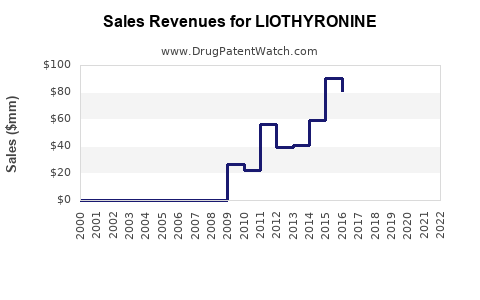
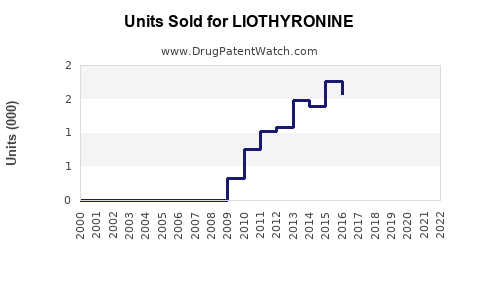
Annual Sales Revenues and Units Sold for LIOTHYRONINE
| Drug Name | Revenues (USD) | Units | Year |
|---|---|---|---|
| LIOTHYRONINE | ⤷ Start Trial | ⤷ Start Trial | 2022 |
| LIOTHYRONINE | ⤷ Start Trial | ⤷ Start Trial | 2021 |
| LIOTHYRONINE | ⤷ Start Trial | ⤷ Start Trial | 2020 |
| >Drug Name | >Revenues (USD) | >Units | >Year |
Liothyronine Market Analysis, Sales Forecast, Patent Status, and Generic Entry Outlook
Liothyronine is a mature, low-cost thyroid hormone market dominated by generic liothyronine sodium tablets and a small branded segment led by Cytomel. U.S. revenue is likely concentrated in a low tens-of-millions annual range, with global pharmaceutical sales materially higher but still limited relative to levothyroxine. The market has minimal patent protection, no meaningful biosimilar exposure, and limited pricing power. Growth depends on prescription volume, supply reliability, physician use in selected hypothyroidism patients, and demand for compounded or specialty formulations rather than broad therapeutic expansion.
What is the current liothyronine market size?
Public manufacturers generally do not report liothyronine revenue separately, and commercial prescription data are not freely available at a global level. A practical market model places worldwide pharmaceutical sales of liothyronine products in a broad range of approximately $100 million to $250 million annually, with the United States accounting for an estimated $40 million to $100 million of branded and generic product sales.
These figures exclude most compounded preparations and may exclude hospital purchasing, wholesaler transfers, and certain international markets. The market is difficult to size because:
- Generic products are sold by multiple manufacturers.
- Retail prices vary substantially by strength, tablet count, pharmacy channel, and payer.
- Compounded liothyronine is often captured separately from FDA-approved products.
- Brand Cytomel pricing can be materially higher than generic acquisition cost.
- Many prescriptions are intermittent, low-dose, or used in combination with levothyroxine.
Market structure by product type
| Segment | Primary products | Commercial position | Growth outlook |
|---|---|---|---|
| Generic tablets | Liothyronine sodium tablets, multiple strengths | Largest volume segment | Low to moderate volume growth |
| Branded tablets | Cytomel | Higher price, limited share | Flat to declining volume |
| Compounded capsules or tablets | Pharmacy-compounded T3 | Specialty and cash-pay channel | Moderate but fragmented growth |
| Combination thyroid products | Desiccated thyroid products containing T3 and T4 | Adjacent competitor | Stable niche demand |
| Injectable liothyronine | Hospital and acute-care use | Small, supply-sensitive market | Low volume, episodic demand |
Liothyronine is substantially smaller than levothyroxine. Levothyroxine is the standard replacement therapy for most hypothyroidism patients, while liothyronine is generally used selectively because of its short half-life and rapid serum concentration changes. The American Thyroid Association has stated that levothyroxine remains the standard of care for routine hypothyroidism treatment.[1]
What are the projected liothyronine sales through 2030?
A reasonable base case projects global approved-product sales growth of approximately 2% to 4% annually through 2030. This reflects modest prescription growth, inflation in some markets, and continued use in selected patients. Unit demand may grow more slowly than revenue because of generic price competition.
Global liothyronine revenue projection
| Year | Downside case | Base case | Upside case |
|---|---|---|---|
| 2024 | $100 million | $160 million | $250 million |
| 2025 | $100 million | $166 million | $263 million |
| 2026 | $101 million | $173 million | $276 million |
| 2027 | $102 million | $180 million | $290 million |
| 2028 | $103 million | $187 million | $305 million |
| 2029 | $104 million | $195 million | $321 million |
| 2030 | $105 million | $203 million | $337 million |
| 2024-2030 CAGR | 0.8% | 4.0% | 5.1% |
The base case assumes a starting market of $160 million, annual volume growth of approximately 2%, and net price growth of approximately 2%. The upside case requires wider use of combination T3/T4 treatment, increased diagnosis and treatment of persistent hypothyroid symptoms, stronger demand for specialty formulations, and improved supply availability.
The downside case reflects continued substitution toward levothyroxine, generic price erosion, reduced branded prescribing, and tighter payer controls.
U.S. sales outlook
The United States should remain the largest commercial market because of its high prescription volume, established Cytomel brand, broad generic availability, and active compounding sector.
| U.S. segment | Estimated 2024 sales range | 2030 base-case outlook |
|---|---|---|
| Generic tablets | $15 million-$40 million | $20 million-$55 million |
| Cytomel and branded products | $10 million-$35 million | $8 million-$30 million |
| Compounded products | $10 million-$30 million | $15 million-$45 million |
| Injectable and institutional products | $3 million-$10 million | $4 million-$12 million |
| Total U.S. market | $38 million-$115 million | $47 million-$142 million |
The U.S. range is wider than a conventional branded drug forecast because the available public data do not provide a single audited market figure for all approved and compounded liothyronine products.
What is the FDA regulatory status of liothyronine?
Liothyronine sodium is an FDA-approved thyroid hormone replacement drug available in oral tablets and injectable formulations. Cytomel is the principal U.S. reference brand for oral liothyronine sodium. Generic tablets are approved under abbreviated new drug applications and can be therapeutically equivalent to the reference product when listed as substitutable in the FDA Orange Book.[2]
The main approved uses include:
- Replacement therapy for hypothyroidism.
- Suppression of thyrotropin in selected thyroid disorders.
- Certain diagnostic or adjunctive thyroid-related uses under labeling conditions.
Liothyronine is a synthetic form of triiodothyronine, or T3. It has a faster onset and shorter duration than levothyroxine, which is synthetic thyroxine, or T4. Those pharmacokinetic characteristics influence both prescribing behavior and product-development opportunities.
FDA regulatory characteristics
| Regulatory issue | Liothyronine position |
|---|---|
| Reference product | Cytomel |
| Generic pathway | ANDA-based approval |
| Dosage forms | Oral tablets; injectable products in selected markets |
| Controlled substance status | Not a controlled substance |
| Biosimilar pathway | Not applicable |
| FDA exclusivity | No material current exclusivity expected for the mature product |
| Pediatric exclusivity | No current product-level exclusivity identified |
| REMS | No major product-specific REMS framework generally associated with oral liothyronine |
| Interchangeability | Depends on FDA therapeutic-equivalence listing and state substitution rules |
What patents protect liothyronine and Cytomel?
The core composition-of-matter and basic pharmaceutical-use patents for liothyronine are long expired. The commercial product is therefore exposed to generic competition and has no meaningful core patent barrier in the United States.
Patent estate overview
| Patent category | Current position | Commercial impact |
|---|---|---|
| Liothyronine active ingredient | Expired | No composition monopoly |
| Conventional oral tablets | Core protection expired | Generic entry permitted |
| Cytomel product claims | Any historical protection is expired or immaterial to current entry | Limited brand defense |
| Method-of-use claims | Potentially narrow and difficult to enforce broadly | Limited |
| Manufacturing processes | May exist as trade secrets or expired process patents | Usually manageable for generic manufacturers |
| Modified-release formulations | Potential opportunity for new applicants | Could support differentiated pricing |
| Compounded formulations | Generally not protected as a branded pharmaceutical product | Fragmented competition |
The primary competitive issue is not patent expiration. It is regulatory approval, manufacturing consistency, supply continuity, physician acceptance, and the ability to differentiate a formulation.
What formulation patents could protect a new liothyronine product?
A new formulation could obtain patents if it demonstrates a novel and nonobvious delivery profile or manufacturing process. Potential claim areas include:
- Sustained-release or extended-release liothyronine.
- Controlled T3/T4 combination delivery.
- Reduced peak plasma T3 concentrations.
- Once-daily dosage forms.
- Liquid or orally disintegrating formulations.
- Stabilized liquid products.
- Transdermal or alternative delivery systems.
- Narrow particle-size or solid-state forms.
- Specific excipient systems that improve dose uniformity.
- Manufacturing methods that reduce potency variability.
A formulation patent would not restore exclusivity to ordinary liothyronine tablets. It would protect only the claimed product, process, or method and would face obviousness, written-description, enablement, and patent-term challenges.
When does liothyronine lose exclusivity?
Liothyronine has already lost effective market exclusivity. The active ingredient was introduced decades ago, and generic competition has existed for many years. Any remaining commercial protection is primarily brand recognition, physician familiarity, supply relationships, trademarks, and potential product-specific regulatory listings rather than patent exclusivity.
Cytomel therefore does not have the exclusivity profile of a modern branded drug approaching loss of exclusivity. The relevant commercial question is the erosion of brand demand and the ability of manufacturers to maintain supply, not the date of a future patent cliff.
Are there Paragraph IV challenges to liothyronine?
Paragraph IV litigation risk for conventional liothyronine tablets is low because the main composition and basic formulation patents are expired or absent from the active commercial barrier. Generic applicants do not generally need to challenge a valuable, unexpired patent estate to enter the standard tablet market.
Paragraph IV activity could become relevant if a company launches:
- A patented extended-release liothyronine product.
- A proprietary T3/T4 fixed-dose combination.
- A new liquid formulation with active Orange Book patents.
- A novel injectable or hospital formulation.
- A product with patented pharmacokinetic characteristics.
For an ordinary generic liothyronine tablet, the main barriers are ANDA approval, bioequivalence or applicable product-specific requirements, manufacturing capacity, and reliable active pharmaceutical ingredient supply.
What is the Orange Book status of liothyronine?
The FDA Orange Book is the primary source for determining current approved products, therapeutic-equivalence ratings, and listed patents for FDA-approved products.[2] Conventional liothyronine sodium tablets are generally represented by multiple approved generic products and the Cytomel reference product. The practical Orange Book conclusion is:
- Generic competition is established.
- Conventional tablet products have no commercially meaningful active patent barrier.
- Product-specific listings must be checked by strength and dosage form.
- A new formulation could create a separate patent and regulatory profile.
Orange Book status can change when sponsors add or remove patent listings, transfer product ownership, or update approved formulations. A transaction or litigation assessment should use the current FDA database rather than relying on historical patent records.
Which companies compete in the liothyronine market?
Competition is fragmented and includes branded, generic, specialty-pharmacy, and hospital suppliers. U.S. generic availability has historically included manufacturers such as Amneal Pharmaceuticals, Hikma Pharmaceuticals, and other ANDA holders, depending on product strength and current market status. Cytomel has been associated with Pfizer through its portfolio and labeling history, although ownership, commercialization, or distribution arrangements can change.
The competitive landscape should be assessed at the National Drug Code level because the same active ingredient may have different suppliers by strength, package size, and channel.
Competitive advantages by participant
| Participant type | Advantage | Limitation |
|---|---|---|
| Branded manufacturer | Recognition, physician familiarity, channel access | High price and generic substitution |
| Large generic company | Scale, pharmacy contracts, regulatory infrastructure | Low margins and price competition |
| Specialty manufacturer | Ability to target modified-release or liquid products | Smaller commercial footprint |
| Compounding pharmacy | Custom dosing and formulation flexibility | Quality, reimbursement, and regulatory constraints |
| Hospital supplier | Institutional contracts and injectable access | Low overall volume |
What manufacturing and intellectual-property barriers affect liothyronine?
Manufacturing barriers are more important than patent barriers. Liothyronine is potent at microgram doses, making blend uniformity, assay accuracy, content uniformity, and stability important quality-control issues. Small deviations can materially alter the delivered dose.
Manufacturers must manage:
- API sourcing and qualification.
- Low-dose content uniformity.
- Tablet compression and blend segregation.
- Stability under heat and humidity.
- Cross-contamination controls.
- Batch-release testing.
- Packaging that protects product potency.
- Supply continuity for multiple strengths.
The most commercially relevant IP may be proprietary manufacturing know-how rather than enforceable patent claims. A supplier that consistently produces low-dose tablets with tight content uniformity can gain pharmacy and wholesaler preference without possessing a blocking patent.
What generic entry risks exist for liothyronine?
Generic entry risk is already realized in the conventional tablet market. A new generic entrant would face low legal risk but meaningful commercial risk.
Key entry risks
- Limited market size relative to regulatory and launch costs.
- Rapid price compression after approval.
- Difficulty securing stable API supply.
- Low switching rates among patients stabilized on a particular product.
- Physician caution over potency and symptom variability.
- Pharmacy reluctance to stock low-volume strengths.
- Product shortages that can damage market credibility.
- State-level substitution rules and payer formulary preferences.
- Competition from compounded products and desiccated thyroid products.
The strongest opportunity is not another undifferentiated immediate-release tablet. It is a product that solves a recognized clinical or commercial problem, such as once-daily dosing, reduced T3 peaks, pediatric dosing flexibility, or improved supply reliability.
How does liothyronine compare with levothyroxine?
| Attribute | Liothyronine | Levothyroxine |
|---|---|---|
| Hormone | T3 | T4 |
| Standard first-line use | No | Yes |
| Half-life | Short | Long |
| Dosing frequency | Often once or multiple times daily depending on regimen | Usually once daily |
| Market size | Small | Very large |
| Generic competition | Extensive | Extensive |
| Price power | Low in generic segment | Low in generic segment |
| Formulation opportunity | High because of pharmacokinetic limitations | Moderate |
| Clinical controversy | Higher | Lower |
| Supply sensitivity | Significant | Significant but more diversified |
| Biosimilar risk | None | None |
The commercial case for liothyronine depends on its pharmacology. The same short half-life that creates formulation problems can support differentiated products with controlled release or improved T3 exposure.
What licensing deals and partnerships affect liothyronine?
Large licensing transactions centered on ordinary liothyronine tablets are unlikely because the core product is generic and commercially mature. Partnership value would be more likely in:
- Extended-release T3 technology.
- Combination T3/T4 products.
- Specialty delivery systems.
- Pediatric or liquid formulations.
- Compounding and specialty-pharmacy distribution.
- International commercialization rights.
- API manufacturing and supply agreements.
A company evaluating a licensing opportunity should focus on ownership of formulation patents, freedom to operate, regulatory exclusivity, clinical evidence, manufacturing scalability, and reimbursement positioning. A license covering only conventional liothyronine tablets would generally have limited strategic value.
What litigation affects liothyronine?
The principal litigation exposure is likely to involve product liability, manufacturing quality, labeling, shortage-related issues, or disputes involving compounded thyroid products rather than core patent infringement. A new patented formulation could create Hatch-Waxman litigation under the ANDA pathway, but standard liothyronine tablets do not present a comparable litigation profile.
For diligence purposes, the relevant review should include:
- FDA warning letters and recalls.
- Current and historical drug shortages.
- ANDA approval and therapeutic-equivalence records.
- Patent listings for any new formulation.
- Product-liability claims involving dosing errors.
- Litigation over compounded thyroid products.
- Ownership and commercialization history for Cytomel.
What is the revenue exposure for manufacturers?
Liothyronine is unlikely to be a material revenue driver for diversified pharmaceutical companies. For a small generic company or specialty manufacturer, however, a reliable product can have strategic value because competition is fragmented and shortages can temporarily improve pricing.
Revenue sensitivity
| Scenario | Effect on market |
|---|---|
| Stable generic supply | Low price growth and modest volume expansion |
| One or more supplier disruptions | Temporary price increases and share shifts |
| New extended-release entrant | Market expansion with potential premium pricing |
| Wider T3/T4 prescribing | Higher prescription volume |
| Stronger levothyroxine preference | Volume decline |
| Increased regulatory scrutiny of compounding | Shift toward approved products |
| Reimbursement tightening | Brand and specialty-product erosion |
Key Takeaways
- Liothyronine is a mature, genericized thyroid-hormone market with limited patent protection.
- Estimated global approved-product sales are approximately $100 million to $250 million annually, with a base case near $160 million in 2024.
- Base-case global sales could reach approximately $203 million by 2030, implying a 4% CAGR.
- Cytomel retains brand recognition but faces persistent generic substitution and limited pricing power.
- Conventional liothyronine tablets have low Paragraph IV and patent-litigation risk.
- The strongest commercial opportunity is a differentiated formulation, especially extended-release or controlled-exposure T3.
- Manufacturing quality, API supply, dose uniformity, and distribution reliability are more important barriers than core intellectual property.
- Biosimilar risk is not applicable because liothyronine is a small-molecule drug.
- The market remains clinically constrained by the dominant role of levothyroxine and continuing debate over routine T3 use.
FAQs
Is liothyronine a profitable generic drug?
It can be profitable for a manufacturer with efficient production, reliable supply, and sufficient pharmacy access. Profitability is limited by the small market, multiple generic competitors, and price erosion.
Does Cytomel have active patent protection?
The core liothyronine product is not protected by a meaningful active composition patent. Any relevant current protection would need to be evaluated at the specific product and Orange Book listing level.
Could an extended-release liothyronine product command a premium price?
Yes. A product that lowers peak T3 exposure, supports once-daily dosing, and demonstrates clinical or pharmacokinetic advantages could support premium pricing, subject to FDA approval, patent strength, and payer acceptance.
Is compounded liothyronine a major commercial competitor?
It is a meaningful specialty-channel competitor, particularly for customized doses and patients seeking alternative formulations. Its fragmented supply base and regulatory constraints limit its ability to replace FDA-approved products across the broader market.
Will liothyronine sales grow faster than levothyroxine sales?
Liothyronine could grow faster on a percentage basis because its market is smaller and has more room for specialty formulation development. Its absolute sales will remain substantially below levothyroxine unless clinical guidelines or prescribing patterns change materially.
References
-
Jonklaas, J., Bianco, A. C., Bauer, A. J., Burman, K. D., Cappola, A. R., Celi, F. S., Cooper, D. S., Kim, B. W., Peeters, R. P., Rosenthal, M. S., & Sawka, A. M. (2014). Guidelines for the treatment of hypothyroidism: Prepared by the American Thyroid Association task force on thyroid hormone replacement. Thyroid, 24(12), 1670-1751.
-
U.S. Food and Drug Administration. (n.d.). Approved drug products with therapeutic equivalence evaluations, Orange Book. FDA.
-
U.S. Food and Drug Administration. (n.d.). Cytomel prescribing information. FDA.
-
National Library of Medicine. (n.d.). DailyMed: Liothyronine sodium and Cytomel labeling. U.S. National Library of Medicine.
-
U.S. Food and Drug Administration. (n.d.). Drugs@FDA: FDA-approved drug database. FDA.
More… ↓
