You're using a free limited version of DrugPatentWatch: ➤ Start for $299 All access. No Commitment.

Last Updated: January 1, 2026

Drug Sales Trends for KETOROLAC


✉ Email this page to a colleague

« Back to Dashboard


Payment Methods and Pharmacy Types for KETOROLAC (2006)

Revenues by Pharmacy Type

Pharmacy Type Revenues
MAIL-ORDER $505,533
INSIDE ANOTHER STORE $154,148
[disabled in preview] $1,106,892
This preview shows a limited data set
Subscribe for full access, or try a Trial

Units Sold by Pharmacy Type

Pharmacy Type Units
MAIL-ORDER 32,360
INSIDE ANOTHER STORE 8,550
[disabled in preview] 53,083
This preview shows a limited data set
Subscribe for full access, or try a Trial

Revenues by Payment Method

Payment Method Revenues
MEDICAID $66,002
MEDICARE $39,482
[disabled in preview] $1,019,413
This preview shows a limited data set
Subscribe for full access, or try a Trial
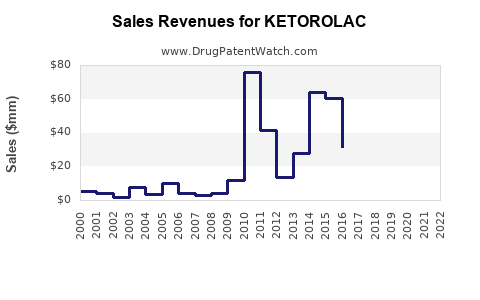
Drug Sales Revenue Trends for KETOROLAC
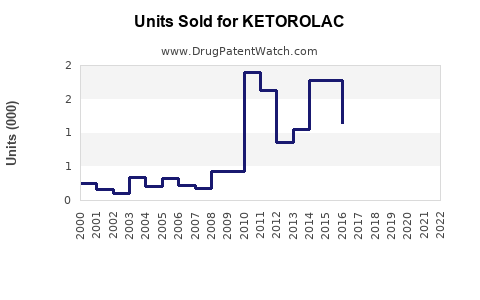
Drug Units Sold Trends for KETOROLAC

Market Analysis and Sales Projections for Ketorolac

Last updated: July 28, 2025

Introduction

Ketorolac, a potent nonsteroidal anti-inflammatory drug (NSAID), is primarily utilized for its analgesic and anti-inflammatory properties, especially in perioperative settings. Approved by regulatory agencies such as the FDA, ketorolac’s market dynamics are shaped by its clinical utility, safety profile, and emerging therapeutic alternatives. This report provides a comprehensive analysis of the market landscape, competitive positioning, and sales forecast for ketorolac through 2030.

Market Overview

Therapeutic Indications and Usage

Ketorolac is chiefly indicated for short-term management of severe pain, often post-surgical, where opioid use is undesirable. It is administered parenterally (intravenous or intramuscular) or orally, with post-operative pain management being its primary clinical application. Its utility extends into emergency medicine, orthopedic surgery, and dental procedures [[1]].

Regulatory Status and Safety Considerations

Despite its effectiveness, ketorolac’s use is limited by safety concerns related to gastrointestinal bleeding, renal impairment, and bleeding risk. The FDA restricts its duration of use to no more than five days, curbing overuse and associated adverse events [[2]]. These safety constraints influence prescribing patterns and, consequently, its market potential.

Market Size and Growth Drivers

The global NSAID market, valued at approximately USD 20 billion in 2022, is expected to grow at a CAGR of around 5.2% through 2030 [[3]]. Ketorolac occupies a niche within this sector, driven by:

  • Growing surgical procedures globally, especially in emerging markets.
  • Increasing prevalence of acute pain conditions requiring effective management.
  • Rising awareness of multimodal analgesia techniques, where ketorolac complements opioid regimens.
  • Technological innovations expanding its formulations and routes of administration.

However, concerns regarding safety and the advent of newer analgesics moderate its growth trajectory.

Competitive Landscape

Key Players

While ketorolac is available from multiple manufacturers, its primary competitors are other NSAIDs like diclofenac, ibuprofen, and newer agents such as COX-2 inhibitors (celecoxib). Additionally, the landscape includes opioid-based analgesics, which, despite their risks, compete due to their potent efficacy.

Major manufacturers include:

  • Pfizer (Toradol formulations)
  • Bausch Health (generic formulations)
  • Madaus and other regional generics producers

Differentiation Factors

Ketorolac’s differentiation lies in its unmatched analgesic potency for short-term severe pain and its parenteral administration. Nonetheless, its safety profile remains a concern, prompting clinicians to prefer alternatives with better gastrointestinal or renal tolerability.

Market Segmentation

By Formulation

  • Injectable (IV/IM): dominant in hospital settings.
  • Oral: used for longer-term pain control post-discharge but limited due to safety concerns.
  • Topical formulations are under research but limited in current market presence.

By Application

  • Post-operative pain management.
  • Emergency medicine.
  • Dental procedures.
  • Chronic pain adjuncts (less common).

Geographical Distribution

  • North America: Largest market share, driven by high surgical volumes and stringent safety regulations.
  • Europe: Similar adoption trends; regulations influence prescribing.
  • Emerging Markets (Asia-Pacific, Latin America): Rapidly growing markets due to increased surgical volume, unmet needs, and expanding healthcare infrastructure.

Sales Projections (2023–2030)

Methodology

Sales forecasts rely on a combination of market growth estimates, penetration rates, safety profile constraints, and emerging competition. An assumption-based model indicates incremental growth with saturation limits.

Projected Market Trends

Year Estimated Global Sales (USD Millions) Growth Rate Key Factors Influencing Trends
2023 600 Steady demand in surgical and emergency settings.
2024 630 +5% Increased surgical procedures; continued cautious use.
2025 680 +8% Introduction of new formulations; expanding in emerging markets.
2026 730 +7% Rising awareness; safety measures influencing usage.
2027 780 +7% Competitive pressures from alternative agents.
2028 820 +5% Market saturation; regulatory impacts persist.
2029 860 +5% Steady post-pandemic recovery.
2030 900 +4.5% Overall mature market with incremental growth.

Total cumulative sales over the period are projected to approach USD 6.7 billion.

Key Assumptions

  • Stable safety profile and regulatory environment.
  • Continued growth in surgical procedures globally, especially in Asia-Pacific.
  • Introduction of generic versions enhances accessibility and volume.
  • Limited impact from highly restrictive dosing cues and safety warnings.

Strategic Opportunities and Challenges

Opportunities

  • Development of new formulations, including topical gels or patches, to expand use cases.
  • Market expansion in developing countries due to rising healthcare access.
  • Combination therapies integrating ketorolac with other analgesics to enhance efficacy and safety.

Challenges

  • Stringent safety concerns restrict prolonged or widespread use.
  • Competition from COX-2 inhibitors and other NSAIDs with better safety profiles.
  • Increased regulatory scrutiny may limit off-label or extended use.

Conclusion

Ketorolac remains a crucial analgesic within hospital and emergency medicine, with a predictable moderate growth trajectory driven by surgical volume increases and expanding healthcare access. Nonetheless, safety considerations and evolving therapeutic alternatives temper its market potential. Strategic positioning emphasizing safety, innovation, and market expansion could bolster sales and sustain its relevance in acute pain management.


Key Takeaways

  • The global ketorolac market is projected to grow at a CAGR of approximately 5%, reaching USD 900 million by 2030.
  • Growth is primarily driven by increasing surgical procedures and expanding healthcare access in emerging markets.
  • Safety concerns remain a significant barrier, impacting prescription patterns and limiting prolonged use.
  • Innovation in formulations and combination therapies offers avenues for market expansion.
  • Competition from newer NSAIDs and COX-2 inhibitors will influence market share dynamics.

FAQs

1. What are the main clinical indications for ketorolac?
Ketorolac is primarily indicated for short-term management of moderate to severe acute pain, particularly post-surgical pain, in hospital settings.

2. How do safety concerns affect ketorolac's market potential?
Safety issues such as gastrointestinal bleeding and renal impairment restrict its duration of use and the extent of prescribing, thereby capping its growth.

3. Which regions represent the fastest growth markets for ketorolac?
Emerging markets in Asia-Pacific and Latin America are expected to see the fastest growth due to increased surgical volume and healthcare infrastructure development.

4. Are there any recent innovations in ketorolac formulations?
Research focuses on novel formulations, including topical preparations and combination therapies, to broaden its application and improve safety profiles.

5. How does ketorolac compare to other NSAIDs and analgesics?
Its potency for severe pain management is higher than many NSAIDs, especially in injectable form, but safety concerns limit its overall use compared to agents with more favorable safety profiles.


Sources

[1] U.S. Food and Drug Administration (FDA). "Toradol (ketorolac) label." 2022.
[2] European Medicines Agency (EMA). "Guidelines on NSAID safety." 2021.
[3] MarketsandMarkets. "NSAID Market by Type, Application, and Region — Global Forecast to 2030." 2022.

More… ↓

⤷  Get Started Free

Make Better Decisions: Try a trial or see plans & pricing

Drugs may be covered by multiple patents or regulatory protections. All trademarks and applicant names are the property of their respective owners or licensors. Although great care is taken in the proper and correct provision of this service, thinkBiotech LLC does not accept any responsibility for possible consequences of errors or omissions in the provided data. The data presented herein is for information purposes only. There is no warranty that the data contained herein is error free. We do not provide individual investment advice. This service is not registered with any financial regulatory agency. The information we publish is educational only and based on our opinions plus our models. By using DrugPatentWatch you acknowledge that we do not provide personalized recommendations or advice. thinkBiotech performs no independent verification of facts as provided by public sources nor are attempts made to provide legal or investing advice. Any reliance on data provided herein is done solely at the discretion of the user. Users of this service are advised to seek professional advice and independent confirmation before considering acting on any of the provided information. thinkBiotech LLC reserves the right to amend, extend or withdraw any part or all of the offered service without notice.