Share This Page
Drug Sales Trends for GATIFLOXACIN
✉ Email this page to a colleague
Payment Methods and Pharmacy Types for GATIFLOXACIN (2006)
Revenues by Pharmacy Type
Units Sold by Pharmacy Type
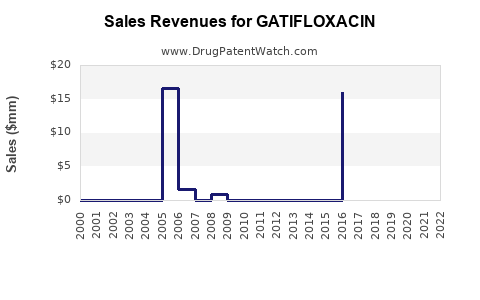
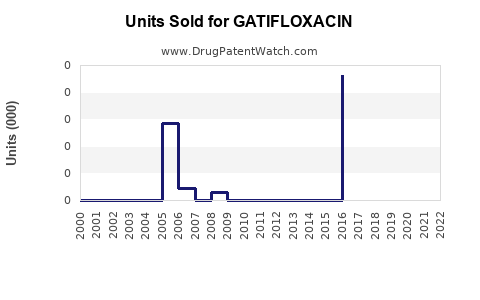
Annual Sales Revenues and Units Sold for GATIFLOXACIN
| Drug Name | Revenues (USD) | Units | Year |
|---|---|---|---|
| GATIFLOXACIN | ⤷ Start Trial | ⤷ Start Trial | 2022 |
| GATIFLOXACIN | ⤷ Start Trial | ⤷ Start Trial | 2021 |
| GATIFLOXACIN | ⤷ Start Trial | ⤷ Start Trial | 2020 |
| GATIFLOXACIN | ⤷ Start Trial | ⤷ Start Trial | 2019 |
| GATIFLOXACIN | ⤷ Start Trial | ⤷ Start Trial | 2018 |
| >Drug Name | >Revenues (USD) | >Units | >Year |
Gatifloxacin Market Analysis, Sales Projections, Patent Status, and Competitive Outlook
Gatifloxacin is a mature fluoroquinolone with limited commercial value in systemic therapy and a residual market in ophthalmic products. U.S. systemic sales ended after FDA withdrawal of Tequin because of dysglycemia and other safety concerns. Ophthalmic gatifloxacin remains available as a generic antibiotic eye drop, but pricing, competition, and clinical substitution by moxifloxacin and other agents constrain growth.
The modeled global gatifloxacin market was approximately $55 million in 2024 across ophthalmic, systemic, hospital, and international formulations. The base case projects a decline to about $49 million by 2030, equivalent to a compound annual growth rate of approximately negative 2%. The ophthalmic segment should account for more than 90% of developed-market revenue.
What is the current gatifloxacin market size?
Public company filings do not report gatifloxacin revenue as a separate product category. The drug is predominantly sold through generic manufacturers, distributors, hospital suppliers, and regional pharmaceutical companies. The market estimate below is an analyst model rather than a reported manufacturer total.
| Segment | Estimated 2024 global sales | 2030 base-case sales | 2024-2030 trend |
|---|---|---|---|
| Ophthalmic gatifloxacin | $48 million | $45 million | -1.1% CAGR |
| Systemic oral and injectable products | $5 million | $2 million | -12.6% CAGR |
| Other regional formulations | $2 million | $2 million | 0% CAGR |
| Total | $55 million | $49 million | -1.9% CAGR |
The estimate reflects generic pricing, low product differentiation, limited branded promotion, declining systemic use, and continued availability in lower-income markets. It excludes combination products where gatifloxacin is not reported separately.
What drives gatifloxacin demand?
Demand is concentrated in ophthalmic treatment of bacterial conjunctivitis and in perioperative or post-operative eye care. Gatifloxacin is a broad-spectrum fluoroquinolone with activity against many gram-positive and gram-negative organisms.
Market demand depends on:
- Ophthalmology procedure volumes.
- Prescription volume for bacterial conjunctivitis.
- Local antimicrobial-resistance patterns.
- Availability of moxifloxacin and ofloxacin.
- Hospital and pharmacy formulary decisions.
- Generic pricing and distributor supply.
- Regional regulatory approval.
The ophthalmic market is more stable than systemic demand because topical administration reduces exposure to the systemic safety concerns that affected oral and injectable gatifloxacin. The product still faces substitution from moxifloxacin ophthalmic products, which are widely used in cataract surgery and other ophthalmic settings.
What are the projected gatifloxacin sales through 2030?
The base-case forecast assumes continued generic availability, no major new branded formulation, no broad return of systemic gatifloxacin in the United States, and gradual substitution toward moxifloxacin and newer ophthalmic antibiotics.
| Year | Base-case sales | Low case | High case |
|---|---|---|---|
| 2024 | $55 million | $45 million | $70 million |
| 2025 | $54 million | $43 million | $70 million |
| 2026 | $53 million | $42 million | $69 million |
| 2027 | $52 million | $40 million | $68 million |
| 2028 | $51 million | $39 million | $67 million |
| 2029 | $50 million | $37 million | $66 million |
| 2030 | $49 million | $35 million | $65 million |
The high case assumes stronger ophthalmic procedure growth in emerging markets and continued use in countries where gatifloxacin is priced below moxifloxacin. The low case assumes faster switching to moxifloxacin, tighter antimicrobial stewardship, and additional supplier exits.
What would change the sales forecast?
The most important upside factor would be expansion in India, China, Southeast Asia, Latin America, and the Middle East. These markets have larger generic ophthalmic populations and lower acquisition costs than the United States and Western Europe.
The largest downside factors are:
- Continued loss of systemic use.
- Physician preference for moxifloxacin.
- Antibiotic stewardship restrictions.
- Generic price erosion.
- Manufacturing interruptions affecting low-volume products.
- Reduced reimbursement for older ophthalmic antibiotics.
A return of systemic gatifloxacin in the United States is not included in the forecast.
Which gatifloxacin formulations have the strongest commercial position?
Ophthalmic formulations have the strongest remaining position. Systemic formulations have low commercial potential because of safety history, regulatory restrictions, and competition from safer or more commonly used fluoroquinolones.
| Formulation | Commercial status | Market outlook |
|---|---|---|
| Gatifloxacin ophthalmic solution | Generic products available in multiple markets | Stable to modest decline |
| Gatifloxacin oral tablets | Discontinued or commercially limited in many developed markets | Sharp decline |
| Gatifloxacin injection | Limited hospital and regional use | Declining |
| Gatifloxacin ophthalmic combination products | Available in selected markets | Niche growth possible |
| Novel sustained-release ophthalmic delivery | Limited commercial penetration | Unproven |
What formulations are protected by gatifloxacin patents?
The original active-ingredient and composition patent estate is generally expired in the United States. Remaining commercial barriers are more likely to involve product-specific formulation patents, regulatory exclusivity, trademarks, manufacturing know-how, or local-country patents than protection for gatifloxacin itself.
Potential formulation areas include:
- Preservative systems.
- Concentration and pH control.
- Ophthalmic suspension technology.
- Sustained-release inserts or gels.
- Fixed-dose combinations.
- Manufacturing processes for sterile ophthalmic solutions.
A formulation patent would need claims that are materially different from the standard generic solution. A conventional gatifloxacin ophthalmic solution generally faces limited U.S. patent protection after expiration of the foundational compound and product patents.
What is the FDA regulatory status of gatifloxacin?
FDA regulatory status differs sharply by route of administration.
Systemic gatifloxacin
The FDA requested withdrawal of Tequin, Bristol-Myers Squibb’s systemic gatifloxacin product, in 2006 after postmarketing reports of serious dysglycemia and related safety concerns. The product was used as an oral and intravenous fluoroquinolone for respiratory and urinary tract infections.
The systemic withdrawal materially reduced the U.S. commercial market and eliminated the principal branded revenue stream.
Ophthalmic gatifloxacin
Gatifloxacin ophthalmic products remain distinct from systemic gatifloxacin. Ophthalmic products are used locally and have a different risk-benefit profile. Generic ophthalmic products have been marketed under abbreviated new drug applications and regional equivalents.
Important U.S. regulatory considerations include:
- Product-specific ANDA approval.
- Bioequivalence or ophthalmic equivalence requirements.
- Sterility validation.
- Container-closure integrity.
- Preservative and inactive-ingredient controls.
- Current Good Manufacturing Practice compliance.
The FDA’s withdrawal of systemic Tequin did not automatically remove all ophthalmic gatifloxacin products from the market.
What is the Orange Book status of gatifloxacin?
The Orange Book relevance of gatifloxacin is primarily historical. Systemic Tequin was withdrawn, and the principal compound and product patent terms have expired. Current commercial opportunities are therefore concentrated in generic ophthalmic products rather than in an active branded reference product.
| Regulatory issue | Assessment |
|---|---|
| Active U.S. systemic branded product | No meaningful commercial presence |
| Active U.S. ophthalmic generic market | Present, subject to product availability |
| Compound patent protection | Expired |
| New-drug exclusivity | Expired |
| Paragraph IV opportunity | Limited commercial value because core protection has expired |
| Current patent-led launch barrier | Low for conventional ophthalmic products |
A current Orange Book review should distinguish discontinued reference products from active reference products. A historical listing does not create an active exclusivity barrier for a new generic applicant.
When did gatifloxacin lose exclusivity?
Gatifloxacin lost core U.S. exclusivity after expiration of the original patent term in the mid-2010s. The foundational U.S. gatifloxacin patent commonly associated with the compound is U.S. Patent No. 5,607,942, assigned to Kyorin Pharmaceutical and licensed for commercialization. The patent issued in 1997 and had a term generally calculated from the earliest nonprovisional filing date, subject to patent-term adjustment and any applicable regulatory extension.
Systemic commercialization by Bristol-Myers Squibb ended before the patent estate became commercially relevant again. The 2006 withdrawal of Tequin was driven by safety concerns rather than by patent expiry.
Are there active gatifloxacin Paragraph IV challenges?
Paragraph IV activity has limited current importance for gatifloxacin. Generic entry has already occurred, and conventional gatifloxacin products are no longer protected by a commercially meaningful compound patent in the United States.
Historical Paragraph IV filings may have targeted patents covering the active ingredient, dosage form, or product formulation. Those disputes do not create a current market barrier unless a specific patent remains unexpired and listed against an active reference product.
Which companies compete in the gatifloxacin market?
The competitive field is fragmented. No single company controls the global gatifloxacin market.
Generic manufacturers
Generic ophthalmic gatifloxacin has been supplied by companies including:
- Akorn and related U.S. ophthalmic businesses.
- Sandoz and other Novartis-associated generic operations.
- Dr. Reddy’s Laboratories.
- Cipla.
- Lupin.
- Sun Pharmaceutical Industries.
- Micro Labs.
- Ajanta Pharma.
- Regional Chinese and Latin American manufacturers.
Product availability varies by country and can change after manufacturing transfers, regulatory actions, or commercial discontinuation.
Competing antibiotic products
The principal competitive products are:
| Drug | Typical commercial position versus gatifloxacin |
|---|---|
| Moxifloxacin ophthalmic | Stronger branded and generic position; common in ophthalmology |
| Ofloxacin ophthalmic | Lower-cost, established generic competitor |
| Ciprofloxacin ophthalmic | Broad generic availability |
| Tobramycin ophthalmic | Important alternative for selected bacterial infections |
| Besifloxacin ophthalmic | More differentiated but generally higher-priced |
| Azithromycin ophthalmic | Alternative for some conjunctivitis cases |
Moxifloxacin is the strongest direct commercial substitute in many markets. It has broad ophthalmic use, strong physician familiarity, and substantial generic availability.
How does gatifloxacin compare with moxifloxacin?
Gatifloxacin and moxifloxacin are both fluoroquinolones, but moxifloxacin has the stronger current commercial position in ophthalmology.
| Category | Gatifloxacin | Moxifloxacin |
|---|---|---|
| U.S. systemic status | Withdrawn or commercially inactive | Systemic products remain subject to fluoroquinolone safety restrictions |
| Ophthalmic availability | Generic and regional | Broad generic and branded history |
| Physician adoption | Mature and declining | Higher in many ophthalmic settings |
| Price | Usually lower | Usually higher but heavily eroded by generics |
| Patent position | Core protection expired | Core and formulation protection largely expired, with historical product-specific patents |
| Growth potential | Limited | Larger installed market and stronger procedure-related demand |
Gatifloxacin can compete where procurement price is the primary factor. Moxifloxacin is more likely to win where surgeons prioritize established post-operative protocols, broad formulary acceptance, or simplified dosing.
What patent litigation affects gatifloxacin?
There is no major current patent litigation expected to materially restrict ordinary generic gatifloxacin ophthalmic sales in the United States. Historical litigation would be more relevant to the launch of Tequin, branded ophthalmic products, and early generic entry than to the present market.
Future disputes could involve:
- Formulation patents for preservative-free products.
- Sustained-release ophthalmic delivery systems.
- Combination products.
- Manufacturing methods.
- Trade secrets involving sterile filling or impurity control.
- Patent rights in countries where local extensions remain active.
Manufacturing and regulatory compliance are more significant barriers than core molecule patents.
How strong is the gatifloxacin patent estate?
The conventional gatifloxacin patent estate is weak from a current commercial perspective.
| Patent category | Current strength |
|---|---|
| Active ingredient | Low; core protection expired |
| Oral or injectable formulation | Low in the United States |
| Standard ophthalmic solution | Low to moderate, depending on country and specific claims |
| Preservative-free formulation | Potentially moderate if claims remain active |
| Sustained-release delivery | Potentially moderate to strong for a novel system |
| Manufacturing process | Variable and difficult to assess from public data |
| Trademarks and brand recognition | Low |
The most defensible future intellectual-property strategy would involve a differentiated delivery system, a fixed-dose combination, or a formulation that demonstrates a clinically meaningful advantage. A standard generic solution does not offer a strong patent-led investment thesis.
What generic launch risks exist for gatifloxacin?
Generic launch risk is operational rather than primarily patent-based.
Regulatory risks
Sterility failures, particulate contamination, preservative variability, container-closure defects, and manufacturing-site observations can delay or interrupt supply. Ophthalmic products face higher quality-control requirements than many oral solid products.
Commercial risks
The market can become unprofitable when several suppliers compete for a small volume. Wholesale acquisition prices may decline rapidly, while ophthalmic manufacturing requires specialized sterile facilities.
Clinical risks
Fluoroquinolone resistance and antimicrobial stewardship can reduce prescribing. Ophthalmic use is less affected than systemic use, but hospitals and surgeons may prefer moxifloxacin or non-fluoroquinolone alternatives.
Supply risks
Low-volume products are vulnerable to supplier exits. A temporary shortage can increase pricing, but such events are difficult to sustain as a long-term investment thesis because competitors can re-enter if margins improve.
What is the revenue exposure for pharmaceutical companies?
Revenue exposure to gatifloxacin is immaterial for large diversified pharmaceutical companies. The product can be meaningful for a small ophthalmic generic manufacturer or regional distributor, particularly where it is sold alongside other eye-care products.
| Company type | Revenue exposure |
|---|---|
| Large diversified pharmaceutical company | Negligible |
| Specialty ophthalmic company | Low to moderate |
| Regional generic manufacturer | Potentially meaningful |
| Contract manufacturer | Volume opportunity, low margin |
| Distributor | Low-margin, working-capital driven |
The principal commercial opportunity is portfolio management, not standalone brand building. A supplier can use gatifloxacin to fill sterile ophthalmic manufacturing capacity or support a broader antibiotic eye-drop portfolio.
What are the most likely gatifloxacin launch scenarios?
Base case
Generic ophthalmic sales continue with gradual volume erosion. Pricing remains low, and no major branded product re-enters the U.S. market. Global sales decline at approximately 2% annually through 2030.
Upside case
Emerging-market ophthalmology procedures increase, low-cost procurement expands, and temporary shortages among competing products support higher volumes. Global sales reach approximately $65 million by 2030.
Downside case
Moxifloxacin substitution accelerates, systemic sales disappear from remaining markets, and one or more sterile manufacturers exit. Global sales fall to approximately $35 million by 2030.
Key Takeaways
- Gatifloxacin is a mature generic antibiotic with limited standalone investment value.
- Ophthalmic products account for the overwhelming majority of remaining commercial demand.
- Systemic U.S. sales ended after FDA action involving Tequin and serious dysglycemia concerns.
- The modeled global market is approximately $55 million in 2024.
- Base-case sales decline to about $49 million by 2030.
- Moxifloxacin is the strongest direct competitive threat.
- Core compound and conventional product patent protection is expired or commercially weak.
- Current barriers are sterile manufacturing, regulatory compliance, pricing, and supplier reliability.
- A differentiated ophthalmic delivery system or combination product would have more strategic value than a standard gatifloxacin solution.
- Paragraph IV and patent-litigation risks are low for ordinary generic ophthalmic entry.
FAQs
Is gatifloxacin still sold in the United States?
Gatifloxacin ophthalmic products may be available through generic channels, but systemic gatifloxacin is no longer a meaningful U.S. commercial product after withdrawal of Tequin.
Is gatifloxacin safer than moxifloxacin?
Safety depends on route, dose, patient characteristics, and indication. Systemic gatifloxacin had a well-documented dysglycemia concern. Ophthalmic exposure is lower, but product selection remains subject to clinical judgment and local prescribing standards.
Does gatifloxacin have biosimilar competition?
No. Gatifloxacin is a small-molecule drug, so competition occurs through generic drug applications rather than biosimilar pathways.
Can a company obtain new patents on gatifloxacin?
A company generally cannot obtain a new patent on the old molecule itself. It may obtain patents on genuinely novel formulations, delivery systems, combinations, manufacturing methods, or new therapeutic uses if statutory patent requirements are met.
Is gatifloxacin a good pharmaceutical licensing target?
A standard generic gatifloxacin product has limited licensing value. A sustained-release ophthalmic system, preservative-free formulation, or clinically differentiated combination could have greater value, particularly if supported by enforceable claims and regulatory exclusivity.
References
-
U.S. Food and Drug Administration. (2006). FDA announces voluntary withdrawal of Tequin, an antibiotic associated with low blood sugar and other serious side effects. FDA.
-
U.S. Food and Drug Administration. (2024). Orange Book: Approved drug products with therapeutic equivalence evaluations. FDA.
-
U.S. Food and Drug Administration. (2024). Drugs@FDA: FDA-approved drugs database. FDA.
-
DailyMed. (2024). Gatifloxacin ophthalmic solution prescribing information. National Library of Medicine.
-
U.S. Patent and Trademark Office. (1997). U.S. Patent No. 5,607,942: Quinolonecarboxylic acid derivatives. USPTO.
-
U.S. Food and Drug Administration. (2018). Fluoroquinolone antimicrobial drugs: Drug safety communication. FDA.
-
World Health Organization. (2023). WHO AWaRe antibiotic book: Antibiotic choice for common bacterial infections. World Health Organization.
More… ↓
