Share This Page
Drug Sales Trends for DELESTROGEN
✉ Email this page to a colleague
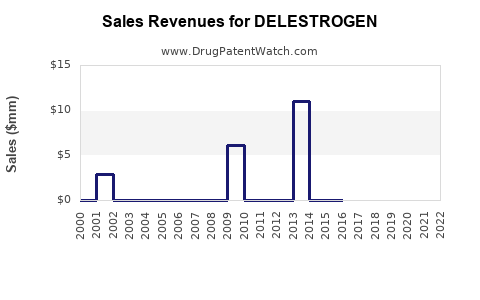
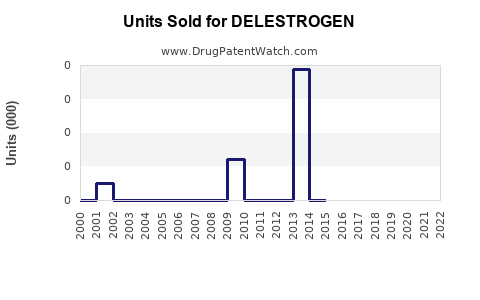
Annual Sales Revenues and Units Sold for DELESTROGEN
| Drug Name | Revenues (USD) | Units | Year |
|---|---|---|---|
| DELESTROGEN | ⤷ Start Trial | ⤷ Start Trial | 2022 |
| DELESTROGEN | ⤷ Start Trial | ⤷ Start Trial | 2021 |
| DELESTROGEN | ⤷ Start Trial | ⤷ Start Trial | 2020 |
| DELESTROGEN | ⤷ Start Trial | ⤷ Start Trial | 2019 |
| DELESTROGEN | ⤷ Start Trial | ⤷ Start Trial | 2018 |
| DELESTROGEN | ⤷ Start Trial | ⤷ Start Trial | 2017 |
| >Drug Name | >Revenues (USD) | >Units | >Year |
DELESTROGEN Market Analysis, Sales Projections, Patent Estate and Generic Risk
Delestrogen is an estradiol valerate injection used primarily for estrogen replacement. The product is a mature, niche pharmaceutical with limited patent protection, no biosimilar exposure, and substantial substitution risk from oral, transdermal, compounded, and competing injectable estrogen products. Public companies do not disclose Delestrogen-specific revenue, so sales projections require scenario modeling rather than historical product sales.
The commercial outlook is limited but defensible in markets requiring injectable estradiol, including patients who cannot use oral or transdermal therapy and some gender-affirming care settings. The main risks are generic availability, manufacturer concentration, supply interruptions, reimbursement pressure, and the absence of meaningful exclusivity.
What is Delestrogen and how large is its addressable market?
Delestrogen is the brand name for estradiol valerate injection, a long-acting ester of estradiol. The product is supplied in injectable strengths including 10 mg/mL, 20 mg/mL, and 40 mg/mL, depending on market availability and manufacturer labeling. It is administered intramuscularly and has historically been used for menopausal symptoms, hypoestrogenism, selected estrogen-responsive cancers, and other conditions described in the prescribing information. [1]
The commercial market is a small segment of the broader estrogen therapy market.
| Market segment | Relevance to Delestrogen |
|---|---|
| Menopausal hormone therapy | Established indication, but oral and transdermal products dominate |
| Hypoestrogenism | Niche demand where injectable therapy is clinically preferred |
| Gender-affirming hormone therapy | Important demand source in some clinics, generally an off-label use |
| Estrogen-responsive cancer | Historical and limited use relative to oncology alternatives |
| Fertility and reproductive medicine | Estradiol products are used, but injectable estradiol valerate is not the principal product in every protocol |
| Compounded hormone therapy | Compounded alternatives can compete directly on price and availability |
The addressable market is constrained by the availability of lower-cost oral estradiol tablets, patches, gels, creams, and other injectable estrogen products. Delestrogen therefore competes in a route-of-administration niche rather than across the full estrogen replacement market.
What is the FDA regulatory status of Delestrogen?
Delestrogen is an FDA-approved prescription drug marketed under an older new drug application framework. The product is not a biologic and is not subject to biosimilar competition. Generic estradiol valerate injections may be approved through the abbreviated new drug application pathway if the applicant demonstrates pharmaceutical equivalence, bioequivalence, quality, and manufacturing compliance. [2]
The FDA label identifies the following broad uses:
- Moderate to severe vasomotor symptoms associated with menopause.
- Vulvar and vaginal atrophy.
- Female hypoestrogenism caused by hypogonadism, castration, or primary ovarian failure.
- Selected palliative treatment of androgen-dependent prostate cancer.
- Selected palliative treatment of androgen-dependent breast cancer in appropriately selected patients. [1]
FDA regulatory considerations include:
- The product contains estrogen and carries class-wide warnings relating to cardiovascular, thromboembolic, and certain cancer risks.
- Injectable products require sterile manufacturing, validated aseptic processes, container-closure controls, and stability data.
- Any change in formulation, strength, manufacturing site, or container may require regulatory review.
- Generic competition is more likely to arise through ANDA approval than through a new clinical-development program.
What patents protect Delestrogen?
The principal Delestrogen patent risk is low because the product is an old small-molecule injectable. No meaningful remaining composition-of-matter exclusivity is expected to protect estradiol valerate or the conventional injectable formulation.
The relevant intellectual-property categories are:
| IP category | Delestrogen position |
|---|---|
| Active-ingredient patent | Expired or commercially irrelevant for this legacy product |
| Basic formulation patent | No material current protection identified in the FDA Orange Book |
| Method-of-use patent | No material current protection expected for the labeled uses |
| Manufacturing process patent | Potentially relevant only to a specific supplier or process |
| Trademark | Delestrogen branding may remain protected separately from the drug substance |
| Trade secrets | Sterile manufacturing, analytical methods, and supply-chain controls may provide practical protection |
The FDA Orange Book is the principal public source for patents and regulatory exclusivities listed for approved drug products. Legacy estradiol valerate products generally do not have the type of active patent estate associated with newer branded drugs. [2]
When does Delestrogen lose exclusivity?
Delestrogen’s meaningful regulatory and patent exclusivity has already expired. The commercial question is not the date of patent expiry but the durability of supply, brand recognition, manufacturing capability, and payer access.
No substantial remaining period of new chemical entity exclusivity, pediatric exclusivity, or orphan-drug exclusivity is expected to protect the product. The product’s competitive position depends on manufacturing execution rather than legal exclusivity.
How many patents cover Delestrogen?
No material active Orange Book patent estate is expected to cover the conventional Delestrogen estradiol valerate injection. Any patents associated with a specific supplier may relate to manufacturing, packaging, analytical methods, or an alternative delivery system rather than the core approved product.
This distinction matters. A process patent could increase the cost of designing around a supplier’s manufacturing method, but it would not prevent all ANDA applicants from selling an equivalent estradiol valerate injection using a different process.
What is the Orange Book status of Delestrogen?
The Orange Book records approved drug products and, where applicable, patent and exclusivity information. Delestrogen’s Orange Book position should be assessed by reviewing the current listing for the relevant NDA, dosage form, strength, and marketing status. [2]
The practical conclusion is:
- No significant active patent barrier is expected.
- A generic applicant could potentially file an ANDA without a Paragraph IV challenge to a current composition patent if no listed patent remains.
- A Paragraph IV certification would become relevant only if an active listed patent were associated with the reference product.
- Commercial launch risk would be driven more by FDA approval, manufacturing capacity, and supply economics than by patent litigation.
Are there Paragraph IV challenges to Delestrogen?
No material publicly reported Paragraph IV campaign is associated with Delestrogen’s conventional estradiol valerate injection. That is consistent with the age of the product and the apparent absence of a valuable, unexpired Orange Book patent estate.
A generic applicant could pursue an ANDA using a certification that no relevant patent is listed, that the reference product has no applicable patent, or that any listed patent has expired. Paragraph IV litigation would be more likely only if a later reformulation or proprietary delivery system created a new listed patent position.
What formulations are protected by Delestrogen?
The conventional Delestrogen formulation is an oil-based intramuscular estradiol valerate injection. The commercial product does not appear to rely on a recently patented extended-release platform, depot device, implant, or novel delivery technology.
Potentially protectable formulation features could include:
- Concentration and dose presentation.
- Vehicle composition.
- Sterility and preservative system.
- Container-closure design.
- Stability profile.
- Manufacturing parameters.
- Novel injection devices or depot technologies.
These features may create technical differentiation, but they do not automatically create enforceable market exclusivity. A generic applicant can often design around formulation or process claims while maintaining pharmaceutical equivalence.
What generic entry risks exist for Delestrogen?
Generic entry risk is high in legal terms and moderate in practical terms.
| Risk factor | Assessment |
|---|---|
| Patent blocking risk | Low |
| Regulatory pathway | Established ANDA pathway |
| Clinical-development requirement | Generally limited compared with a new drug |
| Sterile manufacturing complexity | Moderate to high |
| Market size | Small, which may limit applicant interest |
| Price erosion | High if multiple suppliers enter |
| Supply concentration | Potentially high |
| Substitution by other estrogen products | High |
| Brand loyalty | Limited outside established prescribers and clinics |
The small market can delay generic entry even when legal barriers are absent. Injectable sterile products require specialized facilities, and expected revenue may not justify development and validation costs for every manufacturer.
Generic entry could still produce rapid price erosion because estradiol valerate is a mature active ingredient and prescribers may accept therapeutically equivalent products. Pharmacy substitution depends on state law, payer policy, product availability, and whether the generic is rated therapeutically equivalent to the reference product.
Which companies compete with Delestrogen?
Competition comes from both branded and generic estrogen products.
Direct pharmaceutical competitors
- Generic estradiol valerate injection.
- Estradiol cypionate injection.
- Other injectable estradiol products where available.
Route-of-administration competitors
- Oral estradiol tablets.
- Transdermal estradiol patches.
- Estradiol gels and sprays.
- Topical estrogen products.
- Compounded injectable estradiol.
Commercial substitutes
For menopausal hormone therapy, transdermal estradiol and oral estradiol are the primary substitutes. For gender-affirming care, clinicians may use oral, transdermal, injectable estradiol valerate, injectable estradiol cypionate, or compounded products depending on patient preference, clinical judgment, insurance coverage, and supply.
The competitive advantage of Delestrogen is route-specific. Its disadvantages include injection burden, supply variability, limited payer differentiation, and the availability of alternatives with broader prescribing familiarity.
How strong is the Delestrogen patent estate?
The patent estate is weak from a blocking perspective. The product’s defensibility is operational rather than legal.
| Dimension | Assessment |
|---|---|
| Composition-of-matter protection | Expired |
| Active Orange Book patents | No material current estate expected |
| Method-of-use protection | Weak or absent for core uses |
| Formulation protection | Limited for conventional injection |
| Manufacturing know-how | Potentially meaningful |
| Trademark value | Moderate but narrow |
| Regulatory moat | Low |
| Supply-chain moat | Potentially meaningful |
| Litigation leverage | Low |
The strongest practical barrier is sterile injectable manufacturing. That barrier can support pricing if supply is constrained, but it does not prevent a well-capitalized generic manufacturer from entering.
What patent litigation affects Delestrogen?
No major patent litigation trend is publicly associated with the conventional Delestrogen product. The absence of material litigation is consistent with the product’s age, limited revenue opportunity, and lack of a substantial active patent estate.
Potential disputes would more likely involve:
- ANDA approval and therapeutic equivalence.
- Manufacturing or facility compliance.
- Trademark use.
- Product liability.
- Supply contracts.
- Compounded-drug regulation.
- Pharmacy substitution and reimbursement.
These issues are distinct from a classic branded-drug patent case involving an active composition or formulation patent.
Are there licensing deals involving Delestrogen?
No major publicly disclosed licensing transaction is generally associated with Delestrogen’s core product rights. Ownership and marketing arrangements may change over time through portfolio transfers, contract manufacturing, or distribution agreements, but those arrangements do not necessarily create new exclusivity.
The commercial value of a Delestrogen transaction would depend on:
- Verified annual units.
- Net price after rebates and discounts.
- Supply reliability.
- FDA manufacturing history.
- Contract manufacturer dependence.
- Generic competition.
- Payer concentration.
- Exposure to compounded alternatives.
A buyer would likely value the product as a specialty legacy asset rather than as a patent-protected growth product.
What are Delestrogen sales projections for 2025 through 2029?
Public filings do not normally report Delestrogen revenue separately. The following is an analyst scenario model, not reported company guidance.
Base-case projection
Assumptions:
- U.S.-focused revenue base of approximately $15 million in 2025.
- Low-single-digit unit growth from injectable estrogen demand.
- Net price erosion from generic and compounded competition.
- No major manufacturing interruption.
- No new patent or exclusivity event.
| Year | Base-case net sales | Year-over-year growth |
|---|---|---|
| 2025 | $15.0 million | - |
| 2026 | $15.3 million | 2.0% |
| 2027 | $15.5 million | 1.3% |
| 2028 | $15.6 million | 0.6% |
| 2029 | $15.6 million | 0.0% |
Scenario range
| Scenario | 2025 sales | 2029 sales | Main assumptions |
|---|---|---|---|
| Downside | $8 million | $5 million | Generic entry, price erosion, supply substitution |
| Base case | $15 million | $16 million | Stable supply and modest demand growth |
| Upside | $25 million | $32 million | Injectable estrogen growth, limited competition, improved availability |
The range is wide because Delestrogen-specific sales are not publicly reported. A single manufacturer disruption could reduce annual revenue sharply, while a supply-constrained market could temporarily increase realized pricing.
The base case implies a low-growth legacy product. It does not support a valuation based on patent-protected pricing or rapid market expansion.
What revenue exposure exists for the manufacturer?
Revenue exposure depends on whether Delestrogen is a standalone product or part of a broader women’s-health or specialty-pharmaceutical portfolio.
Key exposure variables include:
- Product concentration: A manufacturer dependent on one injectable estrogen product faces significant supply and reimbursement risk.
- Manufacturing site concentration: A single sterile facility creates interruption risk.
- Channel mix: Institutional, specialty-clinic, wholesale, and retail channels have different pricing and inventory behavior.
- Payer mix: Commercial insurance and government reimbursement can produce materially different net prices.
- Compounding substitution: Demand may shift to compounded products when commercial supplies are unavailable or expensive.
- Generic entry: Multiple approved suppliers would likely reduce net price.
The product can generate attractive cash flow if manufacturing costs are low and competition is limited. The same product has limited strategic value if it requires expensive sterile manufacturing for a small annual market.
What manufacturing and intellectual-property barriers affect Delestrogen?
Manufacturing is the principal barrier. Estradiol valerate injection requires:
- Qualified sterile facilities.
- Validated aseptic filling.
- Control of particulate and microbial contamination.
- Consistent concentration and potency.
- Container-closure integrity.
- Stability data for the labeled shelf life.
- Reliable access to active pharmaceutical ingredient and excipients.
These requirements can create temporary scarcity and protect incumbent economics without creating formal exclusivity. They also expose the product to FDA inspection findings, contract-manufacturing disruptions, raw-material shortages, and batch-release delays.
The product’s IP barrier is comparatively weak. A competitor that reproduces the dosage form and meets ANDA requirements could compete without duplicating proprietary branding or necessarily using the same manufacturing process.
How does Delestrogen compare with estradiol cypionate?
| Attribute | Estradiol valerate injection | Estradiol cypionate injection |
|---|---|---|
| Drug class | Injectable estradiol ester | Injectable estradiol ester |
| Typical use | Estrogen replacement and other estrogen-related indications | Estrogen replacement and gender-affirming care settings |
| Patent position | Mature, limited current protection | Mature, limited current protection |
| Main advantage | Established product familiarity and availability when supplied | Alternative injectable ester |
| Main risk | Supply and generic substitution | Supply and limited commercial availability |
| Primary substitutes | Oral and transdermal estradiol | Oral, transdermal, and estradiol valerate |
Neither product has the patent profile of a recent branded specialty drug. Competition is determined by availability, dosing preferences, reimbursement, and prescriber familiarity.
What is the likely generic launch scenario for Delestrogen?
The most likely launch scenario is a limited number of generic suppliers rather than a large initial wave of entrants.
A realistic sequence is:
- An ANDA sponsor identifies sufficient annual volume to justify sterile-product development.
- The sponsor conducts comparative quality and bioequivalence work.
- FDA review focuses on formulation, manufacturing, labeling, and facility readiness.
- One or more generic products enter without substantial patent litigation.
- Wholesale prices decline, but intermittent shortages may preserve some incumbent pricing.
- Clinics and pharmacies shift between suppliers based on inventory and reimbursement.
The commercial outcome could be price erosion without complete displacement. Injectable products often remain vulnerable to shortages because the number of qualified sterile suppliers is smaller than the number of oral-tablet manufacturers.
Key Takeaways
- Delestrogen is a mature estradiol valerate injection with limited current patent protection.
- Its meaningful exclusivity has already expired.
- No major Paragraph IV or patent-litigation campaign is associated with the conventional product.
- The product is not exposed to biosimilar competition because it is a small-molecule drug.
- Generic entry risk is legally high but may be delayed by sterile manufacturing economics.
- The principal competitors are oral and transdermal estradiol, estradiol cypionate, and compounded injections.
- Product-specific revenue is not publicly disclosed.
- A reasonable modeled 2025 U.S. sales range is $8 million to $25 million, with a base case of approximately $15 million.
- The base-case outlook is flat to low growth through 2029.
- The most important commercial variables are supply continuity, manufacturing capacity, generic entry, reimbursement, and compounded-product substitution.
FAQs
Is Delestrogen still commercially available?
Availability can vary by strength, supplier, wholesaler inventory, and market. Estradiol valerate injection may be marketed under brand or generic names, and supply conditions can change independently of patent status.
Does Delestrogen have orphan-drug exclusivity?
No meaningful current orphan-drug exclusivity is expected to protect the conventional estradiol valerate injection.
Can a generic manufacturer launch Delestrogen without a Paragraph IV lawsuit?
Yes. If no relevant unexpired patent is listed, an ANDA applicant can pursue a certification pathway that does not require challenging an active Orange Book patent.
Is Delestrogen used for gender-affirming hormone therapy?
Estradiol valerate injection is used in some gender-affirming care protocols. That use may be off-label, and prescribing depends on clinical judgment, patient factors, product availability, and applicable standards of care.
What would make Delestrogen more valuable to a buyer?
The strongest value drivers would be reliable sterile manufacturing, documented sales volume, low production cost, stable payer access, limited generic competition, and control of a dependable supply chain.
References
-
U.S. Food and Drug Administration. (n.d.). Delestrogen: Estradiol valerate injection prescribing information. FDA. https://www.accessdata.fda.gov/drugsatfda_docs/label/
-
U.S. Food and Drug Administration. (n.d.). Approved drug products with therapeutic equivalence evaluations: Orange Book. FDA. https://www.accessdata.fda.gov/scripts/cder/ob/
-
U.S. Food and Drug Administration. (n.d.). Drugs@FDA: FDA-approved drugs. FDA. https://www.accessdata.fda.gov/scripts/cder/daf/
-
U.S. Food and Drug Administration. (n.d.). Drug shortages. FDA. https://www.accessdata.fda.gov/scripts/drugshortages/
-
U.S. National Library of Medicine. (n.d.). DailyMed: Estradiol valerate injection. DailyMed. https://dailymed.nlm.nih.gov/dailymed/
More… ↓
