Share This Page
Drug Sales Trends for COPAXONE
✉ Email this page to a colleague
Payment Methods and Pharmacy Types for COPAXONE (2006)
Revenues by Pharmacy Type
Units Sold by Pharmacy Type
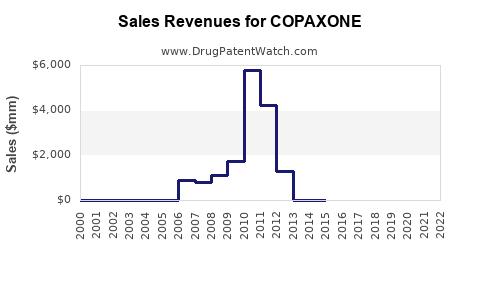
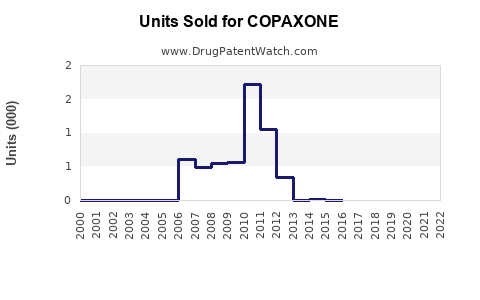
Annual Sales Revenues and Units Sold for COPAXONE
| Drug Name | Revenues (USD) | Units | Year |
|---|---|---|---|
| COPAXONE | ⤷ Start Trial | ⤷ Start Trial | 2022 |
| COPAXONE | ⤷ Start Trial | ⤷ Start Trial | 2021 |
| COPAXONE | ⤷ Start Trial | ⤷ Start Trial | 2020 |
| COPAXONE | ⤷ Start Trial | ⤷ Start Trial | 2019 |
| COPAXONE | ⤷ Start Trial | ⤷ Start Trial | 2018 |
| COPAXONE | ⤷ Start Trial | ⤷ Start Trial | 2017 |
| >Drug Name | >Revenues (USD) | >Units | >Year |
Copaxone Market Analysis and Sales Projections Through 2029
Copaxone, Teva Pharmaceutical Industries’ glatiramer acetate product, remains a large multiple sclerosis franchise but is in structural decline. Teva’s branded sales are being reduced by generic glatiramer acetate, price erosion, switching from daily 20 mg to three-times-weekly 40 mg therapy, and competition from oral and high-efficacy disease-modifying therapies.
The base-case forecast is for Copaxone-branded sales to decline from approximately $1.0 billion in 2023 to about $500 million by 2029. A faster generic conversion scenario produces sales below $350 million by 2029. The franchise retains value through physician familiarity, long-term safety experience, a substantial treated-patient base, and limited manufacturing complexity relative to biologic products, but its growth prospects are negative.
What is Copaxone and how does it generate revenue?
Copaxone is a non-biologic disease-modifying therapy containing glatiramer acetate. It is approved for relapsing forms of multiple sclerosis, including relapsing-remitting multiple sclerosis and clinically isolated syndrome in the United States.
| Product | Dose | Administration | Commercial status |
|---|---|---|---|
| Copaxone 20 mg/mL | 20 mg | Subcutaneous injection once daily | Mature, heavily exposed to generics |
| Copaxone 40 mg/mL | 40 mg | Subcutaneous injection three times weekly | Main branded revenue contributor |
| Generic glatiramer acetate | 20 mg or 40 mg | Subcutaneous injection | Available from multiple manufacturers |
Copaxone is not a monoclonal antibody or other biologic. It is a complex synthetic polypeptide mixture. Generic manufacturers have historically faced product-specific equivalence requirements, but they do not face the same patent and interchangeability framework used for biosimilars.
Teva’s commercial exposure is concentrated in the United States, where Copaxone has faced multiple abbreviated new drug applications, or ANDAs. European sales have also declined as national health systems favor lower-cost generic alternatives.
How much does Copaxone sell?
Teva reported approximately $1.0 billion in global Copaxone revenue in 2023, compared with materially higher levels before generic competition became established in the U.S. market. The product’s sales trajectory has been negative for more than a decade.
Historical sales trend
| Period | Approximate global Copaxone sales | Primary trend |
|---|---|---|
| 2013-2014 | More than $4 billion annually | Peak franchise period |
| 2016 | Approximately $3 billion | 40 mg formulation still protected in the U.S. |
| 2017-2018 | Approximately $2 billion | Generic entry and litigation pressure |
| 2020 | Approximately $1.2 billion | Continuing price and volume erosion |
| 2022 | Approximately $1.0-$1.1 billion | Mature generic market |
| 2023 | Approximately $1.0 billion | Further decline |
| 2024 estimate | Approximately $0.8-$0.9 billion | Continued U.S. erosion |
Historical figures reflect Teva-reported product revenue and rounded estimates where reporting periods or geographic presentations differ. Teva identifies generic competition and price reductions as key drivers of Copaxone declines. [1]
What are the Copaxone sales projections through 2029?
The following forecast models branded Copaxone sales, not total glatiramer acetate market sales. The forecast assumes no major new indication, no material manufacturing disruption, and continued generic availability.
| Year | Base-case branded sales | Downside case | Upside case |
|---|---|---|---|
| 2024 | $850 million | $800 million | $900 million |
| 2025 | $760 million | $680 million | $820 million |
| 2026 | $680 million | $550 million | $750 million |
| 2027 | $610 million | $450 million | $690 million |
| 2028 | $550 million | $390 million | $640 million |
| 2029 | $500 million | $330 million | $600 million |
Forecast assumptions
The base case assumes:
- Annual branded revenue erosion of approximately 8% to 12%.
- Continued generic availability for both 20 mg and 40 mg strengths.
- Gradual migration of remaining branded users to generic glatiramer acetate.
- Stable multiple sclerosis prevalence and treatment demand.
- Continued substitution toward oral therapies and high-efficacy agents.
- No meaningful patent-based exclusion of generic competitors.
The downside case assumes more aggressive payer substitution, additional generic entrants, and faster migration to alternative disease-modifying therapies. The upside case assumes persistent patient and physician preference for Copaxone, slower formulary conversion, and stable reimbursement for the three-times-weekly formulation.
These projections are market-model estimates rather than Teva guidance.
When did Copaxone lose exclusivity?
Copaxone lost its principal U.S. exclusivity in stages.
Copaxone exclusivity timeline
| Date | Event | Commercial impact |
|---|---|---|
| 1996 | FDA approved Copaxone 20 mg/mL | Original U.S. launch |
| 2014 | FDA approved Copaxone 40 mg/mL three-times-weekly dosing | Shifted patients toward higher-value formulation |
| 2015 | Core 20 mg patent protection largely expired | Opened the market to generic challenges |
| 2017 | FDA approval of major generic glatiramer acetate products | Accelerated U.S. price and volume erosion |
| 2017 onward | Litigation and additional generic approvals | Reduced effectiveness of later patent defenses |
| 2020s | Continued generic substitution | Mature decline phase |
The 40 mg formulation delayed the full commercial impact of generic competition because it became the preferred branded presentation and had a later protection profile. Generic entrants nevertheless challenged the relevant patents, and federal courts invalidated or narrowed important portions of Teva’s patent position. [2][3]
What patents protect Copaxone?
Copaxone’s original composition and formulation protection is largely expired or commercially ineffective against approved generic products. Key historic patent disputes included patents covering glatiramer acetate formulations, dosing regimens, and three-times-weekly administration.
Core patent categories
| Patent category | Product relevance | Current commercial effect |
|---|---|---|
| Composition patents | Glatiramer acetate active ingredient | Expired or no longer exclusionary |
| 20 mg formulation patents | Daily injection | Limited remaining value |
| 40 mg formulation patents | Three-times-weekly injection | Subject to invalidity and generic litigation |
| Method-of-use patents | Relapsing multiple sclerosis treatment | Narrower enforcement value |
| Manufacturing patents | Molecular-weight distribution and process controls | May raise entry costs but generally do not block all ANDA products |
| Device or presentation patents | Injection pen, packaging, or delivery system | Limited protection for the core drug market |
One prominent dispute involved Teva’s U.S. Patent No. 8,232,250, which covered aspects of the three-times-weekly 40 mg regimen. The Federal Circuit upheld findings that materially weakened the patent’s ability to prevent generic entry. [3]
Patent listings in the FDA Orange Book should be interpreted separately from practical exclusivity. A listed patent can remain in the Orange Book while being subject to litigation, a judgment of invalidity, a non-infringement ruling, or a settlement permitting launch before nominal expiration. [4]
What is the Orange Book status of Copaxone?
Copaxone is an FDA-approved small-molecule-type drug product listed in FDA regulatory databases and associated with patent and exclusivity information. The commercial significance of current listings is limited because generic glatiramer acetate products have already entered the U.S. market.
Orange Book analysis should focus on:
- Listed patents for the 20 mg and 40 mg strengths.
- Paragraph IV certifications filed by ANDA applicants.
- Thirty-month stays triggered by infringement litigation.
- Court rulings on validity and infringement.
- Settlement terms that permit a generic launch before patent expiration.
- Whether the listed patent covers the drug, formulation, method of use, or a nonessential product attribute.
Copaxone does not have a meaningful remaining period of branded market exclusivity comparable to a newly launched specialty drug. Its commercial protection now depends more on contracting, patient retention, manufacturing reliability, and brand familiarity than on a blocking patent.
Which companies have challenged Copaxone?
Major challengers have included Sandoz, Mylan, and other generic manufacturers that developed or commercialized glatiramer acetate products. Mylan received FDA approval for generic glatiramer acetate, while Sandoz also pursued U.S. generic products and challenged Teva patents.
The competitive set includes:
- Viatris, through Mylan’s generic glatiramer acetate business.
- Sandoz.
- Other ANDA applicants and regional generic manufacturers.
- Authorized or partnered generic products marketed through various channels.
The exact competitive intensity differs by dose. The 20 mg daily product has generally faced earlier and broader generic pressure. The 40 mg three-times-weekly product has retained more branded value because of historical patient preference and the timing of generic approvals.
Is there biosimilar risk for Copaxone?
Copaxone does not face biosimilar risk in the conventional FDA sense. Glatiramer acetate is not regulated as a biologic requiring a biosimilar application under the Public Health Service Act. The relevant risk is generic substitution through ANDAs.
This distinction matters commercially:
- Generic applicants can rely on the FDA’s drug approval framework rather than the biosimilar interchangeability pathway.
- Pharmacy substitution may be easier in states and plans where generic glatiramer acetate is designated therapeutically equivalent.
- Product-specific manufacturing and equivalence requirements still matter because glatiramer acetate is a complex mixture.
- Manufacturing differences can affect regulatory timing, but they do not create durable biologic-style exclusivity.
How strong is the Copaxone patent estate?
Copaxone’s current patent estate is weak to moderate as a commercial barrier.
Strengths
- Teva has long experience defending the product’s patents.
- Manufacturing know-how can create technical and regulatory friction.
- The 40 mg regimen historically supported premium pricing and patient retention.
- Device, packaging, and process patents can complicate generic development.
Weaknesses
- Core patents have expired or have been invalidated.
- Generic products are already approved and marketed.
- Method-of-use claims are narrower than composition claims.
- Patent litigation has not restored meaningful U.S. exclusivity.
- The product has no orphan-drug or pediatric exclusivity advantage that would materially change the outlook.
The estate is therefore more useful for managing launch timing and settlement economics than for preventing long-term competition.
What formulations are protected by Copaxone patents?
The principal commercial formulations are 20 mg/mL daily dosing and 40 mg/mL three-times-weekly dosing. Teva’s patent strategy historically focused on:
- Concentration and dosing frequency.
- Stable aqueous formulations.
- Treatment of relapsing multiple sclerosis.
- Manufacturing characteristics of the glatiramer acetate mixture.
- Delivery devices and prefilled syringes.
The 40 mg formulation created a lifecycle-management benefit by shifting patients from daily administration to three-times-weekly dosing. It did not create a permanent barrier because generic manufacturers eventually developed competing products and challenged formulation and dosing patents.
What patent litigation and settlement agreements affect Copaxone?
Copaxone litigation has involved Teva and generic manufacturers, particularly around the 40 mg three-times-weekly product. The most important commercial outcomes were the invalidation or weakening of key patents and the eventual availability of generic glatiramer acetate.
The litigation history includes:
- Teva patent suits against generic ANDA applicants.
- Declaratory and invalidity proceedings involving core 40 mg patents.
- Federal Circuit review of obviousness and claim-construction issues.
- Settlements that affected the timing of generic launches.
- Continued disputes over Orange Book-listed patents and product-specific claims.
A settlement can delay a generic launch without confirming that the patent estate is strong. For valuation purposes, the relevant variable is the first legally permitted launch date and the number of approved generic competitors, not the nominal expiration date of every listed patent.
What is Copaxone’s FDA regulatory status?
Copaxone remains FDA approved for relapsing forms of multiple sclerosis. The 20 mg/mL and 40 mg/mL presentations are established products with extensive post-market clinical experience.
The regulatory profile is favorable for continued use:
- Long safety history.
- No dependence on a new clinical development program.
- Established injection-device and manufacturing infrastructure.
- Generic products approved under the ANDA pathway.
- No pending regulatory event required to sustain the franchise.
Regulatory risk is therefore lower than commercial risk. The principal threats are pricing, substitution, adherence, and therapeutic competition.
How does Copaxone compare with competing multiple sclerosis drugs?
Copaxone has a lower-risk safety profile and long clinical familiarity, but it is less convenient and generally less potent than many newer disease-modifying therapies.
| Therapy class | Examples | Relative Copaxone position |
|---|---|---|
| Injectable platform therapies | Interferon beta products, glatiramer acetate | Copaxone remains established but faces price competition |
| Oral therapies | Dimethyl fumarate, teriflunomide, fingolimod-class products | Greater convenience and stronger substitution pressure |
| High-efficacy monoclonal antibodies | Natalizumab, ocrelizumab, ofatumumab | Stronger efficacy positioning for higher-risk patients |
| Immune reconstitution therapies | Cladribine and related products | Competitive in selected patient populations |
| Generic glatiramer acetate | Multiple manufacturers | Directly substitutes for Copaxone |
Copaxone is most defensible in patients who prioritize long safety experience, pregnancy-related treatment considerations, or avoidance of systemic immunosuppression. It is less competitive in newly diagnosed patients for whom physicians favor oral or high-efficacy treatment strategies.
What generic launch risks exist for Copaxone?
The principal generic launch risks are already realized rather than contingent.
Current risks
- Additional ANDA approvals.
- Lower generic prices and stronger payer mandates.
- Automatic or plan-directed substitution.
- Loss of branded patients after prescription renewal.
- Greater use of generic 40 mg products.
- Consolidation among specialty pharmacies and payers.
- Reduced physician influence over product selection.
Remaining branded defenses
- Copay assistance and patient-support services.
- Physician familiarity.
- Patient preference for the branded syringe or device.
- Supply reliability.
- Contracting with commercial insurers.
- Retention of patients who are stable on branded therapy.
These defenses can slow decline but are unlikely to restore prior revenue levels.
What is Copaxone’s geographic market outlook?
The United States remains the most important market for branded Copaxone revenue and the largest source of near-term erosion. Generic substitution is more advanced in many European markets, where reimbursement systems often prioritize the lowest-cost equivalent.
| Region | Outlook |
|---|---|
| United States | Continued branded decline, especially as 40 mg generics gain share |
| Western Europe | Mature generic market and reimbursement pressure |
| Central and Eastern Europe | Lower prices and tender-driven competition |
| Japan and other developed markets | Smaller opportunity with local reimbursement constraints |
| Emerging markets | Volume opportunity but limited branded pricing power |
International revenue growth is unlikely to offset U.S. erosion because price levels are lower and generic penetration is generally higher.
What is the revenue exposure for Teva?
Copaxone remains strategically important but is no longer one of Teva’s primary growth assets. Its decline affects:
- U.S. specialty-pharmacy revenue.
- Multiple sclerosis franchise visibility.
- Gross margin, because branded Copaxone historically carried higher margins than generic products.
- Commercial infrastructure utilization.
- Teva’s ability to fund growth products through mature-branded cash flow.
The franchise still generates meaningful cash, but each year of decline reduces its contribution to Teva’s overall operating leverage. Teva’s broader portfolio, including Austedo and other specialty and generic products, is more important to future growth than Copaxone.
What is the likely Copaxone market size in 2029?
The total glatiramer acetate market should remain larger than branded Copaxone sales because generic products will continue serving a stable pool of multiple sclerosis patients. Under the base case:
- Branded Copaxone sales reach approximately $500 million by 2029.
- Total glatiramer acetate sales may remain near $1.0 billion to $1.4 billion globally, depending on price erosion and treatment persistence.
- Generic products capture most incremental volume.
- The total market declines more slowly than the branded product because disease prevalence and treated-patient counts remain stable.
The most likely market structure is a mature, low-growth injectable segment with falling prices and declining branded share.
Key Takeaways
- Copaxone generated approximately $1.0 billion in global sales in 2023.
- Branded sales are expected to decline to approximately $500 million by 2029 in the base case.
- Generic glatiramer acetate, not biosimilar competition, is the primary threat.
- The 20 mg product has experienced the greatest loss of exclusivity.
- The 40 mg three-times-weekly formulation remains the main branded revenue source but has limited long-term patent protection.
- Teva’s patent estate is no longer a reliable barrier to generic entry.
- Regulatory risk is low; pricing and substitution risk are high.
- The multiple sclerosis market is shifting toward oral and high-efficacy therapies.
- Copaxone’s remaining value is concentrated in cash generation, physician familiarity, and patient retention.
- The total glatiramer acetate market will likely outlast the branded Copaxone franchise.
FAQs
Does Copaxone still have patent protection?
Some Orange Book-listed patents and related intellectual-property claims may remain, but they do not provide effective market exclusivity against all approved generic glatiramer acetate products.
Is generic glatiramer acetate interchangeable with Copaxone?
Interchangeability depends on the specific FDA therapeutic-equivalence designation, product strength, state substitution rules, and payer policy. Generic availability has already created substantial substitution pressure.
Will Copaxone sales recover?
A sustained recovery is unlikely without a new indication, a major pricing reversal, or a material reduction in generic competition. The base-case outlook is continued annual decline.
Does Teva still manufacture Copaxone?
Teva continues to market Copaxone, subject to its commercial and manufacturing decisions. The company’s continued participation does not prevent generic competition.
Is Copaxone a biologic drug?
No. Copaxone is glatiramer acetate, a complex synthetic polypeptide drug. Its competitors enter primarily through the generic ANDA pathway rather than the FDA biosimilar pathway.
References
-
Teva Pharmaceutical Industries Ltd. (2024). 2023 annual report on Form 20-F. Teva Pharmaceutical Industries Ltd.
-
U.S. Food and Drug Administration. (2024). Drugs@FDA: FDA-approved drugs, Copaxone and glatiramer acetate products. U.S. Department of Health and Human Services.
-
U.S. Court of Appeals for the Federal Circuit. (2017). Teva Pharmaceuticals USA, Inc. v. Sandoz, Inc., patent litigation involving glatiramer acetate dosing and formulation claims.
-
U.S. Food and Drug Administration. (2024). Approved drug products with therapeutic equivalence evaluations: Orange Book. U.S. Department of Health and Human Services.
-
Teva Pharmaceutical Industries Ltd. (2023). Annual report on Form 20-F for fiscal year 2022. Teva Pharmaceutical Industries Ltd.
More… ↓