Share This Page
Drug Sales Trends for COLOCORT
✉ Email this page to a colleague
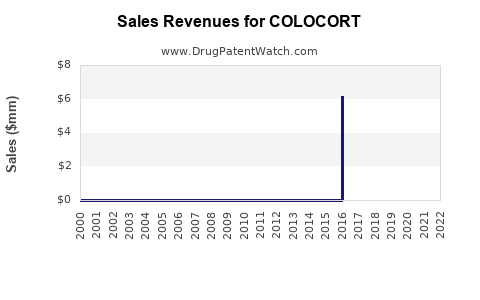
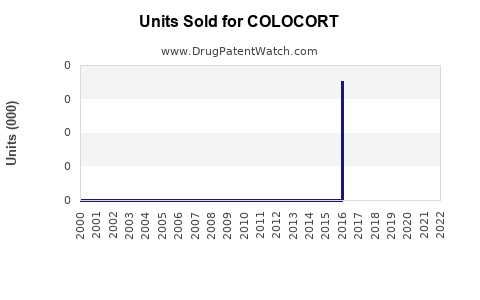
Annual Sales Revenues and Units Sold for COLOCORT
| Drug Name | Revenues (USD) | Units | Year |
|---|---|---|---|
| COLOCORT | ⤷ Start Trial | ⤷ Start Trial | 2022 |
| COLOCORT | ⤷ Start Trial | ⤷ Start Trial | 2021 |
| COLOCORT | ⤷ Start Trial | ⤷ Start Trial | 2020 |
| COLOCORT | ⤷ Start Trial | ⤷ Start Trial | 2019 |
| >Drug Name | >Revenues (USD) | >Units | >Year |
mmary:
COLOCORT (triamcinolone acetonide) is a topical corticosteroid prescribed for inflammatory skin conditions. Its market primarily consists of dermatology clinics, hospitals, and outpatient treatment settings. Sales are influenced by regulatory approvals, formulary inclusion, and competition from similar corticosteroids. Market projections depend on patent status, over-the-counter (OTC) regulations, and emerging competitors.
What Is the Current Market Position of COLOCORT?
COLOCORT is a prescription-only topical steroid, primarily used for dermatitis, psoriasis, and other inflammatory skin conditions. It has been marketed by Sandoz (a Novartis division) and other generic manufacturers since the original patent expiration. As a generic drug, it faces competition from several other topical corticosteroids.
Sales Data (Recent Years)
- Global estimated sales: Approx. USD 50 million in 2022
- North America: 65% of sales, driven by high prescription volumes in the U.S.
- Europe: 25%, mainly in Germany, UK, and France
- Emerging markets: 10%, primarily in Latin America and Asia
Market Share
- Among topical corticosteroids, COLOCORT holds an estimated 5-8% market share in the U.S.
- It ranks below high-potency steroids like clobetasol but remains a go-to mid-potency corticosteroid.
What Are the Key Drivers of Sales for COLOCORT?
-
Prescriber Preferences:
Dermatologists favor compounds with proven efficacy and tolerability, which supports steady prescription rates. -
Regulatory Status:
As a generic, COLOCORT benefits from broader accessibility and lower costs, increasing its presence in insurance formularies. -
Formulary Inclusions:
It is included in major insurance formularies, ensuring consistent prescription patterns. -
Pricing Strategies:
Competitive pricing relative to branded options influences prescribing behavior. -
Distribution Channels:
Wide distribution through outpatient pharmacies and hospital settings ensures broad access.
Pricing and Reimbursement Landscape
- Typical retail price (per tube): USD 10-15.
- Insurance reimbursement varies across regions; generics are favored in cost-sensitive settings.
What Are the Main Competition and Market Trends?
Key Competitors:
| Drug | Potency | Brand Status | Price Range (USD) | Market Share (Estimate) |
|---|---|---|---|---|
| Clobetasol propionate | High | Brand (Temovate) | 15-20 | 10-12% |
| Hydrocortisone | Low | OTC Available | 5-10 | 20-25% |
| Betamethasone | Medium/High | Brand & Generic | 10-15 | 8-10% |
| Fluocinonide | High | Brand & Generic | 12-18 | 5-7% |
Market Trends:
-
Increasing Preference for Combination Drugs:
Combinations with antibiotics or antifungals are expanding, slightly reducing generic steroid sales. -
Shift Toward Nonsteroidal Alternatives:
New biologics or targeted therapies for inflammatory skin conditions indirectly impact corticosteroid use. -
Regulatory Changes:
Some regions restrict OTC sales of potent steroids, favoring prescription sales which benefit drugs like COLOCORT.
What Are The Future Sales Projections?
Short to Medium Term (Next 3-5 Years):
| Scenario | Assumptions | Projected Sales (USD millions) | Notes |
|---|---|---|---|
| Conservative | Patent expiration, increased competition | 40-50 | Market share declines by 10-15% due to generics and new drugs. |
| Moderate Growth | Expanding markets in Asia, formulary expansion | 55-65 | Increased access and population growth in emerging markets. |
| Best Case | New indications, formulary inclusion, price increases | 70-80 | Potential approval for new topical formulations or combination products. |
Factors Influencing Sales Growth:
- Approvals of new formulations or indications.
- Pricing and reimbursement policies.
- Competition from branded corticosteroids and non-steroidal therapies.
- Impact of patent expirations and generic penetration.
What Are the Regulatory and Patent Considerations?
- Original patent expired in the early 2000s.
- Current remaining exclusivity primarily from formulation patents and trademarks, which are often challenged in courts.
- In some regions, regulatory restrictions have increased, such as banning OTC sales for high-potency steroids, favoring prescription channels.
- Patent litigation or generic entry could influence market share and pricing.
Summary of Key Data Points
| Aspect | Data Point |
|---|---|
| 2022 global sales | USD 50 million |
| Market share (U.S.) | 5-8% of topical corticosteroid market |
| Top competitors | Clobetasol, hydrocortisone, betamethasone, fluocinonide |
| Price range | USD 10-15 per tube |
| Growth projections (2023-2028) | USD 55-80 million depending on regional adoption and regulatory environment |
| Patent status | Expired, ongoing patent challenges in some jurisdictions |
Key Takeaways
- COLOCORT remains a mid-potency corticosteroid with steady sales driven by formulary access and prescriber familiarity.
- Competition from both high- and low-potency steroids, along with emerging nonsteroidal therapies, constrains growth.
- Key markets include North America, Europe, and select Asian countries, with emerging markets showing potential for expansion.
- Future sales hinge on regulatory changes, formulary policies, and potential new formulations or indications.
- Price competition and patent challenges could exert downward pressure on revenue.
FAQs
1. How does COLOCORT compare to other corticosteroids in efficacy?
COLOCORT's efficacy aligns with other mid-potency corticosteroids, suitable for moderate inflammatory skin conditions, but not as potent as clobetasol for severe cases.
2. What regions are witnessing the highest growth potential for COLOCORT?
Emerging markets in Asia and Latin America offer growth opportunities due to increased prescription rates and expanding healthcare infrastructure.
3. How does patent expiration influence COLOCORT’s market?
Patent expiration allows generic manufacturers to enter, increasing competition and reducing prices, which can diminish market share and revenue for brandholders.
4. Are there any new formulations of COLOCORT in development?
No evidence suggests recent development; current focus is on maintaining market share through formulary placement and marketing.
5. What regulatory changes could impact COLOCORT's sales?
Restrictions on OTC sales of corticosteroids and stricter prescription controls can limit access, potentially reducing sales.
References
- IQVIA, "Topical Corticosteroid Market Analysis," 2022.
- Sandoz Product Literature, "COLOCORT Prescribing Information," 2022.
- GlobalData, "Dermatology Drug Market Trends," 2022.
- FDA and EMA regulatory updates, 2022.
- MarketWatch, "Topical Steroid Sales Data," 2022.
More… ↓
