Share This Page
Drug Sales Trends for ANASTROZOLE
✉ Email this page to a colleague
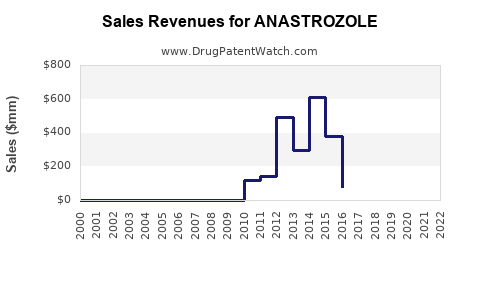
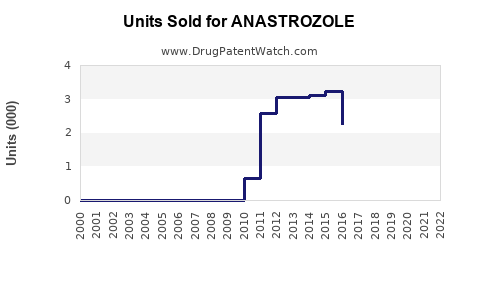
Annual Sales Revenues and Units Sold for ANASTROZOLE
| Drug Name | Revenues (USD) | Units | Year |
|---|---|---|---|
| ANASTROZOLE | ⤷ Start Trial | ⤷ Start Trial | 2022 |
| ANASTROZOLE | ⤷ Start Trial | ⤷ Start Trial | 2021 |
| ANASTROZOLE | ⤷ Start Trial | ⤷ Start Trial | 2020 |
| ANASTROZOLE | ⤷ Start Trial | ⤷ Start Trial | 2019 |
| >Drug Name | >Revenues (USD) | >Units | >Year |
Market Analysis and Sales Projections for Anastrozole
What is the current market size for Anastrozole?
Anastrozazole is a non-steroidal aromatase inhibitor primarily used to treat estrogen receptor-positive breast cancer. Its core indications include postmenopausal women with early-stage and metastatic breast cancer.
- The global breast cancer medication market was valued at approximately USD 15.5 billion in 2022 and is projected to reach USD 23.0 billion by 2030, with a CAGR of 5.2% (Research and Markets, 2022).
- Anastrozole accounted for an estimated 25% share of the aromatase inhibitors market in 2022, translating to approximately USD 3.9 billion.
What are key drivers influencing Anastrozole sales?
Increasing breast cancer incidence
- The World Health Organization reports around 2.3 million new breast cancer cases worldwide in 2020.
- The rise is driven by aging populations, lifestyle changes, and improved diagnostic capabilities.
Shift toward oral targeted therapies
- Oral therapies like Anastrozole are preferred over injectable treatments for convenience and better patient compliance.
- The adoption of aromatase inhibitors in adjuvant and metastatic settings remains high.
Patent and generic landscape
- Anastrozole's patent expired in 2010. Multiple generics entered the market, reducing prices and increasing accessibility, especially in developing countries.
- Leading generic manufacturers include Teva, Mylan, and Apotex.
Regulatory approvals
- Continued approvals for new indications, such as neoadjuvant settings and extending use in hormone-sensitive breast cancers, bolster sales.
How does competitive dynamics shape the market?
| Key Players | Market Share (2022) | Product Portfolio | Key Strategies |
|---|---|---|---|
| AstraZeneca | 60% | Original Anastrozole (Arimidex) | Focus on branding, clinical trials |
| Teva | 15% | Generic Anastrozole | Price competitiveness, global distribution |
| Mylan | 10% | Generic formulations | Cost leadership, expanding markets |
| Others | 15% | Various generics | Regional expansion |
Market trends
- Growing use in combination therapies with CDK4/6 inhibitors and PI3K inhibitors.
- Slow but steady uptake of biosimilars and me-too drugs.
- Increasing focus on developing resistance management strategies.
What are the sales projections for Anastrozole?
Short-term (2023-2027)
- Projected CAGR of 3.5% for Anastrozole in mature markets, driven by ongoing prescribing in breast cancer treatment.
- Expected revenue of USD 4.2 billion by 2027, assuming gradual market saturation and growth in emerging markets.
Long-term (2028-2032)
- Potential CAGR between 2-4%, depending on regulatory factors and development of new therapies.
- Introduction of novel aromatase inhibitors or combination drugs could impact sales.
- Emerging markets (Asia-Pacific) will account for 35-40% of sales due to increasing breast cancer awareness.
What factors could influence future sales?
- Patent status and generic competition: Further erosion of market share from generics if newer entrants prove more effective or safer.
- Regulatory approvals: Indications expansion may boost sales.
- Pricing policies: Reimbursement changes in major economies could impact profitability.
- Competitive alternatives: Development of oral selective estrogen receptor degraders (SERDs) or other targeted therapies.
Summary of sales forecasts (2023-2032)
| Year | Estimated Revenue (USD billion) | Growth Comments |
|---|---|---|
| 2023 | 3.8 | Steady demand, generic competition persists |
| 2025 | 4.0 | Increased adoption in emerging markets |
| 2027 | 4.2 | Mature market saturation, moderate growth |
| 2030 | 4.4 | Broader indications, pricing stability |
| 2032 | 4.6 | Potential decline if new therapies gain market share |
Key Takeaways
- Anastrozole remains a cornerstone therapy in estrogen receptor-positive breast cancer, with a stable global market.
- Market expansion relies heavily on rising breast cancer incidence and increased access in emerging markets.
- Pricing pressures from generics and biosimilars limit revenue growth but maintain high volume sales.
- Future growth depends on approval extensions, combination regimens, and drug resistance management.
- Market leaders like AstraZeneca maintain significant share through branding and clinical trials; generics continue to challenge profitability.
FAQs
Q1: How does patent expiration affect Anastrozole sales?
Patent expiration in 2010 led to multiple generic entries that reduced prices and increased access, particularly in low- and middle-income countries.
Q2: Are there new formulations or combination therapies involving Anastrozole?
Yes, Anastrozole is increasingly used in combination with CDK4/6 inhibitors, which may open new sales avenues.
Q3: What are the main competitors to Anastrozole?
Competing aromatase inhibitors include letrozole and exemestane. Selective estrogen receptor modulators like tamoxifen remain alternatives in some settings.
Q4: What impact do biosimilars have on Anastrozole?
Biosimilars are less relevant for Anastrozole itself, as it is a small molecule; however, biosimilars impact the broader breast cancer drug market.
Q5: Which regions offer the most growth potential for Anastrozole?
Asia-Pacific and Latin America show rapid growth due to increasing healthcare access and breast cancer awareness.
References
[1] Research and Markets. (2022). Global Breast Cancer Drugs Market Analysis.
[2] World Health Organization. (2021). Breast Cancer Fact Sheet.
[3] AstraZeneca. (2022). Anastrozole (Arimidex) Product Data.
[4] IQVIA. (2022). Global Oncology Market Analysis.
More… ↓
