Drug Sales Trends for AMARYL
Payment Methods and Pharmacy Types for AMARYL (2006)
Revenues by Pharmacy Type
Units Sold by Pharmacy Type
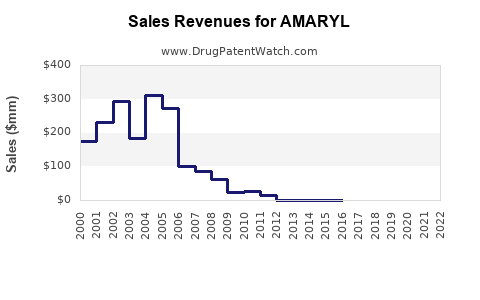
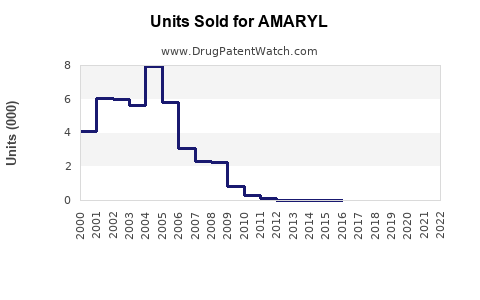
Annual Sales Revenues and Units Sold for AMARYL
| Drug Name | Revenues (USD) | Units | Year |
|---|---|---|---|
| AMARYL | ⤷ Start Trial | ⤷ Start Trial | 2022 |
| AMARYL | ⤷ Start Trial | ⤷ Start Trial | 2021 |
| AMARYL | ⤷ Start Trial | ⤷ Start Trial | 2020 |
| AMARYL | ⤷ Start Trial | ⤷ Start Trial | 2019 |
| AMARYL | ⤷ Start Trial | ⤷ Start Trial | 2018 |
| AMARYL | ⤷ Start Trial | ⤷ Start Trial | 2017 |
| >Drug Name | >Revenues (USD) | >Units | >Year |
AMARYL (Glimepiride) Market Analysis, Patent Status, Competitive Landscape, and Sales Projections
Amaryl is Sanofi’s original brand of glimepiride, a second-generation sulfonylurea for type 2 diabetes. The product received U.S. approval in 1995 and now competes in a mature, predominantly generic market. U.S. brand sales are limited, while commercial volume is concentrated in generic glimepiride across emerging markets, hospitals, retail pharmacies, and government procurement channels.
The base-case outlook is declining global revenue for the glimepiride molecule, driven by generic price erosion, competition from metformin and newer therapies, and the expansion of GLP-1 receptor agonists, SGLT2 inhibitors, and DPP-4 inhibitors. Glimepiride will retain demand because of its low cost, oral dosing, broad availability, and established use in markets where newer diabetes medicines remain unaffordable.
What is Amaryl and how does glimepiride work?
Amaryl contains glimepiride, an oral sulfonylurea that lowers blood glucose by stimulating pancreatic beta cells to release insulin. It is indicated as an adjunct to diet and exercise for adults with type 2 diabetes mellitus.
The U.S. label lists 1 mg, 2 mg, 4 mg, and 8 mg tablets. The usual initial dose is 1 or 2 mg once daily, with titration based on glycemic response. The principal safety concerns are hypoglycemia and weight gain. Glimepiride is not indicated for type 1 diabetes or diabetic ketoacidosis. (U.S. Food and Drug Administration, 2023a)
Amaryl’s commercial profile differs from newer diabetes products:
| Attribute | Amaryl / glimepiride |
|---|---|
| Active ingredient | Glimepiride |
| Drug class | Sulfonylurea |
| Route | Oral tablet |
| Primary use | Type 2 diabetes |
| U.S. approval | 1995 |
| U.S. dosage strengths | 1, 2, 4, 8 mg |
| Current market status | Brand plus multiple generics |
| Administration | Once daily |
| Main commercial advantage | Low acquisition cost |
| Main clinical disadvantage | Hypoglycemia and weight gain |
| Main competitive pressure | SGLT2, GLP-1 and DPP-4 therapies |
How large is the Amaryl and glimepiride market?
No public regulatory source reports Amaryl brand sales separately from generic glimepiride sales. The relevant commercial market is therefore the broader glimepiride market, with Amaryl representing only one portion of total value.
A reasonable market model places global glimepiride revenue in the low hundreds of millions of dollars annually, rather than in the billion-dollar range associated with leading newer diabetes brands. The largest unit demand is likely in India, China, Latin America, Southeast Asia, the Middle East, and other price-sensitive markets. U.S. revenue is more heavily exposed to generic substitution.
Estimated global glimepiride market, scenario model
| Year | Bear case | Base case | Bull case |
|---|---|---|---|
| 2024 | $250 million | $450 million | $700 million |
| 2025 | $235 million | $430 million | $680 million |
| 2026 | $220 million | $410 million | $660 million |
| 2027 | $205 million | $390 million | $640 million |
| 2028 | $190 million | $370 million | $620 million |
| 2029 | $175 million | $350 million | $600 million |
| 2030 | $160 million | $330 million | $580 million |
| 2024-2030 CAGR | -6.7% | -5.0% | -3.0% |
These figures are analytical estimates for the total glimepiride molecule, not reported Amaryl sales. The base case assumes continued unit demand but annual price erosion of approximately 3% to 6% in generic markets.
What are the main Amaryl sales drivers?
The main positive sales drivers are affordability, availability, physician familiarity, and once-daily dosing.
Low-cost diabetes treatment
Glimepiride is substantially less expensive than branded GLP-1 receptor agonists and many SGLT2 inhibitors. In low- and middle-income markets, its low monthly treatment cost supports continued use, particularly where reimbursement excludes newer medicines.
Established physician adoption
Decades of clinical use have created extensive prescribing familiarity. Physicians may use glimepiride as an add-on to metformin or as a low-cost alternative when newer therapies are unavailable.
Expanding diabetes prevalence
The International Diabetes Federation projects continued growth in the number of adults living with diabetes, particularly in Asia, the Middle East, and Africa. Rising prevalence supports demand for inexpensive oral therapies even when market share declines. (International Diabetes Federation, 2021)
Hospital and government procurement
Glimepiride is suitable for tender-based procurement because it is available from many manufacturers and has a simple tablet formulation. Public-sector procurement can preserve volume while compressing price.
What factors are reducing Amaryl sales?
The strongest headwinds are clinical substitution, generic competition, and declining price per tablet.
Competition from newer diabetes therapies
The American Diabetes Association recommends selecting glucose-lowering therapy according to cardiovascular disease, heart failure, chronic kidney disease, weight, hypoglycemia risk, cost, and patient preferences. These considerations increasingly favor SGLT2 inhibitors and GLP-1 receptor agonists for patients with cardiovascular or renal risk. (American Diabetes Association Professional Practice Committee, 2024)
DPP-4 inhibitors also compete directly with glimepiride because they are oral and generally have a lower hypoglycemia risk. Metformin remains the major low-cost first-line competitor.
Hypoglycemia and weight gain
Sulfonylureas increase insulin secretion independently of current glucose concentration. This creates a higher hypoglycemia risk than several newer drug classes. Weight gain also weakens the product’s position in patients for whom weight reduction is a treatment objective.
Generic price erosion
Amaryl’s branded premium is difficult to sustain where multiple glimepiride manufacturers are approved. Pharmacy benefit managers, hospital tenders, and national formularies usually prioritize low acquisition cost over brand differentiation.
Treatment guideline pressure
Guidelines do not eliminate sulfonylureas, but they increasingly reserve them for cost-sensitive situations, later-line use, or markets with limited access to newer drugs. This constrains volume growth in developed markets.
What is the FDA and Orange Book status of Amaryl?
Amaryl was approved by the FDA under NDA 020496. Generic glimepiride products are approved through abbreviated new drug applications and are therapeutically equivalent where listed as substitutable in the FDA Orange Book. (U.S. Food and Drug Administration, 2023b)
The commercial implications are direct:
| Regulatory issue | Amaryl status |
|---|---|
| Original NDA | NDA 020496 |
| FDA product type | Small-molecule prescription drug |
| Generic pathway | ANDA |
| Therapeutic substitution | Available for approved generic equivalents |
| Biosimilar exposure | None |
| Current regulatory barrier | Low relative to newer branded products |
| New formulation opportunity | Requires differentiated clinical or delivery benefits |
The Orange Book should be used for the current product-specific listing, patent certifications, and therapeutic-equivalence codes. Because Amaryl is an old small-molecule product with widespread generic availability, Orange Book protection is not a meaningful barrier to ordinary generic entry.
When did Amaryl lose exclusivity and when does generic entry occur?
Amaryl’s core exclusivity has expired. Generic glimepiride has been commercially available in the United States for many years, and generic substitution is established.
The original product’s commercial exclusivity was based on patents and regulatory exclusivity that ended long before the current forecast period. Any remaining patent listings would need to relate to a specific formulation, use, or other secondary claim rather than the basic commercial availability of glimepiride tablets.
Generic launch scenario
A new generic entrant would face limited legal entry risk but meaningful commercial pressure:
| Launch factor | Assessment |
|---|---|
| Core compound protection | Expired |
| Standard tablet protection | Weak or expired |
| Paragraph IV opportunity | Limited for ordinary glimepiride tablets |
| Manufacturing complexity | Low |
| Regulatory pathway | Standard ANDA |
| Likely launch price | Discounted against existing generics |
| Main barrier | Scale, supply reliability, distribution, and price |
A Paragraph IV filing could still arise if a later-listed patent covered a specific formulation or method of use. For standard 1 mg, 2 mg, 4 mg, and 8 mg tablets, however, the central competitive issue is commercial execution rather than patent clearance.
What patents protect Amaryl and glimepiride?
The original Amaryl patent estate protected the active pharmaceutical ingredient and related sulfonylurea chemistry. Those core rights have expired. Current commercial protection is therefore limited.
Potential secondary rights may cover:
- Specific tablet formulations
- Manufacturing processes
- Particle size or solid-state characteristics
- Combination products
- Dosing methods
- Treatment of specific patient populations
- Geographic or jurisdiction-specific registrations
A secondary patent would need to produce a commercially meaningful distinction to affect generic entry. A formulation patent covering a conventional immediate-release tablet would face validity and infringement challenges if generic products use materially different manufacturing processes or excipients.
Patent-strength assessment
| Patent category | Current strength |
|---|---|
| Core glimepiride compound | Very weak; expired |
| Standard immediate-release tablets | Weak |
| Manufacturing process | Potentially moderate but narrow |
| Combination therapy | Case-specific |
| Method of use | Potentially enforceable but commercially limited |
| Geographic coverage | Fragmented |
| Overall Amaryl estate | Low |
The practical patent risk for investors, generic companies, and licensors is low for the base product and higher only where a transaction depends on a specific secondary patent.
What formulations are protected by Amaryl patents?
The commercially established product is an immediate-release oral tablet. The standard dosage strengths are 1 mg, 2 mg, 4 mg, and 8 mg.
No major commercial moat exists around the basic tablet format. A new formulation could create differentiation through:
- Modified release
- Fixed-dose combination with metformin
- Reduced hypoglycemia exposure
- Orally disintegrating delivery
- Pediatric or geriatric dosing flexibility
- Packaging that improves adherence
These opportunities face a difficult return-on-investment profile. A differentiated glimepiride formulation would compete against inexpensive generic tablets and would need clinical, adherence, or reimbursement advantages to justify a premium.
Which companies compete with Amaryl?
Competition operates at two levels: other glimepiride suppliers and alternative diabetes therapies.
Glimepiride competitors
The generic market includes regional and multinational manufacturers supplying tablets under their own names or through private-label channels. In the United States, generic products are supplied by multiple ANDA holders. In international markets, competition is more fragmented and includes domestic manufacturers, contract manufacturers, and branded-generic companies.
Therapeutic competitors
| Drug class | Examples | Competitive effect |
|---|---|---|
| Biguanide | Metformin | Strongest low-cost competitor |
| DPP-4 inhibitor | Sitagliptin, linagliptin | Oral, lower hypoglycemia risk |
| SGLT2 inhibitor | Empagliflozin, dapagliflozin | Cardiovascular and renal benefits |
| GLP-1 receptor agonist | Semaglutide, dulaglutide | Weight loss and metabolic efficacy |
| Thiazolidinedione | Pioglitazone | Low-cost alternative with different risks |
| Insulin | Basal and mealtime insulin | Used when oral control is inadequate |
Amaryl retains its strongest position when treatment cost dominates clinical selection.
What is the licensing and deal outlook for Amaryl?
The likelihood of a large strategic licensing deal for the Amaryl brand is low. The product is mature, genericized, and clinically differentiated only to a limited extent.
Potential transaction structures are more likely to involve:
- Regional commercialization rights
- Private-label supply
- Contract manufacturing
- Government tenders
- Fixed-dose combinations
- Emerging-market distribution
- Portfolio acquisitions of generic diabetes products
A licensing transaction would be more attractive if it included a differentiated formulation, a high-growth geographic market, or a broader diabetes portfolio. A rights deal for conventional Amaryl tablets alone would likely be valued on supply economics and geographic access rather than patent exclusivity.
What is the litigation status and Paragraph IV risk?
Amaryl is not associated with a current high-value patent litigation profile comparable to recently launched specialty drugs. The central patent disputes surrounding the original product are historical rather than an active constraint on generic supply.
Current litigation risk may arise from:
- ANDA certification disputes
- Manufacturing-process patents
- Trademark or trade-dress claims
- Product liability related to hypoglycemia
- Pricing or distribution conduct
- Regulatory enforcement involving manufacturing quality
For a generic applicant, the most probable pathway is an ordinary ANDA strategy focused on bioequivalence, manufacturing compliance, and supply economics. A Paragraph IV strategy would be more relevant only if a live secondary patent materially delayed entry.
How does Amaryl compare with newer diabetes medicines?
| Factor | Amaryl | SGLT2 inhibitor | GLP-1 receptor agonist |
|---|---|---|---|
| Cost | Low | Moderate to high | High |
| Route | Oral | Oral | Usually injectable, some oral options |
| Weight effect | Gain | Loss or neutral | Substantial loss |
| Hypoglycemia risk | Higher | Low alone | Low alone |
| Cardiovascular evidence | Less differentiated | Strong for selected agents | Strong for selected agents |
| Renal positioning | Limited | Strong for selected agents | Increasing |
| Generic availability | Broad | Expanding for some agents | Limited |
| Market growth | Declining | Positive | Positive |
Amaryl is commercially strongest where patients and payers prioritize price. It is clinically weaker where weight reduction, cardiovascular protection, renal protection, or low hypoglycemia risk determines treatment selection.
What are the 2025-2030 sales projections for Amaryl?
The base-case forecast is for a gradual decline in global glimepiride revenue from approximately $430 million in 2025 to $330 million in 2030. The implied annual decline is about 5%.
Base-case revenue forecast
| Year | Estimated global glimepiride revenue | Market interpretation |
|---|---|---|
| 2025 | $430 million | Stable unit demand, continued price pressure |
| 2026 | $410 million | Generic substitution expands |
| 2027 | $390 million | Newer therapies gain share |
| 2028 | $370 million | Mature-market volume declines |
| 2029 | $350 million | Emerging-market growth offsets part of decline |
| 2030 | $330 million | Low-cost niche remains, brand value contracts |
Amaryl-specific revenue is expected to represent a small and declining share of the total. Sanofi’s economics are likely to depend more on residual brand demand, selected international markets, and portfolio management than on U.S. growth.
Upside scenario
Revenue could decline more slowly if:
- Generic supply shortages increase demand for branded stock;
- Emerging-market diabetes prevalence rises faster than expected;
- Public formularies continue favoring sulfonylureas;
- Glimepiride remains a preferred add-on after metformin;
- Newer therapies remain unaffordable or poorly reimbursed.
Downside scenario
Revenue could fall faster if:
- SGLT2 and GLP-1 prices decline materially;
- Generic glimepiride prices collapse;
- Treatment guidelines further restrict sulfonylurea use;
- Safety concerns lead to more aggressive formulary substitution;
- Manufacturers exit low-margin markets and reduce branded availability.
Key Takeaways
- Amaryl is a mature glimepiride brand with expired core exclusivity and extensive generic competition.
- The relevant market is global glimepiride, not Amaryl alone, because public sales data generally do not separate the brand from generic products.
- Base-case global glimepiride revenue is estimated to decline from about $430 million in 2025 to $330 million in 2030.
- Low cost, once-daily dosing, and broad availability support continued demand in emerging and price-sensitive markets.
- SGLT2 inhibitors, GLP-1 receptor agonists, DPP-4 inhibitors, and metformin are the main commercial alternatives.
- Patent strength is low for standard glimepiride tablets. Secondary formulation or manufacturing patents would have narrow commercial scope.
- Paragraph IV and litigation risk is limited for ordinary generic entry.
- The strongest commercial opportunities are regional distribution, private-label supply, government procurement, and fixed-dose combinations rather than a new branded Amaryl launch.
FAQs about Amaryl market size, patents, and sales
Is Amaryl still profitable?
Amaryl can remain profitable in selected markets because manufacturing costs are low and demand persists, but its profit pool is much smaller than that of newer branded diabetes medicines.
Is glimepiride still prescribed in the United States?
Yes. Glimepiride remains available and prescribed, mainly when low cost is important or when treatment is added to metformin. Generic substitution limits branded Amaryl demand.
Does Amaryl have biosimilar competition?
No. Amaryl is a chemically synthesized small-molecule drug, so its competitors are generics rather than biosimilars.
Can a company launch a new Amaryl formulation?
Yes, but a new formulation would need regulatory approval and a defensible clinical or commercial advantage. A conventional immediate-release glimepiride tablet would have limited differentiation.
What is the investment outlook for glimepiride?
The molecule offers stable, defensive demand but limited growth. Investment value is more likely in manufacturing scale, low-cost supply, emerging-market distribution, or combination products than in the original Amaryl brand.
References
-
American Diabetes Association Professional Practice Committee. (2024). 9. Pharmacologic approaches to glycemic treatment: Standards of care in diabetes-2024. Diabetes Care, 47(Supplement 1), S158-S178.
-
International Diabetes Federation. (2021). IDF diabetes atlas (10th ed.). International Diabetes Federation.
-
U.S. Food and Drug Administration. (2023a). Amaryl (glimepiride) prescribing information. FDA.
-
U.S. Food and Drug Administration. (2023b). Approved drug products with therapeutic equivalence evaluations: Orange Book. FDA.
More… ↓
