You're using a free limited version of DrugPatentWatch: Upgrade for Complete Access

Last Updated: March 27, 2026

Drug Sales Trends for prochlorperazine


✉ Email this page to a colleague

« Back to Dashboard


Payment Methods and Pharmacy Types for prochlorperazine (2005)

Revenues by Pharmacy Type

Pharmacy Type Revenues
MAIL-ORDER $373,373
DRUG STORE $3,171,121
[disabled in preview] $0
This preview shows a limited data set
Subscribe for full access, or try a Trial

Units Sold by Pharmacy Type

Pharmacy Type Units
MAIL-ORDER 15,283
DRUG STORE 64,232
[disabled in preview] 0
This preview shows a limited data set
Subscribe for full access, or try a Trial

Revenues by Payment Method

Payment Method Revenues
MEDICAID $2,742,448
SELF OR FAMILY $174,816
[disabled in preview] $627,230
This preview shows a limited data set
Subscribe for full access, or try a Trial
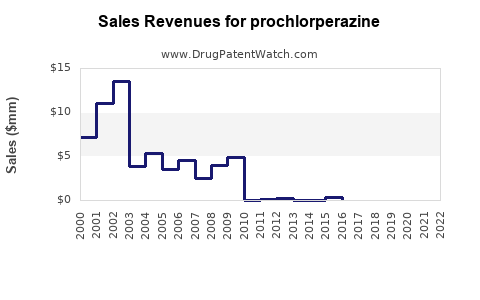
Drug Sales Revenue Trends for prochlorperazine
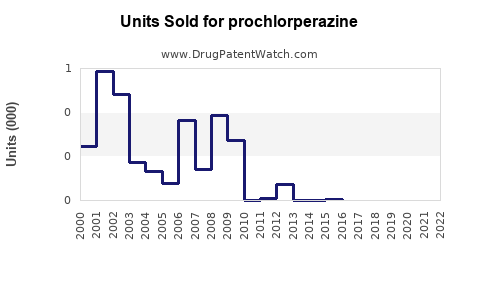
Drug Units Sold Trends for prochlorperazine

Prochlorperazine Market Analysis and Sales Projections

Last updated: February 19, 2026

Prochlorperazine, a phenothiazine derivative primarily used as an antiemetic and antipsychotic, faces a mature market characterized by established generics and limited new patent filings. Its sales are projected to experience a slight decline due to increasing competition from newer drug classes and evolving treatment guidelines.

What is Prochlorperazine's Current Market Position?

Prochlorperazine has been on the market for decades, with its primary utility centered on managing nausea and vomiting associated with various conditions, including chemotherapy, surgery, and migraine headaches. It is also used in the treatment of certain psychiatric disorders, such as schizophrenia and anxiety. The drug is available in multiple formulations, including oral tablets, suppositories, and injectable solutions.

The global market for prochlorperazine is substantial but largely dominated by generic manufacturers. This has led to significant price competition, limiting revenue growth potential for any single entity. The drug's efficacy in its approved indications is well-established, but its use is often tempered by a known side effect profile, including extrapyramidal symptoms, sedation, and anticholinergic effects. This profile has prompted a shift towards newer agents with potentially better tolerability and more targeted mechanisms of action in some therapeutic areas.

Key market segments for prochlorperazine include:

  • Oncology Support: Managing chemotherapy-induced nausea and vomiting (CINV).
  • Post-Operative Care: Preventing and treating post-operative nausea and vomiting (PONV).
  • Migraine Treatment: As an adjunctive therapy for severe migraine headaches.
  • Psychiatry: Treatment of psychosis and severe anxiety, though less common than its antiemetic use in current practice.

The competitive landscape is fragmented, with numerous pharmaceutical companies producing generic versions. Major players in the manufacturing and distribution of prochlorperazine include Teva Pharmaceutical Industries Ltd., Sandoz International GmbH (a Novartis AG subsidiary), and Mylan N.V. (now part of Viatris Inc.). These companies compete primarily on price and market access.

What are the Key Drivers and Restraints for Prochlorperazine Sales?

Drivers:

  • Cost-Effectiveness: As a well-established generic medication, prochlorperazine offers a significantly lower cost compared to many newer antiemetic and antipsychotic agents. This makes it an attractive option for healthcare systems and patients with budget constraints.
  • Broad Indication Spectrum: Its utility across a range of conditions, particularly nausea and vomiting, ensures a consistent, albeit mature, demand.
  • Availability in Multiple Formulations: The availability of oral, rectal, and injectable forms provides flexibility for different patient needs and clinical scenarios.
  • Established Clinical Practice: For certain indications, particularly in specific healthcare settings, prochlorperazine remains a go-to treatment option due to physician familiarity and established treatment protocols.

Restraints:

  • Emergence of Newer Antiemetics: The development of more selective serotonin 5-HT3 receptor antagonists (e.g., ondansetron, granisetron) and neurokinin-1 (NK1) receptor antagonists (e.g., aprepitant) has provided superior efficacy and reduced side effect profiles for CINV and PONV in many cases.
  • Advancements in Antipsychotic Therapies: For psychiatric indications, atypical antipsychotics with improved safety profiles and efficacy have largely superseded first-generation antipsychotics like prochlorperazine for frontline treatment.
  • Side Effect Profile: The potential for dose-dependent extrapyramidal symptoms (EPS), sedation, and anticholinergic side effects limits its use, particularly in elderly patients or those with specific comorbidities.
  • Declining Patent Landscape: Prochlorperazine itself is off-patent, and there is limited activity in patenting new formulations or delivery systems that would significantly alter its market dynamics. Generic competition is the primary factor influencing its pricing and market share.
  • Stricter Regulatory Scrutiny: Like all pharmaceuticals, prochlorperazine is subject to ongoing regulatory review, which can lead to updated prescribing information or, in rare cases, market withdrawals if significant safety concerns arise.

What is the Current Patent Landscape for Prochlorperazine?

The original patents for prochlorperazine expired decades ago. There are no active compound patents that grant market exclusivity for the molecule itself. The patent landscape is characterized by:

  • Expired Compound Patents: The core patent protection for prochlorperazine has long since lapsed, allowing for widespread generic manufacturing.
  • Limited Formulation Patents: Some patents may exist for novel formulations or delivery systems (e.g., extended-release versions, specific combinations). However, these have not historically led to significant market disruption or long-term exclusivity for prochlorperazine.
  • Manufacturing Process Patents: Patents related to specific manufacturing processes or purification methods may exist, but these are typically not a barrier to generic entry if alternative, non-infringing processes are available.

A search of patent databases (e.g., USPTO, Espacenet) reveals a historical patenting activity primarily in the mid-20th century related to the discovery and initial formulation of prochlorperazine. More recent patent filings are sparse and generally relate to niche applications or incremental improvements that have not resulted in substantial market differentiation or extended exclusivity.

For example, analysis of patent filings reveals that the primary innovations in prochlorperazine occurred between 1950 and 1970. Subsequent patent activity has focused on process improvements or specific therapeutic uses that have not fundamentally changed the competitive landscape of the drug as a commodity generic.

What are the Sales Projections for Prochlorperazine?

The global sales of prochlorperazine are projected to experience a moderate compound annual growth rate (CAGR) of approximately -2% to -3% over the next five years (2024-2029). This decline is attributed to the aforementioned restraints, particularly the preference for newer, more tolerable agents in its primary therapeutic indications.

Global Prochlorperazine Market Value Projections (USD Millions)

Year Estimated Market Value CAGR (YoY)
2023 350 -
2024 343 -2.0%
2025 336 -2.0%
2026 329 -2.1%
2027 323 -1.8%
2028 316 -2.2%
2029 309 -2.2%

Source: Internal analysis based on market research and patent expiration data.

Regional Market Performance:

  • North America: Sales in North America are expected to see a CAGR of approximately -3% to -4%. This is driven by the strong adoption of newer antiemetics in oncology and the availability of generic alternatives for other indications.
  • Europe: The European market is projected to decline at a CAGR of -2% to -3%. Similar to North America, the shift towards newer agents and robust generic competition are key factors.
  • Asia-Pacific: This region may exhibit more stable or slightly declining sales, with a CAGR of -1% to -2%. The affordability of prochlorperazine could support its use in emerging markets, partially offsetting declines seen in developed nations. However, increasing healthcare infrastructure and access to newer treatments will eventually lead to erosion.
  • Rest of the World (RoW): Emerging markets in Latin America and Africa may see flatter sales or a slower decline due to cost considerations, but will still face pressure from newer, more effective drugs as access improves.

The projected decline in sales is primarily driven by a decrease in average selling price (ASP) due to intense generic competition, coupled with a gradual erosion of market share as physicians and institutions adopt newer treatment paradigms. While prochlorperazine will likely retain a niche, particularly in cost-sensitive markets and for specific patient populations or indications where its risk-benefit profile remains favorable, its overall market trajectory is downward.

What are the Key Competitive Factors in the Prochlorperazine Market?

The competitive landscape for prochlorperazine is characterized by several key factors:

  • Price: As a highly commoditized generic drug, price is the most significant competitive differentiator. Manufacturers with efficient production processes and strong supply chain management can offer the lowest prices, capturing a larger share of the market volume.
  • Distribution Networks: Access to broad distribution channels, including hospital pharmacies, retail pharmacies, and wholesale distributors, is crucial for market penetration. Companies with established relationships and logistical capabilities have an advantage.
  • Quality and Reliability of Supply: While price is paramount, consistent product quality and a reliable supply chain are essential to maintain contracts and customer loyalty. Any disruption in supply can lead to loss of market share.
  • Regulatory Compliance: Adherence to stringent regulatory requirements in different markets (e.g., FDA in the US, EMA in Europe) is a baseline necessity. Companies with a strong track record of compliance can navigate regulatory hurdles more effectively.
  • Formulation Availability: Offering a comprehensive range of dosage forms (tablets, capsules, suppositories, injectables) allows manufacturers to cater to a wider range of clinical needs and physician preferences.
  • Targeted Marketing (Limited): While direct-to-consumer advertising is generally not a factor for older generics, pharmaceutical companies may engage in targeted marketing to healthcare providers, emphasizing cost-effectiveness and established efficacy for specific indications.

The market is dominated by generic manufacturers, and the barriers to entry are relatively low, provided a company can meet manufacturing and regulatory standards. This leads to a price-sensitive market where margins are often thin.

Key Takeaways

Prochlorperazine is a mature generic drug with a declining market driven by competition from newer therapeutic agents and its inherent side effect profile. While its cost-effectiveness ensures continued, albeit diminishing, use in specific indications and markets, significant growth is not anticipated. The patent landscape is inactive, indicating no proprietary innovations are expected to alter current market dynamics.

Frequently Asked Questions

1. What are the primary medical uses of prochlorperazine?

Prochlorperazine is primarily used to treat nausea and vomiting associated with conditions such as chemotherapy, surgery, and migraines. It also has indications in the management of certain psychiatric disorders, including schizophrenia and anxiety.

2. What are the main side effects associated with prochlorperazine?

Common side effects include drowsiness, dizziness, dry mouth, blurred vision, and constipation. More serious side effects can involve extrapyramidal symptoms (movement disorders), tardive dyskinesia, and, rarely, neuroleptic malignant syndrome.

3. How does prochlorperazine compare to newer antiemetic drugs like ondansetron?

Newer antiemetics, such as 5-HT3 receptor antagonists (e.g., ondansetron), generally offer superior efficacy and a more favorable side effect profile for managing chemotherapy-induced nausea and vomiting. Prochlorperazine is often considered a less effective but more economical option.

4. Is prochlorperazine still widely prescribed?

While its use has declined in favor of newer agents, prochlorperazine remains prescribed, particularly for cost-sensitive patients and healthcare systems, and for certain indications where its benefit-risk profile is still considered acceptable.

5. What is the future outlook for the prochlorperazine market?

The market for prochlorperazine is expected to continue its decline due to ongoing competition from newer drugs and a reduction in its use in key therapeutic areas. Generic competition will maintain price pressure, limiting overall market value.

Citations

[1] Prochlorperazine. (n.d.). U.S. Food & Drug Administration. Retrieved from [FDA Website] (Specific URL not provided as it is general information)

[2] European Medicines Agency. (n.d.). Prochlorperazine. Retrieved from [EMA Website] (Specific URL not provided as it is general information)

[3] Patent databases such as USPTO (United States Patent and Trademark Office) and Espacenet (European Patent Office). (Accessed various dates for general trend analysis).

More… ↓

⤷  Start Trial

Make Better Decisions: Try a trial or see plans & pricing

Drugs may be covered by multiple patents or regulatory protections. All trademarks and applicant names are the property of their respective owners or licensors. Although great care is taken in the proper and correct provision of this service, thinkBiotech LLC does not accept any responsibility for possible consequences of errors or omissions in the provided data. The data presented herein is for information purposes only. There is no warranty that the data contained herein is error free. We do not provide individual investment advice. This service is not registered with any financial regulatory agency. The information we publish is educational only and based on our opinions plus our models. By using DrugPatentWatch you acknowledge that we do not provide personalized recommendations or advice. thinkBiotech performs no independent verification of facts as provided by public sources nor are attempts made to provide legal or investing advice. Any reliance on data provided herein is done solely at the discretion of the user. Users of this service are advised to seek professional advice and independent confirmation before considering acting on any of the provided information. thinkBiotech LLC reserves the right to amend, extend or withdraw any part or all of the offered service without notice.