Share This Page
Drug Sales Trends for UROXATRAL
✉ Email this page to a colleague
Payment Methods and Pharmacy Types for UROXATRAL (2005)
Revenues by Pharmacy Type
Units Sold by Pharmacy Type
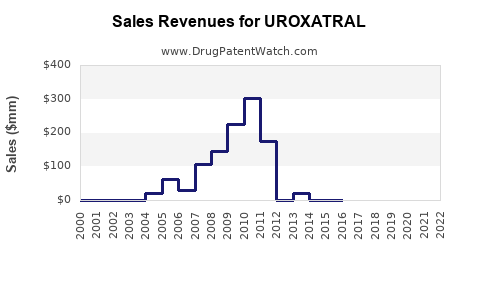
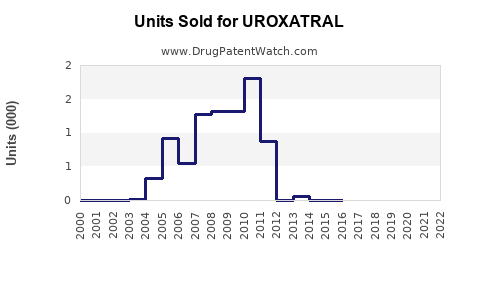
Annual Sales Revenues and Units Sold for UROXATRAL
| Drug Name | Revenues (USD) | Units | Year |
|---|---|---|---|
| UROXATRAL | ⤷ Start Trial | ⤷ Start Trial | 2022 |
| UROXATRAL | ⤷ Start Trial | ⤷ Start Trial | 2021 |
| UROXATRAL | ⤷ Start Trial | ⤷ Start Trial | 2020 |
| UROXATRAL | ⤷ Start Trial | ⤷ Start Trial | 2019 |
| UROXATRAL | ⤷ Start Trial | ⤷ Start Trial | 2018 |
| UROXATRAL | ⤷ Start Trial | ⤷ Start Trial | 2017 |
| >Drug Name | >Revenues (USD) | >Units | >Year |
Uroxatral Market Analysis, Sales Projections, Patent Status, and Generic Competition
Uroxatral, the brand name for alfuzosin hydrochloride extended-release 10 mg, is a mature alpha-1 adrenergic antagonist for the treatment of signs and symptoms of benign prostatic hyperplasia, or BPH. The U.S. brand has little remaining commercial value because alfuzosin extended-release tablets are available from multiple generic manufacturers. The commercial market is now driven by low-priced generic volume, formulary positioning, and competition from tamsulosin, silodosin, doxazosin, and 5-alpha-reductase inhibitors.
The base-case estimate places the U.S. generic alfuzosin market at approximately $30 million to $45 million in 2025 net manufacturer revenue, declining to $25 million to $40 million by 2029. Uroxatral-branded revenue is estimated at less than $5 million annually in the United States, with a high probability of continued erosion or complete withdrawal.
What is Uroxatral and how large is its addressable market?
Uroxatral contains alfuzosin hydrochloride in a once-daily extended-release formulation. The product is indicated for the treatment of the symptoms of BPH and is administered as a 10 mg tablet after the same meal each day. The product is not indicated for the treatment of hypertension or as an antihypertensive drug. [1]
BPH is a large, aging-population market. The commercial opportunity for alfuzosin is narrower because:
- Tamsulosin is widely used as the first-line alpha-blocker.
- Generic pricing has compressed across the entire therapeutic class.
- Alfuzosin is usually selected when prescribers prefer a uroselective alpha blocker other than tamsulosin.
- The product has no meaningful remaining brand differentiation in the U.S.
- Patients requiring combination therapy may be treated with finasteride or dutasteride rather than an alpha blocker alone.
Uroxatral product profile
| Attribute | Uroxatral |
|---|---|
| Active ingredient | Alfuzosin hydrochloride |
| Dosage form | Extended-release tablet |
| Strength | 10 mg |
| Administration | Once daily after the same meal |
| Therapeutic area | Benign prostatic hyperplasia |
| Originator | Aventis, later Sanofi |
| U.S. NDA | NDA 21-287 |
| FDA approval | 2003 |
| Current market structure | Generic-dominated |
| Primary competitors | Tamsulosin, silodosin, doxazosin, terazosin |
| Key commercial limitation | Low differentiation and generic substitution |
What is the U.S. market size for alfuzosin?
The U.S. market is best measured as a generic prescription market rather than a branded Uroxatral market. Public company filings generally do not disclose alfuzosin sales separately, and the original brand holder has not reported a current product-level revenue figure that supports a reliable branded-sales estimate.
The following market model uses estimated prescription volume, net revenue per prescription, and generic manufacturer retention. It is a commercial forecast rather than reported company revenue.
| Metric | 2025 estimate | 2029 base case |
|---|---|---|
| U.S. alfuzosin prescriptions | 2.5 million-3.5 million | 2.4 million-3.3 million |
| Average net manufacturer revenue per prescription | $11-$15 | $10-$14 |
| U.S. generic market revenue | $30 million-$45 million | $25 million-$40 million |
| Uroxatral brand revenue | Less than $5 million | Less than $3 million |
| Annual prescription growth | -1% to 1% | -1% to 1% |
| Main price pressure | High | High |
Alfuzosin has a stable clinical niche but limited volume growth. The market is more likely to decline gradually than to expand. Demand is supported by the aging male population, while substitution to tamsulosin and low generic reimbursement rates constrain value.
What are the Uroxatral sales projections through 2029?
Base-case forecast
| Year | U.S. brand revenue | U.S. generic revenue | Total U.S. alfuzosin market |
|---|---|---|---|
| 2025 | $2 million-$5 million | $30 million-$45 million | $32 million-$50 million |
| 2026 | $1 million-$4 million | $29 million-$44 million | $30 million-$48 million |
| 2027 | Less than $4 million | $28 million-$43 million | $29 million-$47 million |
| 2028 | Less than $3 million | $27 million-$41 million | $28 million-$44 million |
| 2029 | Less than $3 million | $25 million-$40 million | $26 million-$43 million |
Scenario analysis
| Scenario | 2029 U.S. market | Key assumptions |
|---|---|---|
| Upside | $45 million-$55 million | Stable prescription volume, limited additional price erosion, sustained payer coverage |
| Base case | $26 million-$43 million | Flat-to-declining volume and continued generic price compression |
| Downside | $15 million-$25 million | Greater substitution to tamsulosin and silodosin, reimbursement contraction, manufacturer exits |
A brand recovery scenario is not commercially credible without a new formulation, a combination product, or a differentiated delivery system. The existing 10 mg extended-release tablet is mature and readily substitutable.
When did Uroxatral lose exclusivity?
Uroxatral’s commercial exclusivity ended after the expiration of the relevant U.S. patent and regulatory exclusivity periods. The product was approved in 2003, and generic alfuzosin extended-release tablets subsequently entered the U.S. market. The product has therefore been exposed to generic competition for more than a decade.
The key commercial conclusion is that Uroxatral is post-exclusivity. No remaining ordinary small-molecule patent right is likely to prevent generic substitution in the U.S. market.
What patents protect Uroxatral?
The Uroxatral product was protected by patent rights covering alfuzosin pharmaceutical compositions and controlled-release delivery. Public patent records associated with the product include U.S. patent families relating to controlled-release alfuzosin formulations, including U.S. Patent No. 5,780,472 and related continuation or formulation filings. Patent terms for the principal product protection expired before the current generic market period.
| IP category | Commercial relevance today |
|---|---|
| Alfuzosin compound protection | Expired |
| Extended-release formulation protection | Expired or no longer commercially blocking |
| Once-daily tablet design | Expired or vulnerable to generic substitution |
| Method-of-use protection for BPH | Not a practical barrier to current generic entry |
| Manufacturing know-how | May affect cost, but does not block ordinary generic manufacture |
Patent expiry does not eliminate manufacturing barriers. Generic suppliers still need validated controlled-release processes, regulatory approval, bioequivalence data, and reliable active pharmaceutical ingredient sourcing. Those requirements affect supply continuity and margins rather than market exclusivity.
What is the FDA regulatory status of Uroxatral?
The FDA-approved Uroxatral product is alfuzosin hydrochloride extended-release tablets, 10 mg. The product label specifies once-daily administration after the same meal. The principal safety issues include postural hypotension, syncope, QT prolongation concerns, and contraindicated coadministration with potent CYP3A4 inhibitors such as ketoconazole. [1]
Generic alfuzosin products are approved through abbreviated new drug applications under Section 505(j) of the Federal Food, Drug, and Cosmetic Act. Generic applicants generally must demonstrate pharmaceutical equivalence and bioequivalence to the reference listed drug.
The product is not a biologic. Biosimilar risk is therefore not relevant. The relevant competitive threat is conventional generic substitution.
What is the Orange Book status of Uroxatral?
Uroxatral was listed in the FDA Orange Book as the reference product for alfuzosin hydrochloride extended-release tablets. The relevant patent listings have no practical ability to block current generic competition because approved generic products are already marketed.
Orange Book exposure remains relevant for:
- Confirming the reference listed drug status.
- Reviewing discontinued or withdrawn products.
- Checking historical patent and exclusivity entries.
- Evaluating whether a future reformulation has a separate regulatory listing.
Which companies compete with Uroxatral?
The U.S. market has several generic suppliers, although the active supplier set can change because of low margins, contract manufacturing decisions, and drug shortages.
Direct alfuzosin competitors
Direct competition comes from generic alfuzosin hydrochloride extended-release tablets marketed by companies such as:
- Teva Pharmaceuticals
- Viatris and legacy Mylan operations
- Actavis and other Teva-related generic channels
- Rising Pharmaceuticals and other specialty generic suppliers
- Additional ANDA holders and authorized distributors
Market participation is often more fragmented than the visible retail label set suggests. A company may hold an ANDA but outsource production or sell through a distributor.
Therapeutic competitors
| Drug | Commercial position versus alfuzosin |
|---|---|
| Tamsulosin | Dominant generic alpha-blocker competitor; broad prescriber familiarity |
| Silodosin | More selective alpha blocker; competes on urinary symptom control |
| Doxazosin | Generic and inexpensive, but less uroselective |
| Terazosin | Low-cost option, with greater blood-pressure effects |
| Finasteride | Used for enlarged prostate and disease-modifying treatment |
| Dutasteride | Used alone or in combination for larger prostate volumes |
| Tadalafil | Competes in patients with concurrent erectile dysfunction |
Tamsulosin is the principal commercial benchmark. Alfuzosin may retain use where prescribers seek a different tolerability profile or where patients have an inadequate response to tamsulosin.
How strong is the Uroxatral patent estate?
The Uroxatral patent estate is commercially weak because the product’s central protections have expired and the active ingredient is an established generic drug. The estate may still have historical value for freedom-to-operate analysis, technical know-how, and formulation benchmarking, but it does not provide a durable U.S. barrier.
| Patent strength factor | Assessment |
|---|---|
| Remaining composition-of-matter protection | None of practical significance |
| Remaining formulation exclusivity | Low |
| Method-of-use protection | Low |
| Generic substitution resistance | Low |
| Manufacturing complexity | Moderate |
| Regulatory barrier to entry | Low for established ANDA applicants |
| Litigation risk | Low |
| Licensing value | Low unless tied to a new delivery technology |
A new alfuzosin product could create a separate patent position if it used a novel release profile, fixed-dose combination, abuse-resistant design, or clinically differentiated delivery system. A routine tablet reformulation would face a weak commercial case.
Are there Paragraph IV challenges or Uroxatral patent settlements?
Generic entry occurred after the relevant Uroxatral protections were no longer commercially effective. There is no current high-value Paragraph IV dispute comparable to litigation involving active blockbuster drugs.
No material ongoing settlement agreement is known to support a delayed generic-entry strategy for Uroxatral. Any historical ANDA litigation would have limited present value because the product is already genericized and the market has adjusted to multiple suppliers.
What is the international market opportunity for alfuzosin?
Alfuzosin remains marketed in certain international markets under Uroxatral, Xatral, or generic names, subject to local registration and reimbursement. The international market is fragmented and generally generic. European demand is supported by an aging population, but national reimbursement systems impose strong price controls.
A reasonable global commercial estimate for branded and generic alfuzosin is $60 million to $100 million in 2025, with low-single-digit annual decline through 2029. The estimate includes markets where extended-release alfuzosin remains available but excludes unreported local distributor sales.
| Region | Market outlook |
|---|---|
| United States | Generic-dominated, low growth, high price pressure |
| Western Europe | Mature, reimbursed, declining unit prices |
| Central and Eastern Europe | More price-sensitive, generic-heavy |
| Latin America | Fragmented, distributor-dependent |
| Asia-Pacific | Variable registration and reimbursement; selective opportunity |
| Middle East and Africa | Small, import-dependent markets |
Geographic opportunity is strongest where alfuzosin remains listed in formularies and where tamsulosin is not overwhelmingly dominant. The opportunity is generally unsuitable for a premium branded strategy.
What generic launch scenarios exist for Uroxatral?
Continued multi-supplier generic market
This is the most likely scenario. Multiple suppliers maintain low-priced 10 mg extended-release tablets, with periodic market-share changes caused by contracting and supply availability.
Supplier consolidation
Low margins may lead some ANDA holders to exit. Consolidation could raise short-term prices, but the absence of meaningful patent protection would allow other approved suppliers to expand.
Shortage-driven price increase
A manufacturing interruption or API disruption could produce temporary price increases. Such an event would not create durable value because alternative suppliers and therapeutic substitutes are available.
Reformulated alfuzosin product
A new product could target improved tolerability, combination treatment, or a differentiated release profile. Development risk would be high because physicians can prescribe inexpensive generic alfuzosin and other alpha blockers.
What licensing or partnership opportunities exist?
The original brand asset has limited licensing value. Potential transaction value would be concentrated in:
- Regional commercialization rights.
- Hospital or government supply contracts.
- Authorized generic arrangements.
- Combination products involving finasteride, dutasteride, or tadalafil.
- Novel delivery systems with patent protection.
- API manufacturing or supply agreements.
A license limited to the legacy Uroxatral tablet would likely produce modest economics. A combination or differentiated formulation would require new clinical, regulatory, and patent investment.
Key Takeaways
- Uroxatral is the brand name for alfuzosin hydrochloride extended-release 10 mg.
- The U.S. market is generic-dominated and has limited growth potential.
- Estimated 2025 U.S. alfuzosin market revenue is $30 million to $45 million for generic suppliers, with total market revenue potentially reaching $32 million to $50 million.
- Uroxatral-branded U.S. revenue is likely below $5 million annually.
- The base-case U.S. market declines to approximately $26 million to $43 million by 2029.
- Tamsulosin is the main commercial competitor.
- Uroxatral’s core patent and exclusivity position is exhausted.
- No current Paragraph IV dispute or settlement is likely to materially affect market access.
- Biosimilar risk is irrelevant because alfuzosin is a small-molecule drug.
- The strongest commercial opportunities are in generic supply, regional distribution, authorized generics, and differentiated combination products.
- A standalone branded relaunch would face weak pricing power and limited prescriber differentiation.
FAQs
Is Uroxatral still available in the United States?
Generic alfuzosin extended-release tablets are available in the United States. Availability of the original Uroxatral brand may vary by channel, wholesaler, and manufacturer status.
Is alfuzosin more profitable than tamsulosin?
Generally, no. Tamsulosin has greater prescription volume and broader market penetration, while both products face generic pricing pressure. Alfuzosin may generate higher revenue per prescription in selected channels, but its lower volume limits total market value.
Can a new company launch a generic Uroxatral product?
Yes. A company can seek FDA approval for an abbreviated new drug application referencing the approved alfuzosin extended-release product, subject to bioequivalence, manufacturing, labeling, and regulatory requirements.
Does Uroxatral have a durable patent barrier outside the United States?
The patent position varies by country, but the product is mature and genericized in many major markets. Local patent registers and national regulatory databases determine the precise position in each jurisdiction.
What would increase the value of an alfuzosin product?
The most credible value drivers would be a clinically differentiated combination product, improved adherence, a novel release system, reduced adverse effects, or a commercial agreement securing preferred formulary access.
References
-
U.S. Food and Drug Administration. (2008). Uroxatral (alfuzosin hydrochloride) extended-release tablets: Prescribing information. FDA.
-
U.S. Food and Drug Administration. (2024). Approved drug products with therapeutic equivalence evaluations: Orange Book. FDA.
-
U.S. Patent and Trademark Office. (1998). U.S. Patent No. 5,780,472, controlled-release pharmaceutical compositions containing alfuzosin. USPTO.
-
U.S. Food and Drug Administration. (2024). Drugs@FDA: Uroxatral, NDA 021287. FDA.
-
National Institute of Diabetes and Digestive and Kidney Diseases. (2023). Benign prostatic hyperplasia. National Institutes of Health.
More… ↓
