Share This Page
Drug Sales Trends for TRI-LINYAH
✉ Email this page to a colleague
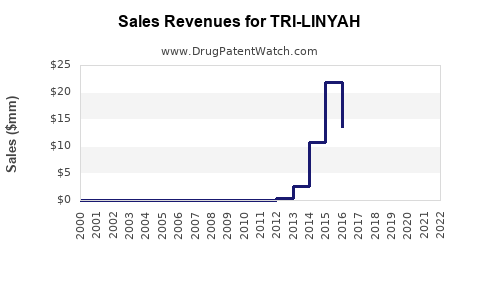
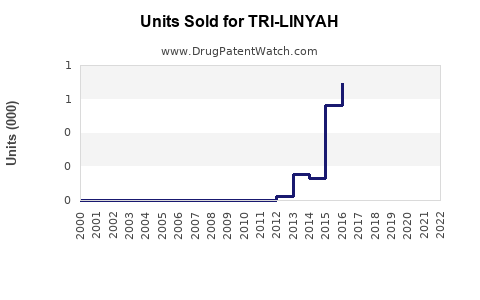
Annual Sales Revenues and Units Sold for TRI-LINYAH
| Drug Name | Revenues (USD) | Units | Year |
|---|---|---|---|
| TRI-LINYAH | ⤷ Start Trial | ⤷ Start Trial | 2022 |
| TRI-LINYAH | ⤷ Start Trial | ⤷ Start Trial | 2021 |
| TRI-LINYAH | ⤷ Start Trial | ⤷ Start Trial | 2020 |
| TRI-LINYAH | ⤷ Start Trial | ⤷ Start Trial | 2019 |
| TRI-LINYAH | ⤷ Start Trial | ⤷ Start Trial | 2018 |
| TRI-LINYAH | ⤷ Start Trial | ⤷ Start Trial | 2017 |
| TRI-LINYAH | ⤷ Start Trial | ⤷ Start Trial | 2016 |
| >Drug Name | >Revenues (USD) | >Units | >Year |
TRI-LINYAH Market Analysis and Sales Projections, 2025-2030
TRI-LINYAH is a generic triphasic oral contraceptive containing norgestimate and ethinyl estradiol. Its commercial market is mature, price-sensitive, and dominated by generic substitution. The product has limited standalone pricing power and no meaningful remaining innovator exclusivity. Revenue depends mainly on prescription volume, payer coverage, pharmacy substitution, distributor access, and the number of competing norgestimate/ethinyl estradiol suppliers.
Public sources do not disclose audited TRI-LINYAH product revenue. The projections below are modeled estimates for the U.S. retail market, based on generic oral-contraceptive pricing, prescription-volume assumptions, and likely market-share behavior.
What is TRI-LINYAH and how does it compete?
TRI-LINYAH is a 28-day oral contraceptive consisting of three norgestimate/ethinyl estradiol dose phases followed by inactive tablets. It is therapeutically comparable to Ortho Tri-Cyclen and other generic norgestimate/ethinyl estradiol products.
| Attribute | TRI-LINYAH |
|---|---|
| Active ingredients | Norgestimate and ethinyl estradiol |
| Dosage form | Oral tablet |
| Regimen | 28 tablets per cycle |
| Therapeutic category | Combined hormonal contraceptive |
| Reference product | Ortho Tri-Cyclen |
| FDA pathway | Abbreviated New Drug Application, or ANDA |
| Market status | Generic, prescription product |
| Primary channels | Retail pharmacy, mail order, managed care |
| Principal commercial constraint | Generic price competition |
| Main clinical alternatives | Monophasic oral contraceptives, progestin-only pills, intrauterine systems, implants, injectables, patches, and rings |
The product competes within a broad contraceptive market rather than only against other triphasic pills. Patients and prescribers may switch to lower-cost monophasic pills, long-acting reversible contraceptives, or products preferred by a payer formulary.
What is the FDA and Orange Book status of TRI-LINYAH?
TRI-LINYAH is marketed as a generic equivalent to a previously approved oral contraceptive. Generic approval requires demonstration of pharmaceutical equivalence and bioequivalence to the reference product under the FDA’s ANDA framework.[1]
The key regulatory characteristics are:
- No new-drug exclusivity comparable to an innovator product.
- No biologic or biosimilar pathway.
- No clinically meaningful biosimilar risk because TRI-LINYAH is a small-molecule drug.
- No expected pediatric exclusivity premium.
- Limited ability to obtain new product-level exclusivity absent a materially differentiated formulation or indication.
- Orange Book relevance is concentrated on the reference product and any listed patents, rather than on a generic manufacturer’s independent patent estate.[2]
Ortho Tri-Cyclen was approved well before the current commercial period for TRI-LINYAH. The relevant patents and regulatory exclusivities associated with the original innovator product have expired or no longer prevent generic competition. Current commercial risk is therefore market-based rather than patent-based.
When does TRI-LINYAH lose exclusivity?
TRI-LINYAH has no significant remaining exclusivity period that would protect it from generic competition. It entered a market in which the reference product had already faced generic substitution.
| Exclusivity category | TRI-LINYAH position |
|---|---|
| New chemical entity exclusivity | None |
| Five-year NCE exclusivity | None |
| Three-year clinical-investigation exclusivity | None publicly associated with the generic product |
| Orphan-drug exclusivity | None |
| Pediatric exclusivity | None identified |
| Patent-based generic protection | None of commercial significance |
| Biosimilar exclusivity | Not applicable |
The product’s economic life is determined by continued prescription demand and supply reliability. A manufacturer can lose share quickly if wholesalers or pharmacies substitute another equivalent product.
How large is the U.S. market for norgestimate and ethinyl estradiol?
The U.S. market for norgestimate/ethinyl estradiol includes several dosage presentations and brand or generic equivalents. The product class has long-established demand among patients using combined oral contraception, although utilization is affected by competition from long-acting methods and newer contraceptive products.
The market has four structural characteristics:
- Demand is recurring because users typically refill monthly.
- Generic substitution keeps average net prices low.
- Pharmacy benefit managers and Medicaid programs exert substantial pricing pressure.
- Volume is more stable than revenue because unit prices tend to decline.
The broader U.S. prescription contraceptive market is materially larger than the TRI-LINYAH segment. TRI-LINYAH is one product within a crowded oral-contraceptive category and should not be valued using total hormonal-contraceptive market revenue.
What are the main commercial drivers for TRI-LINYAH?
Prescription volume
A standard user consumes approximately 13 packs per year. A supplier with 100,000 annualized users would therefore supply roughly 1.3 million packs annually, subject to discontinuation, switching, samples, and channel inventory.
Net price
Generic oral contraceptives usually sell at a substantial discount to branded products. The manufacturer’s realized net price is lower than the pharmacy cash price because of wholesaler discounts, rebates, Medicaid adjustments, prompt-pay terms, returns, and other channel deductions.
Formulary access
Coverage status is more important than nominal list price. Preferred placement can shift prescriptions among therapeutically equivalent products. Medicaid managed-care plans and commercial pharmacy benefit managers may award volume to a limited number of suppliers.
Supply continuity
Oral contraceptives are vulnerable to pharmacy-level substitution when a supplier experiences manufacturing delays, packaging shortages, or wholesaler allocation. Reliable supply can increase share without requiring promotional spending.
Patient switching
Patients may switch from TRI-LINYAH to a monophasic contraceptive, progestin-only pill, implant, intrauterine system, or other delivery system because of tolerability, adherence, pregnancy planning, or payer requirements.
What sales projections are reasonable for TRI-LINYAH?
The following model estimates U.S. manufacturer net sales for TRI-LINYAH only. It assumes a mature generic product with no major regulatory disruption and no material supply outage.
| Scenario | 2025 sales | 2030 sales | 2025-2030 trend | Principal assumption |
|---|---|---|---|---|
| Downside | $3 million | $1.8 million | -11% CAGR | Share erosion and continued price compression |
| Base case | $6 million | $5 million | -4% CAGR | Stable prescriptions with modest net-price decline |
| Upside | $10 million | $11 million | 2% CAGR | Improved payer access, supply reliability, and share gains |
These figures are modeled estimates, not reported company revenue. A reasonable base-case planning range is $4 million to $8 million in annual U.S. net sales during 2025-2027, with gradual erosion thereafter.
Base-case operating assumptions
| Metric | 2025 estimate | 2030 estimate |
|---|---|---|
| Annual packs sold | 1.5 million | 1.6 million |
| Average net revenue per pack | $4.00 | $3.10 |
| Estimated net sales | $6.0 million | $5.0 million |
| Gross-to-net deduction | 25%-35% | 28%-38% |
| Prescription trend | Stable to slightly positive | Stable |
| Price trend | Declining | Declining |
The model assumes that volume remains relatively resilient while net price declines. That pattern is typical of mature oral generics, where prescription demand can persist even as reimbursement per pack falls.
How strong is the TRI-LINYAH patent estate?
The TRI-LINYAH patent estate is commercially weak because the product is an established generic oral contraceptive without a differentiated delivery system or novel active ingredient.
| Patent category | Commercial assessment |
|---|---|
| Active-ingredient patent | Not relevant; norgestimate and ethinyl estradiol are established compounds |
| Composition patent | No material product barrier identified |
| Formulation patent | No publicly prominent proprietary formulation barrier identified |
| Method-of-use patent | No meaningful exclusivity expected for standard contraception |
| Manufacturing patent | Could protect a specific process but would rarely block competing ANDA suppliers |
| Device or delivery patent | Not applicable to the tablet presentation |
| Orange Book blocking risk | Low |
Any process patent held by a manufacturer would generally protect a manufacturing route rather than the broader product market. Competitors could potentially use alternative processes, subject to regulatory filing requirements and patent clearance.
What formulation patents protect TRI-LINYAH?
TRI-LINYAH uses a conventional oral-tablet presentation. Its commercial value is not based on a novel extended-release system, transdermal delivery platform, implant, intrauterine device, or proprietary excipient technology.
Potential formulation-related rights could concern:
- Tablet composition.
- Stability under particular storage conditions.
- Manufacturing or coating processes.
- Packaging configuration.
- Dose uniformity or dissolution characteristics.
Those rights would have limited market impact unless they were listed in the Orange Book and successfully enforced against competing generic products. No broad formulation barrier is expected to prevent substitution among norgestimate/ethinyl estradiol tablets.
Which companies challenge TRI-LINYAH or compete with it?
The relevant competitors are manufacturers of generic norgestimate/ethinyl estradiol products and suppliers of alternative contraceptive technologies.
Direct generic competitors
Competition may include products sold under generic labels by manufacturers such as:
- Teva Pharmaceuticals.
- Glenmark Pharmaceuticals.
- Lupin Pharmaceuticals.
- Amneal Pharmaceuticals.
- Mayne Pharma.
- Other ANDA holders and contract manufacturers.
The exact competitive set can change by dosage strength, pack configuration, distributor contract, and FDA supply status.
Therapeutic alternatives
TRI-LINYAH also competes with:
- Monophasic norgestimate/ethinyl estradiol products.
- Levonorgestrel/ethinyl estradiol products.
- Drospirenone/ethinyl estradiol products.
- Progestin-only pills.
- Hormonal intrauterine systems.
- Etonogestrel implants.
- Transdermal patches.
- Vaginal rings.
- Depot medroxyprogesterone injections.
Long-acting contraceptives create the largest structural threat to the broader oral-pill category because they reduce monthly refill frequency and may improve adherence for some patients.
What generic entry risks exist for TRI-LINYAH?
TRI-LINYAH faces ordinary generic-market risks rather than a likely patent cliff.
High-probability risks
- Price erosion from additional ANDA suppliers.
- Formulary exclusion or nonpreferred placement.
- Retail substitution to another norgestimate/ethinyl estradiol supplier.
- Loss of wholesaler shelf space.
- Manufacturing or packaging interruption.
- Declining use of triphasic oral contraceptives.
- Conversion to long-acting or progestin-only methods.
Lower-probability risks
- Patent litigation affecting a specific manufacturing process.
- Recall or quality event.
- FDA warning or manufacturing-compliance action.
- Supply concentration among a small number of contract manufacturers.
Paragraph IV litigation is unlikely to be commercially central at this stage because TRI-LINYAH is already a generic product and the original reference-product exclusivities are mature. A Paragraph IV filing would be more relevant to a new entrant challenging a later-listed patent than to TRI-LINYAH’s current market position.
What licensing deals affect TRI-LINYAH?
No major publicly disclosed licensing transaction is required to explain TRI-LINYAH’s market position. The product is a conventional generic and may be supplied through manufacturer, distributor, contract-manufacturing, or private-label arrangements.
Potential commercial agreements can include:
- ANDA ownership and commercialization agreements.
- Contract manufacturing.
- Wholesaler distribution.
- Private-label pharmacy supply.
- State or managed-care purchasing contracts.
These agreements can affect reported revenue attribution. Product sales may appear under a parent company, subsidiary, distributor, or private-label customer rather than under the TRI-LINYAH brand name.
What is the revenue exposure and investment outlook?
TRI-LINYAH is unlikely to be a material revenue driver for a large pharmaceutical company. Its value is more consistent with a portfolio contribution from recurring generic volume than with a high-growth branded asset.
| Investment factor | Assessment |
|---|---|
| Demand stability | Moderate |
| Pricing power | Low |
| Patent protection | Low |
| Regulatory risk | Low to moderate |
| Manufacturing risk | Moderate |
| Competitive intensity | High |
| Revenue growth potential | Low |
| Cash-flow predictability | Moderate if supply is reliable |
| Strategic value | Portfolio breadth and recurring pharmacy demand |
The upside case depends on supply reliability, payer access, and share capture from disrupted competitors. The downside case reflects the more common trajectory: stable or slightly declining volume combined with lower reimbursement.
How does TRI-LINYAH compare with branded and long-acting contraceptives?
| Factor | TRI-LINYAH | Branded oral contraceptive | Long-acting contraceptive |
|---|---|---|---|
| Monthly refill | Yes | Yes | Usually no |
| Unit price | Low | Higher | High upfront or procedure-related cost |
| Patent protection | Limited or none | Potentially meaningful | Often stronger |
| Generic substitution | High | Varies | Lower |
| Manufacturer margin | Low to moderate | Higher | Moderate to high |
| Adherence dependence | High | High | Lower |
| Market growth | Mature | Product-specific | More favorable in several segments |
| Payer sensitivity | High | High | High |
TRI-LINYAH is commercially defensible through cost and availability, not differentiation. Its best market position is as a covered, consistently supplied generic option.
Key Takeaways
- TRI-LINYAH is a mature generic oral contraceptive containing norgestimate and ethinyl estradiol.
- It has no material remaining product exclusivity or patent barrier.
- Public sources do not disclose standalone TRI-LINYAH revenue.
- Estimated U.S. manufacturer net sales are approximately $4 million to $8 million annually in the base planning range.
- A base-case forecast is about $6 million in 2025 declining to roughly $5 million in 2030.
- Volume should be more stable than price because generic reimbursement is likely to decline.
- The largest risks are additional generic competition, formulary changes, supply interruptions, and migration to long-acting contraceptives.
- The product’s patent and litigation risk is low; its commercial risk is primarily pricing and distribution risk.
FAQs
Is TRI-LINYAH still available in the United States?
TRI-LINYAH is a U.S. prescription generic oral contraceptive product. Availability can vary by pharmacy, wholesaler inventory, manufacturer supply, and specific package configuration.
Is TRI-LINYAH the same as Ortho Tri-Cyclen?
TRI-LINYAH is a generic equivalent to the norgestimate/ethinyl estradiol triphasic formulation associated with Ortho Tri-Cyclen. Inactive ingredients, packaging, appearance, and labeling can differ.
Can TRI-LINYAH be substituted automatically at the pharmacy?
Pharmacy substitution generally depends on state law, the prescriber’s instructions, FDA therapeutic-equivalence standards, payer requirements, and the product dispensed by the pharmacy.
Does TRI-LINYAH have a biosimilar competitor?
No. TRI-LINYAH is a small-molecule tablet, not a biologic. Its competitors are generic oral contraceptives and alternative contraceptive products, not biosimilars.
What would increase TRI-LINYAH sales?
The strongest near-term growth drivers would be preferred formulary placement, reliable wholesaler supply, competitive net pricing, additional pharmacy contracts, and share gains during shortages affecting competing suppliers.
References
- U.S. Food and Drug Administration. (2023). Abbreviated new drug application (ANDA): Generics. https://www.fda.gov/drugs/types-applications/abbreviated-new-drug-application-anda
- U.S. Food and Drug Administration. (2024). Approved drug products with therapeutic equivalence evaluations: Orange Book. https://www.fda.gov/drugs/drug-approvals-and-databases/approved-drug-products-therapeutic-equivalence-evaluations-orange-book
- U.S. Food and Drug Administration. (2024). DailyMed: TRI-LINYAH, norgestimate and ethinyl estradiol tablets. National Library of Medicine. https://dailymed.nlm.nih.gov/
- Centers for Disease Control and Prevention. (2024). Contraception and birth control methods. https://www.cdc.gov/contraception/
- U.S. Food and Drug Administration. (2024). Generic drug facts. https://www.fda.gov/drugs/generic-drugs/generic-drug-facts
More… ↓
