Drug Sales Trends for SEROQUEL
Payment Methods and Pharmacy Types for SEROQUEL (2005)
Revenues by Pharmacy Type
Units Sold by Pharmacy Type
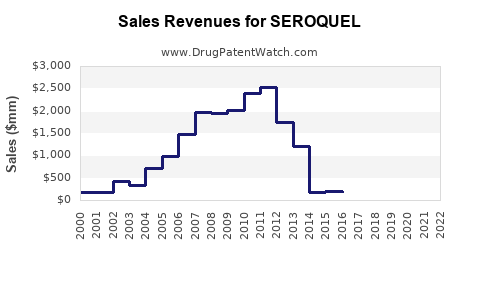
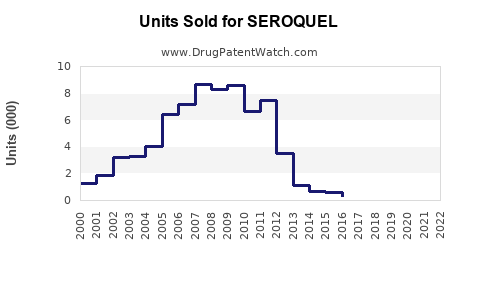
Annual Sales Revenues and Units Sold for SEROQUEL
| Drug Name | Revenues (USD) | Units | Year |
|---|---|---|---|
| SEROQUEL | ⤷ Start Trial | ⤷ Start Trial | 2022 |
| SEROQUEL | ⤷ Start Trial | ⤷ Start Trial | 2021 |
| SEROQUEL | ⤷ Start Trial | ⤷ Start Trial | 2020 |
| >Drug Name | >Revenues (USD) | >Units | >Year |
Seroquel Market Analysis, Sales Projections, Patent Expiration, and Generic Competition
Seroquel (quetiapine fumarate) is a mature antipsychotic franchise with minimal branded sales and a large generic market. AstraZeneca’s commercial exposure peaked before U.S. patent loss and then declined sharply as generic immediate-release and extended-release quetiapine entered the market. Future value is concentrated in generic volume, contract manufacturing, hospital and institutional supply, and off-patent product economics rather than in branded Seroquel revenue.
The base-case forecast projects a broadly stable global quetiapine market through 2030, with prescription volume offsetting continued price erosion. Branded Seroquel revenue should remain commercially immaterial in the United States.
What is Seroquel and how large is the quetiapine market?
Seroquel is the brand name for quetiapine fumarate, an atypical antipsychotic developed and commercialized by AstraZeneca. The drug is available in immediate-release tablets and extended-release tablets marketed as Seroquel XR.
The FDA-approved uses include:
- Schizophrenia
- Acute manic episodes associated with bipolar disorder
- Depressive episodes associated with bipolar disorder
- Maintenance treatment of bipolar disorder
- Adjunctive treatment of major depressive disorder for Seroquel XR
Quetiapine is also widely prescribed for uses not included in the FDA label, including insomnia and anxiety-related conditions. These uses create prescription volume but do not create additional branded intellectual-property protection.
Quetiapine product segments
| Segment | Commercial status | Main demand drivers |
|---|---|---|
| Seroquel immediate release | Mature branded product | Limited residual brand loyalty and institutional use |
| Seroquel XR | Mature branded extended-release product | Once-daily dosing and clinical familiarity |
| Generic quetiapine IR | Dominant U.S. volume source | Low price, broad pharmacy availability |
| Generic quetiapine XR | Dominant post-patent source | Substitution from branded XR |
| Hospital and institutional supply | Generic-heavy | Psychiatric facilities, hospitals and public-sector purchasing |
| International branded products | Mixed | Local reimbursement, trademarks and generic penetration |
The market is highly price-sensitive. Clinical demand is relatively resilient because schizophrenia and bipolar disorder require long-term treatment, but unit prices decline after multiple generic suppliers enter.
How much did Seroquel sales generate before generic entry?
Seroquel was one of AstraZeneca’s largest products before patent expiry. Global sales reached approximately $4.6 billion in 2011, according to AstraZeneca’s annual reporting. Sales declined rapidly after U.S. generic entry for immediate-release quetiapine.
| Year | Approximate global Seroquel sales | Market event |
|---|---|---|
| 2010 | $4.9 billion | Final period of large branded growth |
| 2011 | $4.6 billion | U.S. patent expiry approaching |
| 2012 | Approximately $3.0 billion | Generic immediate-release entry |
| 2013 | Approximately $1.6 billion | Broad generic substitution |
| 2014 onward | Continued decline | Mature generic market and loss of brand volume |
The exact annual figure varies depending on AstraZeneca’s reporting presentation and treatment of regional products. The direction is consistent: Seroquel revenue fell by more than half within roughly two years of U.S. generic competition.
Seroquel’s former revenue base should not be used as a proxy for the current quetiapine market. Generic sales are distributed among manufacturers and are reported differently from branded sales. Retail pharmacy prices also do not equal manufacturer net revenue.
When did Seroquel lose market exclusivity?
Seroquel lost practical U.S. exclusivity in stages.
Immediate-release quetiapine
The core U.S. composition patent for quetiapine was generally associated with U.S. Patent No. 4,879,288. The patent expired in 2012, subject to patent-term calculations and regulatory exclusivity considerations. Generic immediate-release quetiapine entered the U.S. market in 2012.
Extended-release quetiapine
Seroquel XR retained protection longer than the immediate-release product. Extended-release patents and related litigation delayed or shaped generic entry, but the product ultimately faced generic competition in the second half of the 2010s. By 2017, generic extended-release quetiapine had become a material competitive factor in the United States.
| Product | U.S. generic timing | Current commercial position |
|---|---|---|
| Seroquel IR | 2012 | Generic-dominated |
| Seroquel XR | Approximately 2016-2017 period | Generic-dominated |
| International Seroquel | Country-specific | Varies by local patent and regulatory rules |
Exact entry dates differed by dosage form, manufacturer, settlement terms and jurisdiction. FDA Orange Book records and individual ANDA approvals control product-specific timing.[1]
What patents protect Seroquel and quetiapine?
The key patent estate historically covered the active pharmaceutical ingredient, pharmaceutical compositions, dosage forms and extended-release delivery technology. The relevant commercial protection has largely expired.
| Patent category | Historical protection | Current impact |
|---|---|---|
| Quetiapine compound patent | Active ingredient | Expired in the United States |
| Immediate-release tablet claims | Dosage form and composition | No meaningful U.S. barrier to ordinary generic entry |
| Extended-release formulation claims | Controlled-release delivery | Historically delayed XR competition |
| Method-of-use claims | Schizophrenia, bipolar disorder and related uses | Limited ability to block broad generic sales |
| Manufacturing claims | Process and intermediates | May affect individual suppliers but do not protect the product market broadly |
The remaining risk is product-specific rather than franchise-wide. A manufacturer may hold process patents, formulation patents or regulatory exclusivities for a particular product, but those rights do not recreate Seroquel’s former market exclusivity.
What formulations are protected by Seroquel patents?
Seroquel XR used an extended-release formulation designed for once-daily administration. Historically, formulation and controlled-release patents were more commercially important than the basic active-ingredient patent after the immediate-release patent expired.
Generic XR products may enter through different regulatory and patent pathways, including Paragraph IV certifications, Paragraph III certifications, or launches after patent expiry. The commercial barrier is now limited because multiple generic alternatives have been approved.
What is the Orange Book status of Seroquel?
The FDA Orange Book lists approved drug products, therapeutic equivalence information and patent or exclusivity information supplied for listed products. Seroquel and Seroquel XR have been subject to Orange Book-listed patents, but the core protection underlying commercial exclusivity has expired.
The practical Orange Book conclusion is:
- Seroquel is not a protected U.S. new chemical entity.
- Immediate-release quetiapine is genericized.
- Extended-release quetiapine is also subject to generic competition.
- Orange Book listings may still matter for individual dosage forms or patent certifications.
- No current Orange Book listing restores the historical Seroquel franchise barrier.
FDA labeling remains relevant because generic products must demonstrate bioequivalence and conform to applicable labeling requirements. The agency’s approval of generic quetiapine does not permit manufacturers to promote unapproved off-label uses.[2]
Which companies challenged Seroquel patents?
Generic competition came from multiple manufacturers, including major U.S. generic companies and international suppliers. The competitive field has included companies such as Teva, Mylan/Viatris, Sandoz, Dr. Reddy’s Laboratories, Zydus, Lupin and other ANDA sponsors, depending on dosage strength and formulation.
Seroquel-related patent disputes historically focused on:
- Whether generic immediate-release products infringed valid claims
- Whether XR formulation claims were valid and enforceable
- The timing of generic entry
- Paragraph IV certifications
- Settlement terms governing launch dates
Public litigation records show that patent disputes influenced entry timing, especially for extended-release formulations. The present market is no longer defined by a single pending patent dispute. It is defined by the number of approved suppliers, procurement competition and reimbursement pressure.
How strong is the current Seroquel patent estate?
The patent estate is weak as a commercial exclusivity platform.
| Factor | Assessment | Commercial consequence |
|---|---|---|
| Core compound protection | Expired | No protection against ordinary generic quetiapine |
| IR formulation protection | Expired or no longer commercially decisive | Broad generic substitution |
| XR formulation protection | Historically meaningful, now largely exhausted | Generic XR competition |
| Method-of-use patents | Narrow and difficult to enforce against sale of tablets | Limited revenue protection |
| Manufacturing patents | Supplier-specific | May affect cost or supply, not market exclusivity |
| Regulatory exclusivity | Expired | No remaining new-product exclusivity |
The strongest remaining intellectual-property position may exist at the manufacturer level, where process know-how, supply contracts and regulatory history reduce competitive entry. These are operational advantages, not substitutes for an active product patent.
What is the competitive landscape for quetiapine?
Quetiapine competes within a broad atypical antipsychotic market that includes generic risperidone, olanzapine and aripiprazole, as well as branded or specialty products such as Vraylar, Caplyta and Latuda, depending on indication and geography.
Quetiapine compared with competing antipsychotics
| Drug | Patent position | Key commercial strength | Main competitive pressure |
|---|---|---|---|
| Quetiapine | Mature generic | Low cost and broad clinical familiarity | Price erosion and safety concerns |
| Aripiprazole | Generic IR; long-acting products have stronger differentiation | Broad use and depot formulations | Generic competition |
| Olanzapine | Generic | Established efficacy and low price | Metabolic adverse effects |
| Risperidone | Generic | Low cost and long-acting injectable versions | Mature market |
| Cariprazine | Branded in key markets | Bipolar and schizophrenia differentiation | Higher price and payer controls |
| Lumateperone | Branded | Newer mechanism and tolerability positioning | Limited payer access and price |
| Lurasidone | Generic in several markets | Bipolar depression positioning | Generic price pressure |
Quetiapine’s principal advantages are low acquisition cost, extensive physician familiarity and multiple dosage strengths. Its disadvantages include sedation, weight gain, metabolic effects and the presence of cheaper alternatives.
What are the sales projections for Seroquel and generic quetiapine?
Branded Seroquel sales should remain negligible in the United States. The economically relevant forecast is total quetiapine manufacturer revenue across branded and generic products.
The following base case is an analytical forecast, not a reported company guidance figure. It assumes stable treated prevalence, modest prescription growth, continued generic price erosion and no major safety-related withdrawal.
Global quetiapine market revenue forecast
| Year | Base-case revenue | Growth versus prior year | Primary driver |
|---|---|---|---|
| 2024 | $1.65 billion | Base year | Mature generic market |
| 2025 | $1.63 billion | -1.2% | Price erosion exceeds volume growth |
| 2026 | $1.62 billion | -0.6% | Stable chronic demand |
| 2027 | $1.61 billion | -0.6% | Additional tender and pharmacy pressure |
| 2028 | $1.60 billion | -0.6% | Volume offsets lower prices |
| 2029 | $1.60 billion | 0.0% | Market stabilization |
| 2030 | $1.61 billion | 0.6% | Emerging-market volume growth |
A reasonable scenario range for 2030 is approximately $1.3 billion to $2.0 billion.
| Scenario | 2030 revenue | Assumptions |
|---|---|---|
| Bear case | $1.3 billion | Faster generic price compression, substitution toward competing generics |
| Base case | $1.6 billion | Stable prevalence and low-single-digit volume growth |
| Bull case | $2.0 billion | Higher diagnosis and treatment rates in emerging markets, stable net pricing |
The forecast excludes revenue from competing antipsychotics and does not treat off-label use as an approved commercial indication.
What generic launch risks exist for quetiapine?
Generic launch risk is low for standard immediate-release quetiapine and moderate-to-low for extended-release products.
Immediate-release risk
Immediate-release quetiapine has a high substitution risk because:
- Core product patents have expired.
- Multiple suppliers are established.
- Pharmacies can substitute therapeutically equivalent products.
- Buyers use competitive tenders and formulary controls.
- The product has limited differentiation.
Extended-release risk
XR products retain somewhat greater operational complexity because of controlled-release formulation requirements. Risk remains manageable for established suppliers because:
- Generic XR products are already approved.
- Manufacturing scale is available.
- Brand loyalty is limited after years of generic exposure.
- Payers have incentives to prefer lower-cost alternatives.
Potential supply-chain barriers include active pharmaceutical ingredient qualification, dissolution-profile control, tablet manufacturing, stability requirements and regulatory variation across countries. These barriers can affect individual competitors without materially protecting the overall market.
What is the FDA regulatory status of Seroquel?
Seroquel is FDA approved, and generic quetiapine products are approved through the abbreviated new drug application pathway. Generic applicants must establish pharmaceutical equivalence and bioequivalence to the relevant reference-listed drug.
There is no biosimilar pathway for Seroquel because quetiapine is a small-molecule drug, not a biologic. Biosimilar risk is therefore irrelevant. The relevant competitive pathway is ANDA approval, not a 351(k) biologics application.
Pediatric exclusivity and original new chemical entity exclusivity have expired. Current regulatory risk centers on manufacturing compliance, labeling, pharmacovigilance and supply continuity.
What licensing deals affect Seroquel?
Seroquel was developed and commercialized primarily through AstraZeneca’s own pharmaceutical business rather than through a current high-value licensing structure. Generic quetiapine supply is more likely to involve manufacturing agreements, authorized-generic arrangements, regional distribution contracts and procurement relationships than headline licensing transactions.
The commercial value of a new Seroquel licensing deal is limited because:
- Core patents have expired.
- Generic competitors are established.
- Brand pricing power is weak.
- Clinical differentiation is limited.
- Regulatory exclusivity is absent.
A licensing transaction could still have value in a specific territory, manufacturing channel or hospital contract, but it would not resemble the economics of a protected innovative medicine.
What revenue exposure does Seroquel create for AstraZeneca?
Seroquel is no longer a major revenue driver for AstraZeneca. The company’s portfolio has shifted toward oncology, rare disease, respiratory products and newer specialty medicines. The loss of Seroquel revenue was strategically significant when it occurred, but current AstraZeneca earnings are not materially dependent on the product.
For investors, the relevant conclusion is that Seroquel is a historical patent-cliff case, not a current AstraZeneca growth asset. For generic manufacturers, the opportunity is a stable, low-margin volume market rather than a high-margin branded launch.
Key Takeaways
- Seroquel is the branded form of quetiapine fumarate.
- AstraZeneca’s global Seroquel sales peaked at roughly $4.6 billion in 2011.
- U.S. immediate-release generic entry began in 2012.
- Extended-release generic competition became established around the 2016-2017 period.
- The Orange Book no longer provides a commercially meaningful barrier to standard generic quetiapine.
- Branded Seroquel revenue should remain negligible in the United States.
- Generic quetiapine demand should remain stable because schizophrenia and bipolar disorder require chronic treatment.
- Base-case global quetiapine revenue is projected at approximately $1.6 billion in 2030.
- No biosimilar risk exists because quetiapine is a small-molecule drug.
- The strongest remaining competitive advantages are manufacturing reliability, procurement access, regulatory compliance and low cost.
FAQs About Seroquel Market Size and Patent Expiration
When did Seroquel become generic in the United States?
Immediate-release quetiapine became subject to U.S. generic competition in 2012. Extended-release competition followed later, with meaningful generic availability emerging around 2016-2017.
Is Seroquel still profitable for AstraZeneca?
Seroquel may generate residual branded and regional revenue, but it is no longer a material growth or earnings driver for AstraZeneca. Most commercial value now resides in generic quetiapine sales distributed across multiple manufacturers.
Can a generic company launch quetiapine XR without infringing Seroquel patents?
A company must address applicable Orange Book patents through the ANDA certification process and may need to wait for patent expiry, resolve litigation or rely on an authorized launch pathway. The broad XR market is already genericized.
Does quetiapine have biosimilar competition?
No. Quetiapine is a chemically synthesized small-molecule drug. Competition proceeds through generic-drug approvals, not biosimilar approvals.
What is the main long-term risk to quetiapine sales?
The main risk is cumulative price erosion from additional generic suppliers and substitution toward other low-cost antipsychotics. Prescription volume is more resilient than net revenue.
References
- U.S. Food and Drug Administration. (2024). Approved drug products with therapeutic equivalence evaluations: The Orange Book. FDA.
- U.S. Food and Drug Administration. (2023). Seroquel and Seroquel XR prescribing information. FDA/DailyMed.
- AstraZeneca PLC. (2011). Annual report and form 20-F 2011. AstraZeneca.
- AstraZeneca PLC. (2012). Annual report and form 20-F 2012. AstraZeneca.
- AstraZeneca PLC. (2017). Annual report and form 20-F 2017. AstraZeneca.
- U.S. Food and Drug Administration. (2024). Drugs@FDA: FDA-approved drugs database. FDA.
More… ↓
