Share This Page
Drug Sales Trends for PENTASA
✉ Email this page to a colleague
Payment Methods and Pharmacy Types for PENTASA (2005)
Revenues by Pharmacy Type
Units Sold by Pharmacy Type
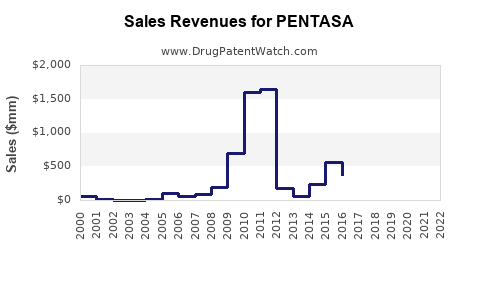
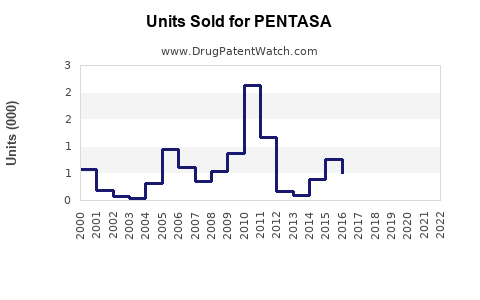
Annual Sales Revenues and Units Sold for PENTASA
| Drug Name | Revenues (USD) | Units | Year |
|---|---|---|---|
| PENTASA | ⤷ Start Trial | ⤷ Start Trial | 2022 |
| PENTASA | ⤷ Start Trial | ⤷ Start Trial | 2021 |
| PENTASA | ⤷ Start Trial | ⤷ Start Trial | 2020 |
| PENTASA | ⤷ Start Trial | ⤷ Start Trial | 2019 |
| >Drug Name | >Revenues (USD) | >Units | >Year |
Pentasa Market Analysis and Sales Projections: Mesalamine Demand, Competition, Patents, and Generic Risk
Pentasa is a mature mesalamine product with established demand in ulcerative colitis and limited differentiation versus lower-cost generic mesalamine products. Its commercial outlook depends on prescription retention, payer coverage, regional brand loyalty, and the availability of alternative mesalamine formulations. Pentasa has no meaningful biologic exclusivity risk, and its principal threat is generic and branded substitution rather than biosimilar competition.
Standalone Pentasa revenue is generally not disclosed by the product owner. The projections below are scenario-based estimates derived from market maturity, generic penetration, formulation positioning, and likely prescription trends.
What is Pentasa and how is it used?
Pentasa contains mesalamine, also known as 5-aminosalicylic acid or 5-ASA. It is an anti-inflammatory drug used primarily to induce remission in adults with mildly to moderately active ulcerative colitis.
In the United States, Pentasa is supplied as extended-release capsules in 250 mg and 500 mg strengths. The labeled dosing regimen is divided multiple times daily, which places the product at a formulation disadvantage compared with once-daily mesalamine products such as Lialda and Apriso.[1]
| Product | Active ingredient | Primary indication | Dosage form | Commercial positioning |
|---|---|---|---|---|
| Pentasa | Mesalamine | Mild-to-moderate ulcerative colitis | Extended-release capsules | Established branded 5-ASA |
| Lialda | Mesalamine | Ulcerative colitis | Delayed-release tablets | Once-daily branded product |
| Apriso | Mesalamine | Maintenance of remission in ulcerative colitis | Extended-release capsules | Once-daily maintenance product |
| Delzicol | Mesalamine | Ulcerative colitis | Delayed-release capsules | Capsule-based alternative |
| Asacol HD | Mesalamine | Ulcerative colitis | Delayed-release tablets | Legacy branded formulation |
| Generic mesalamine | Mesalamine | Ulcerative colitis | Multiple forms | Low-cost substitution |
Pentasa is not a biologic and does not require biosimilar analysis. Its market is exposed to generic substitution, therapeutic interchange, and newer inflammatory bowel disease therapies.
What is the FDA regulatory status of Pentasa?
Pentasa was approved by the U.S. Food and Drug Administration in 1993 under NDA 019839.[1] The product is approved for the treatment of mildly to moderately active ulcerative colitis in adults.
| Regulatory milestone | Status |
|---|---|
| FDA approval | 1993 |
| NDA | 019839 |
| Active ingredient | Mesalamine |
| Dosage strengths | 250 mg and 500 mg extended-release capsules |
| Current regulatory category | Approved prescription drug |
| New chemical entity exclusivity | Expired |
| Orphan-drug exclusivity | None identified |
| Current market exclusivity | None identified |
Pentasa’s long commercial history means FDA regulatory exclusivity no longer protects its sales. Competition is governed primarily by abbreviated new drug applications, state substitution laws, formulary decisions, physician prescribing, and product availability.
What is the Orange Book status of Pentasa?
Pentasa has no material remaining period of regulatory exclusivity. The Orange Book remains the relevant source for current patent and exclusivity listings, but the commercial protection associated with the original approval has expired.[2]
For a generic applicant, the principal regulatory pathway is an ANDA supported by a Paragraph III certification where listed patents have expired, or a Paragraph IV certification if an applicant identifies an allegedly invalid, unenforceable, or non-infringed listed patent.
Because Pentasa is an older product, any remaining U.S. patent value would be expected to come from later-issued formulation, manufacturing, or method-of-use patents rather than the original product approval. Those patents would need to be reviewed in the current Orange Book and related FDA patent-listing records before a definitive launch-risk conclusion is reached.
What patents protect Pentasa?
The original composition and approval rights for mesalamine are no longer commercially blocking. Pentasa’s remaining intellectual-property value is likely concentrated in formulation know-how, release characteristics, manufacturing controls, trademarks, and regional regulatory rights.
| IP category | Pentasa exposure | Commercial relevance |
|---|---|---|
| Mesalamine active ingredient | Expired or non-exclusive | Low |
| Original product approval | Expired exclusivity | Low |
| Extended-release formulation | Potentially relevant, subject to current listings | Moderate |
| Manufacturing process | Potentially protected as trade secret or process patent | Moderate |
| Method of treating ulcerative colitis | Generally weak after long market history | Low to moderate |
| Pentasa trademark | Potentially active by jurisdiction | Moderate for brand retention |
| Distribution and supply agreements | Potentially material | Moderate |
A formulation patent could delay a generic only if it is listed against the relevant NDA, remains enforceable, and covers the product’s release mechanism or other required product characteristics. A process patent generally has less power to prevent a therapeutically equivalent generic if the generic manufacturer uses a non-infringing process.
Pentasa’s most durable commercial assets are therefore its established brand, physician familiarity, supply reliability, and reimbursement access rather than a broad composition-of-matter patent estate.
When does Pentasa lose exclusivity?
Pentasa already lost its meaningful regulatory exclusivity. The initial approval date was more than three decades ago, and generic mesalamine products are commercially available in several dosage forms.
The practical exclusivity timeline is:
| Period | Event | Commercial effect |
|---|---|---|
| 1993 | FDA approval | Original branded launch |
| 1990s-2000s | Expansion of mesalamine competition | Increasing therapeutic substitution |
| 2010s | Growth of generic mesalamine products | Pricing pressure |
| Current market | Mature generic and branded competition | Brand retention depends on payer and prescriber preference |
Pentasa should be treated as a post-exclusivity product. Its revenue trajectory is more sensitive to prescription erosion and net price decline than to a single patent expiration event.
What generic entry risks exist for Pentasa?
Generic risk is high. Mesalamine is a well-established active ingredient with multiple approved dosage forms and extensive clinical use. The primary barriers are not discovery science or clinical uncertainty. They are bioequivalence, release-profile matching, manufacturing scale, regulatory compliance, and commercial distribution.
Generic entrants can compete through:
- Lower wholesale acquisition cost.
- Pharmacy substitution.
- Medicaid and commercial formulary preference.
- Hospital and integrated-delivery-network contracting.
- Authorized-generic or private-label channels.
- Product-specific availability and wholesaler discounts.
Pentasa may retain some patients because of physician familiarity or perceived tolerability, but its multiple-daily dosing and availability of alternative mesalamine products limit premium pricing power.
How strong is the Pentasa patent estate?
The patent estate is commercially weak relative to newer specialty drugs. Pentasa has an older active ingredient, no current composition-of-matter protection, and numerous competing mesalamine products.
A residual formulation patent could create a technical barrier, but it would not necessarily preserve brand revenue. Generic manufacturers may launch non-infringing formulations, and physicians can switch patients to other mesalamine products.
Overall assessment:
| Factor | Assessment |
|---|---|
| Composition-of-matter protection | Very weak |
| Formulation protection | Potentially moderate, but product-specific |
| Method-of-use protection | Weak |
| Manufacturing barriers | Moderate |
| Brand recognition | Moderate to strong |
| Switching costs | Low to moderate |
| Generic substitution risk | High |
| Litigation leverage | Low to moderate |
Which companies compete with Pentasa?
Pentasa competes in a crowded 5-ASA market and against advanced therapies for ulcerative colitis.
Direct mesalamine competitors
Direct competitors include manufacturers and marketers of Lialda, Apriso, Delzicol, Asacol HD, balsalazide, sulfasalazine, and generic mesalamine products. Product ownership and commercialization rights vary by jurisdiction and may change through licensing, acquisition, or distribution agreements.
Advanced ulcerative colitis therapies
Pentasa also competes indirectly with:
- Corticosteroids for induction.
- Immunomodulators such as azathioprine and 6-mercaptopurine.
- Anti-TNF biologics.
- Integrin inhibitors.
- Interleukin inhibitors.
- JAK inhibitors.
- S1P receptor modulators.
- Oral targeted therapies.
These products are generally used in moderate-to-severe disease or in patients who fail 5-ASA therapy. Their higher cost limits direct substitution in mild disease but can reduce long-term Pentasa use when patients escalate treatment.
What is the commercial outlook for Pentasa?
Pentasa’s market outlook is stable to declining in mature markets. Unit demand may remain resilient because ulcerative colitis is chronic and treatment is recurrent, but net sales are exposed to generic price erosion and payer pressure.
The main commercial drivers are:
- Prevalence of ulcerative colitis.
- Continued use of 5-ASA therapy in mild disease.
- Maintenance prescribing after induction.
- Brand preference among gastroenterologists.
- Formulary placement.
- Availability of lower-cost generic alternatives.
- Expansion of advanced therapies into earlier treatment lines.
Pentasa has defensive demand because it treats a chronic condition, but it lacks the pricing power associated with protected specialty medicines.
What are Pentasa sales projections through 2029?
Because Pentasa revenue is not consistently reported as a standalone line item, the following model uses an indexed global net-sales baseline of 100 for the latest normalized year. It assumes mature-market generic erosion, stable chronic disease prevalence, and modest growth in emerging markets.
| Scenario | 2025 | 2026 | 2027 | 2028 | 2029 | CAGR |
|---|---|---|---|---|---|---|
| Bear case | 92 | 83 | 74 | 66 | 59 | -10.2% |
| Base case | 96 | 92 | 88 | 84 | 80 | -4.3% |
| Bull case | 101 | 102 | 103 | 104 | 105 | 1.0% |
Base-case assumptions
The base case assumes:
- High generic substitution in the United States and Western Europe.
- Stable use of mesalamine in mild ulcerative colitis.
- Low-single-digit volume growth in selected emerging markets.
- Continued price reductions in payer-controlled channels.
- No major supply disruption.
- No material new patent exclusivity.
- Limited brand investment relative to newer inflammatory bowel disease products.
Under the base case, Pentasa sales decline approximately 4% annually through 2029. The decline is expected to come primarily from net price erosion and switching to generic or once-daily mesalamine formulations.
Revenue exposure
The revenue risk is asymmetric. A modest prescription decline can produce a larger net-sales decline if branded patients move to generic products or if rebates increase. Conversely, stable prescriptions may not prevent revenue contraction where payers enforce lower-cost substitution.
A simplified revenue bridge is:
| Driver | Expected direction through 2029 |
|---|---|
| Patient prevalence | Positive |
| New mild ulcerative colitis diagnoses | Positive |
| Chronic maintenance use | Positive |
| Generic substitution | Negative |
| Average selling price | Negative |
| Once-daily competing formulations | Negative |
| Advanced therapy escalation | Negative |
| Emerging-market access | Positive |
| Brand loyalty | Moderately positive |
What manufacturing and supply-chain barriers affect Pentasa?
Manufacturing is less technically complex than for biologic drugs, but modified-release mesalamine products require reliable control of dissolution, particle properties, capsule filling, coating, stability, and batch consistency.
Potential manufacturing barriers include:
- Matching the product’s release profile.
- Maintaining content uniformity.
- Controlling mesalamine degradation.
- Meeting dissolution specifications across shelf life.
- Securing pharmaceutical-grade mesalamine API.
- Maintaining supply at multiple dosage strengths.
- Avoiding manufacturing observations or recalls.
These barriers can support brand retention when generic supply is intermittent. They do not create durable exclusivity if multiple manufacturers can meet the FDA’s quality and bioequivalence standards.
What litigation and Paragraph IV challenges affect Pentasa?
Pentasa’s most significant patent-litigation risk occurred earlier in its commercial life, when generic manufacturers could challenge formulation or release patents. The current business risk is more likely to arise from ordinary generic competition, product-quality disputes, manufacturing litigation, trademark issues, or contractual disagreements than from a major late-life Orange Book patent case.
No current blockbuster-scale Paragraph IV litigation outcome is central to Pentasa’s forward sales outlook. Any new ANDA litigation would need to be assessed against the specific patents listed for NDA 019839 at the time of filing.
Settlement agreements, if any, would have greater relevance to historical launch timing than to the 2025-2029 revenue forecast.
What licensing deals and ownership issues affect Pentasa?
Pentasa has been associated with Ferring Pharmaceuticals in key markets, while commercialization and ownership arrangements for mesalamine products have varied by geography and over time. Licensing and distribution rights can affect reported revenue because one company may record sales while another retains regulatory ownership or manufacturing rights.
For commercial diligence, the relevant questions are:
- Which entity holds the local marketing authorization?
- Who owns the NDA or equivalent national approval?
- Which company manufactures the drug product?
- Are supply rights exclusive?
- Are distribution margins retained by a partner?
- Are trademarks controlled locally or globally?
The answer may differ between the United States, Europe, Canada, Australia, and emerging markets. Geographic revenue comparisons should therefore not assume a single global owner or reporting structure.
How does Pentasa compare with competing mesalamine products?
| Attribute | Pentasa | Lialda | Apriso | Generic mesalamine |
|---|---|---|---|---|
| Active ingredient | Mesalamine | Mesalamine | Mesalamine | Mesalamine |
| Dosing convenience | Less favorable | More favorable | More favorable | Depends on product |
| Brand maturity | Very high | High | High | Variable |
| Generic pressure | High | High | High | Core business model |
| Pricing power | Limited | Limited to moderate | Limited to moderate | Low |
| Differentiation | Release formulation and brand | Once-daily tablet | Once-daily capsule | Price and availability |
| Long-term outlook | Stable to declining | Competitive | Competitive | Expanding share |
Pentasa’s key disadvantage is not clinical obsolescence. It is the lack of a strong commercial reason to pay a branded premium when other mesalamine products can satisfy similar treatment needs.
What generic launch scenarios are likely?
Scenario 1: Continued gradual erosion
This is the most likely outcome. Generic products continue to gain share, while Pentasa retains a residual branded base among physicians and patients with stable response or established tolerability.
Scenario 2: Accelerated brand decline
This outcome would follow increased formulary exclusion, deeper rebates from competing mesalamine manufacturers, or a reliable low-cost generic launch with broad wholesaler availability.
Scenario 3: Stable niche demand
Pentasa could maintain relatively stable sales if supply reliability, regional prescribing habits, or reimbursement rules preserve brand use. This scenario is more plausible outside the most aggressively managed U.S. payer channels.
Scenario 4: Supply-driven share loss
A manufacturing interruption or quality event could permanently move patients to alternative mesalamine products. Chronic therapies often have low switching costs once a substitute is established.
Key Takeaways
- Pentasa is a mature mesalamine product approved by the FDA in 1993.
- Its regulatory exclusivity has expired, and generic competition is well established.
- The product has no biosimilar risk because mesalamine is a small-molecule drug.
- Patent strength is limited, with any remaining value concentrated in formulation, manufacturing, trademark, and regional rights.
- Generic substitution and once-daily mesalamine products are the principal commercial threats.
- The base-case sales projection is a decline of approximately 4% annually through 2029.
- A bear case produces an annual decline of roughly 10%, while a stable-demand bull case produces approximately 1% annual growth.
- Pentasa’s strongest defenses are brand familiarity, chronic disease demand, physician continuity, and supply reliability.
- The product does not have the patent profile required to sustain premium pricing against broad generic competition.
FAQs
Is Pentasa still commercially relevant?
Yes. Pentasa remains relevant for patients with mild-to-moderate ulcerative colitis, but its revenue base is mature and exposed to generic substitution.
Can a generic manufacturer challenge Pentasa under Paragraph IV?
Yes, if an applicable unexpired patent is listed for NDA 019839. A Paragraph IV certification would challenge the patent’s validity, enforceability, or infringement. The commercial significance depends on the current Orange Book listings.
Does Pentasa have a biosimilar threat?
No. Pentasa contains mesalamine, a small-molecule active ingredient. Competition occurs through generic drug pathways, not biosimilar approval.
Which Pentasa characteristic is most vulnerable to competition?
The multiple-daily dosing schedule is commercially vulnerable against once-daily mesalamine formulations. Convenience can influence adherence, prescribing, and payer preference.
Could Pentasa sales grow after 2025?
Growth is possible in markets with expanding ulcerative colitis diagnosis and treatment access, but global growth is unlikely to offset generic price erosion in mature markets under the base case.
References
- U.S. Food and Drug Administration. (2023). Pentasa (mesalamine) extended-release capsules: Prescribing information.
- U.S. Food and Drug Administration. (2024). Approved drug products with therapeutic equivalence evaluations, 44th edition.
- U.S. Food and Drug Administration. (2024). Drugs@FDA: FDA-approved drugs database.
- National Institute of Diabetes and Digestive and Kidney Diseases. (2023). Ulcerative colitis.
- U.S. Food and Drug Administration. (2024). Orange Book: Approved drug products with therapeutic equivalence evaluations.
More… ↓
