Share This Page
Drug Sales Trends for NATROBA
✉ Email this page to a colleague
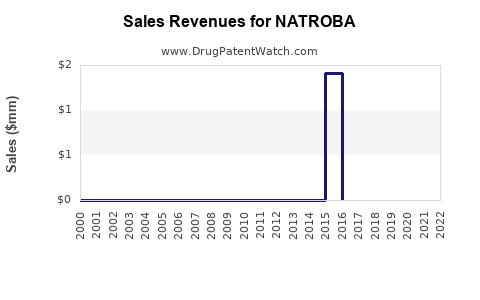
Annual Sales Revenues and Units Sold for NATROBA
| Drug Name | Revenues (USD) | Units | Year |
|---|---|---|---|
| NATROBA | ⤷ Start Trial | ⤷ Start Trial | 2022 |
| NATROBA | ⤷ Start Trial | ⤷ Start Trial | 2021 |
| NATROBA | ⤷ Start Trial | ⤷ Start Trial | 2020 |
| >Drug Name | >Revenues (USD) | >Units | >Year |
Natroba Market Analysis and Sales Projections
Natroba is a prescription topical treatment for head lice containing spinosad 0.9% suspension. Its commercial position rests on a 10-minute application, use in patients aged 6 months and older, and reduced dependence on nit combing compared with several older therapies. The product competes with low-cost permethrin, ivermectin lotion, malathion, benzyl alcohol, abametapir, and nonprescription lice products.
Natroba has a defensible specialty-prescription position, but its growth is constrained by seasonal demand, widespread OTC substitution, generic competition, payer controls, and limited treatment duration. A reasonable U.S. base-case estimate is annual net sales of approximately $120 million to $145 million during 2025, increasing to $145 million to $175 million by 2030 under stable pricing and modest prescription growth. These are analytical estimates rather than reported product sales.
What is Natroba and how does it work?
Natroba is a topical suspension containing spinosad 0.9%, a natural fermentation-derived insecticide. The FDA approved Natroba for topical treatment of head lice infestation in adults and children aged 6 months and older (FDA, 2023a).
The product is applied to dry hair and scalp, left in place for 10 minutes, and rinsed. Nit combing is not required under the FDA-approved labeling. A second treatment can be administered seven days after the first if live lice remain (FDA, 2023a).
| Attribute | Natroba |
|---|---|
| Active ingredient | Spinosad 0.9% |
| Dosage form | Topical suspension |
| Primary indication | Head lice |
| FDA age threshold | 6 months and older |
| Application time | 10 minutes |
| Nit combing | Not required by label |
| Prescription status | Prescription drug |
| Treatment frequency | One treatment; repeat after seven days if needed |
| Main commercial advantage | Short application time and ovicidal activity |
| Main commercial weakness | Prescription access and higher cost than OTC permethrin |
Spinosad acts on insect neuronal nicotinic acetylcholine receptors. Its activity against lice and eggs supports the product’s positioning as a single-application treatment with less mechanical removal than products that require extensive nit combing.
What is the FDA regulatory status of Natroba?
Natroba was approved in January 2011 under New Drug Application 021530. The approved indication covers head lice infestation in patients aged 6 months and older (FDA, 2023a).
The product’s regulatory profile is commercially favorable because the age indication reaches infants and young children, a population in which some alternatives have more restrictive labeling. The label also supports use without nit combing, which can simplify treatment for parents and caregivers.
The main regulatory limitations are the narrow indication and topical route. Natroba has no approved indication for scabies, body lice, or other ectoparasitic conditions. Expansion into those markets would require new clinical and regulatory work.
How large is the U.S. head-lice treatment market?
The addressable U.S. population is large, but the prescription market is much smaller than the epidemiological population. The Centers for Disease Control and Prevention estimates that head lice infestations affect approximately 6 million to 12 million children aged 3 to 11 years annually in the United States (CDC, 2024).
That figure does not equal annual prescription demand. Many cases are treated with OTC products, home remedies, school-based interventions, or no drug treatment. A practical commercial funnel is:
| Market layer | Analytical estimate |
|---|---|
| Annual U.S. head-lice cases | 6 million-12 million |
| Cases receiving pharmaceutical treatment | 3 million-7 million |
| Prescription-treated episodes | 1 million-3 million |
| Natroba-addressable prescription episodes | 0.8 million-2 million |
| Estimated Natroba share of prescription episodes | 15%-30% |
The prescription segment is concentrated in pediatric practices, dermatology, urgent care, family medicine, Medicaid populations, and households with treatment failure or suspected pyrethroid resistance.
Who competes with Natroba?
Natroba competes against both prescription and OTC treatments. The most important competitor is permethrin, which has a low price, broad retail availability, and strong consumer awareness.
| Product or ingredient | Status | Commercial impact on Natroba |
|---|---|---|
| Permethrin 1% | OTC | Largest price-based competitor |
| Permethrin 5% | Prescription | Used when OTC treatment fails or for off-label strategies |
| Ivermectin lotion, Sklice | Prescription | Direct premium prescription competitor |
| Malathion, Ovide | Prescription | Older treatment with longer application time and safety restrictions |
| Benzyl alcohol lotion, Ulesfia | Prescription | Alternative that kills lice but not eggs |
| Abametapir, Xeglyze | Prescription | Newer premium product with potential for differentiation |
| Pyrethrin-piperonyl butoxide | OTC | Widely available but affected by resistance concerns |
| Manual removal and home remedies | Non-drug | Reduces pharmaceutical conversion |
Ivermectin lotion competes closely with Natroba because both offer prescription treatment and simplified use. Natroba’s strongest differentiation is its combination of short application time, activity against lice and eggs, and broad pediatric labeling.
Abametapir is a newer competitive threat. Its commercial effect depends on access, physician adoption, price, and payer coverage. Because head lice is episodic rather than chronic, prescriber familiarity and retail availability can matter more than modest differences in efficacy.
What are Natroba’s commercial strengths and weaknesses?
Strengths
Natroba has several attributes that support premium pricing:
- It is approved for children as young as 6 months.
- The treatment remains on the hair for only 10 minutes.
- Nit combing is not required by the prescribing information.
- Spinosad has activity against lice and eggs.
- The product is suitable for households seeking a fast prescription option after OTC failure.
Weaknesses
The product faces structural commercial pressure:
- Head lice treatment is usually episodic, limiting repeat revenue.
- OTC permethrin is substantially cheaper and easier to obtain.
- Payers may require trial of an OTC product before covering Natroba.
- Treatment demand is seasonal and concentrated around school calendars.
- Generic or alternative spinosad products could reduce price and formulary protection.
- Patients may treat household members with different products, reducing prescription volume.
Natroba’s value proposition is strongest when caregivers prioritize speed, when prior treatment has failed, or when nit removal is difficult.
What are estimated Natroba sales for 2025 to 2030?
Public disclosures do not provide a consistent standalone revenue series for Natroba. The following projection uses a prescription-volume model rather than reported company sales.
Base-case assumptions
- U.S. market is the principal revenue source.
- Net revenue per treated episode is $110 in 2025.
- Annual prescription volume is 1.15 million episodes in 2025.
- Volume grows 3% annually through 2030.
- Net price declines 1% annually because of rebates, payer pressure, and competition.
- No major indication expansion occurs.
- Generic competition remains limited through 2030.
| Year | Estimated treated episodes | Estimated net revenue per episode | Base-case sales |
|---|---|---|---|
| 2025 | 1.15 million | $110 | $127 million |
| 2026 | 1.18 million | $109 | $129 million |
| 2027 | 1.22 million | $108 | $132 million |
| 2028 | 1.26 million | $107 | $135 million |
| 2029 | 1.30 million | $106 | $138 million |
| 2030 | 1.34 million | $105 | $141 million |
Scenario analysis
| Scenario | 2025 sales | 2030 sales | Principal assumptions |
|---|---|---|---|
| Downside | $75 million | $65 million | Generic entry, formulary restrictions, greater OTC substitution |
| Base case | $127 million | $141 million | Stable prescription share and modest volume growth |
| Upside | $175 million | $215 million | Higher physician adoption, stronger OTC failure conversion, limited price erosion |
The downside case is more likely if an authorized or independent generic gains broad pharmacy distribution. The upside case requires higher prescription conversion rather than substantial epidemiological growth, because the total head-lice population is already large.
When does Natroba lose exclusivity?
Natroba’s effective exclusivity depends on several separate protections:
- FDA regulatory exclusivity;
- Orange Book-listed patents;
- formulation and manufacturing know-how;
- trademarks and brand recognition;
- payer and pharmacy positioning.
The original FDA approval occurred in 2011. Any five-year new-chemical-entity exclusivity associated with the initial approval would have expired. Pediatric exclusivity, if granted, would also have ended years ago. The key current barrier is therefore patent and regulatory strategy rather than original approval exclusivity.
Natroba is not a biologic, so biosimilar risk does not apply. The relevant competitive pathway is an ANDA for a generic equivalent or, depending on product differences, a 505(b)(2) application.
What is the Orange Book status of Natroba?
The Orange Book determines whether FDA-listed patents and exclusivity periods affect an ANDA applicant’s approval timing. Natroba should be evaluated through the FDA Orange Book product and patent databases using the product’s NDA and active ingredient, spinosad (FDA, 2024).
The commercial consequences are straightforward:
- If no relevant unexpired patent is listed, an ANDA applicant may avoid a Paragraph IV patent challenge.
- If an unexpired patent is listed, the applicant may file a Paragraph IV certification.
- A timely patent lawsuit can trigger a 30-month stay of ANDA approval under the Hatch-Waxman framework, subject to statutory exceptions.
- If the listed protection covers only a narrow formulation or method of use, a generic may design around it.
The most important patent risks are likely to involve suspension composition, particle characteristics, stabilizers, manufacturing process, and methods of treating lice rather than the basic use of spinosad as an insecticide.
What generic entry risks exist for Natroba?
Generic entry would likely reduce net price faster than it reduces treated-patient demand. Pharmacies and payers would have an incentive to substitute a lower-cost product, especially in Medicaid and managed-care channels.
The risk profile depends on the generic’s product characteristics:
| Generic scenario | Expected commercial effect |
|---|---|
| AB-rated equivalent with broad retail distribution | High price and volume pressure |
| Limited-distribution generic | Moderate pressure |
| 505(b)(2) product with different formulation | Moderate clinical and payer competition |
| Authorized generic | Faster price erosion with retained channel control |
| Compounded spinosad product | Limited regulatory substitution but possible cash-pay pressure |
A generic that matches the 0.9% suspension, application time, age range, and labeling would create the strongest substitution risk. Formulation differences that require additional clinical data could delay entry but would not necessarily prevent it.
What is the litigation and settlement outlook?
The principal litigation issue would be a Paragraph IV challenge to any unexpired Orange Book patent. A settlement could involve:
- an agreed generic entry date;
- an authorized generic arrangement;
- a license limited by channel or geography;
- restrictions on formulation or manufacturing;
- a no-challenge clause, subject to antitrust limitations;
- supply or royalty payments.
No major public litigation or settlement should be assumed without confirmation from PACER, FDA listing data, and company disclosures. In a small seasonal market, a patent settlement may be commercially preferable to prolonged litigation because the expected value of delayed entry is limited by the market’s low annual treatment frequency.
How strong is the Natroba patent estate?
Natroba’s patent strength is likely moderate rather than absolute. The product’s core active ingredient and broad antiparasitic use are older technologies, which limits the ability to rely on broad composition-of-matter protection. Commercial protection is more likely to depend on:
- the specific topical suspension;
- particle-size distribution;
- formulation stability;
- delivery and rinse characteristics;
- manufacturing controls;
- method-of-use claims;
- pediatric dosing and administration parameters.
Formulation patents can delay simple substitution if they claim clinically relevant product characteristics. They are less powerful if a competitor can produce a therapeutically equivalent suspension with a non-infringing composition.
Manufacturing know-how may provide a practical barrier even when patent protection is limited. That barrier is usually weaker than a valid, enforceable patent because a capable generic manufacturer can reproduce the product after reverse engineering and regulatory testing.
How does Natroba compare with Sklice and Xeglyze?
| Metric | Natroba | Sklice | Xeglyze |
|---|---|---|---|
| Active ingredient | Spinosad | Ivermectin | Abametapir |
| Product type | Topical suspension | Topical lotion | Topical lotion |
| Prescription status | Yes | Yes | Yes |
| Pediatric positioning | 6 months and older | Label-dependent age restrictions | Label-dependent age restrictions |
| Treatment convenience | 10-minute application | Short application | Short application |
| Egg activity | Yes | Less direct positioning | Designed for lice treatment |
| Commercial maturity | Established | Established | Newer |
| Main risk | OTC and generic substitution | Access and generic competition | Adoption and payer coverage |
Natroba’s key advantage is maturity combined with a simple dosing procedure. Xeglyze has greater novelty but must build prescribing and payer familiarity. Sklice has strong clinical recognition but faces similar access and generic risks.
Key Takeaways
- Natroba is a prescription spinosad 0.9% topical suspension approved for head lice in patients aged 6 months and older.
- Its commercial differentiation is a 10-minute treatment, activity against lice and eggs, and no required nit combing.
- The U.S. head-lice population is large, but the prescription market is limited by OTC treatment and episodic use.
- Estimated base-case sales are approximately $127 million in 2025 and $141 million in 2030.
- Downside sales could fall below $70 million by 2030 if a broadly distributed generic enters.
- Natroba is exposed to permethrin, ivermectin lotion, abametapir, other prescription products, and non-drug treatment.
- Biosimilar risk does not apply because Natroba is a small-molecule topical drug.
- The central legal question is the scope and remaining life of any Orange Book-listed formulation or method-of-use patents.
- Manufacturing know-how may slow competition but is unlikely to provide durable protection against a well-funded generic manufacturer.
FAQs
Is Natroba stronger than permethrin for resistant lice?
Natroba has a different mechanism and is often used when OTC permethrin fails or resistance is suspected. Comparative clinical choice depends on local resistance, prior treatment, patient age, access, and payer coverage.
Can Natroba be used to treat an entire household?
Natroba is labeled for treatment of infested individuals. Household members should be evaluated and treated when lice are present, but routine treatment of uninfested people is not supported by the product label.
Does Natroba require a prescription in the United States?
Yes. Natroba is an FDA-approved prescription product.
Is spinosad available as a generic?
Generic availability depends on FDA approval, Orange Book status, patent barriers, and commercial distribution. A generic should not be presumed to have broad market access without confirmation of an approved equivalent and pharmacy availability.
What would increase Natroba sales most?
The strongest commercial drivers would be broader payer coverage, fewer prior-authorization requirements, physician conversion after OTC failure, expanded retail access, and an indication or labeling change that increases use in younger patients or additional ectoparasitic conditions.
References
-
Centers for Disease Control and Prevention. (2024). About head lice. https://www.cdc.gov/lice/about-head-lice/index.html
-
U.S. Food and Drug Administration. (2023a). Natroba (spinosad) topical suspension prescribing information. https://dailymed.nlm.nih.gov/dailymed/
-
U.S. Food and Drug Administration. (2024). Approved drug products with therapeutic equivalence evaluations: Orange Book. https://www.fda.gov/drugs/drug-approvals-and-databases/orange-book-approved-drug-products-therapeutic-equivalence-evaluations
-
U.S. Food and Drug Administration. (2023b). Drugs@FDA: FDA-approved drugs. https://www.accessdata.fda.gov/scripts/cder/daf/
More… ↓
