Share This Page
Drug Sales Trends for GUAIFENESIN
✉ Email this page to a colleague
Payment Methods and Pharmacy Types for GUAIFENESIN (2005)
Revenues by Pharmacy Type
Units Sold by Pharmacy Type
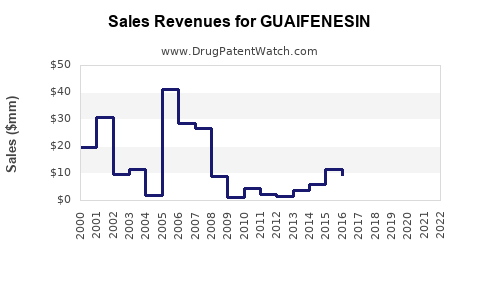
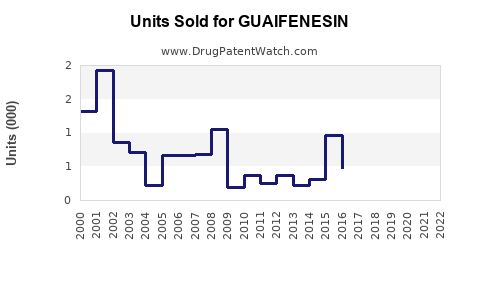
Annual Sales Revenues and Units Sold for GUAIFENESIN
| Drug Name | Revenues (USD) | Units | Year |
|---|---|---|---|
| GUAIFENESIN | ⤷ Start Trial | ⤷ Start Trial | 2022 |
| GUAIFENESIN | ⤷ Start Trial | ⤷ Start Trial | 2021 |
| GUAIFENESIN | ⤷ Start Trial | ⤷ Start Trial | 2020 |
| >Drug Name | >Revenues (USD) | >Units | >Year |
Guaifenesin Market Analysis and Sales Projections Through 2030
Guaifenesin is a mature, low-cost over-the-counter expectorant with stable demand, broad generic availability, and limited patent protection. Global guaifenesin product sales are reasonably modeled at approximately $1.0 billion to $1.5 billion in 2024, with a base-case growth rate of about 3.5% annually through 2030. Growth depends more on branded product execution, combination cold remedies, pediatric and extended-release formulations, and emerging-market distribution than on new chemical-entity innovation.
Reckitt’s Mucinex is the leading U.S. guaifenesin brand, while Perrigo, Haleon, Kenvue, store brands, and regional manufacturers compete through generic tablets, syrups, capsules, and combination products. The active ingredient has no meaningful remaining market exclusivity. Regulatory and commercial barriers are modest, but brand recognition, retail shelf placement, manufacturing scale, and formulation know-how support incumbent pricing.
What is the current guaifenesin market size?
Published market estimates vary because some reports measure guaifenesin API sales, while others include retail sales of guaifenesin-containing products and combination cold medicines. A practical 2024 global estimate is $1.0 billion to $1.5 billion in annual product sales.
| Market measure | 2024 estimated value | 2030 modeled value | Growth assumption |
|---|---|---|---|
| Global guaifenesin products | $1.0B-$1.5B | $1.2B-$2.0B | 3%-5% CAGR |
| Base-case global market | $1.2B | $1.5B | 3.5% CAGR |
| U.S. retail market | $450M-$700M | $550M-$850M | 3%-4% CAGR |
| Europe | $200M-$350M | $240M-$420M | 3%-4% CAGR |
| Asia-Pacific and other markets | $350M-$550M | $450M-$750M | 4%-6% CAGR |
These figures are market-model estimates rather than audited manufacturer sales. Commercial reports place the global guaifenesin market in a similar broad range but use different inclusion criteria and forecast periods (Grand View Research, 2024; Fortune Business Insights, 2024).
The U.S. is the most commercially developed market because of high OTC penetration, strong consumer awareness of Mucinex, extensive pharmacy distribution, and established use in multi-symptom cold products.
How fast will guaifenesin sales grow through 2030?
The base-case projection assumes a 2024 global market of $1.2 billion and a 3.5% compound annual growth rate.
| Year | Base-case global sales | Low case, 2% CAGR | High case, 5% CAGR |
|---|---|---|---|
| 2024 | $1.20B | $1.20B | $1.20B |
| 2025 | $1.24B | $1.22B | $1.26B |
| 2026 | $1.29B | $1.25B | $1.32B |
| 2027 | $1.33B | $1.27B | $1.39B |
| 2028 | $1.38B | $1.30B | $1.46B |
| 2029 | $1.43B | $1.33B | $1.53B |
| 2030 | $1.48B | $1.35B | $1.61B |
The base-case forecast is conservative because guaifenesin is mature and inexpensive. Unit growth is likely to remain low to moderate. Revenue growth will come from price increases, premium branded products, extended-release dosage forms, combination products, and expansion in markets where OTC respiratory products are becoming more accessible.
What factors could accelerate sales?
Demand could exceed the base case if:
- Seasonal respiratory infections remain elevated.
- Consumers shift from single-ingredient products to branded combination products.
- Emerging-market pharmacy access improves.
- Manufacturers expand liquid, chewable, pediatric, and extended-release products.
- Retailers allocate more shelf space to cough and chest-congestion products.
- E-commerce increases consumer access to large-count packages and private-label alternatives.
What factors could reduce sales?
Downside risks include:
- Generic and store-brand substitution.
- Lower retail prices caused by private-label competition.
- Reduced use of multi-symptom cough products.
- Consumer migration toward non-drug remedies.
- Retailer consolidation and shelf-space pressure.
- Product recalls or manufacturing interruptions.
- Weak clinical differentiation between branded and generic products.
Which companies sell guaifenesin products?
The competitive market includes branded OTC companies, private-label manufacturers, contract manufacturers, and API suppliers.
| Company | Relevant brands or role | Competitive position |
|---|---|---|
| Reckitt | Mucinex, Mucinex DM, Mucinex Extended-Release products | Leading U.S. branded franchise |
| Haleon | Robitussin products in selected markets | Strong cough and cold brand presence |
| Kenvue | Tylenol Cold and related combination products | Broad retail distribution |
| Perrigo | Store-brand and private-label OTC products | Major contract and private-label supplier |
| Pharmacies and retailers | CVS, Walgreens, Walmart, Amazon and other private labels | Price-focused competition |
| Regional manufacturers | Local guaifenesin tablets, syrups, capsules and combinations | Important outside the U.S. |
Brand ownership and product availability vary by country. Robitussin ownership and distribution have changed across markets, so commercial analysis should be conducted by jurisdiction rather than by global brand name.
Mucinex has the strongest consumer association with standalone guaifenesin in the United States. Its competitive advantage is based on brand recognition, advertising, packaging, extended-release positioning, and retail availability rather than ingredient exclusivity.
What are the main guaifenesin dosage forms and formulations?
Guaifenesin is sold as a standalone expectorant and as an ingredient in multi-symptom products.
| Formulation | Commercial role | Margin potential |
|---|---|---|
| Immediate-release tablets | Low-cost generic and store-brand format | Low |
| Extended-release tablets | Core branded Mucinex format | Moderate to high |
| Capsules and liqui-caps | Convenience-oriented adult format | Moderate |
| Oral syrups | Pediatric and family use | Low to moderate |
| Chewable tablets | Pediatric and convenience segment | Moderate |
| Combination products | Cough, congestion, pain, fever or nasal-symptom relief | Moderate to high |
| Prescription-style bulk products | Institutional and pharmacy supply | Low |
The principal formulation opportunity is not a new active ingredient. It is a differentiated delivery format with improved dosing convenience, longer duration, better taste, lower sugar content, or simplified combination therapy.
Extended-release products can command a premium over immediate-release generics. The premium is vulnerable to private-label copies and retailer substitution, particularly when consumers recognize guaifenesin as a commodity ingredient.
What FDA regulatory status applies to guaifenesin?
Guaifenesin is regulated in the United States as an OTC expectorant under the FDA OTC monograph framework. The FDA identifies expectorant active ingredients and permitted labeling conditions in the OTC monograph for cough, cold, allergy, bronchodilator, and antiasthmatic products (U.S. Food and Drug Administration, 2023; 21 C.F.R. § 341).
The regulatory position has several commercial consequences:
- A manufacturer generally does not need to obtain a product-specific new drug application for a compliant OTC monograph product.
- Products must satisfy active-ingredient, dosage, labeling, manufacturing, and packaging requirements.
- The ingredient can be sold by multiple manufacturers without an originator exclusivity period.
- Combination products must meet the applicable conditions for each active ingredient and indication.
- Pediatric labeling and dosing remain important compliance issues.
The FDA’s OTC monograph system reduces regulatory barriers for additional entrants. It also limits the ability of a brand owner to create durable exclusivity through the active ingredient itself.
What patents protect guaifenesin products?
Guaifenesin has no commercially significant remaining composition-of-matter patent protection. The active ingredient is long established, and generic manufacturers can produce standard guaifenesin products subject to applicable FDA requirements.
Potentially relevant intellectual-property categories include:
- Extended-release tablet technology.
- Controlled-release matrices.
- Taste-masked liquid formulations.
- Chewable or orally disintegrating dosage forms.
- Combination-product compositions.
- Packaging and dosing systems.
- Manufacturing processes.
- Brand trademarks and trade dress.
These rights generally protect a specific product design, not guaifenesin as a molecule. Their scope depends on claim construction, validity, written-description support, enablement, and whether a competing product uses the claimed release mechanism or formulation.
What is the Orange Book status of guaifenesin?
There is no single Orange Book listing for "guaifenesin" that provides originator-style market exclusivity for the ingredient. Individual approved products can have FDA application records, but most commercial guaifenesin products compete under the OTC monograph framework rather than through a protected new-drug franchise.
The commercial result is straightforward: an entrant can generally launch a compliant guaifenesin product without waiting for expiry of an ingredient patent.
Are there Paragraph IV challenges involving guaifenesin?
Paragraph IV litigation is not the central entry mechanism for standard guaifenesin OTC products. Paragraph IV certifications apply to abbreviated new drug applications referencing listed prescription or approved drug products with Orange Book patents. A manufacturer launching a monograph-compliant OTC guaifenesin product typically does not need to challenge an originator’s patent in the same manner as an ANDA applicant for a protected prescription drug.
Patent litigation remains possible for branded extended-release or combination products if a competitor files an application that relies on listed patents. The litigation risk is product-specific and cannot be inferred from the existence of guaifenesin alone.
When does guaifenesin lose exclusivity?
Guaifenesin already has no meaningful active-ingredient exclusivity in the United States. Generic and private-label products are widely available, and the market has operated for decades without an originator-controlled ingredient franchise.
| Exclusivity category | Current position |
|---|---|
| Chemical composition patent | Expired or commercially irrelevant |
| New chemical entity exclusivity | Not applicable |
| Orphan-drug exclusivity | Not applicable |
| Pediatric exclusivity | Not a current market driver |
| OTC monograph access | Broad manufacturer access |
| Brand trademark | Can remain enforceable indefinitely if maintained |
| Formulation patents | Product-specific and potentially enforceable |
| Trade dress and packaging | Narrow, product-specific protection |
The key remaining defensible assets are trademarks, consumer loyalty, retail relationships, advertising, and formulation patents. These assets can support a premium but do not prevent low-priced entry.
How strong is the guaifenesin patent estate?
The patent estate is weak at the active-ingredient level and moderate at the product level.
| Asset type | Strength | Commercial effect |
|---|---|---|
| Guaifenesin molecule | Very weak or unavailable | No barrier to generic entry |
| Immediate-release tablets | Very weak | Commodity competition |
| Extended-release formulation | Moderate if claims are narrow and valid | Can delay direct copies |
| Combination product | Moderate | Depends on claim scope and listed patents |
| Manufacturing process | Low to moderate | Difficult to enforce against unknown processes |
| Trademark and trade dress | Moderate to strong | Supports brand pricing and shelf presence |
| Consumer brand | Strong commercially, not patent-based | Supports repeat purchases |
A branded company can defend a specific extended-release product more effectively than a standard immediate-release tablet. Even then, competitors may design around the patent using a different polymer system, dosage profile, tablet architecture, or release mechanism.
What generic entry risks exist for Mucinex?
Mucinex faces persistent generic and private-label risk. The highest-risk segments are immediate-release tablets, standard syrups, and common combination products. The lower-risk segments are heavily branded extended-release products, products with strong consumer loyalty, and formulations with meaningful taste or dosing advantages.
Generic entry affects Mucinex through:
- Lower average selling prices.
- Retailer substitution.
- Reduced promotional efficiency.
- Greater private-label shelf presence.
- Lower consumer willingness to pay for standard dosage forms.
The brand can preserve pricing through extended-release positioning, high-dose convenience, product-line breadth, and advertising. Its most important competitive risk is not a single litigation event. It is gradual substitution by pharmacy and retailer brands.
What licensing deals affect the guaifenesin market?
Licensing is more important for brand distribution, contract manufacturing, and regional commercialization than for the guaifenesin molecule. Publicly disclosed licensing economics for individual guaifenesin products are limited.
Relevant deal structures can include:
- Private-label manufacturing agreements.
- Regional brand licensing.
- Retailer supply contracts.
- API supply agreements.
- Co-development of extended-release products.
- Distribution arrangements for combination cold remedies.
The absence of widely disclosed ingredient-level licensing does not indicate a lack of commercial agreements. OTC contracts are often private and may cover broad product portfolios rather than guaifenesin alone.
What patent litigation and settlement issues affect guaifenesin?
Guaifenesin-related patent disputes are most likely to concern formulation or combination products, not the basic expectorant ingredient. The principal litigation questions are:
- Whether a competitor’s formulation practices the asserted release or dosage claims.
- Whether the patent claims are valid over earlier controlled-release formulations.
- Whether a product is an authorized generic, private-label equivalent, or independent formulation.
- Whether settlement terms restrict launch timing or distribution.
- Whether a formulation patent is listed or enforceable against the specific regulatory pathway.
Settlement agreements can set launch dates for a competing extended-release product, but no general settlement date applies to guaifenesin as a drug class. A product-by-product review of FDA records, patent listings, court dockets, and settlement filings is required for transaction or litigation decisions.
What is the competitive landscape for guaifenesin?
The market has four competitive tiers:
- Branded single-ingredient products, led by Mucinex.
- Branded combination products, including cough, congestion, pain and fever products.
- Generic pharmacy products.
- Retailer private-label and e-commerce products.
The branded segment captures the highest revenue per unit. Generic and private-label products capture volume and exert price pressure. Combination products can increase revenue per consumer transaction, but they also face more complex regulatory labeling and greater competition from established cold-remedy brands.
Guaifenesin competes indirectly with dextromethorphan, pseudoephedrine, phenylephrine, antihistamines, acetaminophen, saline products, honey-based remedies and non-drug cough products. These products do not all have the same mechanism, but they compete for the same respiratory-care budget and retail shelf space.
What revenue exposure do manufacturers have to guaifenesin?
Guaifenesin is strategically important to OTC respiratory portfolios but is unlikely to represent a material share of total revenue for diversified manufacturers unless the company owns a leading brand.
| Business model | Revenue exposure | Margin profile |
|---|---|---|
| Global branded OTC company | Usually a small portfolio share | Higher on branded products |
| Leading cough-and-cold franchise | Material category exposure | Moderate to high |
| Generic manufacturer | Volume-driven | Low to moderate |
| API supplier | Ingredient-volume exposure | Low to moderate |
| Retailer private label | Category and traffic exposure | Moderate |
| Contract manufacturer | Customer-specific exposure | Low to moderate |
For Reckitt, Mucinex is commercially significant within U.S. respiratory OTC products, but public financial reporting does not provide a standalone audited Mucinex revenue line. Investors should treat product-level revenue estimates as external estimates rather than reported company figures.
What manufacturing and intellectual-property barriers exist?
Manufacturing barriers are manageable for standard tablets and syrups. The most important technical requirements are API quality, content uniformity, dissolution performance, stability, taste, packaging, and compliance with current good manufacturing practices.
Higher barriers exist for:
- Consistent extended-release dissolution profiles.
- Large-scale manufacture of high-dose tablets.
- Palatable pediatric liquids.
- Stable multi-ingredient liquid systems.
- Tamper-resistant and child-resistant packaging.
- Reliable global API supply.
- Clinical and regulatory documentation for new combinations.
These barriers can protect gross margin for a period, but they usually do not produce durable exclusivity comparable with patented prescription drugs.
What geographic markets offer the strongest growth?
The United States remains the largest high-value market. Europe has established OTC demand but is more fragmented by country, language, reimbursement practice, and pharmacy regulation. Asia-Pacific, Latin America, and selected Middle Eastern markets offer higher unit-growth potential, although pricing is lower and local manufacturing is more important.
| Region | Market outlook | Principal issue |
|---|---|---|
| United States | Stable, premium branded market | Generic and private-label substitution |
| Western Europe | Moderate growth | Country-specific OTC rules |
| China and broader Asia-Pacific | Higher potential unit growth | Local competition and price sensitivity |
| Latin America | Moderate growth | Currency and distribution volatility |
| Middle East and Africa | Selective growth | Import dependence and regulatory fragmentation |
A company seeking growth should prioritize markets where pharmacy distribution, consumer self-medication, and modern retail are expanding. A premium U.S.-style brand strategy may not transfer directly to lower-price markets.
Key Takeaways
- Global guaifenesin product sales are reasonably modeled at $1.0 billion to $1.5 billion in 2024.
- A base-case forecast reaches approximately $1.48 billion by 2030 at a 3.5% CAGR.
- The United States is the leading high-value market, with Mucinex as the principal branded franchise.
- Guaifenesin has no meaningful remaining composition-of-matter exclusivity.
- Standard tablets and syrups face immediate generic and private-label competition.
- Extended-release, pediatric, taste-masked and combination products offer the strongest formulation opportunities.
- Patent risk is product-specific and concentrated in formulation and combination claims.
- OTC monograph status lowers regulatory entry barriers.
- Brand, distribution, packaging and retail execution are more important than ingredient patents.
- Sales growth is likely to be modest, with upside from emerging markets and premium delivery formats.
FAQs
Is guaifenesin a high-growth pharmaceutical market?
No. Guaifenesin is a mature OTC category. A 2% to 5% annual revenue growth range is more realistic than double-digit growth.
Does Mucinex have exclusive rights to guaifenesin?
No. Mucinex has trademark and brand rights, but it does not control the guaifenesin ingredient. Generic and private-label products are widely available.
Which guaifenesin formulation has the highest commercial potential?
Extended-release tablets and differentiated combination products generally have greater pricing potential than standard immediate-release tablets.
Can a company launch a generic guaifenesin product without a Paragraph IV challenge?
A manufacturer can generally launch a compliant OTC monograph product without challenging an originator patent through the standard Paragraph IV process. Product-specific patents and regulatory pathways must still be reviewed.
What is the biggest investment risk in guaifenesin?
The principal risk is commoditization. Price competition, retailer substitution and limited ingredient differentiation can reduce margins even when category demand remains stable.
References
-
Fortune Business Insights. (2024). Guaifenesin market size, share and industry analysis. Fortune Business Insights.
-
Grand View Research. (2024). Guaifenesin market size, share and trends analysis report. Grand View Research.
-
U.S. Food and Drug Administration. (2023). OTC monograph M012: Cough, cold, allergy, bronchodilator, and antiasthmatic drug products for over-the-counter human use. U.S. Department of Health and Human Services.
-
U.S. Food and Drug Administration. (2024). Orange Book: Approved drug products with therapeutic equivalence evaluations. U.S. Department of Health and Human Services.
-
Electronic Code of Federal Regulations. (2024). 21 C.F.R. Part 341: Cold, cough, allergy, bronchodilator, and antiasthmatic drug products for over-the-counter human use. U.S. Government Publishing Office.
More… ↓
