Share This Page
Drug Sales Trends for ELIQUIS
✉ Email this page to a colleague
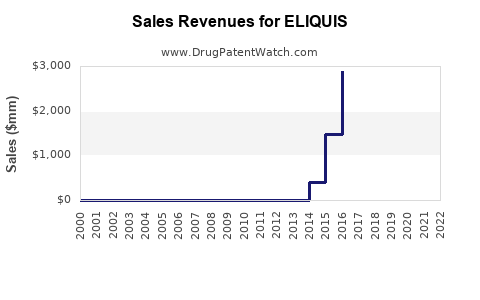
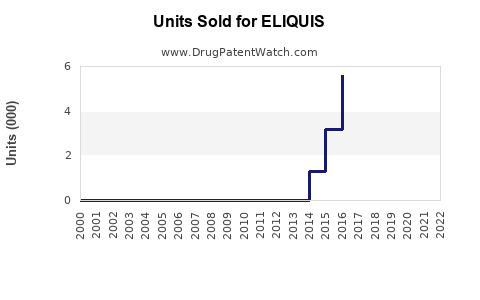
Annual Sales Revenues and Units Sold for ELIQUIS
| Drug Name | Revenues (USD) | Units | Year |
|---|---|---|---|
| ELIQUIS | ⤷ Start Trial | ⤷ Start Trial | 2022 |
| ELIQUIS | ⤷ Start Trial | ⤷ Start Trial | 2021 |
| ELIQUIS | ⤷ Start Trial | ⤷ Start Trial | 2020 |
| ELIQUIS | ⤷ Start Trial | ⤷ Start Trial | 2019 |
| ELIQUIS | ⤷ Start Trial | ⤷ Start Trial | 2018 |
| ELIQUIS | ⤷ Start Trial | ⤷ Start Trial | 2017 |
| ELIQUIS | ⤷ Start Trial | ⤷ Start Trial | 2016 |
| >Drug Name | >Revenues (USD) | >Units | >Year |
Eliquis Market Analysis, Patent Expiration, Competitive Landscape, and Sales Projections
Eliquis, the apixaban anticoagulant marketed by Bristol Myers Squibb and Pfizer, remains one of the world’s largest pharmaceutical products. Combined global sales were approximately $14 billion to $15 billion in 2024, driven by atrial fibrillation and venous thromboembolism indications. The principal commercial risk is U.S. generic entry after the core composition patent expires in December 2026, although settlements have generally delayed commercial generic launches until April 2028.
A base-case forecast puts global Eliquis revenue at approximately $14 billion in 2025, declining to $10 billion to $12 billion in 2027, $6 billion to $8 billion in 2028, and below $3 billion by 2030. The actual decline will depend on the timing of generic entry, the number of approved manufacturers, payer substitution, international patent expiry dates, and continued demand in patients who remain on branded therapy.
What is Eliquis and how large is its market?
Eliquis is an oral factor Xa inhibitor containing apixaban. It is approved for:
- Reduction of stroke and systemic embolism risk in nonvalvular atrial fibrillation.
- Treatment of deep vein thrombosis and pulmonary embolism.
- Reduction in the risk of recurrent deep vein thrombosis and pulmonary embolism.
- Prophylaxis of deep vein thrombosis after hip or knee replacement surgery.
The product is marketed in 2.5 mg and 5 mg tablets. The 5 mg dose is the principal commercial strength for atrial fibrillation and acute venous thromboembolism treatment. The 2.5 mg dose is used in selected atrial fibrillation patients, recurrent venous thromboembolism prevention, and post-surgical prophylaxis.
Eliquis global sales by company
Bristol Myers Squibb and Pfizer commercialize Eliquis under an alliance. Reported sales differ by company because each records its share of alliance revenue and may apply different geographic and accounting treatments.
| Fiscal year | Approximate combined global sales | Commercial interpretation |
|---|---|---|
| 2022 | $11 billion-$12 billion | Continued uptake in atrial fibrillation and venous thromboembolism |
| 2023 | $13 billion-$14 billion | Strong growth before the principal U.S. patent expiry period |
| 2024 | $14 billion-$15 billion | Peak or near-peak commercial performance |
| 2025 estimate | $13.5 billion-$15 billion | Growth slows as loss-of-exclusivity planning intensifies |
| 2026 estimate | $12 billion-$14.5 billion | Core U.S. patent approaches expiry |
| 2027 estimate | $9 billion-$12 billion | Early erosion in some markets and payer anticipation |
| 2028 estimate | $5.5 billion-$8 billion | U.S. generic entry produces material erosion |
| 2030 estimate | $1.5 billion-$3.5 billion | Residual brand sales, protected markets, and slower substitution |
Bristol Myers Squibb identifies Eliquis as a major contributor to revenue and a major loss-of-exclusivity exposure. Pfizer also lists Eliquis among its principal products and identifies patent expiry as a major future revenue risk. (Bristol Myers Squibb, 2025; Pfizer, 2025)
What are the main Eliquis market drivers?
The market is supported by the expanding diagnosed population with atrial fibrillation, increased use of oral anticoagulation, and the shift away from warfarin monitoring.
Atrial fibrillation demand
Atrial fibrillation is the largest Eliquis indication. The aging population, greater detection through wearable devices and ambulatory monitoring, and increased treatment of stroke-risk patients support long-term demand.
Eliquis competes with other direct oral anticoagulants, particularly Xarelto, which contains rivaroxaban. In many markets, Eliquis has gained a strong position because of clinical use patterns, physician familiarity, and a perceived bleeding profile advantage in some patient populations.
Venous thromboembolism
Deep vein thrombosis and pulmonary embolism represent a smaller portion of Eliquis revenue than atrial fibrillation but broaden the product’s prescriber base. The acute-treatment and recurrent-prevention indications support both short-duration and extended-duration therapy.
Pricing and reimbursement
U.S. list pricing has supported high revenue per treated patient, although commercial insurers, Medicare Part D plans, and government programs generally obtain rebates. The Medicare Part D redesign under the Inflation Reduction Act increases manufacturer exposure in the catastrophic phase and can reduce net revenue per patient.
Eliquis was selected for the first cycle of Medicare drug price negotiation. The negotiated price is scheduled to apply in 2026. The negotiated price creates a separate U.S. revenue headwind before or near the beginning of generic entry. (Centers for Medicare & Medicaid Services, 2024)
When does Eliquis lose exclusivity?
Eliquis faces a staged loss-of-exclusivity period rather than a single global expiry date.
| Exclusivity element | Timing | Commercial effect |
|---|---|---|
| FDA new chemical entity exclusivity | Expired after the initial five-year period | Generic development could proceed subject to patent barriers |
| U.S. core composition patent | December 2026, based on the principal listed patent | Primary U.S. generic-entry barrier |
| Pediatric exclusivity | Extends certain FDA protections by six months where applicable | Does not necessarily prevent all post-patent commercial activity |
| U.S. generic settlements | Generally permit entry by April 1, 2028 | Delays large-scale U.S. generic erosion |
| Foreign patents | Vary by country | International revenue declines will occur on different schedules |
The principal U.S. composition patent associated with Eliquis is U.S. Patent No. 6,967,208. Public patent and litigation records identify December 2026 as the key expiry date for this patent, subject to the effect of pediatric exclusivity and other legal developments. (U.S. Food and Drug Administration, 2025; CourtListener, 2025)
What patents protect Eliquis?
Eliquis patent protection has included compound, formulation, and use-related rights.
Core compound patent
U.S. Patent No. 6,967,208 covers apixaban-related chemical matter and is the central patent associated with generic challenges. Its December 2026 expiry date is the main reference point for U.S. loss-of-exclusivity analysis.
Formulation patents
Later patents and patent applications have addressed pharmaceutical compositions, dosage forms, and manufacturing-related subject matter. These patents can create additional litigation positions but do not necessarily extend effective market exclusivity if generic products can avoid the claims or if the patents are invalidated.
Generic applicants may certify under Paragraph IV that listed patents are invalid, unenforceable, or not infringed. A Paragraph IV filing can trigger patent litigation and a 30-month stay of FDA approval under the Hatch-Waxman framework, subject to statutory exceptions and litigation outcomes. (U.S. Food and Drug Administration, 2024)
Method-of-use patents
Eliquis method-of-use protection has covered anticoagulant treatment and prevention indications. Method-of-use patents can affect labeling and litigation strategy, but they generally provide weaker protection against a generic that uses a permitted “skinny label” excluding patented indications.
The commercial value of method-of-use patents is highest when the protected indication represents a substantial share of prescriptions and the generic cannot realistically avoid prescribing for that indication.
What is the Orange Book status of Eliquis?
The FDA Orange Book lists approved drug products, patents submitted by sponsors, and applicable exclusivity information. Eliquis has been subject to Orange Book patent listings and Paragraph IV challenges from generic applicants.
The key Orange Book issue is whether listed patents block approval through their expiry dates or whether generic applicants prevail in litigation. An Orange Book listing does not establish that a patent is valid or infringed. Courts determine those issues.
The practical U.S. sequence is:
- Generic applicants submit abbreviated new drug applications with Paragraph IV certifications.
- Bristol Myers Squibb and Pfizer bring infringement actions against selected applicants.
- Litigation or settlement determines the earliest commercial-entry date.
- FDA approval may occur before the agreed commercial launch date.
- Multiple generic manufacturers may launch after the settlement date, increasing price erosion.
Which companies are challenging Eliquis?
Public litigation and settlement activity has involved several large generic manufacturers, including Teva, Mylan or Viatris, Sandoz, and other abbreviated new drug application sponsors. The exact group of litigants can change as cases settle, consolidate, or proceed separately.
The principal commercial consequence is that the generic field is likely to include multiple manufacturers rather than a single first entrant. A multi-manufacturer launch normally produces faster price erosion than a sole-source or limited-competition launch.
What generic entry risks exist?
The main risks are:
- A court ruling invalidating or not-infringed the core patent before the negotiated launch date.
- A generic applicant securing an earlier launch through settlement or litigation.
- Several manufacturers launching at or near the same time.
- Pharmacy benefit managers rapidly moving patients to generic apixaban.
- Medicare and Medicaid substitution accelerating after FDA approval.
- Generic manufacturers using authorized-generic or low-price strategies to capture formulary access.
The base case assumes commercial U.S. generic entry on or near April 1, 2028. A downside case assumes entry during 2027 following a successful Paragraph IV challenge. An upside case assumes a limited initial launch in 2028, slower substitution, or delayed commercial availability.
How strong is the Eliquis patent estate?
The Eliquis patent estate is commercially strong through the core U.S. patent expiry but materially weaker after 2026.
| Patent-estate factor | Assessment |
|---|---|
| Core chemical protection | Strong until the principal expiry date if upheld |
| Formulation protection | Potentially useful but narrower than compound protection |
| Method-of-use protection | Relevant to specific indications and labeling |
| Manufacturing barriers | Potentially important for process complexity, but unlikely to block all generic entry indefinitely |
| Litigation leverage | High before core expiry; declines sharply after invalidity or expiry |
| Post-2028 protection | Limited ability to preserve broad U.S. brand exclusivity |
Apixaban is a chemically defined small molecule, not a biologic. Biosimilar regulation therefore does not apply. Generic applicants use the abbreviated new drug application pathway, and FDA approval depends primarily on pharmaceutical equivalence and bioequivalence rather than clinical comparability studies required for many biologic products.
How does Eliquis compare with Xarelto?
Eliquis and Xarelto dominate the direct oral anticoagulant market.
| Factor | Eliquis | Xarelto |
|---|---|---|
| Active ingredient | Apixaban | Rivaroxaban |
| Main manufacturers | Bristol Myers Squibb and Pfizer | Johnson & Johnson and Bayer |
| Main use | Atrial fibrillation and venous thromboembolism | Atrial fibrillation and venous thromboembolism |
| Product type | Small-molecule factor Xa inhibitor | Small-molecule factor Xa inhibitor |
| Generic risk | U.S. entry expected around 2028 under settlements | U.S. generic timing also developing through patent litigation |
| Commercial position | One of the highest-revenue drugs globally | Major competitor with broad international sales |
| Competitive risk | Generic apixaban and Medicare pricing | Generic rivaroxaban and formulary competition |
Eliquis has benefited from strong physician adoption and substantial chronic-use volume. Xarelto remains a major competitor, particularly where dosing convenience, indication coverage, or local reimbursement favors rivaroxaban.
What are the Eliquis sales projections through 2030?
The following forecast is a scenario-based market model, not company guidance.
| Year | Base-case global sales | Low case | High case |
|---|---|---|---|
| 2024 | $14.0B-$15.0B | $14.0B | $15.0B |
| 2025 | $13.5B-$15.0B | $13.0B | $15.2B |
| 2026 | $12.0B-$14.5B | $11.0B | $14.5B |
| 2027 | $9.0B-$12.0B | $7.0B | $12.5B |
| 2028 | $5.5B-$8.0B | $4.0B | $9.0B |
| 2029 | $2.5B-$5.0B | $1.5B | $6.0B |
| 2030 | $1.5B-$3.5B | $0.8B | $4.5B |
Base-case assumptions
The base case assumes:
- U.S. generic launch around April 2028.
- Three or more meaningful generic suppliers.
- U.S. revenue erosion of 60% to 75% within the first full year after launch.
- Continued branded demand among patients with physician preference or incomplete payer substitution.
- International erosion occurring on different timelines.
- No major new Eliquis indication that materially expands the treated population.
- Medicare negotiated pricing contributing to lower U.S. net sales from 2026.
Downside case
The downside case assumes earlier litigation success for a generic applicant, rapid multi-source substitution, aggressive payer management, and limited ability to retain branded patients. Under this scenario, global revenue could fall below $5 billion in 2028 and below $2 billion in 2029.
Upside case
The upside case assumes delayed entry, fewer initial suppliers, slower payer conversion, stronger international protection, and continued prescription growth. Revenue could remain near $8 billion to $9 billion in 2028 and above $4 billion in 2030.
What is the revenue exposure for Bristol Myers Squibb and Pfizer?
Eliquis is a high-concentration product risk for both companies. The impact is greater for Bristol Myers Squibb because the product is among its largest revenue contributors and because the company faces several major patent expiries across its portfolio.
For Pfizer, Eliquis is important but represents a smaller share of total revenue than it did before the COVID-19 product decline and portfolio restructuring. Pfizer’s exposure remains significant because Eliquis produces high-quality chronic revenue with established prescribing volume.
The combined annual revenue at risk before generic entry is approximately $14 billion to $15 billion globally. The companies will not lose all of that revenue immediately. Retained branded sales, international markets, authorized-generic economics, and possible settlement structures should preserve a residual revenue stream.
What licensing deals affect Eliquis?
Eliquis is commercialized through the Bristol Myers Squibb-Pfizer alliance. The alliance is the central licensing and commercial arrangement affecting the product. It gives both companies rights and economic participation across defined territories, with each company reporting its share under its accounting framework.
Unlike products developed through a broad network of regional licensees, Eliquis does not depend on a large number of external licensing partners for its primary commercial value. Generic entrants will compete through ANDA approvals and patent settlements rather than license agreements with the originators.
What patent litigation affects Eliquis?
Eliquis litigation has focused on Paragraph IV challenges to listed patents. The central legal questions have included patent validity, infringement, enforceability, and the effect of settlements on commercial launch timing.
The most important business date is not necessarily the FDA approval date. A generic can receive approval while remaining subject to a settlement that restricts commercial launch. The April 1, 2028 date reported in connection with Eliquis settlements is therefore a commercial-entry reference point, not a universal guarantee that every manufacturer will launch on that date.
What manufacturing and intellectual-property barriers remain?
Generic apixaban does not face the manufacturing barriers associated with complex biologics, cell therapies, or antibody products. The active ingredient is a small molecule with established tablet manufacturing methods.
Residual barriers include:
- Active pharmaceutical ingredient sourcing.
- Control of impurity profiles.
- Bioequivalence across strengths.
- Stability and dissolution performance.
- Regulatory inspection readiness.
- Ability to secure formulary access after launch.
- Patent claims covering specific manufacturing or formulation processes.
These barriers can delay an individual manufacturer but are unlikely to preserve broad market exclusivity once multiple generic approvals are available.
Key Takeaways
- Eliquis is likely to generate approximately $14 billion to $15 billion in global sales around 2024-2025.
- The principal U.S. composition patent expires in December 2026.
- Generic settlements have generally pointed to commercial entry by April 1, 2028.
- Medicare negotiated pricing creates a separate U.S. headwind beginning in 2026.
- Base-case global sales decline to $5.5 billion-$8 billion in 2028 and $1.5 billion-$3.5 billion by 2030.
- The largest risks are early Paragraph IV success, multi-source generic entry, rapid payer substitution, and international patent expiry.
- Eliquis is a small-molecule drug, so biosimilar risk does not apply; the relevant threat is conventional generic apixaban.
- Bristol Myers Squibb has the greater concentration risk, while Pfizer has substantial but more diversified exposure.
- Formulation and method-of-use patents may support litigation but are less likely to preserve broad post-2028 U.S. exclusivity than the core compound patent.
FAQs About Eliquis Market Size, Patents, and Generic Entry
When will generic Eliquis become available in the United States?
The leading commercial expectation is April 1, 2028, based on patent settlements and reported generic-entry arrangements. Earlier entry remains possible if a generic applicant prevails in litigation.
Will Eliquis sales fall immediately after the December 2026 patent expiry?
Not necessarily. FDA approval, litigation, settlement restrictions, manufacturing readiness, and payer contracting determine actual commercial launch. Material erosion is more likely after the first broad generic launch.
Is Eliquis included in Medicare drug price negotiation?
Yes. Eliquis was selected for the first Medicare drug-price-negotiation cycle, with negotiated pricing scheduled to apply in 2026. (Centers for Medicare & Medicaid Services, 2024)
Does Eliquis have biosimilar competition?
No. Apixaban is a chemically synthesized small molecule. Future competitors will be approved as generic drugs through the ANDA pathway, not as biosimilars.
What is the biggest long-term threat to Eliquis revenue?
The largest threat is a multi-manufacturer generic launch in the United States, combined with Medicare pricing pressure and rapid formulary substitution. A launch before 2028 would materially worsen the revenue outlook.
References
-
Bristol Myers Squibb. (2025). 2024 annual report. Bristol Myers Squibb.
-
Centers for Medicare & Medicaid Services. (2024). Medicare Drug Price Negotiation Program: Selected drugs for initial price applicability year 2026. U.S. Department of Health and Human Services.
-
CourtListener. (2025). Eliquis and apixaban patent litigation records. Free Law Project.
-
Pfizer Inc. (2025). 2024 annual report. Pfizer Inc.
-
U.S. Food and Drug Administration. (2024). Paragraph IV drug product applications: Patent certification and litigation provisions. U.S. Department of Health and Human Services.
-
U.S. Food and Drug Administration. (2025). Approved drug products with therapeutic equivalence evaluations: Orange Book. U.S. Department of Health and Human Services.
More… ↓
