Share This Page
Drug Sales Trends for DUTASTERIDE
✉ Email this page to a colleague
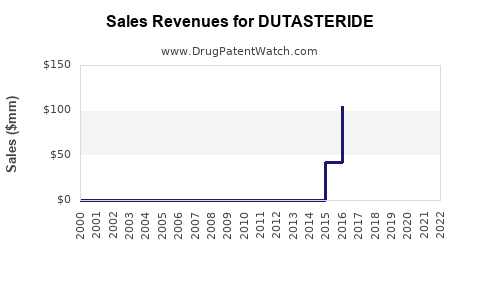
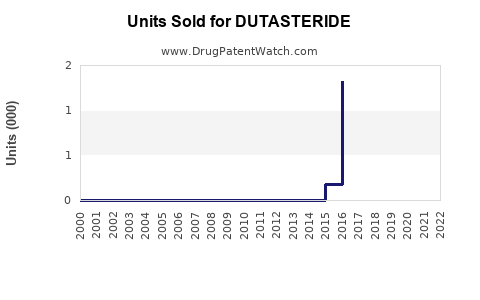
Annual Sales Revenues and Units Sold for DUTASTERIDE
| Drug Name | Revenues (USD) | Units | Year |
|---|---|---|---|
| DUTASTERIDE | ⤷ Start Trial | ⤷ Start Trial | 2022 |
| DUTASTERIDE | ⤷ Start Trial | ⤷ Start Trial | 2021 |
| DUTASTERIDE | ⤷ Start Trial | ⤷ Start Trial | 2020 |
| DUTASTERIDE | ⤷ Start Trial | ⤷ Start Trial | 2019 |
| >Drug Name | >Revenues (USD) | >Units | >Year |
Dutasteride Market Analysis and Sales Projections, 2025-2030
Dutasteride is a mature, largely generic 5-alpha-reductase inhibitor used primarily for benign prostatic hyperplasia (BPH). Its commercial opportunity is shifting from branded prostate treatment to low-cost generic volume, fixed-dose combinations, and off-label androgenetic alopecia use. The global dutasteride market is estimated at approximately $500 million to $750 million in 2024, with a base-case market value of about $620 million. A modeled 2030 range is $650 million to $1.05 billion, depending on growth in hair-loss prescribing, combination products, and emerging-market volume.
The original Avodart franchise no longer controls pricing. Generic competition, low manufacturing costs, and limited regulatory exclusivity constrain revenue per prescription. Growth depends on prescription volume rather than branded price expansion.
What is dutasteride approved to treat?
Dutasteride inhibits both type 1 and type 2 5-alpha-reductase, reducing conversion of testosterone to dihydrotestosterone (DHT). Finasteride primarily inhibits type 2 at the approved BPH dose, giving dutasteride a broader mechanism and stronger DHT suppression.
| Attribute | Dutasteride |
|---|---|
| Active ingredient | Dutasteride |
| Original brand | Avodart |
| Combination brand | Jalyn, dutasteride/tamsulosin |
| Primary FDA indication | BPH |
| FDA-approved dosage | 0.5 mg orally once daily |
| Drug class | 5-alpha-reductase inhibitor |
| FDA approval for male hair loss | No |
| Main approved competitor | Finasteride |
| Common combination use | Dutasteride plus an alpha blocker, especially tamsulosin |
The FDA approved Avodart for the treatment of symptomatic BPH and reduction of the risk of acute urinary retention and BPH-related surgery. Jalyn combines dutasteride with tamsulosin for men with symptomatic BPH and an enlarged prostate [1, 2].
Dutasteride is prescribed off label for male androgenetic alopecia because of its stronger DHT suppression. In several Asian markets, dutasteride has obtained regulatory approval or broad clinical use for hair loss, but the regulatory status differs by country.
How large is the dutasteride market?
Public companies generally do not disclose global dutasteride sales separately from broader generic portfolios. The following market estimate uses prescription volume, generic net pricing, branded residual sales, and combination-product revenue rather than reported company revenue.
| Market segment | Estimated 2024 value | 2030 base-case value | Growth profile |
|---|---|---|---|
| Generic dutasteride monotherapy | $300 million-$425 million | $360 million-$520 million | Low to moderate |
| Dutasteride/tamsulosin combinations | $120 million-$180 million | $160 million-$260 million | Moderate |
| Branded Avodart and regional brands | $25 million-$60 million | $15 million-$35 million | Declining |
| Hair-loss use, including private-pay channels | $70 million-$110 million | $120 million-$230 million | Highest growth |
| Total market | $500 million-$750 million | $650 million-$1.05 billion | Approximately 3%-8% CAGR |
The base-case estimate assumes a 2024 market of $620 million and a 4.8% compound annual growth rate through 2030, producing approximately $820 million in 2030 sales.
What is driving dutasteride market growth?
The most important growth drivers are:
- Generic availability. Low pricing increases access in markets where BPH treatment is paid through public insurance or retail reimbursement.
- Aging male populations. BPH prevalence rises with age, supporting long-term prescription demand.
- Combination therapy. Dutasteride/tamsulosin products retain higher revenue per treatment episode than dutasteride alone.
- Off-label hair-loss use. Dermatology clinics and telehealth providers are expanding use in patients who have inadequate responses to finasteride.
- Emerging-market penetration. India, China, Latin America, Southeast Asia, and the Middle East have large untreated or undertreated BPH populations.
- Long treatment duration. BPH therapy is usually chronic, supporting recurring prescription volume.
The principal constraint is price erosion. Generic dutasteride has limited differentiation, and multiple manufacturers can supply the active ingredient and finished dosage form.
What are the dutasteride sales projections for 2025-2030?
Base-case projection
| Year | Global market estimate | Annual growth | Main commercial assumption |
|---|---|---|---|
| 2024 | $620 million | - | Baseline |
| 2025 | $650 million | 4.8% | Generic volume growth and hair-loss demand |
| 2026 | $682 million | 4.9% | Combination-product expansion |
| 2027 | $715 million | 4.8% | Emerging-market access |
| 2028 | $749 million | 4.8% | Stable BPH volume, higher off-label use |
| 2029 | $785 million | 4.8% | Continued hair-loss prescribing |
| 2030 | $823 million | 4.8% | Mature but expanding generic market |
Scenario analysis
| Scenario | 2024 baseline | 2030 estimate | Implied CAGR | Key conditions |
|---|---|---|---|---|
| Downside | $550 million | $650 million | 2.8% | Faster price erosion and limited regulatory expansion |
| Base case | $620 million | $823 million | 4.8% | Stable BPH demand and moderate hair-loss growth |
| Upside | $700 million | $1.05 billion | 7.0% | Strong telehealth adoption, combination growth, and Asian-market expansion |
The market is more likely to deliver mid-single-digit revenue growth than high-single-digit growth because volume expansion is offset by generic pricing pressure.
Which regions generate the most dutasteride revenue?
North America
The United States is a large prescription market but a difficult pricing environment. Generic dutasteride dominates retail dispensing. Revenue is concentrated in high-volume pharmacy channels, Medicare-related reimbursement, and combination therapy.
The U.S. hair-loss opportunity is commercially significant but not fully captured in prescription datasets because many patients obtain treatment through private dermatology practices, telehealth providers, compounding pharmacies, or cash-pay channels. Dutasteride is not FDA-approved for male pattern hair loss, creating regulatory and promotional limits.
Europe
European demand is driven by aging populations, national reimbursement systems, and generic substitution. Pricing is generally lower than in the United States, but prescription volume is stable. Spain, Italy, France, Germany, and the United Kingdom are important BPH markets.
Asia-Pacific
Asia-Pacific is the highest-growth region. Japan, South Korea, China, and India have large male populations and expanding treatment for both BPH and hair loss. South Korea is particularly relevant for dutasteride hair-loss use. India is important as a manufacturing and generic-export base.
Latin America and the Middle East
These regions offer volume growth but have lower average selling prices and greater exposure to local reimbursement conditions, distributor concentration, and regulatory variation.
| Region | Estimated share of 2024 market | 2025-2030 outlook |
|---|---|---|
| North America | 25%-30% | Low-to-moderate growth |
| Europe | 25%-30% | Stable volume, continuing price pressure |
| Asia-Pacific | 30%-35% | Fastest growth |
| Latin America | 8%-10% | Moderate growth |
| Middle East and Africa | 5%-8% | Small base, selective expansion |
What companies sell dutasteride?
The market includes the original innovator, multinational generic companies, regional pharmaceutical manufacturers, and contract manufacturers.
Key commercial participants include:
- GlaxoSmithKline, the original Avodart and Jalyn holder
- Viatris and its legacy Mylan generic business
- Dr. Reddy’s Laboratories
- Cipla
- Zydus Lifesciences
- Torrent Pharmaceuticals
- Sun Pharmaceutical Industries
- Lupin
- Teva Pharmaceutical Industries
- Sandoz
- Hikma Pharmaceuticals
- Regional manufacturers in China, South Korea, Southeast Asia, Latin America, and the Middle East
Company-level dutasteride revenue is generally not separately reported. A manufacturer’s commercial position depends on product availability, pharmacy contracts, regulatory registrations, API sourcing, and participation in combination products.
What patents protect dutasteride?
The original composition-of-matter and product protection for dutasteride has expired in the United States and major European markets. Generic entry occurred years ago, and the market no longer depends on a primary compound patent.
| IP category | Current commercial relevance |
|---|---|
| Original dutasteride compound patent | Expired in major markets |
| Avodart product protection | Expired or commercially exhausted |
| Dutasteride monotherapy | Broad generic competition |
| Dutasteride/tamsulosin combinations | Formulation and regulatory registrations may differ by jurisdiction |
| Hair-loss methods of use | Limited value where use is off label and not listed as an approved indication |
| Manufacturing processes | Potentially relevant for cost and supply reliability, but not a broad market barrier |
| Drug-device protection | Minimal for standard oral capsules |
The remaining IP value is concentrated in formulation claims, manufacturing processes, specific combination products, and country-level registrations. These rights may delay or complicate entry for an individual manufacturer but do not recreate the market protection held by the original Avodart franchise.
Are there Paragraph IV challenges to dutasteride?
Paragraph IV litigation was most relevant during the initial U.S. generic-entry period. Because dutasteride’s core exclusivity has expired and several generic manufacturers are active, current market risk is primarily commercial rather than patent-based.
Potential disputes may still concern:
- Dutasteride/tamsulosin fixed-dose combinations
- Specific capsule formulations
- Polymorphs or particle-size claims
- Manufacturing processes
- ANDA labeling and method-of-use issues
- Orange Book-listed patents attached to combination products
A new entrant should assess the current FDA Orange Book and individual ANDA litigation records before relying on a specific launch date. The core dutasteride molecule does not present a meaningful U.S. patent barrier.
What is the FDA regulatory status of dutasteride?
Avodart was approved by the FDA in 2001 for BPH. Jalyn was approved in 2010 as a fixed-dose combination of dutasteride and tamsulosin [1, 2].
Dutasteride has no FDA approval for androgenetic alopecia. U.S. prescribing for male hair loss is therefore off label. That status limits direct-to-consumer promotion and prevents manufacturers from making FDA-approved hair-loss claims without conducting the required clinical and regulatory program.
The regulatory situation creates two separate commercial markets:
- A reimbursed, FDA-approved BPH market
- A cash-pay or specialty-prescribing hair-loss market
The second market can grow quickly but has greater compliance and reputational risk.
How does dutasteride compare with finasteride?
| Factor | Dutasteride | Finasteride |
|---|---|---|
| 5-alpha-reductase inhibition | Type 1 and type 2 | Primarily type 2 at BPH dose |
| FDA-approved BPH use | Yes | Yes |
| FDA-approved male hair-loss use | No | Yes, 1 mg formulation |
| Generic pricing | Very low | Very low |
| BPH efficacy positioning | Stronger DHT suppression | Established standard |
| Hair-loss prescribing | Off label in the U.S. | Approved at 1 mg |
| Half-life | Approximately five weeks | Approximately six to eight hours |
| Switching flexibility | Lower because of long persistence | Higher |
| Commercial growth | Combination products and off-label use | Larger established hair-loss market |
Dutasteride can command a clinical preference among some hair-loss prescribers, but finasteride retains the regulatory advantage in the United States. For BPH, dutasteride competes with finasteride, alpha blockers, tadalafil, and surgical interventions.
What formulations are commercially important?
The principal dosage form is the 0.5 mg soft gelatin capsule. The main commercial opportunities are:
- Dutasteride monotherapy capsules
- Dutasteride/tamsulosin modified-release combinations
- Multi-drug BPH regimens
- Regional hair-loss formulations
- Compounded oral or topical preparations
Combination products can produce better commercial economics because they improve adherence and reduce pill burden. Their value depends on regulatory approval, bioequivalence requirements, supply-chain execution, and reimbursement status.
Topical dutasteride has attracted development interest for hair loss, but it remains a technical and regulatory opportunity rather than an established mass-market product. Key barriers include reproducible delivery, systemic exposure control, clinical efficacy, stability, and regulatory classification.
What generic launch risks exist?
A generic dutasteride launch is operationally easier than a novel drug launch but still has several commercial risks:
- Rapid price erosion after additional approvals
- Limited pharmacy shelf space
- API supply interruptions
- Softgel manufacturing complexity
- Bioequivalence failures
- State substitution rules and formulary exclusion
- Low market share without wholesaler access
- Contract-manufacturing dependence
- Limited differentiation in monotherapy
- Product liability exposure associated with reproductive and sexual adverse effects
The most attractive entry strategy is usually not a sixth or seventh undifferentiated monotherapy product. Better opportunities include combination products, difficult-to-source markets, vertically integrated API and finished-dose supply, or differentiated hair-loss channels that comply with local regulations.
What is the revenue exposure to patent expiry?
The patent expiry impact has already been realized. Original-brand revenue declined as generic competition expanded, while total patient treatment volume remained comparatively resilient.
| Revenue source | Patent-expiry exposure | Current outlook |
|---|---|---|
| Avodart branded sales | Very high | Small residual market |
| Jalyn branded sales | High | Regional and reimbursement dependent |
| Generic dutasteride | Low | Volume growth, price pressure |
| Combination products | Moderate | More defensible than monotherapy |
| Hair-loss prescribing | Low patent exposure | Demand-led expansion |
| API manufacturing | Low patent exposure | Cost and quality competition |
The key investment question is no longer whether a generic can enter. It is whether the manufacturer can achieve sufficient volume and margin after entry.
How strong is the dutasteride market outlook?
The market outlook is moderately positive for volume and modest for revenue. BPH creates durable demand, but generic pricing caps upside. Hair-loss prescribing supplies the strongest growth vector, especially in Asia-Pacific and private-pay channels.
The base case assumes:
- BPH prescription volume grows 2%-3% annually
- Generic net pricing declines 1%-3% annually
- Dutasteride/tamsulosin combinations grow 5%-8% annually
- Hair-loss use grows 8%-12% annually from a smaller base
- Branded Avodart revenue continues to decline
- No new FDA-approved hair-loss indication materially changes U.S. demand
Key Takeaways
- The global dutasteride market is estimated at $500 million-$750 million in 2024.
- A base-case projection reaches approximately $823 million by 2030.
- Generic BPH treatment remains the largest revenue source.
- Dutasteride/tamsulosin combinations offer better commercial economics than monotherapy.
- Hair-loss use is the fastest-growing segment but is off label in the United States.
- Original Avodart patent protection is no longer a meaningful market barrier.
- Pricing, distribution, API supply, and regulatory execution matter more than core patent risk.
- Asia-Pacific offers the strongest growth potential.
- Finasteride retains the U.S. regulatory advantage in male pattern hair loss.
- A differentiated combination product or regional hair-loss strategy is more attractive than another undifferentiated generic capsule.
FAQs About Dutasteride Market Size and Sales
Is dutasteride a billion-dollar drug?
No. The current global market is estimated below $1 billion. An upside scenario could approach or exceed $1 billion by 2030 if hair-loss prescribing and combination products expand materially.
Does Avodart still generate significant revenue?
Avodart has residual sales, but generic dutasteride has replaced the original branded product across most major markets. Current commercial value is concentrated in generic and combination products.
Is dutasteride approved for hair loss in the United States?
No. Dutasteride is FDA-approved for BPH, not androgenetic alopecia. U.S. hair-loss prescribing is off label.
Which is commercially stronger, dutasteride or finasteride?
Finasteride has the stronger U.S. commercial position in hair loss because the 1 mg product is FDA-approved. Dutasteride has a stronger pharmacologic profile for DHT suppression and can be commercially attractive in BPH combinations and selected international hair-loss markets.
Can a new generic manufacturer still enter the dutasteride market?
Yes. The core patent barrier has expired. Commercial entry depends on FDA approval, bioequivalence, manufacturing capacity, API supply, pharmacy access, and the ability to withstand rapid generic price erosion.
References
- U.S. Food and Drug Administration. (2001). Avodart (dutasteride) prescribing information.
- U.S. Food and Drug Administration. (2010). Jalyn (dutasteride and tamsulosin hydrochloride) prescribing information.
- U.S. Food and Drug Administration. (2024). Orange Book: Approved drug products with therapeutic equivalence evaluations.
- U.S. Food and Drug Administration. (2024). Drugs@FDA: FDA-approved drug database.
- GlaxoSmithKline plc. (2001-2024). Annual reports and product information for Avodart and Jalyn.
- DailyMed. (2024). Dutasteride capsule and dutasteride/tamsulosin capsule labeling.
- European Medicines Agency. (2024). Medicines for benign prostatic hyperplasia and related product information.
More… ↓
