Drug Sales Trends for CREON
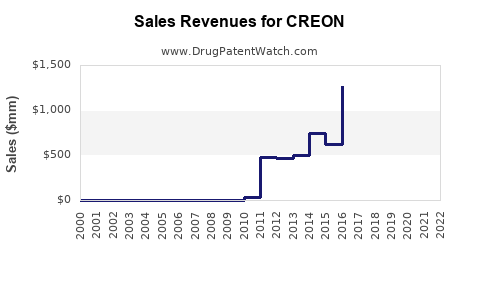
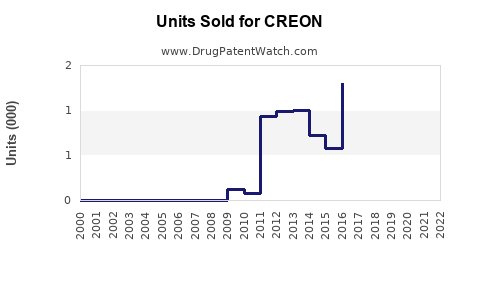
Annual Sales Revenues and Units Sold for CREON
| Drug Name | Revenues (USD) | Units | Year |
|---|---|---|---|
| CREON | ⤷ Start Trial | ⤷ Start Trial | 2022 |
| CREON | ⤷ Start Trial | ⤷ Start Trial | 2021 |
| CREON | ⤷ Start Trial | ⤷ Start Trial | 2020 |
| CREON | ⤷ Start Trial | ⤷ Start Trial | 2019 |
| >Drug Name | >Revenues (USD) | >Units | >Year |
CREON Market Analysis, Sales Projections, Patent Exclusivity, and Generic Entry Risk
CREON, AbbVie’s pancrelipase delayed-release product, is a leading prescription pancreatic enzyme replacement therapy for exocrine pancreatic insufficiency. Its market is supported by chronic use, limited therapeutic substitution, and a concentrated patient population that includes people with cystic fibrosis, chronic pancreatitis, and pancreatic surgery-related insufficiency. AbbVie reported approximately $1.2 billion in CREON net revenue in 2023. A base-case model projects global CREON sales rising to about $1.6 billion by 2029, with growth slowing as generic pancrelipase availability expands and supply constraints ease. [1]
What is CREON and which patients use it?
CREON contains pancrelipase, a mixture of porcine-derived pancreatic enzymes: lipase, amylase, and protease. The product is formulated as delayed-release capsules containing enteric-coated microspheres. It is taken with meals and snacks to replace pancreatic enzymes that are insufficient for fat, protein, and carbohydrate digestion. [2]
CREON is approved for the treatment of exocrine pancreatic insufficiency caused by:
- Cystic fibrosis
- Chronic pancreatitis
- Pancreatectomy
- Other pancreatic diseases associated with inadequate enzyme secretion
The main commercial demand drivers are chronic treatment duration, increasing diagnosis of pancreatic disease, improved cystic fibrosis survival, and broader use after pancreatic surgery.
How does CREON compare with competing pancreatic enzyme products?
| Product | Company | Active ingredient | Dosage form | Principal commercial position |
|---|---|---|---|---|
| CREON | AbbVie | Pancrelipase | Delayed-release capsules | Broadly used branded product |
| Zenpep | Nestlé Health Science / VIVUS legacy asset | Pancrelipase | Delayed-release capsules | Major branded competitor |
| Pertzye | Nestlé Health Science | Pancrelipase | Delayed-release capsules | Niche differentiated formulation |
| Pancreaze | Vivus / legacy Digestive Care asset | Pancrelipase | Delayed-release capsules | Branded alternative |
| Viokace | AbbVie | Pancrelipase | Non-enteric-coated tablets | Used with a proton-pump inhibitor |
| Generic pancrelipase | Multiple manufacturers | Pancrelipase | Delayed-release capsules | Price-based competitive threat |
CREON and Zenpep compete most directly because both are delayed-release pancrelipase capsules used across similar indications. Prescribers generally titrate treatment according to lipase units per meal and patient response. Interchangeability is limited by differences in enzyme activity, formulation, capsule strengths, and dosing instructions.
How large is the CREON market?
The pancreatic enzyme replacement therapy market is a specialized prescription market with high treatment persistence. CREON is one of AbbVie’s largest non-immunology products and has a stronger commercial position than most other digestive-care assets.
AbbVie’s reported CREON sales have benefited from:
- Long-term treatment requirements.
- High disease-specific demand from cystic fibrosis patients.
- Limited availability of clinically comparable non-enzyme substitutes.
- Brand familiarity among gastroenterologists and cystic fibrosis specialists.
- A broad range of lipase strengths and capsule presentations.
The market remains concentrated. AbbVie, Nestlé Health Science, and several generic manufacturers control most branded and generic supply. The number of manufacturers is higher than the number of products with substantial prescriber recognition.
What are CREON’s historical sales?
| Fiscal year | Estimated or reported CREON sales | Market interpretation |
|---|---|---|
| 2021 | Approximately $0.9 billion | Expanding chronic-use base |
| 2022 | Approximately $1.0 billion | Continued growth and pricing contribution |
| 2023 | Approximately $1.2 billion | Strong demand and higher product revenue |
| 2024 | Approximately $1.3 billion to $1.5 billion modeled range | Growth supported by demand, with supply limitations |
| 2025 | $1.4 billion to $1.5 billion base-case estimate | Slower growth as generic competition increases |
The 2021-2023 figures are based on AbbVie product disclosures and company reporting categories. AbbVie’s reporting may include geographic and accounting changes that affect year-to-year comparability. [1]
What are CREON sales projections through 2029?
The following projection uses 2023 revenue of approximately $1.2 billion as the base and assumes continued patient growth, modest price increases, gradual generic substitution, and normalization of supply conditions.
| Year | Bear case | Base case | Bull case |
|---|---|---|---|
| 2024 | $1.25B | $1.40B | $1.50B |
| 2025 | $1.25B | $1.46B | $1.62B |
| 2026 | $1.23B | $1.50B | $1.72B |
| 2027 | $1.20B | $1.54B | $1.80B |
| 2028 | $1.17B | $1.58B | $1.87B |
| 2029 | $1.14B | $1.62B | $1.93B |
What drives the base-case forecast?
The base case assumes:
- Low-single-digit annual growth in treated patients.
- Stable use in cystic fibrosis and chronic pancreatitis.
- Moderate price and mix benefits.
- Limited but increasing generic substitution.
- No major loss of branded access in commercial insurance.
- Continued supply availability after reported pancrelipase shortages.
- No material acquisition, divestiture, or regulatory event affecting the product.
The base case implies a compound annual growth rate of roughly 5% from 2023 to 2029. The bear case reflects rapid generic adoption and sustained payer pressure. The bull case assumes continued branded preference, strong diagnosis growth, and limited generic penetration.
When does CREON lose exclusivity?
CREON’s commercial exclusivity is determined by a combination of patents, FDA regulatory exclusivity, formulation differentiation, and manufacturing complexity. FDA approval alone does not provide permanent protection because pancrelipase is an established active ingredient and generic applicants can pursue abbreviated approval pathways.
CREON does not depend on a single, long-dated active-ingredient patent. Its protection has historically been associated with:
- Delayed-release microsphere formulations.
- Enzyme stabilization.
- Capsule and dosage-strength configurations.
- Manufacturing processes.
- Product-specific bioavailability and performance characteristics.
- Method-of-use protection for pancreatic insufficiency.
FDA regulatory exclusivity for the original product is no longer the principal barrier to generic competition. The practical protection is the combined effect of listed patents, formulation know-how, supplier qualification, clinical substitution friction, and manufacturing controls. [2, 3]
What patents protect CREON?
CREON-related patent protection has generally focused on pancrelipase formulation and delivery rather than ownership of pancrelipase itself. Relevant patent categories include:
| Patent category | Commercial relevance | Generic-entry effect |
|---|---|---|
| Delayed-release microspheres | Controls enzyme release in the gastrointestinal tract | May require a different formulation or non-infringement position |
| Enteric coating | Protects enzyme activity from gastric acid | Affects dissolution and product performance |
| Stabilized enzyme composition | Improves shelf life and potency | Can create manufacturing and formulation barriers |
| Capsule strength and dose presentation | Supports clinical titration | Usually weaker as a standalone barrier |
| Method-of-use patents | Covers treatment of pancreatic insufficiency | Paragraph IV litigation risk depends on listing and enforceability |
| Manufacturing processes | Protects particle formation, coating, and enzyme blending | May be difficult to design around at commercial scale |
The current Orange Book should be used for the controlling patent numbers, expiration dates, and use codes because listings can change through patent expiration, delisting, statutory disclaimers, and FDA administrative updates. [3] The commercial risk is less dependent on the existence of one composition patent than on whether an abbreviated new drug application can establish equivalent performance without infringing enforceable formulation claims.
What is the Orange Book status of CREON?
CREON is an FDA-approved prescription product listed under AbbVie’s pancrelipase product franchise. Its Orange Book status is relevant because generic applicants may certify against listed patents under Paragraph IV of the Hatch-Waxman Act. [3]
A generic applicant can use several certification strategies:
- Paragraph I: No patent information is listed.
- Paragraph II: Listed patents have expired.
- Paragraph III: The applicant will wait for patent expiration.
- Paragraph IV: The listed patent is invalid, unenforceable, or not infringed.
- Section viii statement: The applicant seeks approval without a patented method of use.
For CREON, a Paragraph IV challenge would most directly target formulation, release, coating, or manufacturing claims. The applicant would also need to satisfy FDA requirements for demonstrating pharmaceutical equivalence and comparable enzyme activity.
Which companies are challenging CREON with generics?
Generic pancrelipase competition has expanded through FDA approvals and abbreviated applications covering delayed-release capsule products. Generic entrants can compete on acquisition cost, reimbursement, and pharmacy substitution, but substitution is not automatic in every treatment setting.
The principal competitive groups are:
- Established generic drug manufacturers with enzymatic-product manufacturing capacity.
- Companies developing delayed-release pancrelipase capsules.
- Branded competitors seeking formulary preference.
- Specialty-pharmacy suppliers serving cystic fibrosis and gastrointestinal patients.
The commercial effect of generic entry depends on whether payers mandate substitution, whether pharmacies can automatically substitute the product, and whether physicians maintain a brand preference because of dosing response or patient stability.
What generic launch scenarios exist for CREON?
| Scenario | Likely market effect | Estimated CREON risk |
|---|---|---|
| One generic entrant with limited capacity | Discounts are selective; brand retains substantial share | Low to moderate |
| Two or more reliable generic suppliers | Payers increase substitution and rebate pressure | Moderate |
| Broad generic supply with automatic substitution | Rapid erosion in commodity segments | High |
| Generic shortages or inconsistent availability | Prescribers and pharmacies retain brand use | Lower than expected |
| Formulation differences limit substitution | Brand remains important in stable patients | Moderate |
The most likely outcome is a gradual erosion rather than an immediate collapse. Pancrelipase is a chronic therapy, but dose conversion and patient response can make prescribers cautious about switching stable patients.
What patent litigation affects CREON?
CREON litigation risk is concentrated in Hatch-Waxman cases involving Paragraph IV certifications. The principal legal questions are likely to include:
- Whether delayed-release formulation claims are infringed.
- Whether the asserted claims are valid over earlier pancrelipase formulations.
- Whether the generic product has the same release profile.
- Whether the patent claims cover a product characteristic or a manufacturing step.
- Whether method-of-use claims remain relevant after a Section viii carve-out.
The most important commercial litigation outcome is not only a judgment but also the timing and terms of any settlement. A settlement may allow an authorized generic, a licensed generic, or a delayed generic launch before the latest patent expiration date.
No settlement should be assumed to establish an early generic launch unless the agreement, court docket, and FDA approval status confirm it.
How strong is the CREON patent estate?
CREON’s patent estate is best characterized as moderate, with stronger practical protection than active-ingredient protection.
Strengths
- Chronic-use patient population.
- Complex delayed-release formulation.
- Multiple dosage strengths.
- Manufacturing and coating know-how.
- Clinical reluctance to switch stable patients.
- Concentrated specialist prescribing.
Weaknesses
- Pancrelipase is an established active ingredient.
- FDA generic pathways are available.
- Formulation patents can face obviousness and enablement challenges.
- Generic applicants can design around individual claims.
- Payers have incentives to reduce enzyme replacement costs.
- Product shortages can weaken the value of brand preference if alternatives become more available.
CREON’s strongest protection is operational and clinical. Its weakest protection is exclusivity based solely on the active ingredient.
What FDA regulatory issues affect CREON?
CREON is regulated as a prescription pancreatic enzyme replacement product. The key FDA issues are product quality, enzyme potency, dissolution, delayed-release performance, and manufacturing consistency.
Pancrelipase products are more technically complex than many conventional small-molecule tablets because they contain biological enzyme mixtures with multiple activity measurements. Relevant quality attributes include:
- Lipase, amylase, and protease potency.
- Particle-size distribution.
- Enteric-coating integrity.
- Dissolution at different pH levels.
- Stability during storage.
- Batch-to-batch enzyme activity.
- Microbial and raw-material controls.
The FDA has previously identified pancrelipase supply constraints and shortage conditions. Supply disruptions can temporarily increase CREON demand and reduce the pace of generic substitution. [4]
What formulations are protected by CREON patents?
The principal CREON formulation is an enteric-coated, delayed-release microsphere delivered in capsules. The design is intended to protect pancreatic enzymes from gastric acid and release them in the small intestine.
Commercially relevant formulation characteristics include:
- Delayed release after gastric transit.
- Multiple lipase-unit strengths.
- Capsule contents that can be opened and mixed with soft acidic food when permitted by labeling.
- Protection from premature enzyme degradation.
- Consistent enzyme activity across meal sizes.
Formulation differences can affect physician willingness to switch patients. A generic product may meet FDA equivalence standards while still requiring changes in counseling, administration, dosing, or insurance authorization.
How does CREON compare with Zenpep and Pertzye?
| Factor | CREON | Zenpep | Pertzye |
|---|---|---|---|
| Market position | Large branded franchise | Major branded competitor | Smaller differentiated product |
| Formulation | Delayed-release pancrelipase microspheres | Delayed-release pancrelipase | Delayed-release pancrelipase |
| Main use | Broad EPI population | Broad EPI population | Selected patients and specialists |
| Generic exposure | Increasing | Increasing | Increasing but smaller base |
| Payer leverage | Significant brand volume | Significant competitor | More limited scale |
| Switching risk | Moderate | Moderate | Higher in lower-volume accounts |
CREON has the largest commercial base among the products compared here, which creates both advantages and risks. Scale supports distribution and physician familiarity, but it also makes CREON the primary target for generic substitution and payer cost controls.
What is CREON’s revenue exposure for AbbVie?
CREON is strategically important because it provides diversification from AbbVie’s major immunology and oncology products. Its revenue is smaller than Humira and Skyrizi-related sales but large enough to affect company growth and specialty-pharmaceutical earnings.
Key exposure points include:
- Dependence on the U.S. market.
- Sensitivity to pharmacy benefit manager coverage.
- Exposure to generic pancrelipase launches.
- Supply-chain dependence on enzyme raw materials.
- Reimbursement pressure in chronic gastrointestinal therapy.
- Potential margin compression if rebates increase.
A 20% decline from a $1.5 billion revenue base would reduce annual sales by approximately $300 million. A 40% decline would imply a reduction of approximately $600 million. The earnings effect would depend on manufacturing margins, rebates, and whether AbbVie retains a premium branded mix.
What geographic markets are important for CREON?
The United States is the principal commercial market because of its large diagnosed cystic fibrosis population, high prescription spending, and extensive use of specialty pharmacy distribution. European and other developed markets contribute additional sales but generally have stronger price controls and lower net prices.
| Region | Market characteristics |
|---|---|
| United States | Highest revenue opportunity; strongest generic and payer risk |
| Europe | Lower net pricing; country-specific reimbursement |
| Canada | Smaller market with public-payer controls |
| Asia-Pacific | Variable diagnosis and reimbursement; longer-term growth opportunity |
| Emerging markets | Lower pricing and limited access to enzyme replacement therapy |
CREON’s geographic growth opportunity is constrained by diagnosis rates, reimbursement, cold-chain or controlled storage requirements where applicable, and local availability of pancreatic enzymes.
What manufacturing and intellectual-property barriers affect generic entry?
The main manufacturing barriers are not the availability of pancrelipase as a raw material. They are the ability to produce a stable, reproducible delayed-release product with consistent enzyme activity.
Generic manufacturers must manage:
- Sourcing of porcine pancreatic material.
- Enzyme extraction and purification.
- Potency normalization.
- Microsphere formation.
- Enteric coating.
- Dissolution testing.
- Stability and packaging.
- Commercial-scale batch consistency.
These barriers can delay launch or restrict supply even after FDA approval. They also create a risk that several approved products will not all maintain continuous market availability.
Key Takeaways
- CREON is a leading pancrelipase product for exocrine pancreatic insufficiency.
- AbbVie reported approximately $1.2 billion in CREON revenue in 2023.
- A base-case projection reaches approximately $1.6 billion by 2029.
- Growth is supported by chronic use, cystic fibrosis demand, and limited therapeutic substitution.
- Generic pancrelipase is the main long-term threat.
- Patent protection is concentrated in delayed-release formulations, coatings, manufacturing processes, and use claims.
- CREON’s practical exclusivity is stronger than its active-ingredient exclusivity.
- FDA shortage conditions can temporarily support branded demand.
- Generic entry is likely to produce gradual erosion rather than an immediate loss of most revenue.
- A 20% revenue decline from a $1.5 billion base would reduce AbbVie sales by approximately $300 million annually.
FAQs
Is CREON a biologic drug?
No. CREON is a prescription pancreatic enzyme product containing pancrelipase, a mixture of digestive enzymes. It is not regulated as a biosimilar reference product.
Can pharmacies automatically substitute generic pancrelipase for CREON?
Substitution depends on state law, FDA product ratings, payer policy, and the specific product strength. Generic availability does not guarantee automatic substitution in every prescription or market.
Does CREON have orphan-drug exclusivity?
CREON’s commercial position is not primarily based on current orphan-drug exclusivity. Its protection depends more heavily on formulation patents, manufacturing controls, product familiarity, and chronic treatment demand.
Why can CREON remain expensive when pancrelipase is an old active ingredient?
The active ingredient is established, but commercial pancrelipase requires controlled enzyme potency, delayed-release performance, specialized manufacturing, and regulatory testing. Those requirements limit the number of reliable suppliers.
What would cause CREON sales to decline faster than projected?
The largest downside risks are multiple reliable generic launches, automatic pharmacy substitution, aggressive payer exclusion, sustained supply recovery among generic manufacturers, or a patent settlement that permits early generic entry.
References
- AbbVie Inc. (2024). 2023 annual report. AbbVie.
- U.S. Food and Drug Administration. (2023). CREON (pancrelipase) delayed-release capsules prescribing information. FDA.
- U.S. Food and Drug Administration. (2024). Approved drug products with therapeutic equivalence evaluations: Orange Book. FDA.
- U.S. Food and Drug Administration. (2024). Drug shortages: Pancrelipase delayed-release capsules. FDA.
More… ↓
