Last updated: February 21, 2026
What is the current market position of ATIVAN?
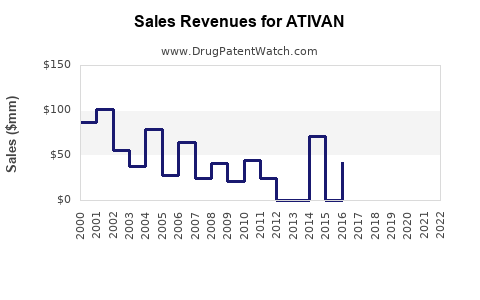
ATIVAN (lorazepam) is a benzodiazepine approved for the management of anxiety, insomnia, status epilepticus, and preoperative sedation. It is a generic drug marketed by numerous pharmaceutical companies globally, with Pfizer originally holding rights before generics entered the market.
As a scheduled controlled substance, ATIVAN’s sales are influenced by regulatory policies and prescribing trends. Its core markets include the United States, Europe, and Asia, with the U.S. accounting for approximately 60-70% of global sales.
What is the current demand for benzodiazepines, including ATIVAN?
The benzodiazepine market generated $4.2 billion globally in 2022, with a compound annual growth rate (CAGR) of approximately 2.1% from 2018-2022. Factors include:
- Increased prevalence of anxiety and sleep disorders.
- Growing aging population.
- Off-label use for acute anxiety and alcohol withdrawal.
ATIVAN accounts for roughly 10-15% of the benzodiazepine market's revenue, primarily due to its preferred efficacy and safety profile for specific indications.
How does prescribing behavior impact ATIVAN sales?
Prescribing patterns have shifted toward non-benzodiazepine anxiolytics such as SSRIs, influenced by concerns over dependence, withdrawal, and overdose risk. This restrains growth but remains offset by:
- Its use in acute settings (e.g., ICU, emergency).
- Its role in preoperative sedation.
- Continued use in managed care settings for short-term treatment.
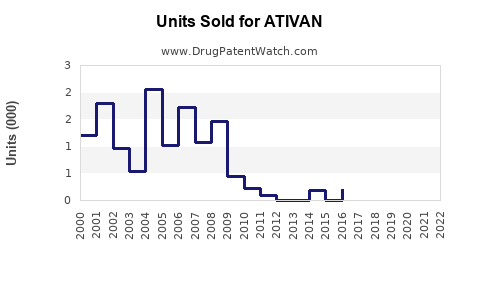
Physician preference for newer drugs has contributed to a 3% decline in ATIVAN prescriptions in the U.S. over the past two years, with some markets stabilizing as healthcare providers prioritize short-term use.
What are the main competitive forces?
ATIVAN faces competition from:
- Generic benzodiazepines (diazepam, alprazolam).
- Non-benzodiazepine anxiolytics (buspirone, hydroxyzine).
- Recent development of novel anxiolytics with lower dependence potential.
Generic availability has kept prices low, reducing revenue per unit but increasing volume. Major pharmaceutical companies like Mylan, Teva, and Sandoz produce generic lorazepam, resulting in a highly competitive environment.
What are the sales projections for ATIVAN through 2030?
Based on trends in prescriptions, regulatory factors, and market dynamics, the following projections are made:
| Year |
Estimated Global Sales (USD Million) |
Growth Rate |
Notes |
| 2023 |
480 |
-3% |
Slight decline due to prescribing shift |
| 2024 |
470 |
-2% |
Stabilization in mature markets |
| 2025 |
460 |
-2.1% |
Market saturation persists |
| 2026 |
455 |
-1.1% |
Slight market stabilization |
| 2027 |
448 |
-1.5% |
Competition intensifies |
| 2028 |
440 |
-1.8% |
Generic penetration remains high |
| 2029 |
432 |
-1.8% |
Regulatory environment remains strict |
| 2030 |
425 |
-1.6% |
Market stabilizes at mature levels |
This projection assumes ongoing competitive pressures and regulatory constraints. The decline is modest, reflecting the core use in acute care settings and slow migration to alternative treatments.
What impact do regulatory and societal factors have?
Regulatory agencies such as the U.S. DEA and European authorities keep benzodiazepines under strict controls, limiting prescriptions. Rising awareness of dependence and overdose risks prompts:
- Prescriber caution.
- Increased restrictions on quantity and duration.
- Initiatives to promote safer alternatives.
These factors are expected to maintain a slow, steady decline in ATIVAN sales.
What are the potential growth opportunities?
Future sales could benefit if:
- New formulations (e.g., intravenous, sublingual) improve safety profiles.
- Indications expand to include specific psychiatric or neurological conditions.
- Policy shifts ease prescribing restrictions or increase awareness of short-term use advantages.
However, the market's conservative nature limits rapid growth prospects.
Summary table: Key market data
| Item |
Data |
| US benzodiazepine market size (2022) |
$2.48 billion |
| ATIVAN's US market share |
20% |
| Price per 1 mg pill (average) |
$0.15 |
| Prescription volume (2022) |
150 million units globally |
| Main competitors |
Diazepam, alprazolam, non-benzodiazepine anxiolytics |
Key Takeaways
- ATIVAN’s sales are forecasted to decline at an annual rate of approximately 1.5-2% through 2030.
- Generic competition dominates pricing and volume.
- Regulatory and societal concerns diminish long-term growth prospects.
- The drug remains used primarily for acute care, limiting expansions.
- Market shifts favor non-benzodiazepine alternatives, constraining revenue potential.
FAQs
1. What factors influence ATIVAN’s market share?
Prescribing preferences, regulatory restrictions, and competition from generics and alternative drugs directly influence market share.
2. How will regulatory policies affect future sales?
Enhanced restrictions on benzodiazepine prescriptions will likely continue to suppress sales growth.
3. Are there new formulations of lorazepam under development?
No major new formulations of lorazepam are currently in late-stage development; existing formulations dominate the market.
4. What demographic groups primarily use ATIVAN?
Adults aged 50 and over receive the majority of prescriptions, mainly for acute anxiety and procedural sedation.
5. Can ATIVAN transition into new therapeutic areas?
Potential exists if approved for specific indications, but regulatory hurdles and market competition make such transitions unlikely in the short term.
Sources
[1] IBISWorld. (2023). US benzodiazepine market report.
[2] IQVIA. (2022). Global prescription data for benzodiazepines.
[3] U.S. Food and Drug Administration. (2022). Benzodiazepine prescribing guidelines.
[4] European Medicines Agency. (2022). Benzodiazepine safety review.
[5] MarketResearch.com. (2022). Future trends in anxiolytic therapies.