Last updated: February 13, 2026
What is Imiquimod and Its Market Position?
Imiquimod is an immune response modifier approved primarily for treating actinic keratosis, superficial basal cell carcinoma, external genital warts, and some other dermatologic conditions. Marketed under brands such as Aldara and Zyclara, it functions by activating toll-like receptor 7, prompting cytokine production that enhances immune response against abnormal cells.
Key Market Data and Approvals
- FDA Approval: 1997 for external genital warts.
- Other Regulatory Clearances: Approved in over 50 countries for various indications.
- Indications Expansion: Off-label uses include treatment of certain HPV-related lesions and possibly melanoma in situ.
Market Size and Revenue
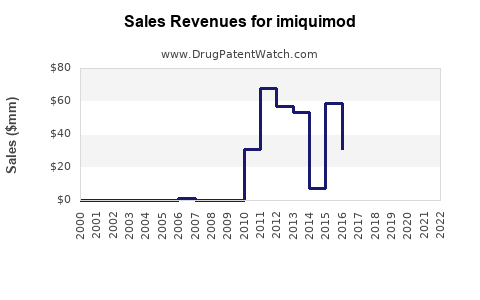
The global market for Imiquimod was valued at approximately $400 million in 2022. The primary revenue drivers include dermatology and HPV treatment sectors. The United States accounts for roughly 60% of sales, with Europe representing 20% and the remaining 20% spread across other regions.
Sales Distribution by Region (2022)
| Region |
Percentage of Total Sales |
Estimated Revenue (USD millions) |
| United States |
60% |
240 |
| Europe |
20% |
80 |
| Asia-Pacific |
10% |
40 |
| Other Regions |
10% |
40 |
Market Trends
- Growing prevalence of HPV-related diseases sustains demand.
- Increased off-label use in dermatology.
- Competition from alternative treatments like cryotherapy, surgeries, and newer pharmaceuticals.
Sales Projections and Future Outlook
Short-Term (Next 3 Years, 2023-2025)
- Compound Annual Growth Rate (CAGR): Estimated at 4-6%, driven by increased awareness and expanding off-label applications.
- Market Expansion Factors: Launches in emerging markets, especially in Asia and Latin America; novel dermatology indications.
Long-Term (2026-2030)
- Projected Market Size: Could reach approximately $500-$550 million by 2030, assuming ongoing expansion.
- Potential Growth Catalysts:
- New indications and combination therapies.
- Patent expirations of key formulations (e.g., Aldara in 2022 in some regions) could influence pricing and market share.
- Rising HPV infection rates and skin cancer incidences globally.
Competitive Landscape
Major competitors include:
- Podophyllotoxin: Topical treatment for genital warts.
- 5-Fluorouracil: Used in actinic keratosis.
- Phototherapies and Cryotherapy: For skin lesions.
Novel agents and biosimilars could further impact sales trends.
Regulatory and Market Dynamics Impacting Sales
- Patent Expiries: Several formulations near patent expiry, risking entry of generics.
- Pricing Pressures: Especially in Europe due to healthcare cost containment.
- Patient Compliance: Preference for less invasive, convenient options influences market share.
- Research Advances: Promising developments in immunotherapy for skin cancers might redefine the role of Imiquimod.
Sensitivity Analysis
Estimations depend on factors such as:
- Disease prevalence.
- Regulatory environment.
- Competition intensity.
- Off-label use expansion.
For example, a 10% decrease in HPV prevalence or improved generic penetration could reduce market size projections.
Key Takeaways
- Imiquimod remains a significant dermatologic immunotherapy with a stable base in HPV and skin cancer treatments.
- The market is experiencing moderate growth, with potential for expansion through new indications and geographic penetration.
- Patent expiries and competition from newer therapies present risks to sustained revenues.
- Strategic positioning in emerging markets could drive future sales growth.
FAQs
Q1: What are the primary indications for Imiquimod?
It treats actinic keratosis, superficial basal cell carcinoma, external genital warts, and off-label dermatologic conditions.
Q2: What is the current market size for Imiquimod?
Approximately $400 million globally in 2022.
Q3: What factors influence future sales growth?
Market expansion in emerging regions, new indications, off-label use, and competition from generics and novel treatments.
Q4: How do patent expiries affect Imiquimod’s sales?
Patent expiries typically lead to generic entry, reducing prices and market dominance for branded formulations.
Q5: What are the main competitive therapies?
Podophyllotoxin, 5-fluorouracil, cryotherapy, laser therapy, and emerging immunotherapies.
References
[1] Market data sourced from Global Market Insights, 2022.
[2] FDA approval records, 1997.
[3] Pharmaceutical patent expiry databases, 2022.
[4] Industry reports on dermatologic treatment trends, 2022.