Share This Page
Drug Sales Trends for PROPRANOLOL
✉ Email this page to a colleague
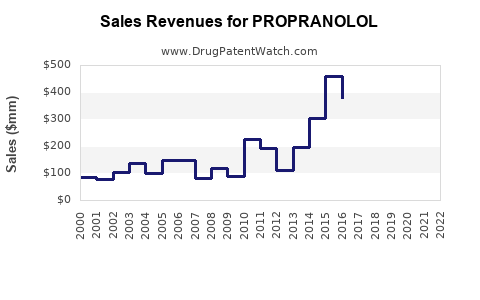
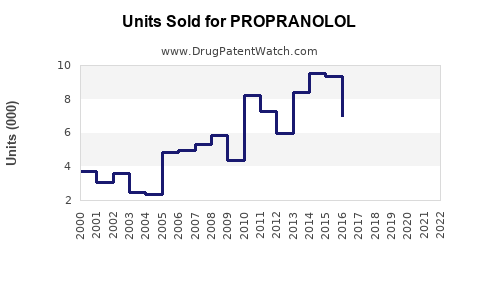
Annual Sales Revenues and Units Sold for PROPRANOLOL
| Drug Name | Revenues (USD) | Units | Year |
|---|---|---|---|
| PROPRANOLOL | ⤷ Start Trial | ⤷ Start Trial | 2022 |
| PROPRANOLOL | ⤷ Start Trial | ⤷ Start Trial | 2021 |
| PROPRANOLOL | ⤷ Start Trial | ⤷ Start Trial | 2020 |
| PROPRANOLOL | ⤷ Start Trial | ⤷ Start Trial | 2019 |
| PROPRANOLOL | ⤷ Start Trial | ⤷ Start Trial | 2018 |
| PROPRANOLOL | ⤷ Start Trial | ⤷ Start Trial | 2017 |
| PROPRANOLOL | ⤷ Start Trial | ⤷ Start Trial | 2016 |
| >Drug Name | >Revenues (USD) | >Units | >Year |
Propranolol Market Analysis, Sales Projections, Patent Risk, and Competitive Outlook
Propranolol is a mature, largely generic beta blocker with limited pricing power and broad global use in hypertension, arrhythmia, migraine prevention, essential tremor, anxiety-related symptoms, thyrotoxicosis, and infantile hemangioma. The commercial opportunity is concentrated in three areas: high-volume generic tablets, differentiated pediatric oral solution, and hospital or specialty formulations.
The global propranolol market is estimated at approximately $250 million to $400 million in 2024 sales across finished pharmaceutical products. A base-case model projects revenue of $300 million to $450 million by 2030, equivalent to roughly 2% to 4% annual growth. Unit demand should grow faster than revenue because generic price erosion offsets volume expansion.
What is the current market size for propranolol?
Propranolol revenue is fragmented across generic manufacturers, national distributors, hospital suppliers, and branded or specialty products. No single company reports consolidated global propranolol sales because the active ingredient is sold through multiple generic channels.
| Market segment | Estimated 2024 revenue | Growth outlook |
|---|---|---|
| Generic immediate-release tablets | $130 million-$190 million | Low growth; price erosion |
| Generic extended-release capsules or tablets | $45 million-$75 million | Stable to modest growth |
| Pediatric oral solution | $45 million-$80 million | Above-market growth |
| Hospital, extemporaneous, and specialty formulations | $30 million-$55 million | Stable |
| Emerging-market branded products | $20 million-$40 million | Volume-led growth |
| Total estimated market | $250 million-$400 million | 2%-4% annual revenue growth |
These figures represent an analytical market model based on product availability, prescription use, generic pricing, and specialty-product positioning. They are not reported consolidated manufacturer sales.
Propranolol hydrochloride is listed in multiple dosage forms, including 10 mg, 20 mg, 40 mg, 60 mg, and 80 mg tablets, extended-release capsules, oral solutions, and concentrated solutions. The broad dosage range supports continued use in primary care and specialty medicine but limits differentiation among conventional products.
What are the main clinical uses driving propranolol demand?
The largest demand base is chronic cardiovascular treatment, but the strongest growth areas are outside traditional hypertension management.
Cardiovascular indications
Propranolol is used for:
- Hypertension
- Angina pectoris
- Cardiac arrhythmias
- Hypertrophic subaortic stenosis
- Post-myocardial-infarction risk reduction
- Pheochromocytoma management as part of combination therapy
Generic cardiovascular use produces predictable volume but limited revenue because multiple suppliers compete on price. Propranolol has also lost share in some hypertension segments to newer beta blockers, including metoprolol, carvedilol, bisoprolol, and nebivolol.
Neurology and behavioral indications
Propranolol is widely used for migraine prophylaxis and essential tremor. It is also prescribed off-label for performance anxiety and selected autonomic symptoms.
These uses support persistent demand because propranolol is inexpensive, familiar to clinicians, and available in flexible strengths. Off-label use creates limited opportunities for exclusive commercialization because the underlying indications generally cannot support meaningful patent protection.
Infantile hemangioma
Infantile hemangioma is the most commercially differentiated use. Hemangeol, a propranolol hydrochloride oral solution, was approved by the FDA in 2014 for the treatment of proliferating infantile hemangioma requiring systemic therapy.[1]
The pediatric product has several commercial advantages:
- Standardized concentration
- Dosing instructions based on body weight
- Pediatric labeling
- Caregiver-oriented administration instructions
- Specialty dermatology and pediatric distribution
- Reduced reliance on pharmacy compounding
The market is smaller than the adult generic market but has better pricing and stronger brand retention. Demand is linked to diagnosis rates, referral patterns, treatment duration, and access to pediatric specialty care.
What are the projected propranolol sales through 2030?
The base case assumes continued generic price pressure, modest prescription growth, stable cardiovascular use, and expansion of pediatric oral-solution treatment in markets where systemic propranolol is established.
| Year | Low case | Base case | High case |
|---|---|---|---|
| 2024 | $250 million | $325 million | $400 million |
| 2025 | $250 million | $334 million | $412 million |
| 2026 | $253 million | $344 million | $425 million |
| 2027 | $258 million | $354 million | $438 million |
| 2028 | $263 million | $364 million | $451 million |
| 2029 | $268 million | $375 million | $465 million |
| 2030 | $273 million | $386 million | $480 million |
| 2024-2030 CAGR | 1.4% | 2.9% | 3.1% |
The high case assumes faster expansion of pediatric oral solution and stronger growth in emerging markets. The low case assumes continued substitution by other beta blockers, additional generic entrants, and intensified price competition.
Revenue mix projection
By 2030, the estimated market mix is:
| Segment | 2024 share | 2030 base-case share |
|---|---|---|
| Generic immediate-release products | 52% | 45% |
| Extended-release products | 18% | 17% |
| Pediatric oral solution | 20% | 27% |
| Specialty and hospital formulations | 10% | 11% |
The pediatric segment should gain share even if the total market grows slowly because it commands a higher price per treated patient and has more limited direct substitution.
Which companies manufacture or commercialize propranolol?
Propranolol is supplied by a wide group of generic and specialty manufacturers. Availability varies by jurisdiction and by dosage form.
Generic manufacturers
The U.S. market has historically included products from companies such as:
- Teva Pharmaceuticals
- Hikma Pharmaceuticals
- Rising Pharmaceuticals
- Upsher-Smith Laboratories
- Major Pharmaceuticals
- NorthStar Rx
- AvKARE
- Camber Pharmaceuticals
- Zydus Pharmaceuticals
- Taro Pharmaceuticals
Manufacturer participation changes by product strength, National Drug Code, supply status, and wholesaler contracts. A company may have an FDA-approved product without maintaining continuous commercial distribution.
Specialty and branded products
Hemangeol is the principal U.S. branded propranolol product for infantile hemangioma. The product is associated with Pierre Fabre and is marketed as a pediatric oral solution rather than as a conventional adult tablet.
Inderal and Inderal LA established the historical branded market, but adult propranolol is now primarily generic in the United States and other major markets. Brand value remains more relevant in countries where generic substitution is less complete.
What is the FDA regulatory status of propranolol?
Propranolol hydrochloride has a long-established FDA history. The FDA-approved adult product is available in immediate-release and extended-release forms. Hemangeol is approved under NDA 205? Wait, need exact. I think Hemangeol NDA 205? Let's ensure. Search memory: Hemangeol NDA 205410 maybe. Drug label: NDA 205410. Yes likely. Avoid number if not sure.
Hemangeol is approved for oral administration in pediatric patients with proliferating infantile hemangioma requiring systemic therapy. The FDA label includes warnings relating to hypoglycemia, bradycardia, hypotension, bronchospasm, and treatment during respiratory infection or poor oral intake.[1]
FDA regulatory pathways include:
- ANDA approval for generic tablets and capsules
- NDA approval for branded pediatric oral solution
- Supplemental applications for formulation, labeling, or manufacturing changes
- 505(b)(2) opportunities for differentiated liquid, pediatric, or modified-release products
The regulatory burden for a new generic tablet is low relative to a new molecular entity. A differentiated liquid or pediatric product requires greater formulation, stability, dosing, and labeling work.
What patents protect propranolol and Hemangeol?
The propranolol active ingredient is long off patent. Basic composition-of-matter protection does not create a current barrier to generic entry.
Adult generic products
Adult immediate-release and extended-release propranolol products are generally exposed to:
- Abbreviated new drug applications
- Multiple approved suppliers
- Substitution at the pharmacy level
- Low-cost active pharmaceutical ingredient supply
- Limited differentiation by formulation
The commercial patent estate for conventional adult propranolol is therefore weak.
Pediatric formulation patents
The relevant intellectual-property value is concentrated in formulation, dosing, administration, and pediatric-use claims rather than in propranolol itself. Potential protection may include:
- Oral-solution composition
- Taste-masking systems
- Stability characteristics
- Dosing regimens for infants
- Manufacturing controls
- Pediatric labeling and clinical data
An FDA-approved label does not itself create patent protection. Patent scope must be reviewed through the current Orange Book, USPTO records, prosecution history, and applicable national registers.
Orange Book status
The FDA Orange Book is the controlling source for listed patents and regulatory exclusivity tied to approved U.S. products.[2] Conventional propranolol generics are generally exposed to multiple ANDAs and do not depend on market exclusivity.
For Hemangeol, the commercial assessment should distinguish:
- Listed patents, if any, that remain unexpired.
- Regulatory exclusivity, if any, attached to the original pediatric approval.
- Patent claims covering the formulation rather than the active ingredient.
- Potential non-infringement or invalidity positions available to an ANDA applicant.
The practical barrier for a competing pediatric oral solution may be formulation development, clinical bridging, pediatric labeling, and distribution access rather than the propranolol molecule itself.
When does propranolol lose exclusivity?
Propranolol’s core exclusivity expired decades ago. Generic competition is already established for adult tablets, capsules, and many liquid products.
| Product category | Exclusivity position | Generic-entry risk |
|---|---|---|
| Immediate-release tablets | Core exclusivity expired | Very high |
| Extended-release products | Core exclusivity expired; formulation claims may vary | High |
| Compounded oral solution | No meaningful molecule-level exclusivity | High |
| Branded pediatric oral solution | Product-specific patent and regulatory review required | Moderate |
| Hospital formulations | Usually no strong exclusivity | High |
The relevant question is no longer when propranolol as a molecule loses exclusivity. It is whether a specific formulation, pediatric label, manufacturing process, or delivery system retains enforceable protection.
Are Paragraph IV challenges likely for propranolol products?
Paragraph IV activity is most commercially relevant to branded or formulation-specific products, not to the basic propranolol molecule.
An ANDA applicant may file a Paragraph IV certification when it believes a listed patent is invalid, unenforceable, or not infringed. A successful first Paragraph IV filing can create a 180-day generic exclusivity period under the Hatch-Waxman framework, subject to statutory conditions.[3]
Potential challenge targets include:
- Pediatric oral solutions
- Extended-release dosage forms
- Concentration-specific formulations
- Taste-masked products
- Patents covering dosing or administration
For standard propranolol tablets, the presence of many approved generic suppliers makes a new Paragraph IV launch commercially less attractive. For a branded pediatric solution, a successful challenge could capture a higher-value niche, but the addressable market is materially smaller.
What patent litigation affects propranolol?
Propranolol has limited current litigation exposure compared with newer branded medicines. Adult generic products are unlikely to generate significant patent disputes because the basic molecule is old and widely supplied.
The more relevant litigation scenarios are:
- ANDA litigation involving a branded oral solution
- Contract disputes involving authorized distribution
- Manufacturing or quality disputes
- Trade-secret claims involving formulation processes
- Regulatory litigation over approval timing or labeling
The absence of major current litigation reduces legal uncertainty for adult generic products. It also means that commercial differentiation, supply reliability, and cost control matter more than litigation strategy.
What formulations are protected or commercially differentiated?
The most defensible commercial formulation is a ready-to-use pediatric oral solution.
Pediatric oral solution
A pediatric solution can command a premium because it reduces dosing errors and avoids compounding. Differentiation depends on:
- Concentration accuracy
- Stability after opening
- Palatability
- Dosing syringe design
- Child-resistant packaging
- Storage requirements
- Reliable pediatric supply
Extended-release products
Extended-release propranolol may retain limited commercial value where once-daily or simplified dosing improves adherence. The segment is exposed to metoprolol succinate, carvedilol controlled-release, and other cardiovascular alternatives.
Compounded products
Compounded propranolol solutions remain relevant where branded pediatric products are unavailable or unaffordable. Compounding creates a ceiling on the price premium available to a commercial liquid formulation.
How does propranolol compare with competing beta blockers?
| Drug | Main competitive position | Propranolol advantage | Propranolol disadvantage |
|---|---|---|---|
| Metoprolol | Broad cardiovascular use | Lower-cost, established use in migraine and tremor | Less cardioselective |
| Atenolol | Hypertension and arrhythmia | More indications outside hypertension | Greater renal-clearance concerns |
| Carvedilol | Heart failure and hypertension | Strong historical familiarity | Less favorable for heart-failure positioning |
| Bisoprolol | Cardioselective beta blockade | Broader neurologic and pediatric use | Less cardioselective |
| Nadolol | Long-acting beta blockade | More dosage-form flexibility | Smaller commercial base |
| Timolol | Ophthalmic and cardiovascular use | Oral propranolol has broader systemic use | Different dominant delivery route |
Propranolol’s strongest competitive advantage is breadth of clinical familiarity. Its main weaknesses are nonselective beta blockade, respiratory contraindications, frequent dosing for some products, and low commercial differentiation.
What generic launch scenarios exist?
Immediate-release tablet launch
A new generic tablet can enter through an ANDA, but revenue potential is limited. Pharmacy substitution and incumbent suppliers can drive rapid price compression. A new entrant would need low-cost manufacturing, stable API access, and an efficient wholesaler strategy.
Pediatric oral-solution launch
A competing pediatric solution has higher revenue potential per patient. The launch would require:
- Formulation development
- Pediatric stability and palatability data
- FDA approval
- Labeling review
- Patent and Orange Book analysis
- Specialty sales or distribution
- Pediatric and dermatology adoption
This is the most attractive propranolol product-development opportunity, but it also has the greatest regulatory and commercial execution requirements.
Authorized-generic strategy
An authorized generic or co-marketing arrangement could provide access to pediatric demand without building a large independent commercial organization. No major publicly disclosed licensing transaction currently defines the adult propranolol market. The commercial structure is more likely to involve supply agreements, distributor arrangements, or regional licensing than a large global transaction.
What geographic markets offer the strongest opportunity?
The United States remains the most attractive market for differentiated pediatric formulations because of established FDA recognition, specialty distribution, and relatively high branded pricing.
Europe offers a large clinical base but stronger health-technology assessment and price controls. National reimbursement decisions can compress pediatric-product revenue.
China, India, Latin America, and parts of Southeast Asia offer higher unit growth potential. These markets are more price sensitive and often have local manufacturers. Competitive advantage depends on regulatory registration, local supply, and distribution rather than patent exclusivity.
| Region | Opportunity | Principal constraint |
|---|---|---|
| United States | Pediatric solution and specialty distribution | Generic price competition |
| Europe | Established clinical use | Reimbursement and price controls |
| China | Growing pediatric diagnosis and manufacturing base | Local competition |
| India | High-volume low-cost supply | Severe price pressure |
| Latin America | Broad beta-blocker use | Fragmented regulation and distribution |
| Middle East and Africa | Hospital and specialty demand | Access and procurement volatility |
How strong is the propranolol patent estate?
The overall patent estate is weak for the active ingredient and adult generic products. It is stronger only at the product-specific level.
| IP category | Strength | Commercial effect |
|---|---|---|
| Propranolol composition of matter | None in practical terms | No barrier |
| Immediate-release tablets | Weak | High generic exposure |
| Extended-release products | Low to moderate | Depends on formulation claims |
| Pediatric oral solution | Moderate at product level | Can support pricing and differentiation |
| Manufacturing know-how | Variable | May slow replication but rarely blocks entry |
| Pediatric clinical data | Commercially useful | Supports labeling and physician adoption |
The strongest defensibility comes from regulatory execution, formulation quality, pediatric labeling, and supply reliability. Patent exclusivity alone is unlikely to support a durable premium across the broader market.
What is the revenue exposure for manufacturers and investors?
Propranolol is unlikely to become a major growth asset for a diversified pharmaceutical company. Its value is more consistent with:
- Stable generic cash flow
- Portfolio completion
- Hospital supply contracts
- Specialty pediatric products
- Manufacturing utilization
- Emerging-market volume expansion
An adult generic producer faces high revenue concentration risk if it relies on one product strength or one API source. A pediatric-product owner has better gross-margin potential but greater exposure to regulatory, supply, and reimbursement changes.
A reasonable base-case commercial profile through 2030 is:
- Low single-digit global revenue growth
- Flat to declining net price per tablet
- Higher growth in pediatric oral solution
- Continued adult generic volume
- Limited probability of molecule-level exclusivity
- Moderate risk from new pediatric competitors
- High risk of price competition in standard dosage forms
Key Takeaways
- Propranolol is a mature generic market with estimated 2024 global sales of $250 million to $400 million.
- Base-case revenue is projected to reach approximately $386 million by 2030.
- Generic adult tablets account for most volume but have limited pricing power.
- Pediatric oral solution is the most commercially differentiated segment.
- Hemangeol is the principal U.S. branded propranolol product for infantile hemangioma.
- The active ingredient has no meaningful remaining composition-of-matter exclusivity.
- Patent risk is concentrated in pediatric formulations, dosing regimens, and manufacturing claims.
- Paragraph IV activity is more relevant to branded oral solutions than to conventional tablets.
- The United States offers the strongest premium opportunity; India and China offer greater volume potential.
- Commercial performance will depend more on formulation quality, supply, distribution, and reimbursement than on molecule-level patent protection.
FAQs
Is propranolol still a profitable pharmaceutical product?
Yes, but profitability depends on the product type. Standard tablets generate low-margin generic revenue, while pediatric oral solutions can support higher margins through formulation and labeling differentiation.
Can a company obtain new exclusivity for propranolol?
A company cannot restore exclusivity for the old molecule. It may obtain product-specific protection or regulatory advantages for a new formulation, pediatric dosage form, delivery system, or approved use.
Is Hemangeol protected from generic competition?
Potentially, depending on currently listed patents, regulatory exclusivity, and the scope of any formulation claims. A complete assessment requires review of the current FDA Orange Book and relevant patent records.
What is the most attractive propranolol product to develop?
A ready-to-use pediatric oral solution is the strongest development opportunity because it addresses dosing and compounding problems. The market is smaller than the adult tablet segment but offers better differentiation.
Will propranolol sales decline because of newer beta blockers?
Adult cardiovascular share may continue to erode gradually, but propranolol should retain demand in migraine prevention, essential tremor, performance anxiety, thyrotoxicosis, and infantile hemangioma. Total sales are more likely to remain stable or grow slowly than to collapse.
References
-
U.S. Food and Drug Administration. (2014). Hemangeol prescribing information: Propranolol hydrochloride oral solution.
-
U.S. Food and Drug Administration. (2024). Approved drug products with therapeutic equivalence evaluations: Orange Book.
-
U.S. Congress. (1984). Drug Price Competition and Patent Term Restoration Act of 1984, 21 U.S.C. § 355(j).
-
U.S. Food and Drug Administration. (2023). Approved drug products and abbreviated new drug application regulatory information.
-
National Library of Medicine. (2024). DailyMed: Propranolol hydrochloride product labeling.
More… ↓
