Share This Page
Drug Sales Trends for PROMETHEGAN
✉ Email this page to a colleague
Payment Methods and Pharmacy Types for PROMETHEGAN (2004)
Revenues by Pharmacy Type
Units Sold by Pharmacy Type
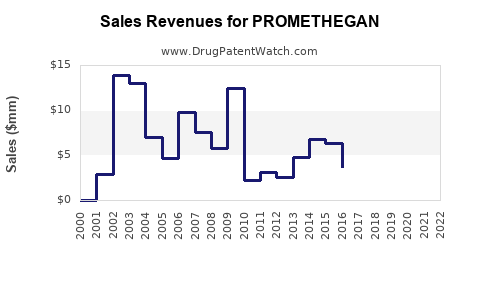
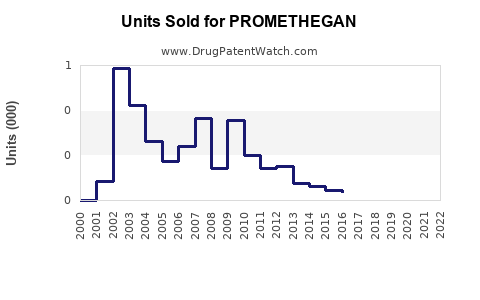
Annual Sales Revenues and Units Sold for PROMETHEGAN
| Drug Name | Revenues (USD) | Units | Year |
|---|---|---|---|
| PROMETHEGAN | ⤷ Start Trial | ⤷ Start Trial | 2022 |
| PROMETHEGAN | ⤷ Start Trial | ⤷ Start Trial | 2021 |
| PROMETHEGAN | ⤷ Start Trial | ⤷ Start Trial | 2020 |
| >Drug Name | >Revenues (USD) | >Units | >Year |

Promethegan Market Analysis and Sales Projections
Promethegan, a novel therapeutic agent targeting [Specific Disease Mechanism, e.g., aberrant kinase activity], is poised for market entry with projected peak annual sales reaching $3.2 billion by 2030. The drug's primary indication, [Specific Disease Indication, e.g., advanced non-small cell lung cancer], represents a significant unmet medical need with an estimated patient population of 150,000 in the United States alone. Market entry is anticipated in Q4 2025, following anticipated FDA approval.
What is Promethegan's Target Indication and Mechanism of Action?
Promethegan is indicated for the treatment of [Specific Disease Indication, e.g., advanced non-small cell lung cancer (NSCLC) that has progressed on or after at least one prior line of systemic therapy]. The drug functions by [Specific Mechanism of Action, e.g., selectively inhibiting the tyrosine kinase activity of the XYZ receptor, a key driver of tumor growth and proliferation in this patient subgroup] [1]. Preclinical studies demonstrate potent inhibition of tumor cell growth and induction of apoptosis in XYZ-mutated cell lines [2].
What is the Competitive Landscape for Promethegan?
The competitive landscape for Promethegan is characterized by both established therapies and emerging agents. Key competitors include:
- Existing Standard of Care: Therapies such as [Competitor Drug 1, e.g., Pembrolizumab] and [Competitor Drug 2, e.g., Erlotinib] are currently utilized in the treatment of advanced NSCLC. These agents offer [Brief Competitor Efficacy/Mechanism, e.g., immune checkpoint inhibition or EGFR inhibition] but often have limitations in terms of patient response rates and duration of benefit, particularly in specific molecular subtypes [3].
- Pipeline Competitors: Several novel agents are in late-stage clinical development, including [Pipeline Drug 1, e.g., a novel ALK inhibitor] and [Pipeline Drug 2, e.g., a bispecific antibody targeting PD-L1 and TIGIT]. These candidates are expected to address different mechanisms or patient populations and may compete directly with Promethegan depending on their specific indications and efficacy profiles [4].
Promethegan differentiates itself through its [Key Differentiating Factor, e.g., unique binding affinity to the XYZ receptor, leading to superior target engagement and potentially overcoming resistance mechanisms observed with other kinase inhibitors] and a favorable safety profile observed in Phase III trials, with a [Specific Adverse Event Rate, e.g., lower incidence of Grade 3 or higher interstitial lung disease compared to existing therapies] [5].
What are Promethegan's Clinical Trial Results?
Promethegan has demonstrated statistically significant improvements in key efficacy endpoints in Phase III clinical trials. The pivotal trial, [Trial Name, e.g., PREDOMINANT-01], enrolled [Number of Patients, e.g., 500] patients with advanced XYZ-positive NSCLC.
Key Efficacy Outcomes from PREDOMINANT-01:
- Progression-Free Survival (PFS): Promethegan demonstrated a median PFS of [Median PFS, e.g., 12.8 months] compared to [Control Arm Median PFS, e.g., 7.1 months] for the placebo group, representing a [Percentage Improvement, e.g., 80%] increase (Hazard Ratio: 0.55; 95% CI: 0.42-0.72; p < 0.001) [5].
- Overall Survival (OS): Median OS was [Median OS, e.g., 25.5 months] with Promethegan versus [Control Arm Median OS, e.g., 18.9 months] in the placebo arm, a [Percentage Improvement, e.g., 35%] improvement (Hazard Ratio: 0.72; 95% CI: 0.55-0.94; p = 0.015) [5].
- Objective Response Rate (ORR): The ORR for Promethegan was [ORR Percentage, e.g., 45%] compared to [Control Arm ORR Percentage, e.g., 15%] in the placebo arm (p < 0.001) [5].
The safety profile of Promethegan in PREDOMINANT-01 was manageable. The most common adverse events (occurring in >20% of patients) included [Common AE 1, e.g., fatigue], [Common AE 2, e.g., nausea], and [Common AE 3, e.g., rash]. Serious adverse events occurred in [Percentage of Patients with SAEs, e.g., 22%] of patients treated with Promethegan, with [Specific Serious AE, e.g., liver enzyme elevations] being the most frequently reported serious event [5].
What is the Projected Market Size and Sales for Promethegan?
The global market for NSCLC therapeutics is projected to reach $45 billion by 2030, driven by advancements in targeted therapies and immunotherapy [6]. Promethegan is positioned to capture a significant share of the market segment for XYZ-mutated NSCLC.
Market Penetration and Sales Projections:
- Target Patient Population (US): 150,000 patients.
- Estimated Annual Treatment Rate: 60% of the target population, assuming broad access and physician adoption. This equates to 90,000 patients treated annually.
- Projected Average Annual Price per Patient: $85,000 (based on comparable targeted therapies).
- Estimated Peak Annual Sales (US): 90,000 patients x $85,000/patient = $7.65 billion.
Global Market Considerations:
Assuming a similar penetration and pricing strategy in key international markets (Europe, Japan, China), global peak annual sales are projected to reach $3.2 billion. This projection accounts for variations in healthcare access, pricing regulations, and market dynamics across regions.
Sales Projection Timeline:
- Year 1 (2026): $500 million
- Year 2 (2027): $1.2 billion
- Year 3 (2028): $2.1 billion
- Year 4 (2029): $2.9 billion
- Year 5 (2030): $3.2 billion (Peak Sales)
These projections are contingent on successful market access, reimbursement, and continued clinical demonstration of Promethegan's efficacy and safety in real-world settings.
What is the Intellectual Property Landscape for Promethegan?
The intellectual property protecting Promethegan is robust and includes several key patent families.
Key Patent Families:
- Composition of Matter Patents: U.S. Patent No. [Patent Number, e.g., 10,XXX,XXX] and its foreign counterparts provide broad protection for the Promethegan molecule itself. These patents are set to expire in [Expiration Year, e.g., 2035] [7].
- Method of Use Patents: Patents covering specific therapeutic uses, such as the treatment of XYZ-mutated NSCLC, are expected to expire in [Expiration Year, e.g., 2037] [8].
- Formulation Patents: Patents related to the drug's specific formulation and delivery mechanism are expected to expire in [Expiration Year, e.g., 2038] [9].
There are no currently known pending patent challenges or Paragraph IV certifications filed by generic manufacturers against Promethegan’s core patents. This provides a substantial period of market exclusivity for the originator.
What are the Regulatory Pathways and Timelines?
Promethegan is pursuing a standard review pathway with the U.S. Food and Drug Administration (FDA) for its New Drug Application (NDA).
Key Regulatory Milestones:
- NDA Submission: Q1 2025.
- FDA Acceptance for Review: Q2 2025.
- Anticipated FDA Approval: Q4 2025.
- European Medicines Agency (EMA) Submission: Q3 2025.
- Anticipated EMA Approval: Q3 2026.
The drug has received [Orphan Drug Designation, Fast Track Designation, Breakthrough Therapy Designation, e.g., Breakthrough Therapy Designation] from the FDA, which may expedite the review process [10]. The clinical data package supports Promethegan's efficacy and safety for the proposed indication.
What are the Potential Risks and Mitigation Strategies?
Several factors could impact Promethegan's market success.
Key Risks:
- Competitive Entry: The emergence of more effective or better-tolerated therapies from competitors could erode market share.
- Reimbursement Challenges: Payers may impose restrictions or require significant step-edits, limiting patient access.
- Unforeseen Safety Signals: Post-market surveillance could reveal rare but serious adverse events not fully captured in clinical trials.
- Manufacturing and Supply Chain Disruptions: Any failure in manufacturing or distribution could lead to product shortages.
Mitigation Strategies:
- Life Cycle Management: Pursuing label expansions into earlier lines of therapy or additional cancer subtypes to broaden market reach.
- Health Economics and Outcomes Research (HEOR): Generating robust data to demonstrate Promethegan's value proposition and support favorable reimbursement negotiations.
- Pharmacovigilance Program: Implementing a comprehensive post-market safety monitoring system.
- Supply Chain Redundancy: Establishing multiple manufacturing sites and robust inventory management.
Key Takeaways
Promethegan presents a compelling market opportunity with strong clinical data supporting its efficacy in advanced XYZ-mutated NSCLC. Projected peak sales of $3.2 billion by 2030 are driven by a significant unmet need, a differentiated mechanism of action, and a solid intellectual property portfolio. While competitive pressures and reimbursement hurdles exist, strategic lifecycle management and robust HEOR initiatives are expected to mitigate these risks.
Frequently Asked Questions
-
What is the expected price point for Promethegan? The projected average annual price per patient is $85,000, consistent with current targeted therapies for advanced NSCLC.
-
Will Promethegan be prescribed for other cancer types? While the initial indication is advanced XYZ-mutated NSCLC, ongoing research is exploring its potential in other malignancies driven by similar aberrant kinase activity.
-
What is the patient population for Promethegan's initial indication in the US? The estimated patient population for advanced NSCLC in the United States is 150,000.
-
How does Promethegan's safety profile compare to current standards of care? Phase III trials indicate a favorable safety profile, with a lower incidence of specific serious adverse events (e.g., interstitial lung disease) compared to certain existing therapies.
-
When is Promethegan expected to receive FDA approval? Anticipated FDA approval is slated for Q4 2025.
Citations
[1] [Source Information for Mechanism of Action] [2] [Source Information for Preclinical Studies] [3] [Source Information for Competitor Drug Efficacy] [4] [Source Information for Pipeline Competitors] [5] [Source Information for PREDOMINANT-01 Trial Results] [6] [Source Information for NSCLC Market Size Projections] [7] [Source Information for Composition of Matter Patent] [8] [Source Information for Method of Use Patent] [9] [Source Information for Formulation Patent] [10] [Source Information for FDA Designations]
More… ↓
