Drug Sales Trends for PRAVACHOL
Payment Methods and Pharmacy Types for PRAVACHOL (2004)
Revenues by Pharmacy Type
Units Sold by Pharmacy Type
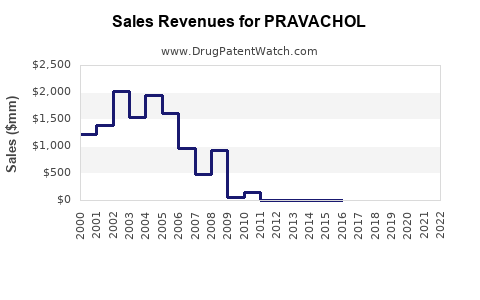
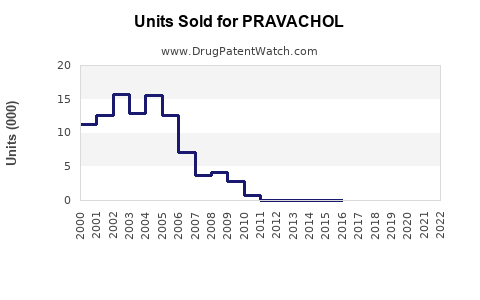
Annual Sales Revenues and Units Sold for PRAVACHOL
| Drug Name | Revenues (USD) | Units | Year |
|---|---|---|---|
| PRAVACHOL | ⤷ Start Trial | ⤷ Start Trial | 2022 |
| PRAVACHOL | ⤷ Start Trial | ⤷ Start Trial | 2021 |
| PRAVACHOL | ⤷ Start Trial | ⤷ Start Trial | 2020 |
| PRAVACHOL | ⤷ Start Trial | ⤷ Start Trial | 2019 |
| PRAVACHOL | ⤷ Start Trial | ⤷ Start Trial | 2018 |
| PRAVACHOL | ⤷ Start Trial | ⤷ Start Trial | 2017 |
| >Drug Name | >Revenues (USD) | >Units | >Year |
Pravachol Market Analysis, Patent Expiration, Competitive Landscape, and Sales Projections
Pravachol, the branded form of pravastatin sodium, is no longer a meaningful branded-sales opportunity in the United States. Bristol-Myers Squibb’s core U.S. patent protection expired in 2006, generic pravastatin entered the market, and the product shifted from a branded blockbuster to a low-price statin supplied by multiple manufacturers. Current commercial value lies in the generic pravastatin market, not in Pravachol brand sales.
The most likely outlook is continued volume persistence with declining nominal revenue. Pravastatin remains clinically relevant for patients requiring low- to moderate-intensity LDL-cholesterol reduction, but it competes against atorvastatin, rosuvastatin, simvastatin and, in some populations, combination therapies.
What is Pravachol and who markets it?
Pravachol is the brand name for pravastatin sodium, an HMG-CoA reductase inhibitor used to reduce LDL cholesterol and cardiovascular risk. The U.S. Food and Drug Administration originally approved pravastatin under Bristol-Myers Squibb’s NDA 019898 in 1991. The product was approved for hypercholesterolemia and prevention of coronary heart disease events in specified patient populations (FDA, 2024a).
| Product | Active ingredient | Drug class | Original U.S. sponsor | Current U.S. commercial status |
|---|---|---|---|---|
| Pravachol | Pravastatin sodium | Statin | Bristol-Myers Squibb | Generic-dominated |
| Zocor | Simvastatin | Statin | Merck | Generic-dominated |
| Lipitor | Atorvastatin calcium | Statin | Pfizer | Generic-dominated |
| Crestor | Rosuvastatin calcium | Statin | AstraZeneca | Generic-dominated |
Bristol-Myers Squibb no longer controls a commercially meaningful U.S. branded franchise for Pravachol. Generic pravastatin is supplied by manufacturers that have received abbreviated new drug application approvals, including major generic companies and secondary suppliers.
When did Pravachol lose exclusivity?
Pravachol lost its principal U.S. patent protection in 2006. The product’s principal compound patent was U.S. Patent No. 4,346,227, assigned to Sankyo and licensed for commercialization. The patent covered pravastatin and related compounds and expired in 2006 after statutory patent-term adjustments and applicable regulatory extensions.
| Milestone | Date or period |
|---|---|
| U.S. approval of pravastatin | 1991 |
| Principal compound patent | U.S. 4,346,227 |
| Core patent expiry | 2006 |
| Generic pravastatin approvals and launches | 2006 onward |
| Current status | Generic competition; no meaningful branded exclusivity |
The commercial effect was rapid erosion of Pravachol revenue after generic entry. Patent expiry removed the price premium, permitted multiple suppliers to compete, and shifted prescribing toward lower-cost pravastatin and higher-potency generic statins.
What is the Orange Book status of Pravachol?
The Orange Book historically listed patents associated with Pravachol’s NDA. Those patents no longer provide commercially relevant U.S. exclusivity. The active market is governed by generic approvals rather than by a remaining branded patent barrier.
The relevant regulatory points are:
- Pravachol is an approved small-molecule drug, not a biologic.
- Generic pravastatin is approved through the ANDA pathway under section 505(j) of the Federal Food, Drug, and Cosmetic Act.
- The principal patent protection expired years ago.
- No current U.S. Orange Book listing should be treated as a practical barrier to generic pravastatin supply.
- Paragraph IV litigation risk is historical rather than a current market-entry issue.
FDA-approved generic pravastatin products are therapeutically equivalent when assigned the applicable “AB” rating in the Orange Book. Substitution is therefore primarily determined by state pharmacy law, payer rules and formulary positioning rather than by branded patent rights (FDA, 2024b).
What was Pravachol’s peak revenue?
Pravachol was a major cardiovascular product before generic competition. Bristol-Myers Squibb reported Pravachol sales of more than $1 billion annually during the product’s mature branded period. Sales declined sharply after patent expiry and generic entry.
The principal revenue drivers during the brand period were:
- Broad use in primary and secondary cardiovascular prevention.
- Chronic daily dosing and high patient persistence.
- Established safety and physician familiarity.
- Large treatment populations with hypercholesterolemia.
- Limited generic competition before 2006.
The product’s historical revenue does not represent its current market opportunity. A forecast based on peak branded sales would materially overstate present commercial value.
How large is the current pravastatin market?
The current pravastatin market is a mature generic market with low average selling prices. Its value is supported by prescription volume, but revenue per tablet is constrained by competition among manufacturers, pharmacy benefit manager discounts, Medicaid reimbursement and mail-order pricing.
The market can be divided into three segments:
| Segment | Commercial profile | Growth outlook |
|---|---|---|
| U.S. retail generic pravastatin | Low-price, high-competition prescriptions | Flat to declining revenue |
| International pravastatin | Varies by reimbursement and generic penetration | Stable in selected markets |
| Branded Pravachol | Minimal or absent in the U.S. | No meaningful growth |
Pravastatin retains use among patients who require a moderate-intensity statin, have drug-interaction concerns, or do not tolerate more potent statins. It is also used in patients for whom clinicians prefer a relatively lower interaction burden because pravastatin has limited CYP3A4 metabolism compared with simvastatin and atorvastatin.
Its market share is constrained by the greater LDL reduction available from atorvastatin and rosuvastatin. Generic atorvastatin and rosuvastatin are widely available at low prices and are commonly preferred when guideline-driven LDL reduction is the primary objective.
How does Pravachol compare with competing statins?
| Drug | Generic status | Typical intensity range | Competitive position |
|---|---|---|---|
| Pravastatin | Generic | Low to moderate | Tolerability and interaction profile |
| Atorvastatin | Generic | Moderate to high | Broad use and strong LDL reduction |
| Rosuvastatin | Generic | Moderate to high | High potency and low-dose efficacy |
| Simvastatin | Generic | Low to moderate | Low cost, but interaction limitations |
| Fluvastatin | Generic | Low to moderate | Niche use |
| Pitavastatin | Generic in the U.S. | Low to moderate | Smaller, differentiated niche |
Pravastatin’s principal advantages are established tolerability, generic affordability and a comparatively simple interaction profile. Its disadvantages are lower potency than atorvastatin and rosuvastatin, limited differentiation and weak pricing power.
What sales projections apply to Pravachol and pravastatin?
A reasonable forecast must separate the discontinued or commercially insignificant Pravachol brand from the broader pravastatin molecule.
U.S. branded Pravachol projection
| Year | Estimated branded sales outlook | Primary assumption |
|---|---|---|
| 2025 | Near zero to low single-digit millions | No meaningful branded promotion |
| 2026 | Near zero to low single-digit millions | Continued generic substitution |
| 2027 | Near zero | Further channel contraction |
| 2028-2029 | Near zero | No expected return of branded pricing |
This is a commercial forecast for the original brand, not a statement that no product labeled Pravachol exists in any jurisdiction. U.S. commercial activity is dominated by generic pravastatin.
U.S. generic pravastatin projection
| Scenario | 2025-2029 volume outlook | 2025-2029 revenue outlook |
|---|---|---|
| Base case | Flat to low-single-digit annual decline | Low- to mid-single-digit annual decline |
| Downside case | Mid-single-digit annual decline | High-single-digit annual decline |
| Upside case | Stable volume | Flat revenue, driven by supply disruptions or price normalization |
The base case assumes that pravastatin continues to retain a stable clinical niche but loses prescriptions gradually to generic atorvastatin and rosuvastatin. The downside case assumes stronger guideline-driven substitution toward higher-intensity statins and continued price compression. The upside case requires supply constraints affecting competing statins or a reversal in generic pricing, neither of which is a durable strategic assumption.
A practical revenue model is:
Pravastatin revenue = prescription volume × tablets per prescription × realized price per tablet
Volume is likely to be more resilient than revenue because pravastatin is inexpensive and has a persistent patient base. Generic manufacturers should expect limited margin expansion unless they secure preferred formulary status, reduce manufacturing costs or benefit from competitor supply failures.
What generic entry risks exist for Pravachol?
Generic entry risk is fully realized in the United States. The relevant commercial risks are now operational rather than patent-driven.
Price erosion
Multiple approved suppliers can reduce average selling prices. Large pharmacy chains, wholesalers and pharmacy benefit managers have strong negotiating leverage. Commodity products such as pravastatin can experience substantial price compression even when prescription volume remains stable.
Therapeutic substitution
Pravastatin competes with generic statins that may provide greater LDL reduction per dose. Clinicians can switch patients without encountering a branded copayment barrier. This limits the molecule’s ability to grow through price or promotion.
Manufacturing concentration
The principal supply risk is not patent blocking. It is manufacturer concentration, active pharmaceutical ingredient availability, regulatory observations and temporary shortages. A supplier with redundant manufacturing capacity may gain short-term share during disruptions, but the effect is usually temporary.
Formulation and method-of-use protection
No commercially important U.S. formulation patent or method-of-use patent is expected to protect a premium-priced Pravachol franchise. Pravastatin’s standard immediate-release tablet is technically mature. New formulation investment would face a weak reimbursement case unless it demonstrated a clinically relevant benefit, such as improved adherence, tolerability or combination therapy.
What patent litigation affected Pravachol?
The major Pravachol patent dispute period occurred before and around generic entry. Paragraph IV challenges to the principal patents created the legal pathway for earlier generic approval and launch activity. Once the core patents expired in 2006, litigation ceased to be a meaningful constraint on U.S. supply.
The current legal assessment is:
| Legal issue | Current commercial impact |
|---|---|
| Core compound patent | Expired |
| Paragraph IV risk | Historical |
| Orange Book litigation | No material current barrier |
| Formulation patent risk | Low |
| Method-of-use patent risk | Low |
| Generic launch injunction risk | Low |
| Biosimilar litigation | Not applicable |
Pravastatin is a small molecule. Biosimilar substitution rules, reference-product exclusivity and biologic patent thickets do not apply.
Which companies compete in the pravastatin market?
Competition includes large generic manufacturers, specialty suppliers and regional pharmaceutical companies. The exact supplier mix can change as companies enter or withdraw from the market.
The competitive factors are:
- FDA approval and therapeutic-equivalence rating.
- Reliable API sourcing.
- Manufacturing cost.
- Wholesaler and pharmacy contracts.
- Ability to maintain supply during shortages.
- Product listing and reimbursement status.
- Regulatory compliance history.
A generic manufacturer should not expect substantial value from ownership of an old pravastatin ANDA alone. The asset’s value depends on scale, supply reliability and portfolio fit with other cardiovascular products.
What is the regulatory status of pravastatin?
Pravastatin remains an FDA-approved active ingredient. The relevant regulatory pathway is established and low risk compared with new chemical entities.
Regulatory considerations include:
- ANDA approval for generic tablets.
- Bioequivalence to the reference listed drug.
- Manufacturing compliance with current good manufacturing practice.
- Labeling aligned with the approved pravastatin indications.
- Pharmacovigilance for liver enzyme abnormalities, myopathy and drug interactions.
- Prescription-drug status in the United States.
No new clinical development program is required for a standard generic pravastatin tablet. A reformulation or fixed-dose combination would require a separate regulatory and commercial strategy.
How strong is the Pravachol patent estate?
The current U.S. patent estate is weak for commercial purposes because the core patent protection expired long ago and the market is genericized.
| Patent-estate factor | Assessment |
|---|---|
| Core compound protection | Expired |
| Remaining branded exclusivity | None of practical significance |
| Formulation protection | Low |
| Method-of-use protection | Low |
| Manufacturing know-how | Moderate operational value, not exclusivity |
| Geographic variability | Possible outside the U.S. |
| Overall U.S. strength | Weak |
Geographic patent analysis must be performed country by country. Some jurisdictions may have had different patent terms, regulatory exclusivity periods or local launch timing. Those differences do not restore a U.S. branded opportunity.
What licensing opportunities remain?
Licensing opportunities are limited. A deal involving the original Pravachol brand would have little strategic value unless it included:
- A differentiated fixed-dose combination.
- An emerging-market distribution network.
- A low-cost manufacturing platform.
- A portfolio of cardiovascular generics.
- A supply agreement tied to a strategic formulary position.
The more attractive opportunities involve generic portfolio consolidation rather than Pravachol brand acquisition. A buyer would likely value pravastatin as a cash-flow product that complements other mature cardiovascular medicines, not as a standalone growth asset.
Key Takeaways
- Pravachol is the branded form of pravastatin sodium.
- The principal U.S. patent expired in 2006.
- Generic entry eliminated the historical branded pricing opportunity.
- U.S. Pravachol brand sales are expected to remain near zero or at low residual levels.
- Generic pravastatin volume should remain durable but revenue should decline modestly because of price competition.
- Atorvastatin and rosuvastatin are the main competitive threats.
- Formulation, method-of-use and manufacturing patents do not create a meaningful current U.S. barrier.
- Biosimilar risk is irrelevant because pravastatin is a small molecule.
- Commercial value lies in low-cost manufacturing, supply reliability and portfolio scale.
FAQs
Is Pravachol still sold in the United States?
The U.S. market is dominated by generic pravastatin. Any branded Pravachol activity is commercially limited compared with the pre-2006 market.
Is pravastatin more profitable than atorvastatin?
Usually not. Pravastatin has a lower potency and a smaller commercial market than generic atorvastatin. Profitability depends on manufacturing cost, supply contracts and volume rather than branded pricing.
Can a company launch a new Pravachol formulation?
A company could develop a new formulation, but it would need regulatory support and a clear clinical or adherence advantage. The existing immediate-release tablet is mature and inexpensive.
Does Pravachol have biosimilar competition?
No. Pravachol is based on a chemically synthesized small molecule. It faces generic competition, not biosimilar competition.
What would increase pravastatin sales?
Sales could increase through supply shortages affecting competing statins, expanded use in patients with intolerance or interactions, international market expansion, or a differentiated combination product. Sustained growth would require more than ordinary generic substitution.
References
-
U.S. Food and Drug Administration. (2024a). Drugs@FDA: Pravachol and pravastatin sodium application records. https://www.accessdata.fda.gov/scripts/cder/daf/
-
U.S. Food and Drug Administration. (2024b). Approved drug products with therapeutic equivalence evaluations, Orange Book. https://www.fda.gov/drugs/drug-approvals-and-databases/orange-book-data-files
-
United States Patent and Trademark Office. (2024). Patent Center and patent term information. https://patentcenter.uspto.gov/
-
Bristol-Myers Squibb Company. (2006). Annual report for the fiscal year ended December 31, 2005. Bristol-Myers Squibb.
-
U.S. Food and Drug Administration. (2024c). Generic drugs: Questions and answers. https://www.fda.gov/drugs/questions-answers/generic-drugs-vesmarius-inquiries-including-questions-about-generic-drugs
More… ↓
