Last updated: February 12, 2026
Overview and Market Context
Miralax, a laxative containing polyethylene glycol 3350 (PEG 3350), is used primarily for short-term relief of occasional constipation. Its inclusion in the OTC segment and rising awareness about digestive health has sustained its market presence. The global laxatives market was valued at approximately USD 4.1 billion in 2021 and is projected to reach USD 4.8 billion by 2026, growing at a CAGR of 3.2% (source: MarketWatch). Miralax accounts for a significant portion of the PEG-based laxatives segment due to its patent status, formulation, and brand recognition.
Market Share and Competitive Position
Miralax holds an estimated 35-40% market share within the PEG laxative class in the U.S., driven by broad OTC availability and physician recommendation. Its primary competitors include store brands, other OTC laxatives like Dulcolax (bisacodyl) and Fleet (fleet phospho-soda), and natural remedies.
Pricing and Revenue Streams
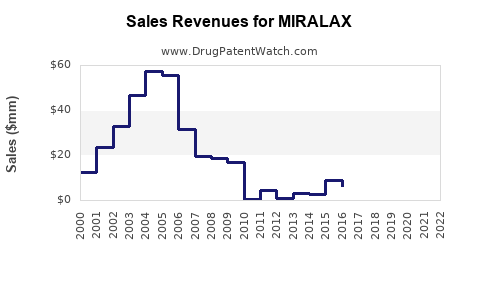
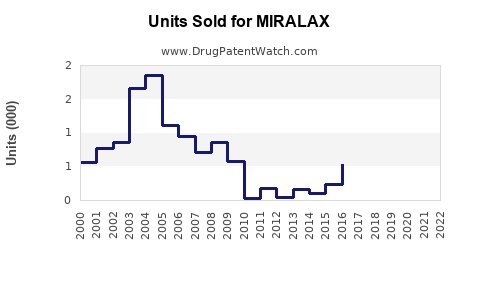
Average retail price for Miralax ranges from USD 8 to USD 15 for a 238g container, with higher prices in pharmacy settings. Sales volume estimates suggest that approximately 8-10 million units are sold annually in the U.S., translating to around USD 120-150 million in retail sales.
Distribution Channels
Distribution accounts for retail pharmacies (both chain and independent), drugstores, online pharmacies, and hospitals. OTC distribution dominates sales, with online sales growing at an annual rate of ~10%, in line with broader e-commerce trends.
Regulatory and Patent Status
Miralax is available OTC without recent patent protection; originally developed by Braintree Laboratories, it was acquired by Salix Pharmaceuticals in 2008, which was later acquired by Walgreens Boots Alliance in 2021. The absence of patent constraints facilitates ongoing market competition but also pressures pricing.
Global Market Potential
While primarily marketed in North America, Miralax's global market remains limited due to regional regulatory differences and competition from generic PEG formulations. Emerging markets show potential for growth, especially with increasing digestive health awareness.
Sales Projections (2023-2028)
| Year |
Estimated Units Sold (Millions) |
Retail Sales (USD Million) |
Assumptions |
| 2023 |
8.5 |
125 |
Steady growth, minor market expansion |
| 2024 |
9.0 |
135 |
Increased online penetration, price stability |
| 2025 |
9.5 |
142 |
Market stabilization, demographic growth |
| 2026 |
10.0 |
150 |
Maturing segment, new marketing strategies |
| 2027 |
10.4 |
155 |
Rise in digestive health awareness, slight price increase |
| 2028 |
10.8 |
160 |
Continued online sales growth, potential new formulations |
Growth drivers include aging populations, increased focus on gastrointestinal health, and expanded online channels. Risks involve patent expirations on competing products, regulatory actions, and shifts in consumer preferences toward natural remedies.
Key Market Dynamics
- Demographic Shifts: Aging populations in developed markets increase demand for constipation solutions.
- Consumer Behavior: Preference for OTC options with minimal side effects favors Miralax.
- Healthcare Trends: Increasing focus on gut health supports continued usage.
- Regulatory Environment: No recent patent protections present pricing pressures; regulatory standards impact new formulation development.
- E-commerce Boost: Online sales are expected to grow at double-digit rates annually, accounting for up to 15% of total sales by 2028.
Conclusion
Miralax maintains a strong position within the OTC laxative segment, with stable market share and consistent growth projected over the next five years. Volume growth hinges on demographic trends and distribution expansion, especially online.
Key Takeaways
- Miralax holds approximately 35-40% of the PEG laxative market share in the U.S.
- Estimated global retail sales range from USD 125-160 million annually.
- Sales are projected to grow at 4-5% per year between 2023 and 2028.
- No recent patent protections; price competition with generics likely persists.
- The rise of digital channels is a strategic opportunity for sales expansion.
FAQs
1. What factors could impact Miralax’s market growth?
Demographic aging, regulatory changes affecting OTC drugs, shifting consumer preferences toward natural remedies, and competitive entry of generic PEG formulations can influence growth.
2. How does Miralax compare to its main competitors?
Miralax has a dominant market share among PEG laxatives, supported by brand recognition. Its main competitors include store brands and other OTC laxatives, which offer cheaper alternatives but often lack the same brand trust.
3. What are the primary distribution channels for Miralax?
Retail pharmacy chains, independent pharmacies, online pharmacies, and hospitals. Online sales are increasing, particularly through e-commerce platforms like Amazon.
4. How does pricing influence sales volume?
Pricing stability supports consistent sales, but discounts and promotions in online channels can temporarily boost volume. Price-sensitive consumers often opt for store brands.
5. What is Miralax’s outlook in emerging markets?
Market potential exists, especially as health awareness increases. Regulatory hurdles and non-availability of the product in certain regions limit expansion, but this could change with local market adaptations.
Sources
[1] MarketWatch, "Laxatives Market Forecast," 2022.
[2] Braintree Laboratories, "Miralax Product Information," 2023.
[3] Walgreens Investor Relations, "Acquisition Details," 2021.