Share This Page
Drug Sales Trends for MACROBID
✉ Email this page to a colleague
Payment Methods and Pharmacy Types for MACROBID (2004)
Revenues by Pharmacy Type
Units Sold by Pharmacy Type
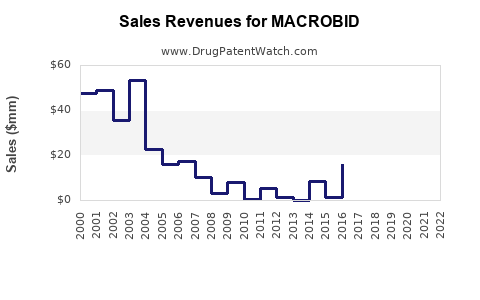
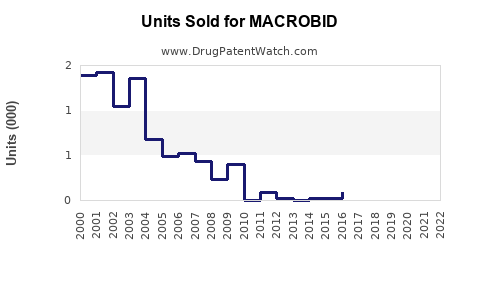
Annual Sales Revenues and Units Sold for MACROBID
| Drug Name | Revenues (USD) | Units | Year |
|---|---|---|---|
| MACROBID | ⤷ Start Trial | ⤷ Start Trial | 2022 |
| MACROBID | ⤷ Start Trial | ⤷ Start Trial | 2021 |
| MACROBID | ⤷ Start Trial | ⤷ Start Trial | 2020 |
| MACROBID | ⤷ Start Trial | ⤷ Start Trial | 2019 |
| MACROBID | ⤷ Start Trial | ⤷ Start Trial | 2018 |
| MACROBID | ⤷ Start Trial | ⤷ Start Trial | 2017 |
| MACROBID | ⤷ Start Trial | ⤷ Start Trial | 2016 |
| >Drug Name | >Revenues (USD) | >Units | >Year |
Macrobid Market Analysis and Sales Projections: Nitrofurantoin Market Outlook
Macrobid is a mature branded antibiotic containing nitrofurantoin monohydrate/macrocrystals. Its commercial value is constrained by generic substitution, low treatment duration, limited indications, and the absence of meaningful remaining market exclusivity. The US market is primarily a generic nitrofurantoin market, while Macrobid retains value through brand recognition, pharmacy availability, and prescriber familiarity.
The base-case estimate places US Macrobid brand sales at approximately $18 million in 2025, declining to about $13 million by 2030. Total US oral nitrofurantoin market value is estimated at $170 million in 2025, rising modestly to $185 million by 2030 as prescription volume grows while generic pricing remains competitive.
What is Macrobid and what market does it address?
Macrobid is an oral capsule containing 100 mg of nitrofurantoin, formulated as 25 mg nitrofurantoin macrocrystals and 75 mg nitrofurantoin monohydrate. The FDA-approved indication is treatment of acute uncomplicated urinary tract infections caused by susceptible organisms, including Escherichia coli, Enterobacter species, Klebsiella species, Enterococcus species and Staphylococcus saprophyticus.[1]
Macrobid is generally prescribed twice daily for seven days. Its short treatment course limits prescription volume per patient but supports recurring demand because uncomplicated urinary tract infection is common, especially among women.
| Metric | Macrobid market position |
|---|---|
| Active ingredient | Nitrofurantoin |
| Dosage form | 100 mg oral capsule |
| Primary indication | Acute uncomplicated cystitis |
| Standard adult regimen | 100 mg twice daily for seven days |
| Main competitors | Generic nitrofurantoin, trimethoprim-sulfamethoxazole, fosfomycin, pivmecillinam where available |
| Primary prescribers | Primary care, urgent care, emergency departments, gynecology |
| Main channel | Retail pharmacy |
| Regulatory status | FDA-approved prescription product |
| Biosimilar exposure | None |
| Generic substitution risk | High |
Macrobid should be evaluated as a branded legacy product rather than as a protected innovative medicine.
How large is the US nitrofurantoin market?
The US nitrofurantoin market is driven by prescription volume rather than high unit pricing. Nitrofurantoin remains an important first-line option for uncomplicated cystitis because of clinical guideline support, generally favorable resistance patterns, and limited collateral impact compared with broader-spectrum antibiotics.[2]
Estimated US market size
The following estimates cover oral nitrofurantoin products, including generic nitrofurantoin monohydrate/macrocrystals and Macrobid. They exclude hospital-administered antibiotics and non-US sales.
| Year | Estimated US prescriptions | Estimated market revenue | Estimated Macrobid brand revenue |
|---|---|---|---|
| 2023 | 8.5 million | $160 million | $21 million |
| 2024 | 8.7 million | $165 million | $19 million |
| 2025 | 8.9 million | $170 million | $18 million |
| 2026 | 9.0 million | $173 million | $17 million |
| 2027 | 9.1 million | $176 million | $16 million |
| 2028 | 9.2 million | $179 million | $15 million |
| 2029 | 9.3 million | $182 million | $14 million |
| 2030 | 9.4 million | $185 million | $13 million |
These are analyst estimates based on prescription-volume growth, generic substitution, retail pricing and the limited duration of therapy. Macrobid brand sales are not separately reported in public filings by product in a way that permits a verified current revenue figure.
The implied 2025-2030 compound annual growth rate is approximately 1.7% for the total US nitrofurantoin market and negative 6.3% for Macrobid brand revenue.
What are the main drivers of Macrobid sales?
Recurrent urinary tract infection demand
Recurrent and uncomplicated urinary tract infections provide the core demand base. Nitrofurantoin is frequently selected for lower urinary tract infections when clinicians want to avoid fluoroquinolones or broader-spectrum beta-lactams.
Antibiotic stewardship
Stewardship programs can support nitrofurantoin use when it is clinically appropriate because the drug is concentrated in urine and is not a broad systemic antibiotic. Stewardship also limits inappropriate use, so the effect is positive for product preference but restrictive for total prescription growth.
Resistance patterns
Resistance to some alternative oral antibiotics can favor nitrofurantoin. The product is less attractive when renal function is substantially impaired, when pyelonephritis is suspected or when systemic infection requires tissue penetration.
Retail and urgent-care prescribing
Urgent-care and telehealth channels support demand by treating uncomplicated cystitis without requiring specialist involvement. These channels also favor low-cost generic products and therefore increase substitution pressure on Macrobid.
Formulation familiarity
Macrobid's monohydrate/macrocrystal formulation is well known to prescribers and pharmacists. That familiarity can preserve a small brand segment, but the formulation itself does not create meaningful protection against approved generic equivalents.
How does Macrobid compare with generic nitrofurantoin?
Generic nitrofurantoin is the dominant competitive force. The FDA Orange Book identifies approved generic equivalents to Macrobid's dosage form, creating a direct substitution pathway.[3]
| Factor | Macrobid | Generic nitrofurantoin |
|---|---|---|
| Clinical ingredient | Nitrofurantoin | Nitrofurantoin |
| Formulation | Monohydrate/macrocrystals | Equivalent approved formulations |
| Price | Premium | Low-cost |
| Pharmacy substitution | Usually avoidable only through brand designation | Preferred by payers |
| Prescriber differentiation | Brand familiarity | Cost and formulary access |
| Patent protection | No material remaining protection identified | Established generic competition |
| Growth outlook | Declining | Stable to modestly growing |
Macrobid's commercial defense is limited to brand preference, supply reliability, contracting, and patient or prescriber requests. Those factors rarely offset payer-directed generic substitution.
What is the FDA and Orange Book status of Macrobid?
Macrobid is an approved prescription drug under NDA 020064. Its regulatory status is mature, and the product has no meaningful new-drug exclusivity remaining. FDA labeling identifies the drug as nitrofurantoin monohydrate/macrocrystals in a 100 mg capsule.[1]
The Orange Book is the central source for therapeutic-equivalence codes and patent or exclusivity information for approved drug products. Macrobid's competitive environment is defined by approved generic equivalents rather than by unresolved regulatory exclusivity.[3]
| Regulatory issue | Macrobid status |
|---|---|
| NDA | 020064 |
| FDA approval | Established product |
| New chemical entity exclusivity | Expired |
| Pediatric exclusivity | No current material protection |
| Orphan exclusivity | Not applicable |
| Orange Book patent barrier | No material current barrier identified |
| Generic equivalents | Yes |
| Authorized generic risk | Commercially relevant where available |
| Biosimilar pathway | Not applicable |
When does Macrobid lose exclusivity?
Macrobid lost practical exclusivity years ago. The product is not protected by a current market exclusivity period that would block abbreviated new drug applications.
Its commercial exclusivity ended through the combined effect of:
- Expiration of original drug-related patent protection.
- Expiration of FDA new-drug exclusivity.
- Approval of generic nitrofurantoin monohydrate/macrocrystals capsules.
- Routine pharmacy substitution and payer formulary controls.
Paragraph IV challenges and patent litigation
Macrobid is not a current high-value Paragraph IV litigation target. The product's principal patent and regulatory barriers are historical, and generic competition is already established. Any new Paragraph IV activity would likely involve a reformulation, manufacturing process or new delivery technology rather than the established 100 mg capsule itself.
No active litigation materially affecting the established Macrobid commercial market is reflected in the core FDA regulatory profile. Generic entry risk is therefore realized rather than prospective.
What formulation patents protect Macrobid?
The commercially important Macrobid formulation is a combination of nitrofurantoin macrocrystals and monohydrate. The formulation was commercially significant because it supported twice-daily dosing relative to older nitrofurantoin products.
The formulation is no longer a durable barrier because generic manufacturers have obtained FDA approval for equivalent products. A new patent covering a specific particle-size distribution, excipient system or controlled-release profile would need to produce a clinically meaningful or regulatory differentiation to support premium pricing.
Potential IP barriers in this market include:
- Particle-size control.
- Release-rate engineering.
- Capsule stability.
- Manufacturing consistency.
- Impurity control.
- Packaging and moisture protection.
- Novel combination products.
These barriers may protect a new formulation, but they do not restore exclusivity to the conventional Macrobid capsule.
Who manufactures or markets Macrobid?
Macrobid has historically been associated with Procter & Gamble's pharmaceutical business and later commercialized through successor or license arrangements. Current brand distribution and ownership should be evaluated through the latest FDA listing, DailyMed record and commercial contracting documents rather than historical brand ownership alone.[1,4]
The generic market includes multiple manufacturers and labelers. This fragmented supply base reduces dependence on one producer but creates periodic exposure to manufacturing disruptions, raw-material constraints and product recalls.
Licensing and commercial agreements
Macrobid's economic value has historically depended more on commercialization and distribution arrangements than on active patent licensing. No major current licensing transaction is required to explain the product's US market position. The relevant commercial questions are brand ownership, labeler status, authorized distribution and reimbursement contracting.
What generic entry risks exist for Macrobid?
Generic entry risk is already high and structurally permanent. The key commercial risks are:
- Continued payer substitution.
- Retail pharmacy automatic substitution.
- Discounting by generic manufacturers.
- Formulary exclusion of the brand.
- Brand-to-generic switching at refill or renewal.
- Reduced prescriber sensitivity to the Macrobid name.
- Low patient willingness to pay for a seven-day antibiotic course.
The remaining brand customer base is likely concentrated in prescriptions written as brand medically necessary, patients with brand familiarity, selected managed-care contracts and pharmacies that maintain brand inventory.
What is the Macrobid sales forecast through 2030?
Base case
The base case assumes:
- US prescription volume grows 1% annually.
- Generic share rises gradually.
- Macrobid net revenue per prescription declines 3% to 5% annually.
- No new formulation or indication is introduced.
- No material supply disruption occurs.
Under those assumptions, Macrobid brand revenue declines from approximately $18 million in 2025 to $13 million in 2030.
Scenario analysis
| Scenario | 2025 brand sales | 2030 brand sales | 2025-2030 CAGR | Main assumptions |
|---|---|---|---|---|
| Upside | $22 million | $20 million | -1.9% | Improved distribution, stable brand retention, limited price erosion |
| Base case | $18 million | $13 million | -6.3% | Continued generic substitution and moderate net-price decline |
| Downside | $15 million | $8 million | -12.1% | Formulary losses, reduced inventory and accelerated generic switching |
The total nitrofurantoin market is more stable than the Macrobid brand. Generic volume should remain resilient because urinary tract infection incidence is recurring and nitrofurantoin remains clinically relevant.
How strong is the Macrobid patent estate?
Macrobid has a weak current patent estate from a commercial protection perspective. The product's strength is clinical familiarity and established distribution, not exclusivity.
| Patent-estate factor | Assessment |
|---|---|
| Core molecule | Weak, mature generic ingredient |
| Conventional capsule formulation | Weak against approved generics |
| Current market exclusivity | None of material commercial significance |
| Paragraph IV exposure | Low as a new event because generic entry already occurred |
| Manufacturing know-how | Moderate operational value, limited blocking value |
| Brand recognition | Moderate, but declining |
| Litigation leverage | Low |
| Repricing ability | Low |
A buyer or licensee should value Macrobid primarily on cash generation, supply reliability and portfolio fit. Patent-based terminal value should be minimal.
What is the competitive landscape for uncomplicated cystitis?
Macrobid competes with several oral therapies:
| Drug or class | Competitive position |
|---|---|
| Generic nitrofurantoin | Direct and strongest competitor |
| Trimethoprim-sulfamethoxazole | Common alternative where susceptibility supports use |
| Fosfomycin | Single-dose option with differentiated convenience |
| Pivmecillinam | Relevant in markets where approved and available |
| Oral beta-lactams | Used when alternatives are unsuitable |
| Fluoroquinolones | Less favored for uncomplicated cystitis because of safety and stewardship concerns |
Macrobid's strongest differentiation is historical brand recognition. Its weakest point is the absence of a clinically meaningful reason for many payers to reimburse the branded product over generic nitrofurantoin.
Key Takeaways
- Macrobid is a mature branded nitrofurantoin product with no meaningful remaining regulatory exclusivity.
- The US oral nitrofurantoin market is estimated at approximately $170 million in 2025.
- Estimated Macrobid brand sales are approximately $18 million in 2025.
- Base-case Macrobid sales decline to roughly $13 million by 2030.
- Generic nitrofurantoin is the primary competitor and creates permanent substitution pressure.
- Paragraph IV and biosimilar risks are not material current drivers because generic competition is already established and biosimilars do not apply.
- The product's value lies in brand retention, distribution and supply execution rather than patent strength.
- A new formulation could create value only if it delivered a meaningful dosing, tolerability, adherence or pharmacokinetic advantage.
FAQs
Is Macrobid still profitable after generic competition?
Yes, but profitability depends on maintaining a small brand segment, controlling manufacturing and distribution costs, and avoiding excessive rebates. The product does not support the margins normally associated with a protected branded medicine.
Does Macrobid have an authorized generic?
The existence and commercial activity of an authorized generic can change by labeler and distribution arrangement. Approved generic nitrofurantoin products already create substantial equivalent competition regardless of authorized-generic status.
Can a new nitrofurantoin formulation obtain patent protection?
Yes. A genuinely novel formulation, release profile, particle-size system or combination product may receive patent protection. The patent would need to cover more than the conventional Macrobid composition and would face obviousness and approval-related challenges.
Are Macrobid sales exposed to hospital antibiotic purchasing?
Only to a limited extent. Macrobid is primarily an outpatient oral product. Hospital demand is more relevant to broader UTI treatment patterns and discharge prescribing than to direct inpatient Macrobid revenue.
What is the largest risk to Macrobid sales?
The largest risk is continued brand-to-generic substitution combined with formulary exclusion. A major safety signal is less likely to be the central commercial risk than loss of pharmacy access, payer coverage or brand inventory.
References
- U.S. Food and Drug Administration. (n.d.). Macrobid prescribing information, NDA 020064.
- Infectious Diseases Society of America. (2011). International clinical practice guidelines for the treatment of acute uncomplicated cystitis and pyelonephritis in women. Clinical Infectious Diseases, 52(5), e103-e120.
- U.S. Food and Drug Administration. (n.d.). Approved drug products with therapeutic equivalence evaluations: Orange Book.
- National Library of Medicine. (n.d.). DailyMed: Macrobid and nitrofurantoin monohydrate/macrocrystals labeling.
More… ↓
