Drug Sales Trends for KLONOPIN
Payment Methods and Pharmacy Types for KLONOPIN (2004)
Revenues by Pharmacy Type
Units Sold by Pharmacy Type
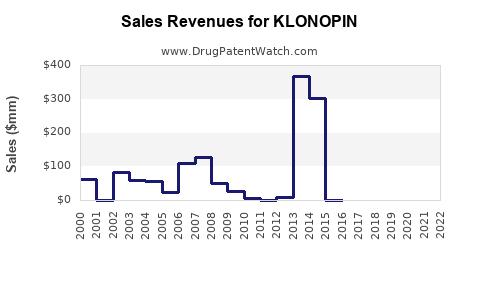
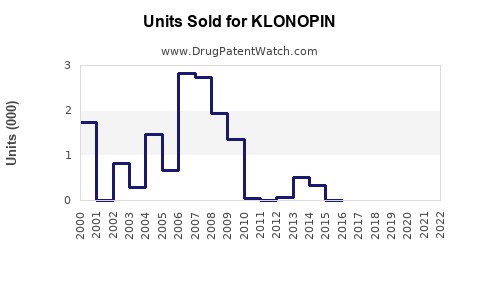
Annual Sales Revenues and Units Sold for KLONOPIN
| Drug Name | Revenues (USD) | Units | Year |
|---|---|---|---|
| KLONOPIN | ⤷ Start Trial | ⤷ Start Trial | 2022 |
| KLONOPIN | ⤷ Start Trial | ⤷ Start Trial | 2021 |
| KLONOPIN | ⤷ Start Trial | ⤷ Start Trial | 2020 |
| KLONOPIN | ⤷ Start Trial | ⤷ Start Trial | 2019 |
| >Drug Name | >Revenues (USD) | >Units | >Year |
Klonopin Market Analysis and Sales Projections: Clonazepam Revenue, Generic Competition, Patents and Outlook
Klonopin, the brand name for clonazepam, is a mature benzodiazepine with limited branded revenue potential and a large, price-sensitive generic market. The U.S. market is controlled by generic clonazepam manufacturers, while Roche and Genentech retain historical ownership of the Klonopin brand and original NDA. Patent protection has expired, no biosimilar pathway applies, and future market growth is constrained by controlled-substance regulation, dependence concerns, substitution by other therapies, and declining branded utilization.
A reasonable base-case forecast places U.S. clonazepam product sales at approximately $300 million to $500 million annually across brand and generic channels in 2025, with low-single-digit annual unit decline and flat-to-negative revenue growth through 2029. Branded Klonopin revenue is likely a small fraction of the total market.
What is Klonopin and how large is the clonazepam market?
Klonopin is clonazepam, a long-acting benzodiazepine approved in the United States for panic disorder and certain seizure disorders. The product is available in 0.5 mg, 1 mg and 2 mg tablets, along with orally disintegrating tablet formulations. Clonazepam is a Schedule IV controlled substance in the United States.[1]
The commercial market has two distinct segments:
- Generic clonazepam tablets and orally disintegrating tablets.
- Branded Klonopin products, where commercially available.
Generic products account for most prescriptions because the active ingredient, dosage forms and core clinical uses have been available for decades. The principal demand base is chronic or recurring treatment for anxiety-related disorders, panic disorder, seizure disorders and selected off-label uses.
Estimated U.S. market structure
| Segment | 2025 estimated annual sales | Market position |
|---|---|---|
| Generic clonazepam tablets | $250 million-$425 million | Dominant by volume |
| Generic orally disintegrating tablets | $25 million-$60 million | Smaller, higher-price niche |
| Branded Klonopin | $5 million-$25 million | Limited residual demand |
| U.S. total | $300 million-$500 million | Mature and contracting |
These are analytical estimates rather than reported manufacturer revenue. Public company filings generally aggregate clonazepam within broader generics or central-nervous-system portfolios and do not disclose standalone Klonopin sales.
What are the Klonopin sales projections for 2025 to 2029?
The base case assumes prescription volume declines by 2% annually, generic pricing remains under pressure, and brand utilization continues to migrate toward generic clonazepam. The result is modest market contraction.
U.S. clonazepam sales forecast
| Year | Base-case market sales | Low case | High case |
|---|---|---|---|
| 2025 | $400 million | $300 million | $500 million |
| 2026 | $393 million | $285 million | $505 million |
| 2027 | $385 million | $270 million | $510 million |
| 2028 | $378 million | $255 million | $515 million |
| 2029 | $370 million | $240 million | $520 million |
The high case assumes stable prescription volume, limited generic price erosion and continued demand from seizure-disorder patients. The low case assumes faster benzodiazepine deprescribing, lower reimbursement and greater substitution by antidepressants, nonbenzodiazepine anxiolytics and behavioral therapies.
Branded Klonopin forecast
| Year | Estimated branded sales |
|---|---|
| 2025 | $5 million-$25 million |
| 2026 | $4 million-$22 million |
| 2027 | $3 million-$20 million |
| 2028 | $3 million-$18 million |
| 2029 | $2 million-$16 million |
The brand forecast is structurally weaker than the total clonazepam forecast. Generic substitution, absence of meaningful patent exclusivity and limited differentiation in the immediate-release oral products prevent premium pricing.
When does Klonopin lose exclusivity?
Klonopin has already lost market exclusivity. The product’s core composition and oral dosage-form protection expired long ago, allowing multiple generic clonazepam products to enter the U.S. market.
The FDA’s Orange Book identifies approved drug products and any relevant listed patents or exclusivity information. The current commercial status of clonazepam is therefore driven by generic competition rather than an active Klonopin patent barrier.[2]
| Exclusivity category | Current status |
|---|---|
| New chemical entity exclusivity | Expired |
| Core compound patent protection | Expired |
| Original oral formulation exclusivity | Expired |
| Pediatric exclusivity | Expired or not commercially relevant |
| Active Orange Book patent barrier | No material barrier identified |
| Generic availability | Extensive |
What patents protect Klonopin?
No commercially significant active patent estate is expected to protect the original Klonopin tablets or clonazepam active ingredient in the United States. Historical benzodiazepine patents associated with clonazepam and Roche’s development program expired before the current generic market was established.
The relevant patent position is therefore defensive rather than exclusionary. A manufacturer could still obtain patents for a new delivery system, abuse-deterrent formulation, combination product or manufacturing process, but those rights would not restore exclusivity to conventional Klonopin tablets.
What is the FDA regulatory status of Klonopin?
Klonopin was approved by the FDA under NDA 017533 for panic disorder and seizure-related indications. Generic clonazepam products are approved through the ANDA pathway and must demonstrate pharmaceutical equivalence and bioequivalence to the reference listed drug.[1][3]
Regulatory factors affecting market demand
The FDA labeling includes warnings regarding abuse, misuse, addiction, dependence and withdrawal. The label also warns about serious respiratory depression when benzodiazepines are used with opioids.[1] These warnings influence prescribing, payer controls and institutional treatment protocols.
Klonopin is not a biologic and has no biosimilar competition. Competition occurs through the generic drug approval system.
Which companies compete in the clonazepam market?
The market has many generic suppliers, including large diversified manufacturers and smaller specialty-generic companies. Typical competitors in the U.S. generic benzodiazepine sector include Teva Pharmaceuticals, Sandoz, Amneal Pharmaceuticals, Solco Healthcare, Rising Pharmaceuticals, Aurobindo Pharma, Dr. Reddy’s Laboratories, Zydus Lifesciences and Hikma Pharmaceuticals, depending on product presentation and current marketing status.[3]
The competitive structure has four characteristics:
- Low product differentiation for standard tablets.
- Price competition at the pharmacy-benefit and wholesaler levels.
- Supply concentration risk if manufacturers discontinue low-margin presentations.
- Higher relative pricing for orally disintegrating tablets and selected package sizes.
Roche and Genentech have historical brand ownership, but they do not control the commercial economics of the overall clonazepam market. The generic manufacturers determine most net pricing and supply availability.
How strong is the Klonopin patent estate?
The Klonopin patent estate is weak for conventional products because the core protection has expired and generic entry is established.
| Patent-strength factor | Assessment |
|---|---|
| Active ingredient protection | None of material commercial value |
| Standard tablet protection | Expired |
| Orally disintegrating tablet protection | No material barrier to generic competition |
| Method-of-use protection | Limited practical value; core indications are old |
| Manufacturing-process protection | Could exist at supplier level but is non-blocking |
| Patent litigation leverage | Low |
| Generic entry risk | Already realized |
A new patent covering a narrow formulation or manufacturing process would not prevent existing generic tablets from competing. The strongest remaining intellectual-property opportunity would involve a differentiated delivery system, such as a long-acting formulation, abuse-deterrent product or combination therapy. Such a product would require new clinical, regulatory and commercial investment.
Are there Paragraph IV challenges to Klonopin?
Paragraph IV challenges were relevant during the historical generic approval period, when applicants could assert that listed patents were invalid, unenforceable or would not be infringed. That phase is commercially complete for the original Klonopin product.
No active patent dispute is expected to delay generic clonazepam entry. The market has already transitioned from a patent-protected brand to a multisupplier generic category. Future Paragraph IV activity would be more likely to involve a reformulated clonazepam product than the original Klonopin tablets.
What patent litigation affects Klonopin?
No material current patent litigation is expected to affect conventional Klonopin or generic clonazepam supply. The principal legal issues are regulatory and commercial rather than patent-based:
- Controlled-substance compliance.
- Product labeling and pharmacovigilance.
- Manufacturing quality.
- Drug-supply continuity.
- State and federal prescribing restrictions.
- Potential liability involving misuse, dependence or opioid coadministration.
The absence of a live patent dispute reduces launch risk for generic suppliers but also eliminates a credible route to premium pricing for the original brand.
What formulation patents protect clonazepam products?
Standard clonazepam tablets have limited formulation differentiation. Orally disintegrating tablets may support higher pricing because they offer administration convenience, but the product concept is not sufficient by itself to create durable market exclusivity once competing products are approved.
Potential formulation opportunities include:
- Orally disintegrating tablets.
- Sublingual or buccal delivery.
- Modified-release formulations.
- Abuse-deterrent dosage forms.
- Pediatric or geriatric liquid formulations.
- Fixed-dose combinations with nonbenzodiazepine agents.
These products would face substantial regulatory and clinical hurdles. A new formulation would need to demonstrate bioequivalence or clinical benefit, depending on the extent of the change. Abuse-deterrent positioning would also require credible evidence that the design reduces manipulation or misuse.
What generic launch risks exist for Klonopin?
Generic launch risk is low because numerous products are already approved. Commercial risk remains meaningful in five areas.
Pricing and reimbursement risk
Generic clonazepam prices are exposed to pharmacy-benefit-manager negotiations, wholesaler purchasing and reimbursement compression. Manufacturers with limited scale may exit if prices fall below sustainable margins.
Supply-chain risk
The market depends on multiple active-pharmaceutical-ingredient and finished-dose suppliers. Manufacturing disruptions, FDA inspections or shortages at a major supplier could produce temporary price increases, especially for 2 mg tablets and orally disintegrating products.
Regulatory risk
Clonazepam is subject to controlled-substance requirements, including inventory controls, prescription restrictions and monitoring. Enforcement changes can reduce prescription volume or increase compliance costs.
Clinical substitution risk
Prescribers may replace chronic benzodiazepine therapy with selective serotonin reuptake inhibitors, serotonin-norepinephrine reuptake inhibitors, buspirone, cognitive behavioral therapy or newer digital and behavioral interventions.
Liability risk
Dependence, withdrawal and concomitant opioid use create litigation and compliance exposure for manufacturers, distributors and prescribers. These risks can affect insurance, distribution agreements and corporate appetite for the category.
How does Klonopin compare with competing anxiety and seizure drugs?
| Product category | Main advantage over clonazepam | Main disadvantage |
|---|---|---|
| Alprazolam | Rapid onset and strong established demand | Shorter duration, dependence concerns |
| Lorazepam | Broad acute-care use and injectable form | Dependence and sedation risk |
| Diazepam | Multiple dosage forms and long half-life | Accumulation and impairment |
| SSRIs/SNRIs | Preferred for long-term anxiety management | Delayed onset and tolerability issues |
| Buspirone | Lower dependence potential | Narrower efficacy profile |
| Lamotrigine or levetiracetam | Nonbenzodiazepine seizure treatment | Not direct substitutes for panic disorder |
| Clonazepam | Long duration and established efficacy | Dependence, sedation and withdrawal risks |
Klonopin retains clinical value where long duration, anticonvulsant activity or established patient response is important. Its long-term anxiety market is more exposed to substitution than its seizure-related use.
What commercial opportunities remain for clonazepam manufacturers?
The conventional tablet market offers limited strategic upside. The strongest opportunities are operational:
- Secure low-cost API supply.
- Maintain FDA-compliant manufacturing.
- Focus on underserved dosage strengths or package sizes.
- Improve supply reliability.
- Compete in orally disintegrating products.
- Use contract manufacturing to reduce fixed costs.
- Target non-U.S. markets where generic competition is less intense.
Geographic economics vary. The United States has high prescription volume but aggressive generic pricing. Emerging markets may offer stronger unit growth but lower prices, local registration requirements and more fragmented distribution. European markets are also largely generic and subject to national reimbursement controls.
Key Takeaways
- Klonopin is a mature clonazepam brand with limited residual branded revenue.
- The U.S. clonazepam market is estimated at $300 million-$500 million annually across brand and generic products.
- Base-case U.S. market sales are projected to decline from about $400 million in 2025 to $370 million in 2029.
- Generic clonazepam controls most prescription volume and revenue.
- Core patents and exclusivity have expired, and no material Orange Book barrier is expected.
- Paragraph IV litigation no longer represents a meaningful barrier to conventional generic entry.
- No biosimilar competition applies because clonazepam is a small-molecule drug.
- Orally disintegrating, abuse-deterrent and modified-release products are the main potential sources of differentiation.
- Long-term commercial risk is driven by generic price erosion, benzodiazepine deprescribing, controlled-substance regulation and opioid-related safety concerns.
- The most defensible generic strategies are supply reliability, low-cost manufacturing and targeted dosage-form coverage.
FAQs About Klonopin Market Size and Exclusivity
Is Klonopin still sold as a brand-name drug?
Klonopin has historical brand recognition, but generic clonazepam products dominate the U.S. market. Brand availability and manufacturer marketing status can vary by dosage form and channel.
Does clonazepam have a new drug exclusivity period?
No current new chemical entity exclusivity protects clonazepam. The active ingredient and original oral products are long past their exclusivity periods.
Can a new clonazepam formulation receive patent protection?
Yes. A genuinely novel delivery system, abuse-deterrent design or modified-release formulation could receive patent protection, subject to patentability and FDA approval requirements. That protection would apply to the new product, not conventional Klonopin tablets.
What is the largest commercial risk for generic clonazepam?
Generic price erosion is the largest recurring commercial risk. Controlled-substance compliance, manufacturing interruptions and declining chronic benzodiazepine use are important secondary risks.
Is Klonopin likely to experience a major sales rebound?
A major rebound is unlikely without a new formulation, expanded indication or supply disruption affecting competing products. The mature generic market and safety-driven prescribing constraints favor stable-to-declining sales.
References
- U.S. Food and Drug Administration. (2023). Klonopin (clonazepam) prescribing information. FDA. https://www.accessdata.fda.gov
- U.S. Food and Drug Administration. (2024). Approved drug products with therapeutic equivalence evaluations: Orange Book. FDA. https://www.fda.gov/drugs/drug-approvals-and-databases/approved-drug-products-therapeutic-equivalence-evaluations-orange-book
- U.S. Food and Drug Administration. (2024). Drugs@FDA: FDA-approved drugs database. FDA. https://www.accessdata.fda.gov/scripts/cder/daf/
More… ↓
