Share This Page
Drug Sales Trends for FOCALIN
✉ Email this page to a colleague
Payment Methods and Pharmacy Types for FOCALIN (2004)
Revenues by Pharmacy Type
Units Sold by Pharmacy Type
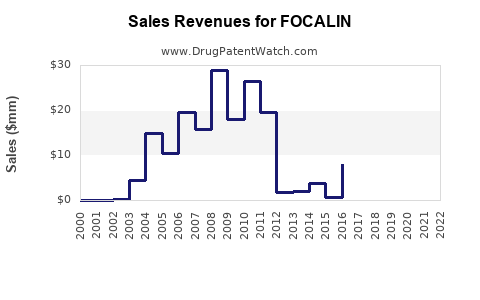
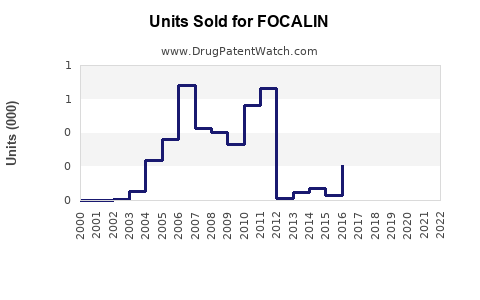
Annual Sales Revenues and Units Sold for FOCALIN
| Drug Name | Revenues (USD) | Units | Year |
|---|---|---|---|
| FOCALIN | ⤷ Start Trial | ⤷ Start Trial | 2022 |
| FOCALIN | ⤷ Start Trial | ⤷ Start Trial | 2021 |
| FOCALIN | ⤷ Start Trial | ⤷ Start Trial | 2020 |
| FOCALIN | ⤷ Start Trial | ⤷ Start Trial | 2019 |
| FOCALIN | ⤷ Start Trial | ⤷ Start Trial | 2018 |
| >Drug Name | >Revenues (USD) | >Units | >Year |
Focalin Market Analysis and Sales Projections: Dexmethylphenidate, Generics, Competition, and Patent Risk
Focalin and Focalin XR are branded formulations of dexmethylphenidate, the d-enantiomer of methylphenidate. The products treat attention-deficit/hyperactivity disorder, or ADHD, in patients aged six years and older. Their commercial position is established but mature. Generic competition, controlled-substance supply constraints, and low differentiation from other methylphenidate products limit branded growth.
A reasonable U.S. market estimate places total annual Focalin and dexmethylphenidate sales at approximately $150 million to $300 million on a gross-to-net adjusted basis, including brand and generic products. The branded portion is likely a minority of the market. Base-case market growth through 2029 is expected to be low single digit, with most growth coming from prescription volume rather than price.
What is Focalin and how large is its addressable market?
Focalin contains dexmethylphenidate hydrochloride. Focalin XR is an extended-release capsule using a bimodal release design intended to provide coverage across the school or work day. Both products are central nervous system stimulants and Schedule II controlled substances in the United States. [1]
The addressable market includes:
- Children and adolescents with ADHD.
- Adults receiving stimulant treatment.
- Patients who respond inadequately to amphetamine products.
- Patients who experience tolerability issues with racemic methylphenidate.
- Patients requiring once-daily extended-release treatment.
Focalin competes within the broader U.S. ADHD prescription market, which includes methylphenidate, amphetamine salts, lisdexamfetamine, atomoxetine, guanfacine, clonidine, and newer nonstimulants. The stimulant segment remains the commercial center of the market because of its established efficacy and rapid onset.
Focalin product portfolio
| Product | Active ingredient | Dosage form | Typical commercial role |
|---|---|---|---|
| Focalin | Dexmethylphenidate HCl | Immediate-release tablet | Flexible, short-duration dosing |
| Focalin XR | Dexmethylphenidate HCl | Extended-release capsule | Once-daily ADHD treatment |
| Generic dexmethylphenidate | Dexmethylphenidate HCl | Tablets and extended-release capsules | Lower-cost substitute |
Focalin XR is generally more commercially important than immediate-release Focalin because once-daily therapy supports adherence and reduces dosing during school or work hours.
How much are Focalin sales, and what is the revenue outlook?
Novartis does not report Focalin revenue as a separately disclosed product line in its public financial reporting. Public prescription databases also vary in whether they combine brand Focalin, generic dexmethylphenidate, and different dosage forms. The following estimates are therefore an analytical market model rather than reported company revenue.
Estimated U.S. Focalin market
| Year | Total dexmethylphenidate market | Branded Focalin estimate | Generic share |
|---|---|---|---|
| 2023 | $150 million-$260 million | $45 million-$90 million | 55%-70% |
| 2024 | $155 million-$275 million | $40 million-$85 million | 60%-72% |
| 2025E | $160 million-$285 million | $38 million-$82 million | 62%-74% |
| 2026E | $165 million-$295 million | $36 million-$80 million | 64%-75% |
| 2027E | $170 million-$305 million | $35 million-$78 million | 65%-76% |
| 2028E | $175 million-$315 million | $34 million-$77 million | 66%-77% |
| 2029E | $180 million-$325 million | $33 million-$76 million | 67%-78% |
The central forecast assumes annual market growth of roughly 2% to 4%, continued generic substitution, stable reimbursement, and no major regulatory change.
What drives Focalin revenue?
Prescription volume is supported by several factors:
- Continued diagnosis and treatment of ADHD in children and adults.
- Greater treatment duration as patients remain on therapy into adulthood.
- Switching among stimulant classes during shortages.
- Use of dexmethylphenidate in patients who do not respond well to amphetamine products.
- Demand for extended-release formulations.
Revenue is constrained by generic substitution, payer pressure, pharmacy supply disruptions, and the lack of meaningful exclusivity for the core active ingredient.
What are the Focalin sales projections through 2029?
Base-case projection
The base case assumes that dexmethylphenidate prescriptions grow by approximately 3% annually, while branded Focalin pricing remains broadly stable after discounts and rebates. Generic penetration increases by one to two percentage points per year.
Under this scenario:
- Total U.S. market revenue reaches approximately $250 million to $280 million by 2029.
- Branded Focalin revenue declines modestly to approximately $50 million to $60 million.
- Generic dexmethylphenidate captures more than two-thirds of unit volume.
- Focalin XR remains the largest branded contributor.
- Immediate-release Focalin remains a smaller, more price-sensitive segment.
Scenario analysis
| Scenario | 2029 total market | 2029 branded Focalin | Primary assumptions |
|---|---|---|---|
| Downside | $180 million-$220 million | $25 million-$40 million | Faster generic substitution and weaker stimulant growth |
| Base | $250 million-$280 million | $50 million-$60 million | Low-single-digit volume growth and stable access |
| Upside | $320 million-$380 million | $70 million-$95 million | Sustained diagnosis growth, supply-driven switching, and stronger XR retention |
The upside scenario depends on continuing shortages of competing stimulants, stronger adult ADHD treatment rates, and stable availability of Focalin products. It does not require a new indication or a major product reformulation.
How does Focalin compare with competing ADHD drugs?
Focalin competes against both direct methylphenidate products and longer-acting amphetamine therapies.
| Drug or product | Class | Duration profile | Competitive position |
|---|---|---|---|
| Focalin XR | Dexmethylphenidate | Extended release | Established branded and generic option |
| Concerta and generics | Methylphenidate | Long acting | Larger methylphenidate franchise |
| Ritalin and generics | Methylphenidate | Immediate and extended release | Broad low-cost competition |
| Adderall and generics | Mixed amphetamine salts | Immediate and extended release | Large stimulant franchise |
| Vyvanse and generics | Lisdexamfetamine | Long acting | Strong adult and branded demand |
| Mydayis | Mixed amphetamine salts | Very long acting | Niche extended-duration option |
| Atomoxetine | Nonstimulant | Long acting | Alternative for selected patients |
| Qelbree | Nonstimulant | Long acting | Branded nonstimulant competitor |
Focalin’s main commercial advantage is its position as a dexmethylphenidate option for patients who prefer or respond better to the methylphenidate class. Its main weakness is the absence of a durable product-level barrier against generic substitution.
What is the FDA status of Focalin and Focalin XR?
The FDA approved Focalin for ADHD and later approved Focalin XR as an extended-release formulation. The products carry stimulant-class warnings relating to abuse, misuse, addiction, cardiovascular effects, psychiatric reactions, and growth suppression. [1]
Generic versions of immediate-release dexmethylphenidate and extended-release dexmethylphenidate have been approved through abbreviated new drug applications. FDA approval of generic products allows substitution subject to state pharmacy laws and payer formularies. The FDA’s Orange Book identifies therapeutic-equivalence information and any listed patents or exclusivities for approved products. [2]
FDA regulatory considerations
The principal regulatory risks are not clinical-development risks. They are supply-chain and controlled-substance risks:
- DEA production quotas can affect stimulant availability.
- Manufacturing interruptions can create pharmacy-level shortages.
- Generic applicants must demonstrate bioequivalence for extended-release products.
- Reformulations may require additional pharmacokinetic studies.
- Abuse-deterrent or abuse-resistant features could create differentiation but would require a new development and regulatory program.
When does Focalin lose exclusivity?
Core U.S. market exclusivity for Focalin has already expired. Immediate-release dexmethylphenidate has faced generic competition for many years, and extended-release generic competition has also entered the market.
The commercial impact is significant:
- No meaningful compound-patent barrier remains for dexmethylphenidate.
- Generic manufacturers can compete on price and payer access.
- Brand prescriptions are concentrated among patients with prescriber preference, supply availability, or insurance coverage.
- Any remaining formulation or method-of-use rights would have limited value unless they block approved generic presentations.
The practical exclusivity question is therefore not whether generic entry is possible. Generic entry is established. The relevant issue is the rate of substitution and whether manufacturing or supply constraints temporarily increase branded demand.
What patents and formulation rights protect Focalin?
Focalin’s original protection centered on dexmethylphenidate and its pharmaceutical formulations. Those rights are no longer sufficient to prevent ordinary generic competition in the United States.
Potentially relevant patent categories include:
- Extended-release delivery systems.
- Capsule bead or multilayer release technologies.
- Specific dosage strengths.
- Manufacturing and crystallization processes.
- Method-of-use claims for ADHD treatment.
- Abuse-deterrent formulations.
These categories can support incremental lifecycle management but do not necessarily block generic Focalin XR products. The strength of any formulation patent depends on claim scope, Orange Book listing, expiration, patent-term adjustment, and the generic applicant’s Paragraph IV certification.
Which companies compete with Focalin?
The competitive field includes originator manufacturers, generic pharmaceutical companies, specialty ADHD developers, and contract manufacturers.
Relevant competitors include:
- Novartis, associated historically with the Focalin brand.
- Teva Pharmaceutical Industries.
- Amneal Pharmaceuticals.
- Lannett and other suppliers of generic methylphenidate products.
- Janssen, associated with Concerta.
- Takeda, associated with Vyvanse.
- Various generic manufacturers filing abbreviated applications for dexmethylphenidate products.
The competitive structure is fragmented. No single generic supplier controls the entire dexmethylphenidate market. Availability can shift between manufacturers based on DEA quotas, active pharmaceutical ingredient supply, manufacturing capacity, and wholesaler inventories.
What generic entry risks affect Focalin?
Generic entry risk is high because both immediate-release and extended-release products have generic alternatives. The main commercial effects are:
- Reduced branded unit share.
- Lower net prices after rebates.
- Greater payer substitution.
- Pressure on pharmacy reimbursement.
- Greater volatility during supply shortages.
A generic launch does not guarantee immediate full substitution. Extended-release products can retain some brand volume when pharmacies experience generic back orders, prescribers specify a particular formulation, or patients report differences in duration or tolerability. The effect is usually temporary unless the brand has a differentiated delivery system.
What is the commercial outlook for Focalin XR?
Focalin XR has the stronger commercial profile because extended-release therapy has higher prescription value and greater adherence utility. It is also more exposed to generic competition because extended-release products attract manufacturers seeking higher revenue than immediate-release tablets.
The likely outlook is:
- Unit demand remains stable to moderately positive.
- Brand revenue declines gradually.
- Generic volume expands.
- Shortages create intermittent brand-volume rebounds.
- Price increases are difficult to sustain under payer scrutiny.
- Adult use supports long-term demand but does not create meaningful exclusivity.
The primary asset value is cash generation from an established product, not pipeline optionality or patent protection.
What licensing and settlement agreements affect Focalin?
No major current licensing deal or high-value Paragraph IV settlement is publicly associated with Focalin that materially changes the U.S. market outlook. Generic entry appears to be governed primarily by ordinary abbreviated-approval pathways rather than a commercially significant authorized-generic or litigation settlement structure.
Any future settlement would need to be evaluated for:
- Generic launch date.
- Authorized-generic rights.
- Supply or manufacturing restrictions.
- Patent claims covering extended-release delivery.
- Compensation or reverse-payment provisions.
- Impact on Orange Book litigation.
What is the investment outlook for Focalin?
Focalin is a mature, low-growth pharmaceutical asset. Its value depends on three variables:
- Prescription retention.
- Brand-to-generic substitution.
- Product availability during stimulant shortages.
The base case supports stable to declining branded revenue and modest growth in the total dexmethylphenidate market. An acquisition thesis based solely on patent protection would be weak. A commercial thesis could remain viable where the buyer has efficient manufacturing, strong pharmacy distribution, or a broader ADHD portfolio.
Key Takeaways
- Focalin and Focalin XR contain dexmethylphenidate, the d-enantiomer of methylphenidate.
- The U.S. market for brand and generic dexmethylphenidate is estimated at roughly $150 million to $300 million annually.
- Branded Focalin likely represents less than half of total market revenue.
- Core U.S. exclusivity has expired, and generic competition is established.
- Focalin XR is commercially more important than immediate-release Focalin.
- Base-case total market growth through 2029 is approximately 2% to 4% annually.
- Brand revenue is likely to decline modestly as generic penetration increases.
- Supply shortages, adult ADHD treatment, and prescription growth are the main upside factors.
- Patent, licensing, and Paragraph IV risks are secondary to generic substitution and manufacturing availability.
FAQs
Is Focalin still a profitable drug?
Yes, but profitability is concentrated in established brand sales, generic manufacturing, and distribution efficiency. The product is mature and does not have strong remaining exclusivity.
Is Focalin XR more valuable than immediate-release Focalin?
Generally, yes. Focalin XR supports once-daily dosing and has a higher-value prescription profile, although it also faces substantial extended-release generic competition.
Can generic dexmethylphenidate replace Focalin?
Yes. FDA-approved generic dexmethylphenidate products may be therapeutically substitutable subject to state law, payer rules, and pharmacy availability.
Does Focalin have biosimilar risk?
No. Focalin is a small-molecule drug, not a biologic. Its relevant competitive risk is generic substitution under the ANDA pathway, not biosimilar competition.
What could increase Focalin sales?
Higher ADHD diagnosis and treatment rates, adult use, shortages of competing stimulants, improved product availability, and a differentiated extended-release or abuse-deterrent formulation could increase sales.
References
- U.S. Food and Drug Administration. (2023). Focalin XR (dexmethylphenidate hydrochloride) extended-release capsules: Prescribing information.
- U.S. Food and Drug Administration. (2024). Approved drug products with therapeutic equivalence evaluations: Orange Book.
- U.S. Food and Drug Administration. (2024). Drug shortages: Methylphenidate hydrochloride and related stimulant products.
- Centers for Disease Control and Prevention. (2024). Data and statistics on ADHD.
- Drug Enforcement Administration. (2024). Controlled substances quotas and stimulant manufacturing controls.
More… ↓
