Drug Sales Trends for COSOPT
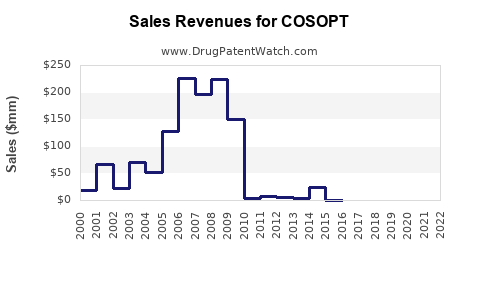
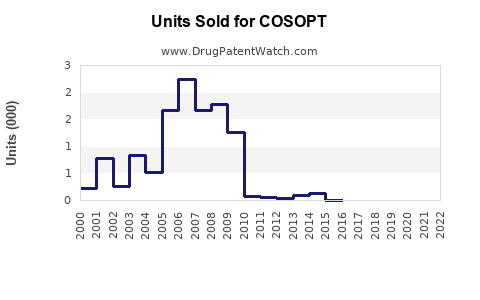
Annual Sales Revenues and Units Sold for COSOPT
| Drug Name | Revenues (USD) | Units | Year |
|---|---|---|---|
| COSOPT | ⤷ Start Trial | ⤷ Start Trial | 2022 |
| COSOPT | ⤷ Start Trial | ⤷ Start Trial | 2021 |
| COSOPT | ⤷ Start Trial | ⤷ Start Trial | 2020 |
| COSOPT | ⤷ Start Trial | ⤷ Start Trial | 2019 |
| COSOPT | ⤷ Start Trial | ⤷ Start Trial | 2018 |
| COSOPT | ⤷ Start Trial | ⤷ Start Trial | 2017 |
| COSOPT | ⤷ Start Trial | ⤷ Start Trial | 2016 |
| >Drug Name | >Revenues (USD) | >Units | >Year |
COSOPT Market Analysis, Sales Forecast, Patent Status, and Generic Competition
COSOPT is a mature ophthalmic glaucoma product containing dorzolamide hydrochloride 2% and timolol maleate 0.5%. Its commercial market is dominated by generic equivalents and therapeutic substitutes. The branded product has limited growth potential, while the combined dorzolamide/timolol molecule remains commercially relevant in glaucoma maintenance therapy.
A reasonable base-case forecast places worldwide branded COSOPT and COSOPT PF revenue below $50 million annually through 2029, with continued erosion from generic competition. The broader dorzolamide/timolol market is substantially larger but lacks transparent public sales reporting because generic revenue is fragmented across manufacturers.
What is COSOPT and how is it used?
COSOPT is a fixed-dose ophthalmic combination used to reduce elevated intraocular pressure in patients with open-angle glaucoma or ocular hypertension.
| Product | Active ingredients | Dosage form | Primary use |
|---|---|---|---|
| COSOPT | Dorzolamide hydrochloride 2% and timolol maleate 0.5% | Preserved ophthalmic solution | Glaucoma and ocular hypertension |
| COSOPT PF | Dorzolamide hydrochloride 2% and timolol maleate 0.5% | Preservative-free ophthalmic solution | Glaucoma and ocular hypertension |
| Generic equivalents | Same active ingredients and strengths | Ophthalmic solution, including preservative-free versions | Glaucoma and ocular hypertension |
Dorzolamide is a topical carbonic anhydrase inhibitor. Timolol is a topical beta blocker. The combination reduces aqueous humor production through two complementary mechanisms.
COSOPT is generally used when a prostaglandin analog is insufficient, unsuitable, or not tolerated. Prostaglandin analogs, including latanoprost, bimatoprost, and travoprost, remain major first-line competitors.
What is the FDA regulatory status of COSOPT?
The FDA approved COSOPT as a new drug application product in 1998. COSOPT PF was approved later as a preservative-free formulation. Merck Sharp & Dohme originally commercialized COSOPT, and Akorn became associated with U.S. commercialization of the product and related ophthalmic products.
The product is no longer an innovation-stage medicine. Its clinical value is established, but its commercial position reflects generic substitution, payer control, and the availability of alternative fixed-dose glaucoma combinations.
FDA status summary
| Regulatory item | Status |
|---|---|
| Original COSOPT approval | FDA-approved ophthalmic combination |
| COSOPT PF | FDA-approved preservative-free formulation |
| Therapeutic category | Ophthalmic glaucoma therapy |
| Generic pathway | ANDA approval based on pharmaceutical equivalence and bioequivalence |
| Current market structure | Brand, authorized or licensed products, and multiple generic suppliers |
| Regulatory risk | Low for the active ingredients; moderate for manufacturing and supply continuity |
FDA-approved generic products can compete directly with COSOPT when they meet the required quality, strength, dosage-form, and bioequivalence standards. The clinical development barrier is low compared with a new glaucoma therapy, although sterile ophthalmic manufacturing creates meaningful quality-control requirements.
What are COSOPT sales and revenue trends?
Public companies generally do not report COSOPT revenue as a separate line item. Merck reports broader pharmaceutical performance, while companies involved in generic commercialization often aggregate ophthalmic products into larger portfolios. As a result, a precise audited revenue history for COSOPT is not publicly available.
The brand market has likely contracted substantially from its pre-generic period. The principal revenue pools are now:
- Branded COSOPT prescriptions where physicians or payers retain brand preference.
- Preservative-free COSOPT PF prescriptions for patients with ocular-surface disease or preservative intolerance.
- Generic dorzolamide/timolol prescriptions.
- International sales in markets with slower generic conversion or different reimbursement rules.
Indicative U.S. annual revenue model
The following ranges are analytical estimates, not company-reported results. They reflect the product's mature lifecycle, generic competition, and limited brand pricing power.
| Year | U.S. branded COSOPT revenue | U.S. branded COSOPT PF revenue | Total U.S. branded estimate |
|---|---|---|---|
| 2024 | $15 million-$30 million | $10 million-$25 million | $25 million-$55 million |
| 2025 | $13 million-$27 million | $10 million-$23 million | $23 million-$50 million |
| 2026 | $11 million-$24 million | $9 million-$21 million | $20 million-$45 million |
| 2027 | $9 million-$21 million | $8 million-$19 million | $17 million-$40 million |
| 2028 | $8 million-$19 million | $7 million-$17 million | $15 million-$36 million |
| 2029 | $7 million-$17 million | $6 million-$16 million | $13 million-$33 million |
The forecast assumes annual branded erosion of approximately 7% to 12%, stable underlying glaucoma prevalence, and continued generic availability. Preservative-free demand should decline more slowly than preserved-product demand because some patients require or prefer preservative-free therapy.
The total U.S. revenue generated by generic dorzolamide/timolol is likely several times larger than branded COSOPT revenue, but generic net sales are distributed across manufacturers and are difficult to measure without prescription or claims databases.
What is the global market outlook for COSOPT?
Global demand for dorzolamide/timolol should remain stable in volume terms but weak in value terms. Glaucoma prevalence increases with aging populations, yet fixed-dose combination products face price compression after loss of exclusivity.
The strongest commercial opportunities are in:
- Markets with high glaucoma diagnosis and treatment rates.
- Countries where preservative-free ophthalmic products receive reimbursement.
- Regions with limited access to newer combination products.
- Hospital and government tenders where generic manufacturing scale is decisive.
- Markets where physicians use carbonic anhydrase inhibitor and beta-blocker combinations after prostaglandin therapy.
A base-case global market model for branded and generic dorzolamide/timolol products is shown below.
| Scenario | 2024 estimated global market | 2029 estimated global market | 2024-2029 trend |
|---|---|---|---|
| Low case | $180 million | $145 million | Decline from price erosion |
| Base case | $250 million | $225 million | Volume stability offsets part of price decline |
| High case | $340 million | $350 million | Higher diagnosis and preservative-free uptake |
These figures describe the active-product market, not COSOPT brand revenue. They combine branded, generic, and licensed products and should not be interpreted as reported market size.
When does COSOPT lose exclusivity?
COSOPT has already lost practical market exclusivity in the United States. Generic dorzolamide/timolol products have been marketed for years, and the active-ingredient combination is no longer protected by a commercially meaningful new chemical entity period.
The key exclusivity events are:
| Exclusivity issue | Commercial effect |
|---|---|
| New chemical entity exclusivity | Expired |
| Original formulation protection | Expired or no longer commercially blocking |
| Generic ANDA entry | Established |
| Preservative-free product protection | Does not prevent competition across the wider molecule market |
| Method-of-use protection | Limited ability to block routine glaucoma treatment |
| Regulatory exclusivity | No remaining exclusivity expected to support brand-level pricing |
The relevant legal question is not whether COSOPT has any historical patent documents. It is whether an unexpired, enforceable patent can block an FDA-approved generic for the intended product and indication. For a mature dorzolamide/timolol combination, that barrier is low.
What patents protect COSOPT and COSOPT PF?
The original product was protected through formulation, composition, and product-specific patent filings associated with dorzolamide, timolol, and ophthalmic combination technology. Those protections are historical rather than commercially decisive.
The FDA Orange Book is the controlling source for current U.S. patent and exclusivity listings. Historical patents associated with the product do not automatically create a current barrier to generic entry. Orange Book-listed patents, if any, must be assessed by claim scope, expiration, pediatric extensions, terminal disclaimers, and litigation history. [1]
Formulation patent exposure
The most relevant potential protection areas are:
- The fixed combination of dorzolamide and timolol.
- Specific concentration and pH ranges.
- Ophthalmic vehicle composition.
- Preservative systems.
- Preservative-free packaging and container systems.
- Stability and manufacturing processes.
These claims can support narrower products but generally do not recreate broad exclusivity for the active ingredients. Generic manufacturers can design around formulation claims or rely on alternative approved formulations.
Method-of-use patents
Method-of-use patents for glaucoma treatment may cover dosing, patient populations, or administration techniques. Their practical value is limited where the generic label carries the same indication or where physicians prescribe the product for an established, non-patent-restricted use.
Are there Paragraph IV challenges to COSOPT?
Paragraph IV litigation is unlikely to be a major current risk factor for COSOPT because generic entry has already occurred. Paragraph IV certifications matter most before first generic launch, when a challenger contests an Orange Book patent as invalid, unenforceable, or not infringed.
For COSOPT, the commercial issues are now:
- Continued generic supply.
- ANDA manufacturing compliance.
- Product recalls or shortages.
- Formulation differentiation.
- Reimbursement and substitution.
- Market withdrawal by small manufacturers.
A new Paragraph IV dispute could arise for a future preservative-free formulation or a reformulated product, but it would not restore broad exclusivity for the established dorzolamide/timolol combination.
Which companies compete with COSOPT?
Competition comes from both direct generic equivalents and alternative glaucoma regimens.
Direct competitors
Direct competitors include generic products containing dorzolamide hydrochloride and timolol maleate in the same concentrations. Suppliers may include large generic manufacturers, ophthalmology-focused companies, and regional sterile ophthalmic manufacturers. The supplier set changes over time as companies enter, exit, or consolidate products.
Therapeutic competitors
| Competitor class | Examples | Competitive effect |
|---|---|---|
| Prostaglandin analogs | Latanoprost, bimatoprost, travoprost | Major first-line alternatives |
| Beta blocker monotherapy | Timolol | Lower-cost substitute for some patients |
| Carbonic anhydrase inhibitor monotherapy | Dorzolamide, brinzolamide | Used when combination therapy is not required |
| Alpha agonists | Brimonidine | Alternative or add-on treatment |
| Other fixed combinations | Brimonidine/timolol, brinzolamide/brimonidine | Compete for combination-therapy patients |
| Preservative-free therapies | PF prostaglandins and combinations | Compete for ocular-surface-sensitive patients |
Prostaglandin analogs exert the greatest prescribing pressure because they are widely used as initial therapy and often require once-daily administration. COSOPT can retain demand where dual therapy is required and where cost is more important than dosing convenience.
How strong is the COSOPT patent estate?
The patent estate is commercially weak for broad market protection and relatively stronger only for product-specific formulation or packaging claims.
| Patent factor | Assessment |
|---|---|
| Broad active-ingredient protection | Expired |
| Combination-product protection | No longer a meaningful broad barrier |
| Preservative-free formulation | Potentially relevant but narrow |
| Manufacturing patents | Possible process advantages, limited market exclusivity |
| Method-of-use patents | Limited enforcement value |
| Generic blocking power | Low |
| Licensing leverage | Low for the established product |
| Litigation exposure | Low relative to newly launched ophthalmic products |
Patent strength should not be confused with brand recognition. COSOPT can retain prescriptions despite a weak patent position, but it cannot rely on patent-backed pricing.
What licensing deals and commercial arrangements affect COSOPT?
COSOPT's commercial history includes manufacturer and commercialization changes rather than a prominent current licensing strategy that materially changes the market outlook. Product rights, supply arrangements, and authorized-generic structures can affect which company records revenue, but they do not materially alter demand for the molecule.
For due diligence, the relevant commercial documents are:
- U.S. product rights and trademark ownership.
- Authorized-generic agreements.
- Contract manufacturing and sterile-fill arrangements.
- Distribution agreements.
- International registration and commercialization rights.
- Supply obligations for preservative-free packaging.
A change in commercialization rights could shift reported revenue between companies without changing total market demand.
What generic launch scenarios exist for COSOPT?
The most likely market scenarios are:
| Scenario | Expected outcome |
|---|---|
| Continued multi-source generic supply | Annual price erosion and stable prescription volume |
| Manufacturer exit | Short-term price recovery for remaining suppliers, followed by new entry |
| Sterile ophthalmic manufacturing disruption | Temporary shortages and substitution |
| Higher preservative-free adoption | Slower decline for COSOPT PF and PF generics |
| Payer-driven substitution | Rapid brand share loss |
| Product recall | Temporary channel disruption and competitor gains |
The highest operational risk is manufacturing quality. Ophthalmic solutions are sterile products, and contamination, particulate matter, container-closure failures, or supply interruptions can remove a product from the market quickly.
What is the expected revenue exposure through 2029?
COSOPT is unlikely to be a material growth asset for a diversified pharmaceutical company. Its value is more consistent with a mature branded or generic ophthalmology portfolio product.
Base-case revenue outlook
| Revenue pool | 2024 | 2029 | Expected change |
|---|---|---|---|
| Branded COSOPT, global | $35 million-$75 million | $20 million-$50 million | Decline |
| Generic dorzolamide/timolol, global | $180 million-$300 million | $170 million-$300 million | Stable to modest decline |
| COSOPT PF and PF equivalents | Included above | Included above | More resilient than preserved products |
| Total active-product market | $250 million-$340 million | $225 million-$350 million | Flat to down in value |
The principal upside is volume growth from glaucoma diagnosis and aging populations. The principal downside is price compression, payer substitution, and manufacturing exits.
Key Takeaways
- COSOPT is a mature dorzolamide/timolol glaucoma product with no meaningful broad U.S. market exclusivity.
- Generic competition is established and limits branded revenue growth.
- Branded U.S. COSOPT and COSOPT PF revenue is likely below $55 million annually and should decline through 2029.
- The broader global dorzolamide/timolol market is materially larger but is fragmented across generic manufacturers.
- COSOPT PF has better commercial durability than preserved COSOPT because preservative intolerance creates a differentiated patient segment.
- Prostaglandin analogs are the strongest therapeutic competitors.
- Patent risk is low for broad generic entry; manufacturing quality and supply continuity are more important commercial risks.
- Paragraph IV litigation is not expected to be a central current issue because generic entry has already occurred.
- The product has limited licensing upside and should be valued as a cash-generating mature asset rather than a growth product.
FAQs About COSOPT Market Potential
Is COSOPT still protected by patents?
COSOPT is no longer protected by broad, commercially meaningful exclusivity for the dorzolamide/timolol combination. Narrow formulation or packaging claims may exist, but they do not prevent broad generic competition.
Is COSOPT PF commercially stronger than regular COSOPT?
Yes. COSOPT PF can retain patients who experience ocular-surface irritation or preservative intolerance. Its market remains exposed to preservative-free generic competition.
Can a generic company launch another COSOPT equivalent?
Yes, subject to FDA approval, pharmaceutical-equivalence requirements, bioequivalence standards, sterile manufacturing controls, labeling requirements, and available manufacturing capacity.
What is the largest competitive threat to COSOPT?
The largest prescribing threat is the prostaglandin analog class, particularly once-daily products. The largest pricing threat is multi-source generic dorzolamide/timolol substitution.
Is COSOPT an attractive licensing or acquisition target?
It may have value as part of a broader ophthalmology portfolio with established distribution and manufacturing capacity. As a standalone growth asset, its outlook is limited by generic competition, declining brand share, and weak patent leverage.
References
-
U.S. Food and Drug Administration. (2024). Approved drug products with therapeutic equivalence evaluations: Orange Book. https://www.fda.gov/drugs/drug-approvals-and-databases/approved-drug-products-therapeutic-equivalence-evaluations-orange-book
-
U.S. Food and Drug Administration. (2024). Drugs@FDA: FDA-approved drugs. https://www.accessdata.fda.gov/scripts/cder/daf/
-
U.S. Food and Drug Administration. (2024). Generic drug facts. https://www.fda.gov/drugs/generic-drugs/generic-drug-facts
-
National Eye Institute. (2024). Glaucoma. National Institutes of Health. https://www.nei.nih.gov/learn-about-eye-health/eye-conditions-and-diseases/glaucoma
-
American Academy of Ophthalmology. (2020). Primary open-angle glaucoma preferred practice pattern. Ophthalmology, 127(1), P71-P138.
More… ↓
