Share This Page
Drug Sales Trends for drospirenone
✉ Email this page to a colleague
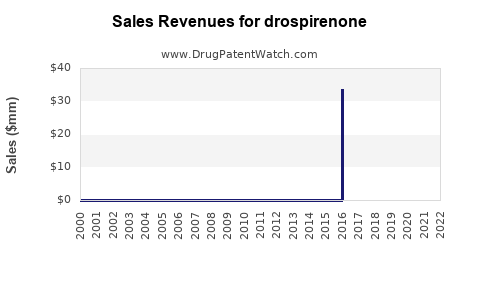
Annual Sales Revenues and Units Sold for drospirenone
| Drug Name | Revenues (USD) | Units | Year |
|---|---|---|---|
| DROSPIRENONE | ⤷ Start Trial | ⤷ Start Trial | 2022 |
| DROSPIRENONE | ⤷ Start Trial | ⤷ Start Trial | 2021 |
| DROSPIRENONE | ⤷ Start Trial | ⤷ Start Trial | 2020 |
| DROSPIRENONE | ⤷ Start Trial | ⤷ Start Trial | 2019 |
| >Drug Name | >Revenues (USD) | >Units | >Year |

Market Analysis and Sales Projections for DROSPIRENONE
What is the current market landscape for drospirenone?
Drospirenone is a synthetic progestin widely used in oral contraceptives. It exhibits anti-mineralocorticoid and anti-androgenic properties, making it a popular choice in combined oral contraceptive pills (COCPs). The global contraceptive market reached approximately $21 billion in 2022, with a compound annual growth rate (CAGR) of 6% projected through 2030[1].
Key competitors include Yaz, Yasmin, and Yasminelle, among other formulations by Bayer, Teva, and other pharmaceutical companies. These products often incorporate drospirenone with ethinylestradiol.
What are the regulatory statuses impacting drospirenone?
Drospirenone-containing products received FDA approval in 2000[2]. The European Medicines Agency (EMA) approved similar formulations around the same time. Post-marketing, concerns emerged about increased venous thromboembolism (VTE) risk compared to other progestins, leading to regulatory reviews[3].
Despite safety discussions, drospirenone's favorable anti-androgenic and anti-mineralocorticoid effects sustain its market demand, especially in formulations targeting acne, premenstrual dysphoric disorder (PMDD), and other hormonal therapies.
What are the key market drivers?
Growing demand for oral contraceptives that reduce androgenic side effects influences sales. The aging population opting for hormone-based therapies and the increase in contraceptive awareness in emerging markets also drive expansion.
Innovations such as extended-cycle formulations and lower-dose options attract consumers seeking convenience and safety. Additionally, new regulatory guidelines emphasizing safety profiles influence formulation choices, favoring drospirenone's positioning.
What challenges does the market face?
Safety concerns regarding VTE events continue to impact market growth. Litigation risks pose financial hazards for manufacturers. Patent expirations may enable generic entries, compressing profit margins. Economic variables, including healthcare spending and access disparities, influence adoption rates across regions.
What are the sales projections?
The global market for drospirenone-containing contraceptives is expected to grow from approximately $8.2 billion in 2022 to nearly $12 billion by 2030, reflecting a CAGR of 5.3%. This growth is driven primarily by increased penetration in Asia-Pacific and Latin America, where contraceptive use remains lower than in North America and Europe[4].
In North America, sales are projected to sustain at around $3 billion annually, constrained by regulatory scrutiny and patent litigation. Conversely, Asia-Pacific is anticipated to see a compounded annual growth rate of 7%, reaching $2.8 billion by 2030, due to rising contraceptive awareness and shifting cultural acceptance.
How are competitors positioned?
Bayer's Yasmin, YAZ, and Yasminelle comprise a significant market share, with combined revenue surpassing $2 billion annually. Early generic entrants are penetrating markets post-patent expiry, pressuring brand-name prices.
Developers of new formulations with improved safety profiles and reduced side effects aim to reclaim market share. Companies investing in formulations combining drospirenone with other active agents, like anti-acne or PMS-specific therapies, are gaining accelerated approval pathways for niche markets.
What are the regulatory and patent outlooks?
Patent protection on key drospirenone formulations is expected to expire by 2025. Generics are anticipated to introduce cost-effective alternatives shortly after. Regulatory agencies continue to review safety data, influencing labeling and usage restrictions.
Emerging markets are less affected by patent protections, enabling broader access to generic products, which could significantly impact global sales distribution.
Summarized sales projection table:
| Year | Projected Market Size (USD billion) | CAGR | Key Drivers |
|---|---|---|---|
| 2022 | 8.2 | - | Existing market, patent protections |
| 2024 | 9.6 | 6.4% | Patent expiries, emerging markets expansion |
| 2026 | 10.9 | 6.1% | Increased safety innovations, generics entering |
| 2028 | 11.6 | 3.6% | Market saturation in mature regions |
| 2030 | 12.0 | 5.3% | Continued growth, new formulations |
Key takeaways
- The global market for drospirenone-containing contraceptives is set to grow modestly, from $8.2 billion in 2022 toward $12 billion in 2030.
- North American sales will remain stable but face regulatory hurdles; emerging markets will be primary growth regions.
- Patent expiries will facilitate generic competition, exerting downward pressure on prices.
- Safety profile concerns remain central to regulatory and consumer decision-making.
- Innovation in formulations and indications will shape market share dynamics.
FAQs
1. How does drospirenone compare with other progestins?
Drospirenone's anti-androgenic and anti-mineralocorticoid effects distinguish it from others like levonorgestrel, reducing side effects like acne and water retention.
2. What safety concerns are associated with drospirenone?
It is linked to increased VTE risk compared to some other progestins. Regulatory agencies have issued warnings, but the product maintains clinical utility where benefits outweigh risks.
3. Which markets are driving growth in drospirenone-based contraceptives?
Asia-Pacific and Latin America exhibit the fastest growth due to increasing contraceptive use, urbanization, and healthcare infrastructure improvements.
4. When will patent protection expire for major drospirenone products?
Major patents expire around 2025; generic versions are expected to enter markets shortly afterward.
5. What are the emerging therapeutic applications for drospirenone?
Potential uses include hormone replacement therapy and treatment of conditions like PCOS and acne, expanding beyond contraception.
References
[1] MarketsandMarkets. (2022). Contraceptive Market Forecast to 2030.
[2] U.S. Food and Drug Administration. (2000). Approval of Yasmin.
[3] European Medicines Agency. (2013). Review of Drospirenone Containing Contraceptives.
[4] Grand View Research. (2023). Global Contraceptives Market Analysis.
More… ↓
