Share This Page
Drug Sales Trends for doxazosin
✉ Email this page to a colleague
Payment Methods and Pharmacy Types for doxazosin (2003)
Revenues by Pharmacy Type
Units Sold by Pharmacy Type
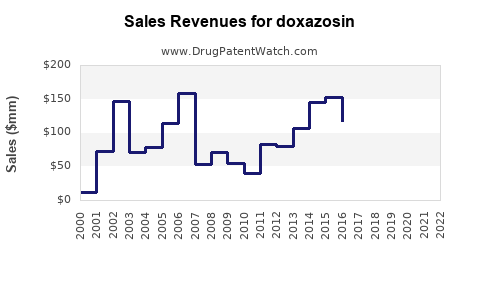
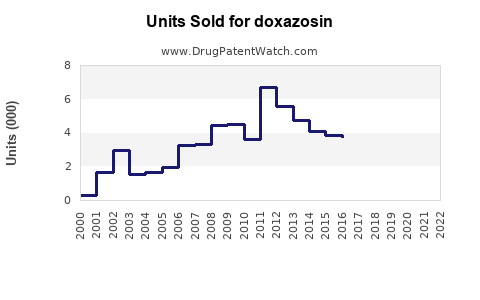
Annual Sales Revenues and Units Sold for doxazosin
| Drug Name | Revenues (USD) | Units | Year |
|---|---|---|---|
| DOXAZOSIN | ⤷ Start Trial | ⤷ Start Trial | 2022 |
| DOXAZOSIN | ⤷ Start Trial | ⤷ Start Trial | 2021 |
| DOXAZOSIN | ⤷ Start Trial | ⤷ Start Trial | 2020 |
| DOXAZOSIN | ⤷ Start Trial | ⤷ Start Trial | 2019 |
| DOXAZOSIN | ⤷ Start Trial | ⤷ Start Trial | 2018 |
| DOXAZOSIN | ⤷ Start Trial | ⤷ Start Trial | 2017 |
| >Drug Name | >Revenues (USD) | >Units | >Year |
Doxazosin Market Analysis and Sales Projections, 2025-2030
Doxazosin is a mature, low-cost generic alpha-1 blocker with limited commercial growth prospects. Its principal markets are benign prostatic hyperplasia (BPH) and hypertension. Tamsulosin has displaced doxazosin in much of the BPH market, while modern antihypertensive classes have reduced its role in hypertension. No meaningful patent or regulatory exclusivity protects standard doxazosin tablets in the United States.
A reasonable base-case model places global doxazosin product sales at approximately $60 million to $90 million in 2025, declining to $50 million to $75 million by 2030. The range reflects fragmented generic pricing, limited public disclosure, country-level reimbursement differences and the absence of a single audited global sales source. U.S. annual sales are likely below $30 million for immediate-release products, with most commercial value generated through generic prescriptions rather than branded products.
What is the current market position of doxazosin?
Doxazosin is an established generic drug marketed mainly as doxazosin mesylate. Immediate-release tablets are approved for hypertension and BPH. Extended-release doxazosin products have been marketed for BPH but have had limited commercial impact compared with immediate-release generic tablets.
| Market attribute | Doxazosin position |
|---|---|
| Active ingredient | Doxazosin mesylate |
| Drug class | Selective alpha-1 adrenergic antagonist |
| Main indications | BPH and hypertension |
| U.S. brand | Cardura; historical brand, with generic substitution dominant |
| Main dosage forms | Immediate-release tablets; extended-release tablets in selected markets |
| U.S. regulatory status | Generic prescription drug |
| Patent position | Core composition and original use patents expired |
| Biosimilar exposure | None |
| Generic competition | High |
| Pricing power | Low |
| Growth outlook | Flat to declining |
Doxazosin lowers blood pressure through vascular alpha-1 blockade and improves urinary flow by relaxing smooth muscle in the prostate and bladder neck. The same mechanism can cause dizziness, orthostatic hypotension and first-dose syncope, limiting use in some patients.
For BPH, doxazosin competes with tamsulosin, alfuzosin, silodosin and terazosin. Tamsulosin has stronger market positioning because of extensive prescribing familiarity and lower blood-pressure effects. For hypertension, doxazosin competes with angiotensin receptor blockers, ACE inhibitors, calcium-channel blockers, thiazide diuretics and beta blockers.
When did doxazosin lose exclusivity?
Doxazosin lost meaningful commercial exclusivity years ago. The original Cardura franchise is no longer protected by a live core patent estate that could prevent ordinary generic competition in the United States.
Pfizer obtained U.S. approval for Cardura in 1990. The drug later received approval for BPH. The principal active-ingredient and original-use patent protection has expired, and multiple manufacturers now market generic doxazosin tablets.
| Exclusivity category | Current position |
|---|---|
| New chemical entity exclusivity | Expired |
| Core composition protection | Expired |
| Original hypertension use protection | Expired |
| BPH method-of-use protection | Expired or commercially immaterial |
| Formulation protection | No broadly effective barrier for immediate-release tablets |
| Orphan exclusivity | None |
| Pediatric exclusivity | Not commercially relevant |
| Current U.S. market protection | None of material duration |
Patent expiration dates for historical Cardura patents should be verified against the specific Orange Book patent listing and product presentation. They do not materially change the current competitive assessment because generic entry has already occurred at scale.
What is the FDA regulatory and Orange Book status of doxazosin?
Doxazosin is an FDA-approved prescription drug with abbreviated new drug application competition. Generic manufacturers can rely on the reference product’s safety and efficacy findings through the ANDA pathway.
The U.S. regulatory profile is commercially favorable for manufacturers because:
- The active ingredient is well characterized.
- Immediate-release tablets are relatively simple to manufacture.
- Bioequivalence requirements are established.
- The reference product has a long clinical history.
- No biosimilar-style development program is required.
The FDA’s Orange Book identifies approved reference products and related patent or exclusivity information. For current commercial purposes, doxazosin’s Orange Book position is primarily relevant to confirming approved reference products and generic approvals, not to identifying a meaningful remaining patent barrier. The FDA label identifies doxazosin mesylate tablets for hypertension and BPH, with dosing that typically begins at a low level and is titrated to reduce postural adverse events. (FDA, 2024a; FDA, 2024b)
Is a Paragraph IV challenge relevant to doxazosin?
Paragraph IV litigation is no longer a major commercial issue for standard doxazosin tablets. ANDA applicants historically could challenge listed patents, but the remaining market is dominated by approved generic products.
Any future Paragraph IV activity would more likely concern:
- A new extended-release presentation.
- A reformulated tablet.
- A combination product.
- A narrowly drafted method-of-use patent.
- A manufacturing or drug-delivery technology.
A Paragraph IV filing against an old immediate-release doxazosin product would have limited strategic value unless the challenged patent covered a commercially important formulation with substantial market share.
What patents protect doxazosin today?
No broad, commercially meaningful patent estate protects ordinary doxazosin tablets in the United States. The key historical intellectual property categories were:
| Patent category | Commercial relevance in 2025 |
|---|---|
| Doxazosin active ingredient | Expired |
| Immediate-release tablet | No meaningful barrier |
| Hypertension indication | Expired |
| BPH indication | Expired or ineffective against established generic entry |
| Extended-release formulation | Potentially relevant only to specific products and jurisdictions |
| Manufacturing process | Limited value unless difficult to design around |
| Combination therapy | Product-specific and narrow |
| Device or delivery system | Not central to the conventional market |
The strongest remaining IP opportunity would not be the conventional molecule. It would be a differentiated product, such as a once-daily combination, a modified-release system, a lower-orthostatic-risk formulation or a fixed-dose product with a separate patent estate.
Those opportunities face clinical and commercial constraints. Doxazosin’s therapeutic differentiation is limited, and a new formulation would compete against inexpensive generic tablets and established BPH drugs.
How large is the doxazosin market?
Public company filings generally do not disclose doxazosin revenue separately. Pfizer reports do not provide a current, standalone commercial picture for the historical Cardura franchise, and generic manufacturers typically report portfolio sales without molecule-level detail.
A bottom-up model is therefore more useful than a reported-sales comparison.
2025 modeled global market
| Scenario | Estimated global revenue | Main assumptions |
|---|---|---|
| Low | $35 million-$55 million | Heavy generic price erosion; lower volumes |
| Base | $60 million-$90 million | Stable prescription demand; continued low pricing |
| High | $100 million-$140 million | Higher emerging-market volume and stronger branded-generic pricing |
The base case assumes that global volume remains broadly stable or declines modestly, while average net prices continue to fall in mature markets. Emerging markets can support unit growth, but low prices constrain revenue.
U.S. modeled market
| U.S. segment | 2025 estimated revenue |
|---|---|
| Immediate-release generic tablets | $15 million-$28 million |
| Extended-release and specialty presentations | Below $5 million |
| Branded or authorized-branded sales | Minimal |
| Total U.S. market | Approximately $18 million-$33 million |
These estimates represent modeled product revenue, not patient spending or pharmacy reimbursement. Gross-to-net deductions, wholesaler discounts and government reimbursement can materially change manufacturer net sales.
What are the doxazosin sales projections for 2025-2030?
The base-case forecast is for gradual nominal decline. Volume should remain supported by chronic use in BPH and hypertension, but price erosion, therapeutic substitution and manufacturer competition should outweigh unit growth.
| Year | Low case | Base case | High case |
|---|---|---|---|
| 2025 | $35M-$55M | $60M-$90M | $100M-$140M |
| 2026 | $33M-$53M | $59M-$88M | $101M-$142M |
| 2027 | $31M-$51M | $57M-$86M | $102M-$145M |
| 2028 | $29M-$49M | $55M-$84M | $103M-$148M |
| 2029 | $27M-$47M | $53M-$82M | $104M-$151M |
| 2030 | $25M-$45M | $50M-$78M | $105M-$155M |
The high case requires unusual conditions, such as significant emerging-market expansion, supply shortages among competing alpha blockers or successful commercialization of a differentiated formulation. It should not be treated as the central investment case.
What drives the forecast?
The principal forecast variables are:
- BPH prescription retention among older patients.
- Continued use in patients who cannot tolerate alternatives.
- Generic price erosion.
- Availability of tamsulosin and other alpha blockers.
- Hospital and pharmacy formulary decisions.
- National reimbursement policies.
- Supply reliability and manufacturing costs.
- Any new combination or extended-release product.
The strongest negative factor is therapeutic substitution. The American Urological Association recommends alpha blockers as a treatment option for bothersome lower urinary tract symptoms associated with BPH, but the choice depends on adverse-effect profiles, patient factors and blood-pressure considerations. (American Urological Association, 2023)
How does doxazosin compare with competing BPH drugs?
| Drug | Primary commercial position | Relative advantage | Relative weakness |
|---|---|---|---|
| Tamsulosin | Leading alpha blocker in many markets | Lower blood-pressure effect; strong prescribing familiarity | Ejaculatory dysfunction; generic competition |
| Alfuzosin | Established BPH option | Generally less blood-pressure impact than doxazosin | Smaller commercial base |
| Silodosin | Specialty-oriented BPH alpha blocker | Uroselectivity | Higher cost and ejaculatory adverse effects |
| Terazosin | Older generic alpha blocker | Low price; hypertension and BPH use | Orthostatic effects and titration |
| Doxazosin | Mature generic option | Broad indication history and low cost | Blood-pressure effects and titration burden |
| 5-alpha-reductase inhibitors | Disease-modifying BPH therapy | Prostate-volume reduction | Slow onset and sexual adverse effects |
Doxazosin is most competitive where price, availability and dual treatment of hypertension and BPH matter. It is less competitive where clinicians prioritize uroselectivity or minimizing orthostatic hypotension.
Which companies are competing in doxazosin?
The U.S. generic market has included large and specialty generic manufacturers such as Teva Pharmaceuticals, Viatris, Rising Pharmaceuticals, Solco Healthcare, Major Pharmaceuticals and other approved ANDA holders. Manufacturer participation can change because of portfolio rationalization, facility economics, supply contracts and drug shortages.
The competitive structure is fragmented:
- Large generic companies compete for pharmacy and wholesaler contracts.
- Smaller suppliers compete in selected strengths and package sizes.
- Contract manufacturers can produce private-label or distributor products.
- Hospitals and managed-care purchasers tend to favor the lowest reliable cost.
- Retail availability depends on wholesaler inventory and manufacturer continuity.
No single manufacturer has a durable molecule-level moat in standard doxazosin tablets.
What manufacturing and supply risks affect doxazosin?
Manufacturing barriers are modest for immediate-release tablets. The active pharmaceutical ingredient is established, and production does not require biologic fermentation, aseptic filling or complex device assembly.
Commercial risks include:
- API supplier concentration.
- Low margins that discourage redundant capacity.
- Product discontinuations after price compression.
- Shortages in specific strengths or package sizes.
- Quality-control findings at contract facilities.
- Procurement dependence on a limited number of wholesalers.
Extended-release products may have greater formulation and process complexity. Those products can create a temporary manufacturing advantage, but the advantage is meaningful only if the formulation retains clinical or adherence benefits.
What licensing deals and partnerships affect doxazosin?
No major current licensing transaction is central to the conventional doxazosin market. The original Cardura commercial franchise was associated with Pfizer, but the market has transitioned to generic competition.
Potential licensing value is concentrated in:
- Fixed-dose combinations.
- Modified-release formulations.
- Regional branded generics.
- Hospital or government supply contracts.
- Technology that reduces peak plasma concentration or orthostatic effects.
A licensing transaction for unmodified doxazosin tablets would likely have limited value because the active ingredient is commoditized and generic alternatives are widely available.
What litigation and settlement risks exist?
Current litigation risk is low for standard doxazosin. The main legal risks would involve:
- Product liability claims related to hypotension, falls or syncope.
- Manufacturing-quality disputes.
- Trademark disputes involving Cardura or confusingly similar names.
- ANDA litigation for a newly patented formulation.
- Antitrust or supply-contract claims in a concentrated regional market.
Settlement agreements related to historic Cardura patent disputes would have little effect on the present market unless they imposed continuing supply, licensing or distribution obligations. No broad settlement-based barrier should be assumed for conventional generic doxazosin.
What generic launch scenarios exist for doxazosin?
Immediate-release generic launch
This scenario offers the lowest development risk and the weakest return. Bioequivalence and routine tablet manufacturing are manageable, but several existing suppliers constrain pricing. A new entrant would need dependable supply, competitive cost and access to pharmacy or institutional channels.
Extended-release launch
An extended-release product could command higher pricing if it demonstrates improved adherence or tolerability. The commercial hurdle is substantial because generic immediate-release treatment is inexpensive and clinicians already have established alternatives.
Combination-product launch
A fixed-dose combination with another antihypertensive could create a more defensible product profile. It would require clinical, regulatory and reimbursement support. The combination would compete against separately prescribed low-cost generics.
Regional branded-generic launch
A branded-generic strategy may work in markets where physicians influence product selection and generic substitution is incomplete. It would not create strong protection in the United States without a differentiated formulation, delivery system or approved clinical claim.
How strong is the doxazosin patent estate?
The conventional patent estate is weak. Its strengths are regulatory familiarity, established manufacturing and a long safety record. Its weaknesses are expired core patents, substantial generic competition, low pricing and limited clinical differentiation.
| Value driver | Assessment |
|---|---|
| Patent exclusivity | Weak |
| Regulatory complexity | Low |
| Manufacturing complexity | Low to moderate |
| Clinical differentiation | Limited |
| Generic entry risk | Very high |
| Pricing power | Very low |
| Revenue durability | Moderate at low absolute value |
| Licensing attractiveness | Low for tablets; selective for reformulations |
| Biosimilar risk | None |
Key Takeaways
- Doxazosin is a mature generic drug with no meaningful core patent protection.
- The principal markets are BPH and hypertension.
- Tamsulosin and other alpha blockers limit BPH growth.
- Modern antihypertensive therapies limit use in hypertension.
- No material biosimilar risk exists because doxazosin is a small-molecule drug.
- Standard immediate-release tablets have low manufacturing and regulatory barriers.
- Modeled global sales are approximately $60 million to $90 million in 2025.
- The base-case market declines to approximately $50 million to $78 million by 2030.
- A differentiated extended-release, combination or delivery product would be required to support material premium pricing.
- Conventional doxazosin is unattractive as a standalone patent or licensing asset but can remain commercially viable as a low-cost portfolio product.
FAQs
Is doxazosin still profitable for generic manufacturers?
Yes, but profitability depends on manufacturing cost, supply reliability and contracted volume. The molecule does not support strong pricing power.
Does doxazosin have any remaining U.S. patent protection?
No broad patent protection should be assumed for conventional immediate-release doxazosin tablets. Product-specific formulation patents require separate verification.
Can a new company launch doxazosin without conducting new clinical trials?
An ANDA applicant generally can rely on the reference product’s safety and efficacy findings and demonstrate bioequivalence. A novel formulation or new combination may require additional clinical or bridging evidence.
Is doxazosin a growth market in emerging economies?
Unit demand can grow in emerging markets, particularly where low-cost hypertension and BPH treatment is needed. Revenue growth remains constrained by low local prices and public reimbursement limits.
What would increase the commercial value of doxazosin?
The most credible value-creation options are a differentiated formulation, a fixed-dose combination, improved tolerability, dependable supply in shortage-prone markets or a strong regional branded-generic distribution platform.
References
-
American Urological Association. (2023). Management of lower urinary tract symptoms attributed to benign prostatic hyperplasia: AUA guideline. https://www.auanet.org/guidelines-and-quality/guidelines/benign-prostatic-hyperplasia-(bph)-guideline
-
U.S. Food and Drug Administration. (2024a). Drugs@FDA: FDA-approved drugs. https://www.accessdata.fda.gov/scripts/cder/daf/
-
U.S. Food and Drug Administration. (2024b). Approved drug products with therapeutic equivalence evaluations, Orange Book. https://www.accessdata.fda.gov/scripts/cder/ob/
-
U.S. National Library of Medicine. (2024). Doxazosin mesylate tablet: DailyMed labeling. https://dailymed.nlm.nih.gov/dailymed/
More… ↓
