Share This Page
Drug Sales Trends for ZOLPIDEM
✉ Email this page to a colleague
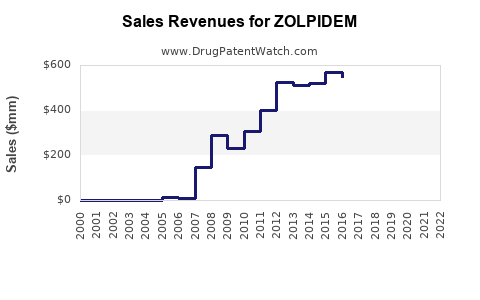
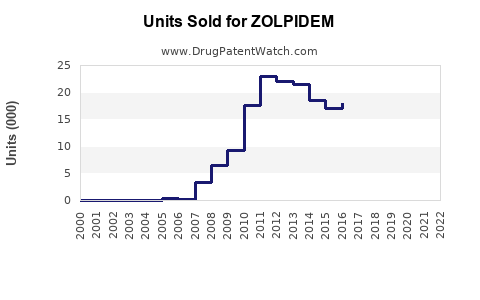
Annual Sales Revenues and Units Sold for ZOLPIDEM
| Drug Name | Revenues (USD) | Units | Year |
|---|---|---|---|
| ZOLPIDEM | ⤷ Start Trial | ⤷ Start Trial | 2022 |
| ZOLPIDEM | ⤷ Start Trial | ⤷ Start Trial | 2021 |
| ZOLPIDEM | ⤷ Start Trial | ⤷ Start Trial | 2020 |
| >Drug Name | >Revenues (USD) | >Units | >Year |
Market Overview and Sales Projections for Zolpidem
Zolpidem, marketed primarily as Ambien, is a hypnotic agent used for short-term treatment of insomnia. It is one of the most prescribed sleep aids worldwide, with a well-established presence in the market. The ongoing development of alternative formulations and competitors influences its future sales.
Market Size and Current Value
The global sleep aid market was valued at approximately $8.1 billion in 2022 and is projected to reach $10.7 billion by 2027, growing at a compound annual growth rate (CAGR) of 5.6%. Zolpidem accounts for an estimated 35-40% of this market, reflecting its dominant position.
Regional Market Distribution
| Region | Market Share | Estimated Market Size (2022) | Growth Rate (2022-2027) |
|---|---|---|---|
| North America | 45% | $1.8 billion | CAGR 4.8% |
| Europe | 25% | $1 billion | CAGR 6.0% |
| Asia-Pacific | 20% | $0.8 billion | CAGR 7.2% |
| Rest of World | 10% | $0.4 billion | CAGR 5.3% |
North America remains the largest market due to high prescription rates, with the US accounting for roughly 90% of North American sales. Europe follows, driven by aging populations and increasing sleep disorder awareness. Asia-Pacific shows rapid growth, fueled by rising income levels and urbanization.
Key Market Drivers
- Increasing prevalence of insomnia: 30-40% of adults report sleep disturbances, boosting demand.
- Aging populations: Older adults are more prone to sleep disorders.
- Prescribing practices: Zolpidem's quick onset and efficacy maintain its popularity.
Regulatory and Market Challenges
- Safety concerns over dependency, tolerance, and complex sleep behaviors.
- Regulatory restrictions: Certain formulations, such as controlled-release forms, face tighter regulation.
- Competition: Newer drugs like lemborexant and suvorexant are gaining market share due to improved safety profiles.
Future Sales Projections
Based on market growth trends, current prescribing patterns, and emerging competitors, sales of Zolpidem are expected as follows:
| Year | Estimated Global Sales | Notes |
|---|---|---|
| 2023 | ~$3.2 billion | Continued market dominance with stable demand. |
| 2025 | ~$3.7 billion | Slight decline as competitors gain ground. |
| 2027 | ~$4.0 billion | Growth plateau expected, with market share increasingly challenged. |
Factors Influencing Future Projections
- Formulation Innovations: Extended-release and sublingual formulations may expand use but also introduce risks of misuse.
- Generic Entry: Patent expirations (the US patent for Ambien expired in 2017) increase generic competition, reducing unit prices.
- Regulatory Environment: Heightened safety regulations may limit prescribing and impact sales.
- Market Penetration of Alternatives: New drugs with lower dependence risk could erode Zolpidem's market share.
Competitive Landscape
- Traditional Sleep Aids: Eszopiclone, zaleplon.
- Novel Agents: Lemborexant, suvorexant, which target orexin receptors, gaining market traction.
- Over-the-counter options: Diphenhydramine, melatonin, but limited to less severe cases.
Key Takeaways
- Zolpidem remains a leading insomnia treatment with an estimated global market share of approximately 35-40% in sleep aids.
- Market size is driven by high prevalence of sleep disorders, especially in aging populations.
- Sales are projected to reach around $4 billion globally by 2027, with a slow growth trend influenced by market competition, safety concerns, and regulatory shifts.
- Innovation in formulations and rising competition from newer drugs could temper growth rates.
- Regulatory restrictions and generics are key factors in pricing pressures, impacting profitability.
FAQs
1. How does Zolpidem compare to newer sleep medications?
Newer drugs like lemborexant and suvorexant target different pathways (orexin receptor antagonism) and tend to have lower dependency risks, capturing market share from Zolpidem.
2. What are the main risks affecting Zolpidem sales?
Safety concerns over dependence, complex sleep behaviors, and regulatory actions are primary risks that could limit prescriptions or lead to product reformulation.
3. How does patent expiration impact Zolpidem sales?
Patent expiration leads to increased generic competition, reducing prices and profit margins, thus constraining overall sales growth.
4. What role do formulations play in future sales?
Extended-release and sublingual formulations aim to improve compliance but may also increase misuse potential, influencing regulatory scrutiny.
5. How does regional variation affect sales projections?
North America, especially the US, dominates sales due to high prescription rates, while growth in Asia-Pacific results from increasing awareness and urbanization.
References
- MarketsandMarkets. (2022). Sleep Disorder Market by Type, Treatment, Region - Global Forecast to 2027.
- IQVIA. (2022). Global Prescription Drug Market Data.
- Statista. (2022). Leading Prescription Sleep Aids Sales in the US.
- U.S. FDA. (2013). Zolpidem (Ambien) Safety Labeling Changes.
More… ↓
