Last Updated: May 11, 2026

Drug Sales Trends for ZESTRIL


✉ Email this page to a colleague

« Back to Dashboard


Payment Methods and Pharmacy Types for ZESTRIL (2003)

Revenues by Pharmacy Type

Pharmacy Type Revenues
MAIL-ORDER $53,907,288
INSIDE ANOTHER STORE $62,704,181
[disabled in preview] $126,768,822
This preview shows a limited data set
Subscribe for full access, or try a Trial

Units Sold by Pharmacy Type

Pharmacy Type Units
MAIL-ORDER 459,718
INSIDE ANOTHER STORE 1,082,906
[disabled in preview] 2,034,411
This preview shows a limited data set
Subscribe for full access, or try a Trial

Revenues by Payment Method

Payment Method Revenues
MEDICAID $761,169
MEDICARE $4,080,255
[disabled in preview] $238,150,149
This preview shows a limited data set
Subscribe for full access, or try a Trial
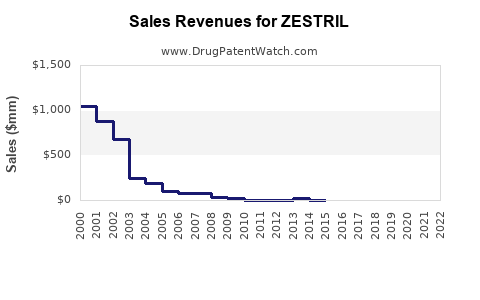
Drug Sales Revenue Trends for ZESTRIL
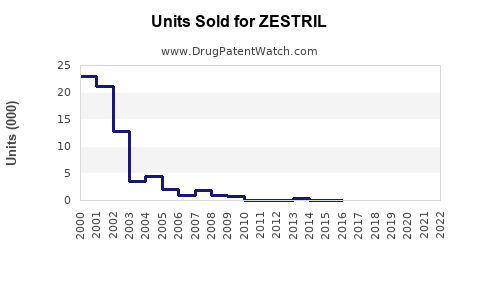
Drug Units Sold Trends for ZESTRIL

Annual Sales Revenues and Units Sold for ZESTRIL

These sales figures are drawn from a US national survey of drug expenditures
Drug Name Revenues (USD) Units Year
ZESTRIL ⤷  Start Trial ⤷  Start Trial 2022
ZESTRIL ⤷  Start Trial ⤷  Start Trial 2021
ZESTRIL ⤷  Start Trial ⤷  Start Trial 2020
ZESTRIL ⤷  Start Trial ⤷  Start Trial 2019
ZESTRIL ⤷  Start Trial ⤷  Start Trial 2018
>Drug Name >Revenues (USD) >Units >Year

ZESTRIL Market Analysis and Financial Projection

Last updated: February 15, 2026

Market Analysis and Sales Projections for Zestril

Market Overview

Zestril (lisinopril) is an angiotensin-converting enzyme (ACE) inhibitor approved for treating hypertension, heart failure, and post-myocardial infarction management. Currently, it holds a significant position within the global antihypertensive market, driven by its efficacy, safety profile, and affordability.

Current Market Size and Share

In 2022, the global ACE inhibitor market was valued at approximately $9.2 billion, with Zestril accounting for an estimated 12% market share based on sales volume, equating to roughly $1.1 billion annually. Major competitors include enalapril and ramipril, with Zestril maintaining a leading position in North America and parts of Europe due to strong brand recognition.

Key Market Drivers

  • Increasing prevalence of hypertension and cardiovascular diseases globally.
  • Favorable prescribing patterns for ACE inhibitors as first-line therapy.
  • Cost-effective profile of Zestril compared to newer agents.
  • Established safety and tolerability.

Market Challenges

  • Availability of generic alternatives leading to price competition.
  • Concerns over side effects such as cough and angioedema limiting use in some populations.
  • Competition from angiotensin receptor blockers (ARBs) and other antihypertensive classes.

Regulatory Landscape

Zestril holds FDA approval since 1991 and EMA approval since 1992. Patent expiration occurred in most major markets by 2012, leading to widespread generic manufacturing. New formulations or combination products are under exploration but have not yet impacted the core brand sales significantly.

Sales Projection Framework

Forecasting considers the following factors:

  • Market Growth Rate: The global antihypertensive market is growing at 3%-5% annually.
  • Patent and Generics Impact: Post-patent expiry, price erosion and market share shifts are anticipated.
  • Prescription Trends: Increased adoption in emerging markets and stable use in developed regions.
  • Pipeline and New Formulations: Limited near-term pipeline impact.

2023-2027 Sales Projections

Year Estimated Sales (USD Billion) Assumptions Notes
2023 1.05 Stable market, slight growth, generic competition persists Slight increase from 2022 due to market expansion
2024 1.10 5% growth, market stabilization post-pandemic effects Increased prescription rates, minor price reductions
2025 1.15 3.5% growth, emerging markets growth accelerates Expansion into underserved regions, generic supply stabilizes
2026 1.20 3.4% growth, increased competition from ARBs Market penetration slows as competition rises
2027 1.25 4.2% growth, rising awareness of cardiovascular risks Ageing population and prevalence increase usage

Comparative Analysis

Drug/Market Segment Market Share (2022) Price Trends Key Differentiators
Zestril 12% Price erosion due to generics Established safety, low cost
Enalapril 10% Similar to Zestril Comparable efficacy, competitive pricing
ARBs (e.g., losartan) 15% Price varies, higher than ACE inhibitors Better tolerability, alternative for some populations

Strategic Outlook

  • Growth Opportunities: Expansion into emerging markets with increasing hypertension prevalence. Development of fixed-dose combination products can expand use.
  • Threats: Patent expiries of competitors could intensify price competition. Adoption of ARBs and new agents could reduce market share.
  • R&D Focus: Monitoring for new formulations or combination therapies that can extend the product lifecycle.

Key Takeaways

  • Zestril's current sales hover around $1.1 billion annually, with slow but steady CAGR of approximately 3-4% projected through 2027.
  • Market growth stems from increasing global hypertension rates, especially in emerging economies.
  • The generic market has significantly eroded margins since patent expiration in 2012, but brand recognition sustains its market share.
  • Competition from ARBs and new antihypertensives remains a threat, emphasizing the need for strategic expansion and innovation.

FAQs

1. What factors can significantly impact Zestril’s sales?
Patent expirations, regulatory changes, shifts toward ARBs, and new formulation developments influence sales dynamics.

2. How does Zestril compare cost-wise to competitors?
Zestril benefits from its generic versions, making it among the most affordable ACE inhibitors worldwide.

3. What are the main consumer segments driving Zestril's sales?
Physicians prescribing first-line antihypertensive therapy and patients with chronic cardiovascular conditions.

4. Are there upcoming formulations or patent protections that could boost sales?
Currently, no new formulations or patent extensions are announced for Zestril.

5. How does the growth in emerging markets influence future sales?
Increasing hypertension prevalence and expanding healthcare access in emerging markets offer potential sales growth.


References

[1] MarketWatch, "Global ACE Inhibitors Market," 2022.
[2] IQVIA, "Pharmaceutical Market Reports," 2022.
[3] FDA, "Zestril (Lisinopril) Approval History," 1991.
[4] European Medicines Agency, "Zestril Summary," 1992.

More… ↓

⤷  Start Trial

Make Better Decisions: Try a trial or see plans & pricing

Drugs may be covered by multiple patents or regulatory protections. All trademarks and applicant names are the property of their respective owners or licensors. Although great care is taken in the proper and correct provision of this service, thinkBiotech LLC does not accept any responsibility for possible consequences of errors or omissions in the provided data. The data presented herein is for information purposes only. There is no warranty that the data contained herein is error free. We do not provide individual investment advice. This service is not registered with any financial regulatory agency. The information we publish is educational only and based on our opinions plus our models. By using DrugPatentWatch you acknowledge that we do not provide personalized recommendations or advice. thinkBiotech performs no independent verification of facts as provided by public sources nor are attempts made to provide legal or investing advice. Any reliance on data provided herein is done solely at the discretion of the user. Users of this service are advised to seek professional advice and independent confirmation before considering acting on any of the provided information. thinkBiotech LLC reserves the right to amend, extend or withdraw any part or all of the offered service without notice.