Share This Page
Drug Sales Trends for XARELTO
✉ Email this page to a colleague
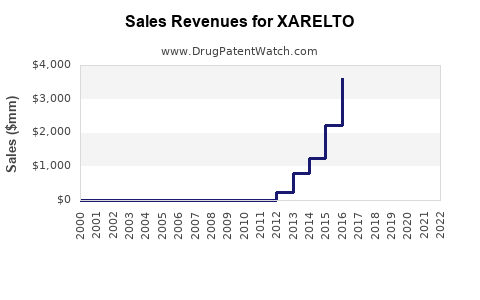
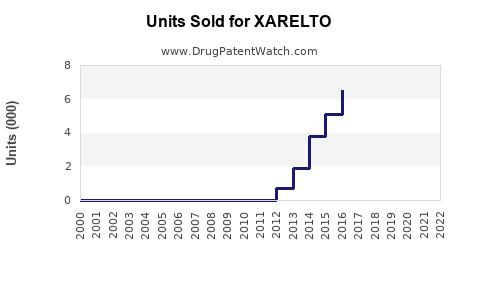
Annual Sales Revenues and Units Sold for XARELTO
| Drug Name | Revenues (USD) | Units | Year |
|---|---|---|---|
| XARELTO | ⤷ Start Trial | ⤷ Start Trial | 2022 |
| XARELTO | ⤷ Start Trial | ⤷ Start Trial | 2021 |
| XARELTO | ⤷ Start Trial | ⤷ Start Trial | 2020 |
| >Drug Name | >Revenues (USD) | >Units | >Year |
Xarelto Market Analysis, Patent Expiry, Sales Forecast, and Generic Entry Outlook
Xarelto, the oral anticoagulant rivaroxaban, is entering a multi-year patent erosion cycle. Global sales remain substantial, supported by atrial fibrillation, venous thromboembolism, coronary artery disease, peripheral artery disease, and pediatric indications. The main commercial risk is U.S. generic entry after settlement agreements involving Johnson & Johnson, Bayer, and generic-drug manufacturers. A base-case model projects global Xarelto sales declining from approximately $7.5 billion in 2024 to $3.0 billion-$3.5 billion by 2030, with the steepest reduction occurring after U.S. generic launches.
What is Xarelto and how large is its market?
Xarelto is a direct oral factor Xa inhibitor marketed by Johnson & Johnson through Janssen in the United States and by Bayer outside the United States. Its active ingredient is rivaroxaban.
The drug is approved for several indications:
- Stroke and systemic embolism prevention in nonvalvular atrial fibrillation.
- Treatment and prevention of recurrence of deep-vein thrombosis and pulmonary embolism.
- Venous thromboembolism prophylaxis after hip- or knee-replacement surgery.
- Reduction of major cardiovascular events in patients with chronic coronary artery disease or peripheral artery disease, in combination with aspirin.
- Prevention of venous thromboembolism in selected pediatric patients.
The commercial market is dominated by factor Xa inhibitors. Eliquis, marketed by Bristol Myers Squibb and Pfizer, is the leading competing product. Xarelto competes with Pradaxa, Savaysa, warfarin, low-molecular-weight heparins, and newer generic anticoagulants.
| Product | Active ingredient | Primary manufacturers | Commercial position |
|---|---|---|---|
| Eliquis | Apixaban | Bristol Myers Squibb, Pfizer | Global market leader in oral anticoagulation |
| Xarelto | Rivaroxaban | Johnson & Johnson, Bayer | Large second-ranked branded factor Xa inhibitor |
| Pradaxa | Dabigatran | Boehringer Ingelheim | Older direct thrombin inhibitor with generic competition in some markets |
| Savaysa/Lixiana | Edoxaban | Daiichi Sankyo | Regional factor Xa competitor |
| Warfarin | Warfarin | Multiple manufacturers | Low-cost alternative requiring monitoring |
The principal commercial advantages of Xarelto are once-daily dosing for several indications, broad label coverage, substantial physician familiarity, and established use in cardiovascular disease. Its disadvantages include competition from Eliquis, bleeding risk, price pressure, and the loss of exclusivity in multiple jurisdictions.
How much revenue does Xarelto generate?
Xarelto generates revenue for both Bayer and Johnson & Johnson, but the companies report sales separately and use different geographic and accounting presentations. The figures should not be added without adjusting for currency, territory, and reporting conventions.
| Year | Bayer reported Xarelto sales | Johnson & Johnson reported Xarelto sales | Market interpretation |
|---|---|---|---|
| 2022 | Approximately €4.5 billion | Approximately $2.9 billion | Pre-cliff scale remained high |
| 2023 | Approximately €4.7 billion | Approximately $2.8 billion | Stable global demand with early pricing pressure |
| 2024 | Approximately €4.5 billion | Approximately $2.6 billion | Decline reflected competition, pricing, and patent erosion |
| 2025 estimate | Approximately €4.0 billion-$4.3 billion | Approximately $2.2 billion-$2.5 billion | Continuing erosion before broad U.S. generic substitution |
Bayer reported Xarelto sales of approximately €4.5 billion in 2024. Johnson & Johnson reported Xarelto sales of approximately $2.6 billion for the same year. The U.S. business represents a disproportionate share of profit because branded reimbursement and net pricing are generally higher than in many international markets. [1][2]
What are the Xarelto sales projections through 2030?
The following base case assumes gradual erosion in Europe and other markets, U.S. generic entry beginning in the 2026-2027 period, and rapid substitution after multiple manufacturers obtain commercial supply.
| Year | Estimated global Xarelto revenue | Year-over-year change | Main driver |
|---|---|---|---|
| 2024 | $7.4 billion-$7.8 billion | Baseline | Branded demand remains high |
| 2025 | $6.9 billion-$7.3 billion | -5% to -8% | International generic pressure and contracting |
| 2026 | $6.0 billion-$6.6 billion | -9% to -16% | Initial U.S. generic entry and price reductions |
| 2027 | $4.7 billion-$5.4 billion | -15% to -25% | Broader U.S. substitution |
| 2028 | $3.8 billion-$4.4 billion | -12% to -20% | Mature generic competition |
| 2029 | $3.3 billion-$3.9 billion | -8% to -15% | Residual branded use and protected channels |
| 2030 | $3.0 billion-$3.6 billion | -5% to -12% | Stable post-cliff market |
The base case implies a 50%-60% decline from 2024 global sales by 2030. That decline is less severe than the erosion experienced by small-molecule drugs with only one generic entrant because rivaroxaban has multiple indications, strong clinical adoption, and substantial international demand.
Upside scenario
In an upside scenario, branded Xarelto retains a larger share of the U.S. market because of payer contracting, physician familiarity, and delayed generic supply. Global revenue could remain near $4 billion in 2030. The scenario requires slower FDA approvals, limited generic manufacturing capacity, or settlements that delay commercial entry.
Downside scenario
In a downside scenario, several generic manufacturers launch close to the first permitted date and pharmacy benefit managers rapidly substitute rivaroxaban. Global revenue could fall below $2.7 billion by 2030. U.S. revenue would experience the largest reduction, potentially declining 70%-90% from pre-generic levels within three years.
When does Xarelto lose exclusivity?
Xarelto does not have one universal worldwide loss-of-exclusivity date. Exclusivity depends on jurisdiction, patent scope, pediatric extensions, regulatory exclusivity, and litigation settlements.
The original U.S. composition patent, U.S. Patent No. 7,157,456, covered rivaroxaban and was listed with an expiration date in 2024. Pediatric exclusivity and later Orange Book-listed patents extend portions of the U.S. protection period beyond the original compound patent. The commercial date for generic launch depends on settlement terms and the status of each generic applicant, not only on the earliest patent expiration date. [3]
| Protection category | Commercial relevance |
|---|---|
| Original composition patent | Established the principal early U.S. protection period |
| Pediatric exclusivity | Added six months to certain FDA-related exclusivity periods |
| Dose and regimen patents | May cover particular strengths or treatment schedules |
| Formulation patents | Can protect dosage-form characteristics and manufacturing features |
| Method-of-use patents | Can cover cardiovascular-risk reduction or other labeled uses |
| Litigation settlements | Can establish agreed generic launch dates before later patents expire |
In Europe and other markets, generic entry has occurred or can occur at different times because national patents, supplementary protection certificates, and litigation outcomes vary by country.
What patents protect Xarelto?
The Xarelto patent estate includes compound, formulation, dosage, regimen, method-of-use, and manufacturing-related rights. The most commercially important early patent was U.S. Patent No. 7,157,456, assigned to Bayer entities and associated with the rivaroxaban compound.
Later U.S. patents listed for Xarelto have included patents directed to formulations, dosage regimens, and therapeutic uses. Orange Book listings can change through patent additions, delistings, certifications, and FDA updates. The following categories are more commercially relevant than any single patent number:
| Patent category | Protected subject matter | Generic impact |
|---|---|---|
| Compound patents | Rivaroxaban molecule and related chemical claims | Broadest protection, generally expired or near expiry |
| Tablet formulation patents | Composition, excipients, stability, or release properties | May require a different formulation or litigation strategy |
| Dosing patents | Specific treatment schedules and strengths | Relevant to ANDA labeling and skinny-label design |
| Cardiovascular use patents | Rivaroxaban plus aspirin for CAD/PAD risk reduction | Can support partial carve-outs from generic labels |
| Pediatric use patents | Pediatric dosing and treatment populations | May affect label scope rather than core adult sales |
| Manufacturing patents | Processes, intermediates, purification, and scale-up | Can raise supply-chain barriers without blocking all generic entry |
The patent estate is commercially meaningful but weaker than it was before the composition patent expired. Generic manufacturers can challenge listed patents through Paragraph IV certifications or seek approval with omitted indications where permitted by the FDA.
Which companies are challenging Xarelto patents?
Multiple generic companies have pursued rivaroxaban ANDA strategies or participated in patent litigation. The exact group of challengers and launch rights depends on individual settlement agreements and FDA approval status.
Generic manufacturers active in major U.S. pharmaceutical patent litigation involving Xarelto have included Teva Pharmaceuticals, Mylan/Viatris, Sun Pharmaceutical Industries, and other ANDA applicants. Johnson & Johnson and Bayer have used settlements to resolve or limit litigation exposure with certain challengers. [4][5]
A settlement may provide a generic company with:
- A fixed launch date.
- A license to manufacture and sell before later patent expiry.
- Restrictions on authorized generic competition.
- A covenant not to sue for specified products or indications.
- Terms covering damages, patent challenges, or future litigation.
The existence of a settlement does not mean all generics can launch on the same date. Each applicant remains subject to FDA approval, manufacturing readiness, labeling requirements, and settlement-specific conditions.
What is the FDA regulatory status of Xarelto?
Xarelto is an FDA-approved small-molecule prescription drug. It is regulated through the abbreviated new drug application pathway for generic versions, not through the biosimilar pathway.
The FDA has approved Xarelto for several adult and pediatric indications. The drug’s broad label creates both an opportunity and a constraint for generic applicants. An ANDA must generally demonstrate pharmaceutical equivalence and bioequivalence, but the applicant may omit a protected method of use through a section viii labeling strategy if the remaining label is legally and regulatorily supportable. [6]
Does Xarelto face biosimilar risk?
No. Xarelto is a chemically synthesized small molecule, not a biologic. Biosimilar approval is not the relevant competitive pathway. The principal threat is conventional generic rivaroxaban submitted through ANDAs.
This distinction matters commercially. Generic entry can occur through multiple manufacturers with products that are therapeutically substitutable at the pharmacy level. The market does not require a biologics-style interchangeability designation for the same degree of price competition.
What is the Orange Book status of Xarelto?
Xarelto has had multiple patents listed in the FDA Orange Book. The Orange Book identifies patents and exclusivity information relevant to approved drug products, but it does not itself determine the final commercial launch date for each generic applicant.
The key Orange Book issues are:
- Whether a patent is listed against the relevant Xarelto strength and dosage form.
- Whether the ANDA applicant submitted a Paragraph IV certification.
- Whether the patent holder filed suit within the statutory period.
- Whether FDA approval is subject to a 30-month stay.
- Whether a settlement grants an earlier license.
- Whether the generic label can omit protected indications.
The Orange Book should be reviewed at the product-strength level because patent listings and certification consequences can differ among tablets and treatment indications. [3]
What generic launch risks exist for Xarelto?
The most probable U.S. launch pattern is staged entry rather than a single-day collapse.
Scenario 1: Limited first-wave entry
One or two manufacturers launch after settlement-authorized dates. Net prices fall quickly, but branded Xarelto retains meaningful volume through commercial contracts and patients with stable therapy.
Scenario 2: Broad multi-manufacturer entry
Several manufacturers launch within a short period. Pharmacy benefit managers favor generic substitution, and branded volume falls sharply. This is the base case for 2027 onward.
Scenario 3: Delayed or constrained entry
FDA approval, manufacturing issues, litigation, or settlement restrictions delay some entrants. Branded sales remain higher for an additional 12-24 months.
Generic erosion is likely to be faster in high-volume atrial fibrillation and venous thromboembolism indications. The CAD/PAD combination regimen may erode more slowly if labeling, physician adoption, or reimbursement rules create barriers to immediate substitution.
How strong is the Xarelto patent estate?
The estate is moderate after the original composition protection period. It has meaningful residual value in specific formulations, indications, and treatment regimens, but it is unlikely to block broad rivaroxaban generic entry indefinitely.
Strengths
- Large clinical and regulatory footprint.
- Multiple patent families across formulation and use claims.
- Significant litigation resources from Bayer and Johnson & Johnson.
- Potentially differentiated cardiovascular uses.
- Manufacturing complexity that may delay some entrants.
Weaknesses
- Core molecule protection has expired or reached the end of its effective commercial life.
- Generic applicants can target unprotected indications.
- Multiple ANDA applicants reduce the chance of prolonged market exclusivity.
- Formulation and method patents generally protect narrower subject matter.
- Settlement agreements indicate that patent litigation alone is unlikely to preserve the pre-cliff market.
How does Xarelto compare with Eliquis?
Eliquis has the stronger current commercial position, while Xarelto has broader historical exposure in certain cardiovascular and VTE segments.
| Metric | Xarelto | Eliquis |
|---|---|---|
| Active ingredient | Rivaroxaban | Apixaban |
| Main dosing pattern | Once daily for several uses | Twice daily |
| Leading company position | Bayer and Johnson & Johnson | Bristol Myers Squibb and Pfizer |
| Main competitive advantage | Broad indications and once-daily dosing | Strong efficacy and safety perception |
| Patent risk | Active generic-entry cycle | Later U.S. loss-of-exclusivity profile |
| Near-term sales risk | High | Lower before its own patent cliff |
| Substitution pressure | Increasing | Strong branded demand remains |
Eliquis has generally generated higher global sales than Xarelto. Its later exclusivity profile gives it a temporary commercial advantage, although it will face its own generic erosion cycle later in the decade. Xarelto’s main strategic challenge is maintaining differentiated use in CAD/PAD and other segments while defending price against generic rivaroxaban.
What licensing deals and commercial arrangements affect Xarelto?
Xarelto’s commercial structure is based primarily on collaboration between Bayer and Johnson & Johnson, with Bayer leading commercialization in many markets outside the United States and Johnson & Johnson leading U.S. commercialization.
The companies have not relied on a conventional third-party license to preserve broad post-expiry exclusivity. Their key commercial tools have been:
- Joint development and commercialization rights.
- Geographic allocation of sales responsibility.
- Patent litigation and settlements.
- Contracting with insurers and pharmacy benefit managers.
- Lifecycle management in pediatric and cardiovascular indications.
- Manufacturing and supply arrangements for multiple tablet strengths.
After generic entry, the partnership’s economic value will depend more on residual branded share, international pricing, indication mix, and manufacturing efficiency than on monopoly pricing.
What revenue exposure do Bayer and Johnson & Johnson face?
Johnson & Johnson faces concentrated U.S. exposure because Xarelto is a major product within its pharmaceutical portfolio. A 70%-90% U.S. revenue decline over several years could reduce annual sales by approximately $1.8 billion-$2.3 billion relative to the 2024 level, before any offset from volume growth or pricing.
Bayer faces broader international exposure. Its revenue decline is likely to be more gradual because country-level patent expiry and reimbursement changes occur at different times. Bayer’s exposure could still reach several billion euros annually by 2030 if international generic substitution accelerates.
The profit impact will exceed the revenue impact if branded Xarelto has a high contribution margin. Corporate cost reductions, supply-chain adjustments, and portfolio growth may offset part of the earnings decline, but they will not eliminate the loss of a mature blockbuster.
What manufacturing and intellectual-property barriers remain?
Rivaroxaban tablets are commercially accessible to capable generic manufacturers, but successful entry requires more than chemical synthesis. Applicants must manage:
- Bioequivalence across strengths.
- Control of particle size and solid-state properties.
- Tablet uniformity at low dose strengths.
- Stability and impurity specifications.
- Scalable API sourcing.
- Regulatory compliance across multiple facilities.
- Patent-safe labeling.
- Commercial supply sufficient for pharmacy substitution.
These barriers may delay smaller manufacturers, but they are unlikely to prevent entry by large generic companies. The most durable protection is likely to come from formulation know-how, reliable supply, and payer contracts rather than from broad exclusivity.
What is the likely generic launch and market-share outcome?
A practical forecast is:
| Period after broad generic entry | Estimated generic share of U.S. rivaroxaban volume |
|---|---|
| First 6 months | 15%-35% |
| 12 months | 40%-65% |
| 24 months | 65%-85% |
| 36 months | 75%-90% |
Branded Xarelto can retain a higher share in Medicare, hospital discharge programs, complex patients, or indications with labeling differences. The product is unlikely to retain a dominant U.S. share once several FDA-approved generics are available and reimbursed as therapeutically equivalent.
Key Takeaways
- Xarelto remains a multibillion-dollar global product but is entering a material patent-cliff period.
- Bayer reported approximately €4.5 billion in Xarelto sales in 2024; Johnson & Johnson reported approximately $2.6 billion.
- Base-case global sales decline from roughly $7.5 billion in 2024 to $3.0 billion-$3.6 billion by 2030.
- U.S. generic entry is the principal commercial catalyst, with broad substitution most likely in 2027 or later depending on settlement and FDA timelines.
- Xarelto faces generic, not biosimilar, competition.
- Residual formulation, method-of-use, pediatric, and manufacturing patents may delay or narrow competition but are unlikely to preserve broad branded exclusivity.
- Eliquis has the stronger near-term commercial position because its U.S. exclusivity period extends later.
- Bayer and Johnson & Johnson face several billion dollars of combined annual revenue exposure over the post-generic period.
FAQs
Is Xarelto still commercially attractive after patent expiry?
Yes, for generic manufacturers with scalable API supply, multiple approved strengths, and access to pharmacy and payer channels. The opportunity is volume-driven rather than margin-driven.
Will generic Xarelto be automatically substituted for branded Xarelto?
In many cases, yes, if the generic is FDA-approved as therapeutically equivalent and state pharmacy-substitution rules permit substitution. Payer formularies and physician instructions can still affect the timing.
Which Xarelto indication is most vulnerable to generic erosion?
Atrial fibrillation and standard VTE treatment are likely to experience the fastest erosion because they have large patient populations and established generic-label pathways.
Can a generic company sell Xarelto for every approved indication?
Not necessarily. A generic applicant may omit indications protected by method-of-use patents if the FDA pathway and labeling strategy support a section viii carve-out.
What is the most important investment risk for Xarelto?
The main risk is faster-than-modeled U.S. generic substitution after multiple manufacturers launch. That outcome would reduce branded revenue, pricing, and contribution margin faster than international sales growth could offset.
References
- Bayer AG. (2025). Annual report 2024. Bayer AG.
- Johnson & Johnson. (2025). 2024 annual report. Johnson & Johnson.
- U.S. Food and Drug Administration. (2025). Approved drug products with therapeutic equivalence evaluations: The Orange Book. FDA.
- U.S. District Court for the District of Delaware. (Various years). Rivaroxaban patent litigation records involving Janssen Pharmaceuticals and generic applicants.
- Johnson & Johnson. (2024). Annual report and pharmaceutical product disclosures. Johnson & Johnson.
- U.S. Food and Drug Administration. (2024). Xarelto prescribing information and abbreviated new drug application guidance. FDA.
More… ↓
