Share This Page
Drug Sales Trends for VALACYCLOVIR
✉ Email this page to a colleague
Payment Methods and Pharmacy Types for VALACYCLOVIR (2003)
Revenues by Pharmacy Type
Units Sold by Pharmacy Type
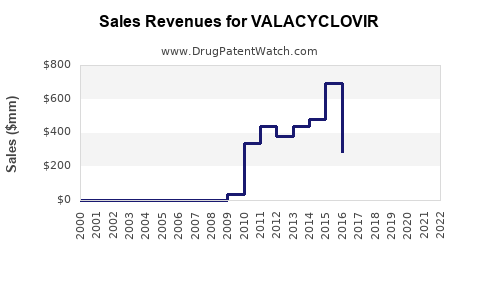
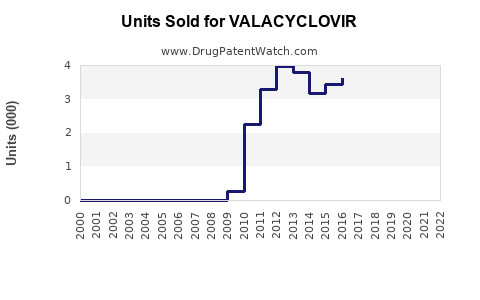
Annual Sales Revenues and Units Sold for VALACYCLOVIR
| Drug Name | Revenues (USD) | Units | Year |
|---|---|---|---|
| VALACYCLOVIR | ⤷ Start Trial | ⤷ Start Trial | 2022 |
| VALACYCLOVIR | ⤷ Start Trial | ⤷ Start Trial | 2021 |
| VALACYCLOVIR | ⤷ Start Trial | ⤷ Start Trial | 2020 |
| VALACYCLOVIR | ⤷ Start Trial | ⤷ Start Trial | 2019 |
| VALACYCLOVIR | ⤷ Start Trial | ⤷ Start Trial | 2018 |
| >Drug Name | >Revenues (USD) | >Units | >Year |
Valacyclovir Market Analysis, Sales Forecast, Patent Position, and Generic Competition
Valacyclovir is a mature, off-patent oral antiviral with high generic penetration and limited pricing power. Global sales are concentrated in generic prescription markets, especially the United States, Japan, and Europe. The market is likely to remain broadly stable in volume through 2030, while nominal revenue growth will depend on population growth, herpes zoster treatment rates, channel mix, and price inflation.
A base-case estimate places the global valacyclovir market at approximately $450 million to $650 million in 2025, with potential growth to $500 million to $750 million by 2030. The forecast implies a compound annual growth rate of roughly 2% to 4%, driven primarily by prescription volume rather than innovation or price increases.
What is the current market status of valacyclovir?
Valacyclovir hydrochloride is the oral prodrug of acyclovir. It is converted to acyclovir after administration and is used for herpes simplex virus and varicella-zoster virus infections.
The U.S. Food and Drug Administration approved Valtrex, the originator product, in 1995. Current U.S. labeling covers treatment of herpes zoster, treatment or suppression of genital herpes, reduction of transmission of genital herpes, and treatment of herpes labialis. Pediatric indications include chickenpox and cold sores in specified age groups and dosing settings (FDA, 2024a).
The market has four principal demand segments:
| Segment | Commercial role | Volume outlook through 2030 |
|---|---|---|
| Genital herpes treatment | Large recurring prescription base | Stable to modest growth |
| Genital herpes suppression | Recurring chronic-use segment | Moderate growth |
| Herpes zoster | Higher-dose, episodic treatment | Stable, age-driven growth |
| Herpes labialis and chickenpox | Smaller and more episodic | Stable to modest growth |
The product has a favorable commercial profile because it is orally administered, widely recognized by prescribers, and available in multiple tablet strengths. Its limitations are generic substitution, low wholesale prices, and limited differentiation from acyclovir.
How large is the valacyclovir market?
Public sources do not provide a single audited global market figure for generic valacyclovir. The following estimate uses historical branded sales, prescription-market structure, generic pricing, and epidemiological demand as inputs.
| Market scenario | 2025 estimated sales | 2030 estimated sales | 2025-2030 CAGR |
|---|---|---|---|
| Low case | $350 million | $360 million | 0.6% |
| Base case | $550 million | $620 million | 2.4% |
| High case | $750 million | $900 million | 3.7% |
These figures represent estimated pharmaceutical sales across branded and generic oral valacyclovir products. They exclude acyclovir, famciclovir, topical antivirals, and nonprescription cold-sore products.
The U.S. is expected to remain the largest individual country market because of high prescribing, broad insurance coverage, and extensive pharmacy distribution. Europe has substantial demand but stronger generic price compression. Japan has a meaningful market for herpes zoster and herpes simplex treatment, with reimbursement and prescribing rules affecting volume. Emerging markets contribute volume but generally generate lower revenue per prescription.
What drives valacyclovir sales?
The principal growth drivers are:
- An aging population with higher herpes zoster incidence.
- Continued diagnosis and treatment of genital herpes.
- Greater use of suppressive therapy in recurrent genital herpes.
- Improved access to prescription medicines in emerging markets.
- Increased clinical attention to herpes zoster complications in older adults.
The main constraints are generic substitution, low treatment duration for episodic indications, use of acyclovir as a lower-cost alternative, and vaccination against herpes zoster. The increasing uptake of recombinant zoster vaccine reduces the addressable incidence of shingles over time, although it does not eliminate treatment demand.
What are the sales projections for valacyclovir through 2030?
The base case assumes stable prescription volume, low-single-digit population and utilization growth, and continued price erosion in generic channels.
| Year | Low case | Base case | High case |
|---|---|---|---|
| 2025 | $350 million | $550 million | $750 million |
| 2026 | $352 million | $563 million | $770 million |
| 2027 | $354 million | $576 million | $793 million |
| 2028 | $356 million | $590 million | $817 million |
| 2029 | $358 million | $604 million | $858 million |
| 2030 | $360 million | $620 million | $900 million |
The base case assumes that prescription growth offsets generic price declines. The high case requires stronger volume growth in suppressive genital-herpes therapy, higher use in older populations, and relatively stable pharmacy reimbursement. The low case reflects continuing price compression, lower shingles incidence after vaccination, and substitution toward acyclovir.
Revenue is likely to be less predictable than unit demand. A manufacturer can increase tablet volume while experiencing flat or declining revenue if payer reimbursement and pharmacy acquisition prices fall.
When did valacyclovir lose market exclusivity?
Valacyclovir lost meaningful U.S. market exclusivity in the late 2000s. Generic valacyclovir hydrochloride products entered the U.S. market after the expiration or settlement of key Valtrex patent barriers. FDA records identify multiple abbreviated new drug applications for valacyclovir hydrochloride tablets, confirming the mature generic status of the product (FDA, 2024b).
The commercial effect was substantial:
- The Valtrex brand lost control of the U.S. market.
- Generic substitution became the dominant dispensing pattern.
- Average selling prices declined sharply.
- Patent-based premium pricing ended.
- The remaining commercial opportunity shifted to manufacturing efficiency, supply reliability, distribution, and contracting.
Historical Valtrex revenue is therefore not a reliable proxy for current valacyclovir market revenue. Originator-era sales reflected branded pricing and market control that no longer exists.
What patents protect valacyclovir today?
No commercially important U.S. composition-of-matter patent is generally expected to block generic valacyclovir supply. The key patent estate was associated with valacyclovir as an oral prodrug and with pharmaceutical formulations and uses developed before generic entry.
Historical Valtrex patent protection included patents covering valacyclovir compounds, pharmaceutical compositions, and methods of treating herpesvirus infections. The relevant patent family was associated with Glaxo Wellcome and later GlaxoSmithKline. Patent expiration dates varied by jurisdiction and by patent term adjustment or supplementary protection rights.
Current patent risk is comparatively low because:
- The active ingredient is long off patent.
- Multiple generic manufacturers are established.
- The FDA Orange Book does not create a current branded exclusivity barrier comparable to a new molecular entity.
- New method-of-use patents would face limited commercial value unless they covered a clearly differentiated indication and had enforceable claims.
Patent clearance remains relevant for a company seeking a new dosage form, pediatric formulation, combination product, or specialty indication. It is not a material barrier to standard immediate-release valacyclovir tablets.
What is the Orange Book status of valacyclovir?
The FDA Orange Book historically listed Valtrex and related patent information for the approved valacyclovir product. Current commercial activity is dominated by abbreviated new drug applications and generic equivalents rather than by a protected branded product (FDA, 2024c).
For a prospective generic entrant, the relevant regulatory questions are:
| Issue | Current assessment |
|---|---|
| Reference listed drug | Valtrex |
| FDA pathway | ANDA |
| Bioequivalence | Required |
| New clinical efficacy trials | Generally not required for a standard generic |
| Current NCE exclusivity | Expired |
| Current market exclusivity | No meaningful blocking exclusivity expected |
| Pediatric exclusivity | Not a current commercial barrier |
| Biosimilar pathway | Not applicable |
Applicants must still evaluate Orange Book listings, pediatric labeling, any remaining use codes, and product-specific FDA requirements at the time of filing.
Are there Paragraph IV challenges involving valacyclovir?
Paragraph IV litigation was relevant during the original generic-entry period, when manufacturers challenged listed Valtrex patents or asserted noninfringement and invalidity. The principal commercial consequence of those disputes was the timing of generic entry.
Valacyclovir is no longer a typical high-value Paragraph IV target. A new challenge would have limited economic value unless it involved an unexpired patent covering a commercially important formulation or indication. Standard valacyclovir tablets are already exposed to broad generic competition.
The principal litigation risk has shifted from molecule patents to:
- Manufacturing-process patents.
- Controlled-release or taste-masked formulations.
- Pediatric dosage forms.
- Patent claims covering combination antiviral products.
- Trade-secret and supply-chain disputes.
- ANDA product-quality or manufacturing issues.
Does valacyclovir face biosimilar risk?
Valacyclovir does not face biosimilar risk because it is a chemically synthesized small molecule, not a biologic. Its competitive risk is generic substitution under the ANDA pathway.
This distinction matters commercially. Biosimilar entry often involves manufacturing complexity, interchangeability questions, and substantial development costs. Valacyclovir generic entry requires conventional pharmaceutical development, analytical testing, bioequivalence work, and compliance with current good manufacturing practices.
Which companies compete in the valacyclovir market?
Competition is fragmented. The U.S. market has historically included generic manufacturers such as Teva, Sandoz, Dr. Reddy's Laboratories, Mylan or Viatris, Lupin, Zydus, Torrent, and other approved ANDA holders. The active supplier set varies by dosage strength, packaging configuration, wholesaler contracts, and manufacturing status.
The originator brand Valtrex remains commercially relevant as a reference product and brand-prescribing option, but it does not control the market in the way it did before generic entry.
Competitive advantages are primarily operational:
| Competitive factor | Importance |
|---|---|
| API supply security | High |
| FDA manufacturing compliance | High |
| Wholesale price | High |
| Pharmacy and wholesaler contracts | High |
| Product availability | High |
| Brand differentiation | Low |
| New clinical data | Low |
| Patent exclusivity | Low |
What manufacturing and intellectual-property barriers affect valacyclovir?
The active pharmaceutical ingredient is commercially available from multiple sources, but quality and continuity of supply remain important. Valacyclovir manufacturing requires control of impurity profiles, assay, dissolution, stability, and conversion-related product quality attributes.
Manufacturers can create defensible positions through:
- Lower-cost API sourcing.
- Dual-source supply arrangements.
- Reliable regulatory inspection performance.
- High service levels to wholesalers.
- Contract manufacturing capacity.
- Specialized packaging for institutional or pediatric use.
- Regional registrations in markets with fewer approved suppliers.
A formulation patent could have value if it materially improves stability, tablet size, swallowing, taste, or adherence. Its commercial potential would remain constrained by the low price of standard tablets and the availability of inexpensive alternatives.
What is the generic launch risk for valacyclovir?
Generic launch risk is high for any new standard-tablet entrant because the market is mature and price-sensitive. A successful launch requires a credible supply and contracting strategy rather than a patent-based premium.
Base launch scenario
A new manufacturer entering the U.S. market with standard tablets would likely face:
- Established generic competitors.
- Rapid price competition.
- Limited prescriber influence because substitution is automatic or payer-directed.
- Low brand loyalty.
- Dependence on wholesaler and pharmacy access.
- Potentially thin margins at high production volumes.
More attractive launch opportunities
The strongest opportunities are likely to involve:
- Supply-constrained dosage strengths.
- Regional markets with limited generic competition.
- Hospital and institutional contracts.
- Pediatric or easy-to-administer formulations.
- Combination or co-packaged antiviral products.
- Reliable supply during competitor manufacturing interruptions.
What is the commercial value of a valacyclovir licensing deal?
Licensing value for standard valacyclovir tablets is low. A conventional product license would likely be based on manufacturing access, geographic rights, distribution, or an approved dossier rather than on proprietary science.
Higher-value licensing opportunities could involve:
- A differentiated formulation.
- A novel delivery system.
- A combination product.
- A new antiviral indication.
- Rights in a country where registration or supply capacity is limited.
- A manufacturing process that reduces cost or improves yield.
There is no broad, current licensing event comparable to the major originator development and commercialization agreements associated with new antiviral products. Historical rights and commercialization arrangements tied to Valtrex do not create a current premium opportunity for ordinary generic valacyclovir.
How does valacyclovir compare with acyclovir and famciclovir?
| Attribute | Valacyclovir | Acyclovir | Famciclovir |
|---|---|---|---|
| Prodrug | Yes | No | Yes |
| Oral dosing convenience | Better than acyclovir in many indications | Less convenient | Generally convenient |
| Generic availability | Extensive | Extensive | Extensive |
| Price pressure | High | Very high | High |
| Main advantage | Higher oral bioavailability than acyclovir | Lowest-cost option | Alternative prodrug |
| Commercial outlook | Stable mature market | Larger low-cost base | Smaller niche |
| Patent barrier | Expired | Expired | Expired or largely expired |
Valacyclovir retains a commercial advantage where fewer daily doses improve adherence or where clinicians prefer its pharmacokinetic profile. Acyclovir remains a strong price competitor, especially in cost-sensitive markets.
What is the investment outlook for valacyclovir?
Valacyclovir is a defensive, volume-driven generic opportunity rather than a growth pharmaceutical asset. Investment attractiveness depends on manufacturing cost, supply reliability, regulatory execution, and access to distribution.
The market supports stable cash flow for efficient suppliers but offers limited upside from pricing or intellectual property. A buyer valuing a valacyclovir product should focus on:
- Net sales after rebates and chargebacks.
- Gross margin by dosage strength.
- Customer concentration.
- API source concentration.
- FDA inspection history.
- Back-order frequency.
- Contract duration.
- Regional registration status.
- Litigation and product liability exposure.
Key Takeaways
- Valacyclovir is a mature, genericized oral antiviral with no meaningful current composition-of-matter exclusivity in the United States.
- Estimated global sales are approximately $450 million to $650 million in 2025.
- Base-case global sales could reach about $620 million by 2030, implying roughly 2% to 4% annual growth.
- Volume growth should come from aging populations, genital-herpes suppression, and emerging-market access.
- Pricing power will remain weak because of extensive generic substitution and acyclovir competition.
- Biosimilar risk is not applicable; the relevant competitive threat is conventional generic entry.
- Standard-tablet patent risk is low, while formulation, manufacturing, and supply-chain risks remain commercially relevant.
- The strongest business cases involve reliable supply, lower manufacturing cost, differentiated formulations, or underserved geographic markets.
FAQs
Is valacyclovir still profitable for generic manufacturers?
Yes, but profitability depends on scale, API cost, manufacturing utilization, and supply reliability. Standard tablets generally offer low margins compared with protected or specialty products.
Will valacyclovir sales decline because of shingles vaccination?
Shingles vaccination can reduce treatment demand over time, particularly in older adults. The effect is likely to be gradual because vaccine uptake is incomplete and genital-herpes demand is not affected by zoster vaccination.
Can a company obtain new patent protection for valacyclovir?
A company may patent a novel formulation, delivery system, manufacturing process, or treatment method if it meets statutory patentability requirements. New protection would not normally restore exclusivity for ordinary immediate-release valacyclovir tablets.
Is valacyclovir a good target for a 505(b)(2) application?
A 505(b)(2) strategy could be viable for a differentiated dosage form or delivery system. The commercial case would require a clear clinical or adherence advantage because standard tablets are inexpensive and widely available.
What would cause valacyclovir revenue to outperform the base forecast?
Outperformance could result from increased suppressive therapy, greater prescription access in emerging markets, supply shortages among competitors, higher treatment rates for herpes zoster, or successful commercialization of a differentiated formulation.
References
- U.S. Food and Drug Administration. (2024a). Valtrex (valacyclovir hydrochloride) prescribing information.
- U.S. Food and Drug Administration. (2024b). Drugs@FDA: Valtrex and valacyclovir hydrochloride abbreviated new drug applications.
- U.S. Food and Drug Administration. (2024c). Approved drug products with therapeutic equivalence evaluations: Orange Book.
- World Health Organization. (2022). Global epidemiology of herpes simplex virus infections.
- Centers for Disease Control and Prevention. (2024). Sexually transmitted infections treatment guidelines: Genital herpes.
- Centers for Disease Control and Prevention. (2024). Shingles vaccination recommendations.
- Glaxo Wellcome, Inc. (1995). Valtrex regulatory and product information.
More… ↓
