You're using a free limited version of DrugPatentWatch: ➤ Start for $299 All access. No Commitment.

Last Updated: April 5, 2026

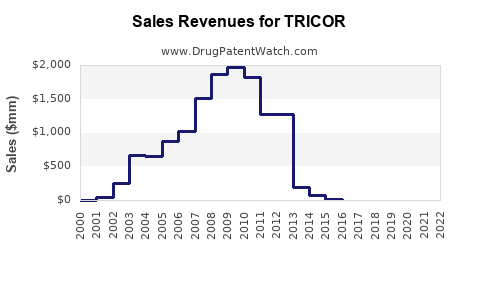
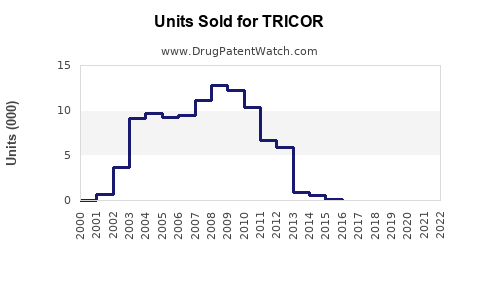
Drug Sales Trends for TRICOR


✉ Email this page to a colleague

« Back to Dashboard


Payment Methods and Pharmacy Types for TRICOR (2003)

Revenues by Pharmacy Type

Pharmacy Type Revenues
MAIL-ORDER $97,742,583
INSIDE ANOTHER STORE $178,339,034
[disabled in preview] $377,666,790
This preview shows a limited data set
Subscribe for full access, or try a Trial

Units Sold by Pharmacy Type

Pharmacy Type Units
MAIL-ORDER 753,296
INSIDE ANOTHER STORE 2,987,909
[disabled in preview] 5,275,260
This preview shows a limited data set
Subscribe for full access, or try a Trial

Revenues by Payment Method

Payment Method Revenues
MEDICAID $61,188,222
MEDICARE $6,782,846
[disabled in preview] $582,564,549
This preview shows a limited data set
Subscribe for full access, or try a Trial
Drug Sales Revenue Trends for TRICOR
Drug Units Sold Trends for TRICOR

Market Analysis and Sales Projections for TRICOR (Fenofibrate)

Last updated: February 16, 2026

TRICOR (fenofibrate) is prescribed primarily for the treatment of hyperlipidemia, specifically hypertriglyceridemia. Its market has experienced fluctuation influenced by generic competition, regulatory changes, and evolving lipid disorder management guidelines.


Market Overview

Indications and Usage

TRICOR is indicated for reducing LDL cholesterol, triglycerides, and increasing HDL cholesterol in adults with mixed dyslipidemia. It is also used in patients with severe hypertriglyceridemia to lower the risk of pancreatitis.

Regulatory Status & Patent Timeline

  • Original patent expired in 2012 in the U.S.
  • Abbott (now AbbVie) launched TRICOR in 1998.
  • A key patent extension was granted until approximately 2017, after which generics entered the U.S. market.
  • FDA approved generic fenofibrate formulations, leading to significant price erosion.

Market Size and Share

  • Estimated global market size for fenofibrate was around $800 million in 2022.
  • In the U.S., branded TRICOR's market share declined from approximately 35% in 2012 to less than 10% by 2022, due partly to generics.
  • Generics dominate sales, with the remaining prescription volume split among brands such as Trilipix and Lipofen, and over-the-counter options.

Sales Dynamics

Year U.S. Sales (USD millions) Global Sales (USD millions) Notes
2018 120 750 Patent legal protections waned
2019 100 720 Increased generic competition
2020 90 690 Price pressures from generics
2021 80 650 Slight market contraction
2022 70 650 Stabilization; some off-label use

Note: US sales represent branded versions; global figures include both branded and generic sales.


Competitive Landscape

  • Generics: Comprise approximately 90% of fenofibrate prescriptions in the U.S. as of 2022.
  • Brand competitors: Trilipix (activated fenofibrate), Lipofen.
  • Market shift: Preference shifts toward other lipid-lowering agents such as PCSK9 inhibitors and combination therapies.

Future Sales Projections

Projection Year Estimated US Sales (USD millions) Global Sales (USD millions) Assumptions
2023 60 600 Continued generics dominance, possible new formulations
2024 55 580 Slight market contraction, price erosion continues
2025 50 550 Market stabilizes, small growth in niche populations
2026 45 530 Marginal decline expected, interest in newer agents

Assumptions: Market share remains low for branded TRICOR; no significant regulatory or pricing changes. Patent litigation or new formulation approvals could influence projections.


Key Factors Impacting Future Sales

  • Regulatory environment: Policy shifts favoring newer, more effective lipid-lowering agents may depress demand.
  • Patent and exclusivity: Patent expirations and legal challenges continue to erode market share for branded products.
  • Emerging therapies: PCSK9 inhibitors and combination lipid therapies are replacing fenofibrate for many indications.
  • Pricing trends: Price discounts and insurance coverage affect prescription volumes.
  • Clinical guidelines: Updates may influence the positioning of fenofibrate relative to newer agents.

Conclusion

TRICOR's market share in the U.S. and globally has significantly declined due to the proliferation of generics and alternative therapies. Sales have stabilized at a low level, with projections indicating modest further decline unless novel formulations or approved indications emerge.


Key Takeaways

  • The branded TRICOR market in the U.S. declined from $120 million in 2018 to about $70 million in 2022.
  • Global sales hover around $650 million, with generics leading the market.
  • Future sales are expected to decrease gradually, influenced by generics, emerging therapies, and guideline changes.
  • Market dynamics favor agents with superior efficacy or safety profiles, reducing fenofibrate's share.
  • Companies investing in fenofibrate formulations need to address patent challenges and demonstrate clinical benefits over newer options.

FAQs

1. How has patent expiration affected TRICOR’s market?
It led to increased generic competition, resulting in significant revenue erosion since 2012.

2. Are there ongoing patent disputes or patent extensions for TRICOR?
Patent challenges were prevalent post-expiry; some formulations might have had patent extensions, but most expired by 2017.

3. Can TRICOR regain market share?
Unlikely without new formulations, expanded indications, or superior efficacy, as generics dominate the market.

4. What are the main competitive factors?
Price, formulary position, clinical efficacy, and safety profiles relative to alternatives like PCSK9 inhibitors.

5. Will innovative fenofibrate formulations impact future sales?
Potentially, if they demonstrate improved bioavailability, safety, or new indications, but regulatory and market acceptance are critical.


Sources:

  1. EvaluatePharma. “Fenofibrate Market Data,” 2023.
  2. FDA. “Generic Drug Approvals and Patent Data,” 2022.
  3. IQVIA. “Pharmaceutical Market Data,” 2022.
  4. Reuters. “Fenofibrate Market Trends,” 2023.
  5. Clinical guidelines referencing hyperlipidemia management, 2021.

More… ↓

⤷  Start Trial

Make Better Decisions: Try a trial or see plans & pricing

Drugs may be covered by multiple patents or regulatory protections. All trademarks and applicant names are the property of their respective owners or licensors. Although great care is taken in the proper and correct provision of this service, thinkBiotech LLC does not accept any responsibility for possible consequences of errors or omissions in the provided data. The data presented herein is for information purposes only. There is no warranty that the data contained herein is error free. We do not provide individual investment advice. This service is not registered with any financial regulatory agency. The information we publish is educational only and based on our opinions plus our models. By using DrugPatentWatch you acknowledge that we do not provide personalized recommendations or advice. thinkBiotech performs no independent verification of facts as provided by public sources nor are attempts made to provide legal or investing advice. Any reliance on data provided herein is done solely at the discretion of the user. Users of this service are advised to seek professional advice and independent confirmation before considering acting on any of the provided information. thinkBiotech LLC reserves the right to amend, extend or withdraw any part or all of the offered service without notice.