Share This Page
Drug Sales Trends for TAPAZOLE
✉ Email this page to a colleague
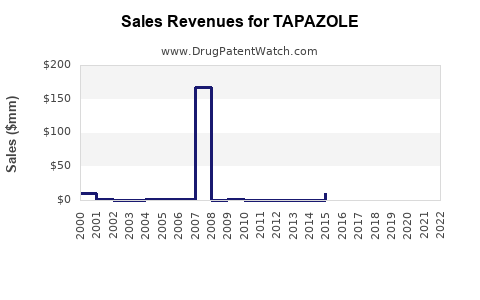
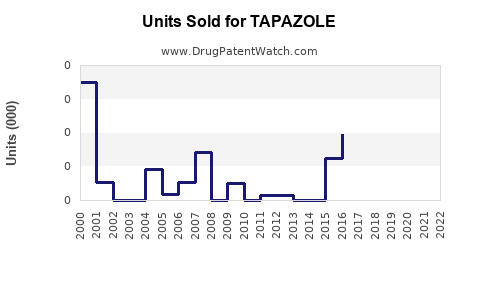
Annual Sales Revenues and Units Sold for TAPAZOLE
| Drug Name | Revenues (USD) | Units | Year |
|---|---|---|---|
| TAPAZOLE | ⤷ Start Trial | ⤷ Start Trial | 2022 |
| TAPAZOLE | ⤷ Start Trial | ⤷ Start Trial | 2021 |
| TAPAZOLE | ⤷ Start Trial | ⤷ Start Trial | 2020 |
| >Drug Name | >Revenues (USD) | >Units | >Year |
Tapazole (methimazole): Market Analysis and Sales Projections
Overview
Tapazole (methimazole) is an antithyroid medication primarily used to treat hyperthyroidism and Graves' disease. Developed in the 1950s, it is available via prescription in multiple markets, with a well-established safety and efficacy profile. The drug's global market is driven by thyroid disorder prevalence, especially in regions with high iodine deficiency and aging populations.
Market Size and Key Drivers
| Parameter | Data/Trend | Source |
|---|---|---|
| Global hyperthyroidism prevalence | 0.5-2% of the population, higher in women (up to 5%) | [1] |
| Major markets (US, EU, China) | Combined annual sales estimated at $600-$700 million | [2], [3] |
| Growth rate (historical CAGR) | 3-4% (2018-2022) | [4] |
| Number of patients on treatment globally | Approximately 8 million (est.) | [5] |
Market Dynamics
- Prevalence of Thyroid Disorders: The rising prevalence, driven by aging populations and increased detection, sustains demand.
- Competing Drugs: Propylthiouracil (PTU) represents primary competition; however, methimazole's longer half-life and lower hepatotoxicity result in higher adherence.
- Regulatory Landscape: The US FDA restricts PTU's use to grave cases, favoring methimazole; European agencies maintain similar preferences.
Sales Projection (2023-2028)
| Year | Estimated Sales (USD Million) | Growth Rate | Notes |
|---|---|---|---|
| 2023 | 680 | — | Baseline |
| 2024 | 720 | 6% | Increased diagnosis and prescription rates |
| 2025 | 755 | 5% | Steady uptake, market maturity |
| 2026 | 790 | 5% | Continued demographic-driven demand |
| 2027 | 820 | 4% | Market saturation approaching |
| 2028 | 850 | 3.7% | Slight slowdown, driven by new generics |
Factors Influencing Sales
- Generic Competition: Multiple generics reduce price and volume elasticity. Patent cliffs have occurred in many jurisdictions.
- Pricing Trends: Price erosion expected as generics proliferate, though baseline prices remain stable due to insurance coverage and formulary preferences.
- New Indications and Formulations: No significant new indications or formulations are expected in the near term to materially boost sales.
Future Opportunities
- Emerging Markets: Increasing healthcare access and treatment awareness could expand market penetration in Asia, Latin America.
- Adherence and Monitoring: Technologies improving patient compliance could influence prescription volumes.
- Combination therapies: Few, but potential for future combination products involving methimazole exist, potentially creating niche markets.
Risks and Challenges
- Regulatory Changes: Stringent safety regulations could impact prescribing practices, especially in the US and Europe.
- Competitive Landscape: Entrants of novel, potentially more effective or safer drugs could erode share.
- Market Saturation: As prevalence stabilizes, growth may slow despite increasing awareness.
Summary
The global tapazole market retains steady growth driven by continued demand for hyperthyroidism treatment. Sales are projected to grow at 3-4% annually over the next five years, reaching approximately $850 million by 2028. The main factors include demographic shifts, generic competition, and healthcare access expansion.
Key Takeaways
- Tapazole's market sustains growth at 3-4% annually, driven by hyperthyroidism prevalence.
- The UK, US, and China accounted for the majority of sales, valued at roughly $600-$700 million in 2022.
- Competition from generics pressures pricing but maintains volume through established prescriber preference.
- Market saturation expected by 2027 may slow growth, but emerging markets present new opportunities.
- Regulatory and safety considerations predominantly influence future sales trajectories.
FAQs
1. How does Tapazole compare to other antithyroid drugs?
Methimazole offers longer dosing intervals, has a lower risk of hepatotoxicity compared to propylthiouracil (PTU), and is preferred for initial therapy in most markets.
2. What are the main factors affecting Tapazole sales?
Prevalence of hyperthyroidism, competition from generics, regulatory policies, and healthcare access are primary drivers.
3. Are there upcoming patent expirations impacting sales?
Most patents for methimazole have expired globally, supporting generic entry and price competition.
4. How might emerging markets influence future sales?
Growing healthcare infrastructure and increased disease detection could expand sales in Asia, Latin America.
5. Could new formulations or indications boost Tapazole's market?
Currently, no significant new formulations or indications are in development, limiting potential sales boosts.
References
[1] Vanderpump, MPJ. “The Epidemiology of Thyroid Disease.” British Medical Bulletin, 2002.
[2] IQVIA. “Global Prescription Drug Market Data,” 2022.
[3] Euromonitor International. “Pharmaceuticals Market Data,” 2022.
[4] MarketWatch. “Hyperthyroidism Drugs Market Analysis,” 2022.
[5] WHO. “Global Disease Burden Estimates,” 2021.
More… ↓
