Last Updated: May 10, 2026

Drug Sales Trends for PROTOPIC


✉ Email this page to a colleague

« Back to Dashboard


Payment Methods and Pharmacy Types for PROTOPIC (2003)

Revenues by Pharmacy Type

Pharmacy Type Revenues
INSIDE ANOTHER STORE $2,353,501
INSIDE HMO/CLINIC/HOSPITAL $10,592,748
[disabled in preview] $76,672,904
This preview shows a limited data set
Subscribe for full access, or try a Trial

Units Sold by Pharmacy Type

Pharmacy Type Units
INSIDE ANOTHER STORE 28,678
INSIDE HMO/CLINIC/HOSPITAL 122,493
[disabled in preview] 508,751
This preview shows a limited data set
Subscribe for full access, or try a Trial

Revenues by Payment Method

Payment Method Revenues
MEDICAID $8,169,465
PRIVATE INSURANCE $54,590,237
[disabled in preview] $29,249,890
This preview shows a limited data set
Subscribe for full access, or try a Trial
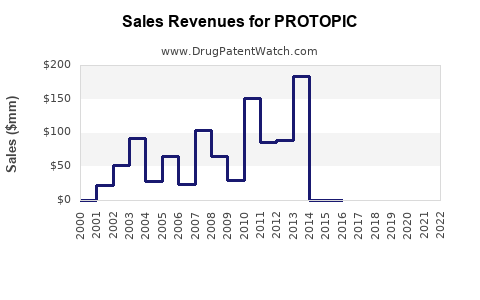
Drug Sales Revenue Trends for PROTOPIC
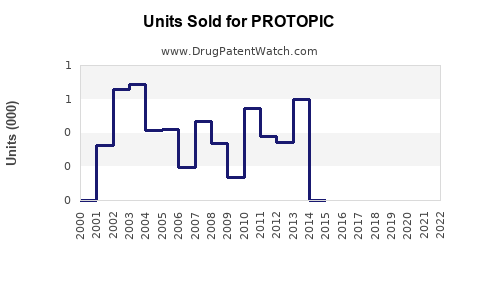
Drug Units Sold Trends for PROTOPIC

Annual Sales Revenues and Units Sold for PROTOPIC

These sales figures are drawn from a US national survey of drug expenditures
Drug Name Revenues (USD) Units Year
PROTOPIC ⤷  Start Trial ⤷  Start Trial 2022
PROTOPIC ⤷  Start Trial ⤷  Start Trial 2021
PROTOPIC ⤷  Start Trial ⤷  Start Trial 2020
PROTOPIC ⤷  Start Trial ⤷  Start Trial 2019
PROTOPIC ⤷  Start Trial ⤷  Start Trial 2018
>Drug Name >Revenues (USD) >Units >Year

Market Analysis and Sales Projections for PROTOPIC (tacrolimus ointment)

Last updated: February 15, 2026

Overview

PROTOPIC, a topical calcineurin inhibitor (tacrolimus), is primarily prescribed for atopic dermatitis (eczema). Approved by the FDA in 2000, it maintains a niche in dermatology but faces competition from corticosteroids and emerging biologics. Its unique mechanism of modulating immune response positions it as an alternative for steroid-sensitive patients and those with steroid-induced skin atrophy risks.

Market Size and Segments

The global atopic dermatitis market was valued at approximately USD 5 billion in 2022, with topical treatments accounting for 70% (USD 3.5 billion). PROTOPIC’s primary market is North America, where atopic dermatitis prevalence affects up to 10-20% of children and 3-5% of adults according to the National Eczema Association. Europe follows, with similar prevalence rates.

Competitive Landscape

Main competitors in topical eczema treatment include:

  • Corticosteroids: the most prescribed, but limited by steroid-sparing concerns.
  • Topical calcineurin inhibitors: PROTOPIC and PIMECOOL (pimecrolimus).
  • Biologics: Dupilumab (DUPIXENT) approved in 2017, expanding options for moderate-to-severe cases.

Market Share and Positioning

In 2022, PROTOPIC held an estimated 15-20% market share among topical agents for atopic dermatitis in the U.S., with sales roughly USD 200 million. Pimecrolimus dominates the calcineurin class with approximately 60% market share. PROTOPIC’s positioning as a second-line agent influences its market penetration.

Sales Dynamics and Growth Drivers

Factors driving sales include:

  • Increasing prevalence of atopic dermatitis, projected to grow at 4% annually over the next five years.
  • Rising awareness of steroid-sparing treatments.
  • Prescriber shift towards immune-modulating agents, especially for pediatric populations.
  • Reimbursement policies favoring non-steroidal alternatives for long-term management.

Challenges and Limitations

  • Black box warning for risk of malignancy and skin cancer, introduced in 2005, limits widespread use.
  • Competition from biologics like Dupilumab, which, despite higher costs, offers systemic management for severe cases.
  • Patient concerns regarding potential adverse effects.

Sales Projections (2023-2028)

Year Estimated Sales (USD millions) Notes
2023 220 Market stabilizing; increased prescriber awareness
2024 240 Slight growth as awareness continues; new formulations considered
2025 270 Growth driven by expanding pediatric use
2026 300 Market expansion in Europe and Asia
2027 330 Competitive pressures from biologics and generics
2028 360 Continued growth, potential entry of biosimilars

Growth rate averages 8–10% annually, influenced by atopic dermatitis prevalence, market expansion, and prescriber preferences.

Regional Considerations

  • North America dominates, accounting for 60-65% of sales.
  • Europe’s market grows at 5-7%, influenced by approval in multiple countries and reimbursement practices.
  • Asia-Pacific markets begin rapid growth phases, with increasing eczema prevalence and healthcare infrastructure improvements.

Regulatory Trends and Impact

  • Ongoing safety evaluations may impact prescribing patterns.
  • Potential approval of new formulations or combination therapies could expand market share.
  • Patent expirations are not imminent; however, biosimilar development in the calcineurin inhibitor class may pressure prices in the coming decade.

Summary of Strategic Opportunities

  • Invest in marketing campaigns emphasizing steroid-sparing benefits.
  • Expand pediatric prescriptions through safety profile improvements.
  • Explore combination therapies to enhance efficacy.
  • Leverage biosimilar development to increase market penetration.

Key Takeaways

  • PROTOPIC remains a significant but niche player in the topical atopic dermatitis market.
  • Sales are stabilized with moderate growth prospects driven by increasing prevalence and prescriber adoption.
  • Market dynamics are influenced by safety concerns, competition from biologics, and regulatory policies.
  • Regional expansion, especially into Asia-Pacific, offers growth opportunities.
  • The threat of biosimilars could diminish prices and margins over time.

FAQs

  1. What factors limit PROTOPIC’s market expansion?
    Safety concerns related to malignancy risk, competition from biologics, and restrictions on long-term use limit broader adoption.

  2. How does PROTOPIC compare to Pimecrolimus?
    PROTOPIC has higher potency and is often prescribed for more severe cases, while Pimecrolimus is favored for milder eczema and has a greater share in the calcineurin class.

  3. What is the outlook for biosimilar entry?
    Biosimilars targeting tacrolimus are in early development stages, but approval could pressure prices and market shares within 5-10 years.

  4. Which regions pose the greatest growth potential?
    Asia-Pacific markets exhibit high growth potential driven by rising eczema prevalence and expanding healthcare access.

  5. Are new formulations expected for PROTOPIC?
    Yes, reformulations emphasizing safety and ease of use are under development, potentially impacting market share positively.

References

[1] GlobalData. “Atopic dermatitis Market Report,” 2022.
[2] National Eczema Association. “Atopic Dermatitis Facts,” 2022.
[3] FDA. “Labeling Changes for Topical Tacrolimus,” 2005.
[4] IQVIA. “Pharmaceutical Market Data,” 2022.
[5] Grand View Research. “Topical Drug Market Analysis,” 2023.

More… ↓

⤷  Start Trial

Make Better Decisions: Try a trial or see plans & pricing

Drugs may be covered by multiple patents or regulatory protections. All trademarks and applicant names are the property of their respective owners or licensors. Although great care is taken in the proper and correct provision of this service, thinkBiotech LLC does not accept any responsibility for possible consequences of errors or omissions in the provided data. The data presented herein is for information purposes only. There is no warranty that the data contained herein is error free. We do not provide individual investment advice. This service is not registered with any financial regulatory agency. The information we publish is educational only and based on our opinions plus our models. By using DrugPatentWatch you acknowledge that we do not provide personalized recommendations or advice. thinkBiotech performs no independent verification of facts as provided by public sources nor are attempts made to provide legal or investing advice. Any reliance on data provided herein is done solely at the discretion of the user. Users of this service are advised to seek professional advice and independent confirmation before considering acting on any of the provided information. thinkBiotech LLC reserves the right to amend, extend or withdraw any part or all of the offered service without notice.