Share This Page
Drug Sales Trends for NYSTATIN
✉ Email this page to a colleague
Payment Methods and Pharmacy Types for NYSTATIN (2003)
Revenues by Pharmacy Type
Units Sold by Pharmacy Type
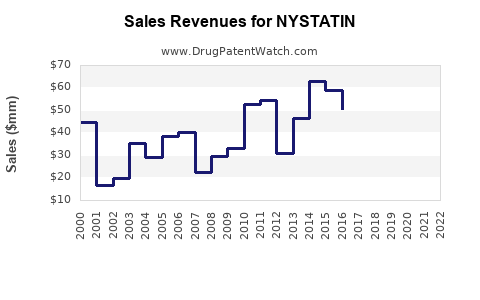
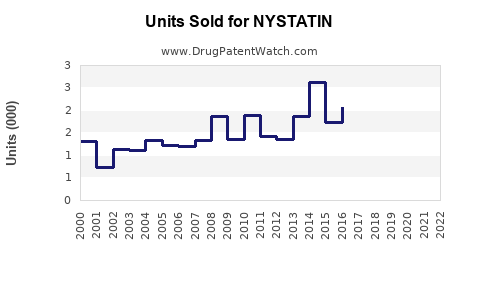
Annual Sales Revenues and Units Sold for NYSTATIN
| Drug Name | Revenues (USD) | Units | Year |
|---|---|---|---|
| NYSTATIN | ⤷ Start Trial | ⤷ Start Trial | 2022 |
| NYSTATIN | ⤷ Start Trial | ⤷ Start Trial | 2021 |
| NYSTATIN | ⤷ Start Trial | ⤷ Start Trial | 2020 |
| NYSTATIN | ⤷ Start Trial | ⤷ Start Trial | 2019 |
| >Drug Name | >Revenues (USD) | >Units | >Year |
Nystatin Market Analysis, Sales Projections, Competition, and Exclusivity Outlook
Nystatin is a mature, low-cost antifungal with stable demand across oral suspension, topical cream, ointment, powder, and vaginal dosage forms. Its commercial market is fragmented among generic manufacturers, private-label suppliers, hospital distributors, and regional brands. The product has no meaningful remaining patent or regulatory exclusivity in major markets. Revenue growth is likely to track population growth, healthcare access, and inflation rather than clinical innovation.
Public companies generally do not report nystatin revenue separately. The most defensible projection is therefore an indexed market forecast rather than a precise global dollar estimate.
What is nystatin used for?
Nystatin is a polyene antifungal used primarily against Candida infections. It binds to ergosterol in fungal cell membranes and has limited systemic absorption when administered orally or topically.
| Dosage form | Main uses | Commercial status |
|---|---|---|
| Oral suspension | Oropharyngeal candidiasis, including thrush | Prescription generic |
| Oral tablets | Intestinal candidiasis in selected markets | Limited and market-dependent |
| Cream and ointment | Cutaneous candidiasis | Prescription and market-dependent OTC products |
| Powder | Intertriginous and moist-skin Candida infections | Prescription or OTC, depending on jurisdiction |
| Vaginal tablets or cream | Vulvovaginal candidiasis | Prescription or market-dependent OTC products |
Nystatin is not appropriate for systemic fungal infections because it is not absorbed adequately from the gastrointestinal tract. Fluconazole and other systemic azoles are used when systemic exposure is required. [1]
How large is the nystatin market?
No consolidated public revenue figure captures all nystatin sales across prescription, OTC, hospital, private-label, and international channels. The market is divided among multiple product codes and manufacturers, making company-level reporting incomplete.
The market has four commercial characteristics:
- Low average selling prices.
- High generic substitution.
- Large geographic fragmentation.
- Limited dependence on a single manufacturer.
Nystatin’s market value is materially smaller than the markets for fluconazole, terbinafine, or newer antifungals. Its unit volume remains relevant because it is inexpensive, familiar to prescribers, available in pediatric formulations, and useful for localized Candida infections.
Indicative market structure
| Segment | Relative commercial importance | Growth outlook |
|---|---|---|
| Oral suspension | High in pediatric and primary-care channels | Low to moderate |
| Topical cream and ointment | High unit volume but low price | Low |
| Vaginal formulations | Moderate | Low to moderate |
| Powder | Smaller | Stable |
| Oral tablets | Small and geographically variable | Flat or declining |
| Hospital and institutional supply | Moderate | Stable |
The largest commercial opportunity is not premium pricing. It is reliable supply, broad distribution, contract manufacturing, and registration in markets where antifungal access is expanding.
What are the 2025-2029 nystatin sales projections?
A precise dollar forecast cannot be derived from public manufacturer filings because nystatin sales are not reported as a consolidated product category. The following scenario uses 2024 market value as an index of 100 and assumes continued generic competition.
| Year | Downside case | Base case | Upside case |
|---|---|---|---|
| 2024 | 100 | 100 | 100 |
| 2025 | 98 | 102 | 104 |
| 2026 | 97 | 104 | 108 |
| 2027 | 96 | 106 | 112 |
| 2028 | 95 | 108 | 117 |
| 2029 | 94 | 110 | 122 |
| 2024-2029 CAGR | -1.2% | 1.9% | 4.1% |
The base case assumes modest volume growth offset by price erosion. The upside case requires stronger demand in emerging markets, increased diagnosis of mucocutaneous candidiasis, and stable supply from manufacturers. The downside case reflects substitution by azoles, formulary pressure, manufacturing interruptions, and continued price compression.
If the market generated revenue of $X in 2024, the base-case 2029 value would be approximately $1.10X. This is an index-based projection, not a reported industry revenue figure.
Key revenue drivers
- Growth in pediatric and primary-care treatment.
- Rising healthcare access in low- and middle-income markets.
- Continued use for oral thrush and superficial Candida infections.
- Demand for low-cost antifungal products.
- Public-sector and hospital procurement.
- Private-label and contract-manufacturing opportunities.
Key revenue constraints
- Generic price competition.
- Substitution by fluconazole, clotrimazole, and miconazole.
- Limited use in systemic disease.
- Low patient switching value once a generic product is available.
- Supply concentration for selected dosage forms.
- Limited ability to differentiate on clinical efficacy.
When does nystatin lose exclusivity?
Nystatin has already lost practical exclusivity in the United States and other major pharmaceutical markets. The active ingredient was introduced in the 1950s, and current products are supplied largely through generic or legacy branded channels.
There is no commercially meaningful composition-of-matter patent barrier protecting nystatin. Any relevant patents covering the original active ingredient would have expired decades ago. Newer patents, where present, would generally relate to formulations, manufacturing processes, packaging, or specific combinations rather than the basic active ingredient.
| Exclusivity category | Current position |
|---|---|
| Active-ingredient patent | Expired |
| Original product exclusivity | Expired |
| New chemical entity exclusivity | Not applicable |
| Pediatric exclusivity | Not commercially relevant to current market access |
| Orphan-drug exclusivity | Not applicable to ordinary nystatin products |
| Biosimilar exclusivity | Not applicable |
| Generic competition | Established |
What is the FDA regulatory status of nystatin?
Nystatin is an established FDA-regulated antifungal marketed through multiple prescription and OTC pathways. FDA-recognized products include oral suspensions, topical preparations, and vaginal formulations. The exact status of a specific product depends on its application number, dosage form, manufacturer, and marketing status.
Nystatin oral suspension is generally supplied as a prescription product in the United States. Topical products may be prescription or OTC depending on the formulation and labeling. FDA-approved labeling identifies nystatin as a treatment for Candida infections of the mouth, skin, and vagina, depending on dosage form. [2]
The product does not have the regulatory profile of a modern branded drug. Approval risk is concentrated in manufacturing controls, product quality, stability, microbiological testing, labeling, and supply continuity.
What is the Orange Book status of nystatin?
The FDA Orange Book may list approved prescription nystatin products and therapeutically equivalent generic products, but Orange Book coverage is product-specific. OTC products and certain discontinued products may not appear in the same manner as active prescription products.
The commercial implications are straightforward:
- ANDA-based generic competition is established.
- Patent certifications are unlikely to create a meaningful barrier for the core product.
- Orange Book listings do not create a practical branded moat.
- Market access depends more on approved manufacturing capacity and distribution than on patent ownership.
A company assessing a particular nystatin product should distinguish among active, discontinued, and approved-but-not-marketed listings. Product-level Orange Book status can change as manufacturers withdraw or reintroduce products. [3]
What patents protect nystatin products?
The core nystatin molecule is not protected by live composition-of-matter exclusivity in major markets. Potentially relevant IP may cover:
- Cream or ointment vehicles.
- Sustained-release or mucoadhesive formulations.
- Combination products.
- Particle-size or dispersion characteristics.
- Manufacturing and purification methods.
- Packaging that improves stability.
- Specific delivery systems.
These rights generally have narrower commercial scope than an active-ingredient patent. A formulation patent could affect a particular product, but it would not prevent competitors from selling conventional nystatin suspension, cream, ointment, powder, or other non-infringing forms.
Manufacturing and IP barriers
Nystatin is produced through fermentation, followed by recovery and purification. Manufacturing quality can be more important than patent position. Risks include:
- Fermentation yield variability.
- Impurity control.
- Batch-to-batch potency.
- Microbial contamination.
- Stability of suspensions and semisolid products.
- Dependence on a limited number of active pharmaceutical ingredient suppliers.
These factors can create temporary supply advantages without creating durable legal exclusivity.
Are there Paragraph IV challenges involving nystatin?
Nystatin has been subject to generic competition for decades, and current market entry does not depend on a new branded product launch. Paragraph IV litigation is therefore less commercially significant than it is for recently approved drugs.
A Paragraph IV certification could arise for a specific listed nystatin product if an applicant challenges a listed patent. In practice, any dispute would likely concern a formulation, delivery system, or combination product rather than nystatin itself.
The primary competitive risk is ordinary generic substitution, not a wave of new Paragraph IV launches against a protected reference product.
What patent litigation and settlement agreements affect nystatin?
There is no widely recognized, market-defining patent litigation campaign centered on conventional nystatin products comparable to disputes involving high-value oncology, immunology, or specialty drugs.
Settlement agreements may exist at the manufacturer or product level, but they are unlikely to influence the broader nystatin market unless they restrict a major formulation or a high-volume supplier. For commercial diligence, litigation exposure should be assessed by product code and formulation rather than by the active ingredient alone.
How does nystatin compare with competing antifungals?
| Drug | Main role | Systemic absorption | Relative commercial position |
|---|---|---|---|
| Nystatin | Local Candida infections | Minimal for oral topical use | Low-cost mature generic |
| Fluconazole | Mucosal and systemic candidiasis | High | Larger and more strategically important |
| Clotrimazole | Vaginal and topical infections | Low | Strong local-formulation competitor |
| Miconazole | Vaginal and topical infections | Low to moderate | Major OTC and prescription competitor |
| Terbinafine | Dermatophyte infections | Systemic oral and topical forms | Stronger in dermatophyte segment |
| Amphotericin B | Serious systemic fungal infections | Formulation-dependent | Hospital and specialty product |
Nystatin competes most directly with clotrimazole and miconazole in topical and vaginal indications. Fluconazole is the main substitute when oral systemic treatment is clinically preferred.
Nystatin retains advantages in low cost, local activity, and long clinical experience. It lacks the convenience of a single-dose systemic regimen and is unsuitable for invasive infection.
Which companies manufacture or market nystatin?
Nystatin is supplied by a broad group of generic pharmaceutical companies, contract manufacturers, regional brands, and distributors. Manufacturer participation changes by country and dosage form. Known market participants in the broader generic and topical pharmaceutical sectors have included companies such as Taro Pharmaceutical, Perrigo, Teva, Viatris, Amneal, and various regional suppliers, although not every company markets every nystatin formulation in every jurisdiction.
The market is better characterized by supplier type than by a single originator:
- Large generic companies with regulatory infrastructure.
- Regional prescription manufacturers.
- OTC and private-label suppliers.
- Hospital and institutional vendors.
- Contract manufacturers producing for distributors.
No single company appears to control a durable global nystatin franchise.
What is the geographic market outlook?
North America and Western Europe are mature markets with low pricing and established generic access. Growth potential is higher in Latin America, Asia-Pacific, the Middle East, and Africa, where diagnosis and treatment access can expand.
| Region | Market condition | Commercial outlook |
|---|---|---|
| United States | Mature generic market | Stable volume, price pressure |
| Western Europe | Mature and regulated | Stable to modest decline |
| Japan | Mature, formulation-specific | Stable |
| China | Large manufacturing base and growing access | Moderate opportunity |
| India | Strong generic production and domestic demand | Moderate opportunity |
| Latin America | Variable access and private-sector demand | Moderate growth |
| Africa and selected Middle Eastern markets | Lower baseline access | Higher volume potential, greater tender risk |
International expansion requires local registration, pharmacopoeial compliance, pharmacovigilance, and reliable distribution. Price competition is often severe in public tenders.
What generic launch risks exist for nystatin?
For conventional nystatin products, legal launch risk is low because core exclusivity has expired. Commercial launch risk remains material.
| Risk | Impact |
|---|---|
| Failed bioequivalence or product-quality testing | Delays approval |
| Unstable suspension or semisolid formulation | Recalls and loss of buyers |
| API supply disruption | Stock-outs |
| Low reimbursement | Limited commercial return |
| Established preferred suppliers | Difficult formulary access |
| Product liability or labeling error | Regulatory and financial exposure |
| Price undercutting | Rapid margin compression |
A generic entrant needs a cost-efficient supply chain, dependable manufacturing, and channel access. Clinical differentiation alone is unlikely to support a premium.
What is the nystatin investment outlook?
Nystatin is a defensive, low-growth pharmaceutical product rather than a high-upside innovation asset. Attractive opportunities may exist in:
- Reliable supply of difficult-to-source dosage forms.
- Emerging-market registration portfolios.
- Private-label topical and vaginal products.
- Improved suspension stability.
- Combination products with clinically justified use.
- Contract manufacturing and institutional supply.
The weakest investment case is a standalone branded product that depends on premium pricing without meaningful formulation or distribution differentiation. The strongest case is a low-cost, multi-market portfolio supported by manufacturing efficiency and broad channel access.
Key Takeaways
- Nystatin is a mature generic antifungal with stable but low-growth demand.
- Core composition-of-matter exclusivity has expired.
- The market is fragmented across prescription, OTC, hospital, private-label, and regional channels.
- Public companies do not report consolidated nystatin revenue, so indexed scenarios are more reliable than a single global dollar estimate.
- The base-case 2024-2029 market outlook is approximately 1.9% annual growth in nominal market value.
- Generic price pressure will remain stronger than innovation-driven pricing.
- The main competitors are fluconazole, clotrimazole, and miconazole.
- Manufacturing reliability, formulation quality, and distribution are more important than patent ownership.
- Biosimilar risk does not apply because nystatin is a small-molecule antifungal.
- The best commercial opportunities are in supply reliability, private label, contract manufacturing, and underserved international markets.
FAQs
Is nystatin still commercially relevant?
Yes. It remains relevant for oral thrush, cutaneous candidiasis, and selected vaginal infections, particularly where low cost and local treatment are priorities.
Does nystatin have patent protection?
The original active ingredient does not have meaningful live patent protection in major markets. Narrow patents may exist for specific formulations or manufacturing processes.
Is nystatin a biologic or biosimilar product?
No. Nystatin is a small-molecule antifungal produced through fermentation. Biosimilar regulation does not apply.
Which nystatin formulation has the strongest commercial opportunity?
Oral suspension and topical products have the broadest established demand. Opportunity depends on country, reimbursement, supply reliability, and competition from clotrimazole and miconazole.
Can a company launch a premium nystatin product?
A premium launch would require a defensible formulation, delivery advantage, combination product, or distribution position. Conventional nystatin products are unlikely to sustain premium pricing because generic alternatives are widely available.
References
-
National Library of Medicine. (n.d.). Nystatin: MedlinePlus drug information. U.S. National Library of Medicine. https://medlineplus.gov/druginfo/meds/a682758.html
-
U.S. Food and Drug Administration. (n.d.). Nystatin prescribing information and drug labeling. FDA. https://www.accessdata.fda.gov/scripts/cder/daf/
-
U.S. Food and Drug Administration. (2024). Approved drug products with therapeutic equivalence evaluations: The Orange Book. FDA. https://www.fda.gov/drugs/drug-approvals-and-databases/approved-drug-products-therapeutic-equivalence-evaluations-orange-book
-
World Health Organization. (2023). WHO model list of essential medicines: 23rd list. World Health Organization. https://www.who.int/publications/i/item/WHO-MHP-HPS-EML-2023.02
More… ↓
