Drug Sales Trends for LYRICA
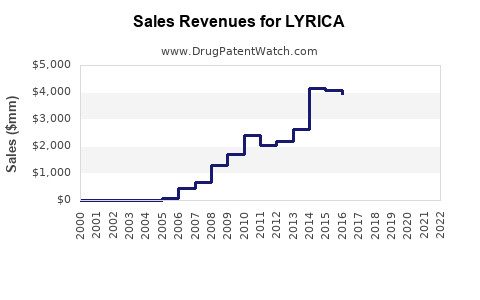
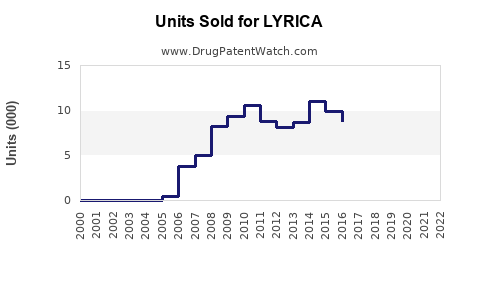
Annual Sales Revenues and Units Sold for LYRICA
| Drug Name | Revenues (USD) | Units | Year |
|---|---|---|---|
| LYRICA | ⤷ Start Trial | ⤷ Start Trial | 2022 |
| LYRICA | ⤷ Start Trial | ⤷ Start Trial | 2021 |
| LYRICA | ⤷ Start Trial | ⤷ Start Trial | 2020 |
| >Drug Name | >Revenues (USD) | >Units | >Year |
Lyrica Market Analysis, Sales Projections, Patent Expiration and Generic Competition
Lyrica, Pfizer's brand for pregabalin, is a mature small-molecule drug with global approval for neuropathic pain, fibromyalgia, and adjunctive treatment of partial-onset seizures. Its U.S. composition and method-of-use exclusivity ended between 2018 and 2019, allowing multiple generic manufacturers to enter. Pfizer's Lyrica revenue declined sharply after generic launch, while the broader pregabalin market shifted from a premium branded product to a high-volume, low-price generic category.
The commercial outlook is now driven by generic volume, prescription substitution, regional pricing, and continued use in neuropathic pain. U.S. Lyrica brand sales have limited growth potential. Global pregabalin demand should remain stable to moderately higher, but market value will remain below the pre-generic peak.
What is Lyrica and how large is the pregabalin market?
Lyrica contains pregabalin, a structural analogue of gamma-aminobutyric acid that binds to the alpha-2-delta subunit of voltage-gated calcium channels. The drug reduces excitatory neurotransmitter release and is administered orally as capsules, oral solution, and extended-release tablets.
The FDA approved Lyrica in 2004 for adjunctive treatment of partial-onset seizures and later expanded its label to include diabetic peripheral neuropathy, postherpetic neuralgia, spinal cord injury-related neuropathic pain, and fibromyalgia. The current FDA label includes:
| Product | Dosage form | Main commercial role |
|---|---|---|
| Lyrica | Immediate-release capsules | Original branded product |
| Lyrica | Oral solution | Pediatric and swallowing-related use |
| Lyrica CR | Extended-release tablets | Once-daily formulation |
| Generic pregabalin | Capsules and oral solution | Main U.S. market volume |
| Generic pregabalin ER | Extended-release tablets | Smaller, formulation-specific market |
The largest commercial indication is neuropathic pain. Epilepsy contributes a smaller share of prescriptions, while fibromyalgia is important in the United States and selected international markets. Pregabalin competes with gabapentin, duloxetine, amitriptyline, venlafaxine, topical agents, opioids, and newer non-opioid pain therapies.
How much did Lyrica generate before generic entry?
Lyrica reached peak global sales shortly before broad generic competition. Pfizer reported approximately $5 billion in Lyrica revenue in 2018, making it one of the company's largest products. Revenue declined after generic pregabalin entered the United States in 2019 and after price competition intensified in Europe and other markets.
| Year | Approximate Pfizer Lyrica revenue | Market position |
|---|---|---|
| 2016 | About $4.2 billion | Strong global brand growth |
| 2017 | About $4.5 billion | Near-peak sales |
| 2018 | About $5.0 billion | Peak or near-peak revenue |
| 2019 | About $4 billion | U.S. generic transition begins |
| 2020 onward | Declining | Generic erosion and regional substitution |
Reported figures vary by Pfizer reporting structure, currency, and whether certain regional products are included. Pfizer's annual reports identify Lyrica as a major product before the company separated its Upjohn business, but later reports show the expected post-expiration erosion.[1-3]
The principal revenue driver was not a large increase in treated patients. It was the combination of brand pricing, broad indication coverage, international sales, and limited generic competition in several markets.
When did Lyrica lose U.S. exclusivity?
Lyrica's U.S. exclusivity ended in stages rather than on one universal date.
The core pregabalin compound patent was generally associated with an expiration date in December 2018 after patent-term adjustment and pediatric exclusivity. Six-month pediatric exclusivity extended the effective protection period into 2019 for certain listed patents and regulatory purposes. Generic pregabalin approvals followed, with commercial entry beginning in 2019.
Lyrica U.S. exclusivity timeline
| Milestone | Date or period | Commercial impact |
|---|---|---|
| FDA approval of Lyrica | 2004 | Initial U.S. launch |
| Fibromyalgia approval | 2007 | Expanded addressable market |
| Core patent protection | Through late 2018 | Protected branded pricing |
| Pediatric exclusivity period | Into 2019 | Delayed full generic availability |
| First FDA generic approvals | July 2019 | Market-wide substitution began |
| Broad generic competition | 2019-2020 | Rapid price and share erosion |
| Current status | Generic-dominated | Brand retains limited residual demand |
The effective loss of U.S. exclusivity was commercially decisive because pregabalin is relatively easy to manufacture as a conventional small molecule. Generic substitution did not require the clinical development or interchangeability process associated with biologics.
What patents protected Lyrica?
Lyrica's principal protection came from the pregabalin compound patent and later method-of-use and formulation patents. The relevant patent estate was stronger before 2019 than it is today because most commercially meaningful rights have expired or have limited practical value after generic entry.
Core patent categories
| Patent category | Protected subject matter | Commercial relevance |
|---|---|---|
| Composition of matter | Pregabalin molecule and related substituted amino acids | Primary protection |
| Method of treatment | Use for neuropathic pain, seizures, and related conditions | Supported indication-specific listings |
| Formulation | Extended-release and controlled-release products | Relevant mainly to Lyrica CR |
| Manufacturing | Chemical processes and intermediates | Potential barrier if technically difficult, but not a broad market barrier |
| Pediatric use | Pediatric indications and regulatory exclusivity | Delayed generic timing rather than creating a durable monopoly |
The composition patent created the strongest barrier because it covered the active pharmaceutical ingredient itself. Method-of-use patents were narrower and vulnerable to label carve-outs, while formulation patents applied primarily to extended-release products rather than the larger immediate-release capsule market.
The FDA Orange Book records listed patents and associated exclusivity information for approved Lyrica products. Orange Book status must be reviewed by product and dosage form because the patent profile for immediate-release Lyrica was not identical to that of Lyrica CR.[4]
What is the Orange Book status of Lyrica?
Lyrica is an Orange Book-listed drug, and its generic competition was enabled through abbreviated new drug applications. Generic applicants could challenge listed patents through Paragraph IV certifications or use Paragraph III certifications and wait for the relevant patent term to end.
The Orange Book framework gave Pfizer the ability to sue generic applicants after Paragraph IV notices. Such litigation can trigger a 30-month stay of FDA approval, subject to statutory exceptions. That mechanism delayed commercial entry but did not preserve long-term exclusivity after the core patents expired.
For current commercial analysis, the key Orange Book conclusions are:
- The original immediate-release Lyrica franchise no longer has an effective composition-of-matter barrier in the United States.
- Any remaining listed formulation or method patents have narrower commercial scope.
- Generic pregabalin has broad approval across the principal immediate-release dosage strengths.
- Lyrica CR remains more formulation-specific, but its market is substantially smaller than the immediate-release capsule market.
Which companies challenged Lyrica patents?
Multiple generic manufacturers pursued pregabalin approvals and challenged or worked around Pfizer's listed patents. The U.S. competitive field included major generic companies such as Teva, Mylan, Watson/Actavis, Sandoz, and other ANDA sponsors.
The litigation strategy generally involved one or more of the following:
- Paragraph IV challenges to listed patents.
- Paragraph III certifications with launch after patent expiration.
- Skinny-label filings excluding patented indications.
- Challenges to method-of-use claims.
- Separate development of immediate-release and extended-release products.
The most important competitive event was not the outcome of one isolated lawsuit. It was the eventual accumulation of approved generic products, which eliminated Pfizer's ability to sustain pre-expiration pricing.
What generic entry risks exist for Lyrica?
Generic entry risk is complete for the U.S. immediate-release market. The key risks are now commercial rather than patent-based.
U.S. generic erosion
Generic pregabalin typically sells at a substantial discount to branded Lyrica. The discount expands as the number of approved suppliers increases. Pharmacy benefit managers and insurers generally prefer generic substitution, and state substitution laws support automatic substitution where the generic is rated therapeutically equivalent.
The expected effects are:
- Brand unit share falls rapidly after generic launch.
- Net price declines faster than prescription volume.
- Gross-to-net deductions increase as Pfizer defends residual brand demand.
- Generic suppliers compete largely on acquisition cost and distribution access.
- Lyrica brand demand persists in limited cases involving prescriber preference, payer restrictions, or patient stability.
Launch scenarios
| Scenario | U.S. brand outcome | Generic market outcome |
|---|---|---|
| Base case | Low residual sales with continued decline | Stable high-volume, low-price market |
| Upside for brand | Limited retention in selected patients | Slower substitution in restricted plans |
| Downside for brand | Near-total substitution | Additional price compression |
| Supply disruption | Temporary brand or supplier share recovery | Short-lived pricing improvement |
A new Paragraph IV event against the original Lyrica franchise is unlikely to change the competitive structure because the principal exclusivity period has ended.
What are the Lyrica sales projections?
A standalone long-term growth forecast for branded Lyrica is not supported by the product's U.S. lifecycle position. The appropriate forecast is a decline or stabilization at a low residual base.
Branded Lyrica projection
| Period | Expected branded trend | Main assumptions |
|---|---|---|
| 2024-2025 | Declining or flat at low levels | Mature generic competition |
| 2026-2027 | Low-single-digit decline to stabilization | Residual international and specialty demand |
| 2028 onward | Limited commercial growth | No meaningful new exclusivity |
The broader pregabalin market has a different profile. Volume should remain resilient because the drug is established, inexpensive, and used across chronic pain and seizure indications. Market value is constrained by generic pricing.
Global pregabalin market outlook
| Variable | 2025-2029 expectation |
|---|---|
| Prescription volume | Low-single-digit annual growth |
| Average selling price | Flat to declining in mature markets |
| Global market value | Low-single-digit growth or broadly stable |
| U.S. brand value | Declining |
| U.S. generic value | Stable volume with price pressure |
| Emerging-market value | Moderate growth from diagnosis and access expansion |
The strongest growth opportunities are in markets where neuropathic pain diagnosis is expanding, generic access is improving, and pregabalin remains affordable. The weakest markets are those with aggressive substitution controls and low generic reimbursement.
How does Lyrica compare with gabapentin and other neuropathic pain drugs?
Pregabalin's strongest competitor is gabapentin. Both drugs are alpha-2-delta ligands, but pregabalin has more predictable pharmacokinetics and higher bioavailability across the approved dose range. Gabapentin is generally cheaper and has a larger installed generic base.
| Drug | Competitive strength | Commercial weakness |
|---|---|---|
| Pregabalin | Predictable exposure, broad pain use, established efficacy | Generic price erosion and controlled-substance restrictions in some jurisdictions |
| Gabapentin | Very low cost and extensive prescribing history | Less predictable absorption at higher doses |
| Duloxetine | Useful for neuropathic pain and depression comorbidity | Different tolerability and contraindication profile |
| Amitriptyline | Low acquisition cost | Anticholinergic and cardiovascular tolerability concerns |
| Opioids | Strong analgesic effect in selected settings | Dependence, abuse, and regulatory restrictions |
Pregabalin retains a commercial role where clinicians value predictable dosing, titration, and tolerability relative to alternatives. Its generic status limits the ability of any manufacturer to capture premium pricing without differentiated delivery, packaging, or distribution.
What formulation patents protect Lyrica CR?
Lyrica CR uses an extended-release formulation intended for once-daily administration. Formulation protection is narrower than compound protection because it covers release characteristics, excipients, manufacturing parameters, or specific dosage forms rather than all pregabalin products.
The commercial effect is limited for four reasons:
- Immediate-release pregabalin already satisfies most clinical demand.
- Generic manufacturers can enter the larger capsule market without reproducing the extended-release product.
- Formulation patents do not block all pregabalin prescriptions.
- The value of once-daily dosing is difficult to monetize after the active ingredient is generic.
Lyrica CR may retain a niche among patients requiring once-daily administration, but it is unlikely to restore Pfizer's pre-2019 franchise economics.
Are biosimilars a risk to Lyrica?
No. Lyrica is a small-molecule drug, not a biologic. The relevant competitors are generic pregabalin products approved through the ANDA pathway, not biosimilars under the Public Health Service Act.
The main regulatory risks are therefore:
- Generic ANDA approvals.
- Therapeutic-equivalence ratings.
- State substitution rules.
- Controlled-substance scheduling.
- Labeling differences and indication carve-outs.
- Formulation-specific approvals.
What manufacturing and intellectual-property barriers remain?
Pregabalin synthesis is commercially established, and manufacturing is not generally viewed as a durable barrier comparable to biologic production or complex drug-device systems. Remaining barriers include:
- Control of stereochemical purity.
- Impurity specifications.
- Process validation.
- Supply-chain reliability for starting materials.
- Regulatory compliance across multiple jurisdictions.
- Controlled-substance handling requirements in certain markets.
- Formulation know-how for extended-release products.
These barriers can affect individual generic suppliers, but they do not protect the Lyrica brand from market-wide competition.
What licensing deals affect Lyrica?
Lyrica's principal commercial rights were retained by Pfizer and its operating units. The strategic transaction most relevant to the franchise was Pfizer's 2020 separation of Upjohn, which transferred a portfolio of established products, including Lyrica-related commercial operations in relevant markets, to Viatris.[3]
This transaction changed ownership and reporting exposure for portions of the established-products portfolio but did not restore patent exclusivity. Licensing and distribution arrangements may affect country-level sales, yet they do not materially alter the global generic economics of pregabalin.
What is the investment outlook for Lyrica?
Lyrica is a cash-generative mature product only where Pfizer or its successor retains pricing, distribution, or regulatory advantages. It is not a high-growth branded asset.
The investment case depends on:
- Residual international brand sales.
- Generic supply stability.
- Country-specific reimbursement.
- Product mix between immediate-release and extended-release forms.
- Prescription growth in neuropathic pain.
- Ability to maintain distribution in markets with delayed generic substitution.
The principal downside is continued price erosion. The principal upside is volume growth in emerging markets, not a return to pre-expiration revenue.
Key Takeaways
- Lyrica is Pfizer's pregabalin brand and reached roughly $5 billion in global annual sales near its 2018 peak.
- U.S. exclusivity ended in stages through late 2018 and 2019, with generic entry beginning in 2019.
- Immediate-release generic pregabalin now controls the U.S. market.
- Remaining formulation and method-of-use rights have limited ability to protect the broader franchise.
- Lyrica is not exposed to biosimilar competition because pregabalin is a small molecule.
- Branded Lyrica revenue should remain flat to declining, while total pregabalin volume should grow modestly.
- The market's principal competitive variable is generic price, not patent litigation.
- Lyrica CR has a narrower opportunity because once-daily formulation benefits do not protect the larger immediate-release market.
FAQs
What is the generic name for Lyrica?
The generic name is pregabalin.
Is Lyrica still patented in the United States?
The principal U.S. composition protection has expired. Some formulation or method-of-use rights may have had later dates, but they do not block generic immediate-release pregabalin across the market.
When did generic Lyrica first launch?
FDA-approved generic pregabalin products entered the U.S. market in 2019 after the expiration of relevant patent and pediatric-exclusivity protections.
Does Pfizer still sell branded Lyrica?
Pfizer and successor commercial organizations continue to sell Lyrica in selected markets, but U.S. branded sales are substantially lower than before generic entry.
Is pregabalin a controlled substance?
Pregabalin is federally controlled in the United States as a Schedule V substance. Scheduling and dispensing restrictions vary by jurisdiction.
References
- Pfizer Inc. (2019). 2018 annual report. Pfizer Investor Relations.
- Pfizer Inc. (2020). 2019 annual report. Pfizer Investor Relations.
- Pfizer Inc. (2021). 2020 annual report. Pfizer Investor Relations.
- U.S. Food and Drug Administration. (2024). Approved drug products with therapeutic equivalence evaluations: Orange Book. FDA.
- U.S. Food and Drug Administration. (2023). Lyrica prescribing information. FDA.
- U.S. Food and Drug Administration. (2019). FDA approves first generics of Lyrica. FDA.
More… ↓
