Last updated: April 15, 2026
What is the Current Market Size for Loperamide?
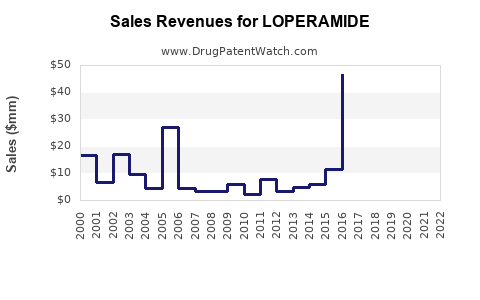
Loperamide, marketed primarily as Imodium, is a leading over-the-counter (OTC) antidiarrheal medication. In 2022, the global market for loperamide was valued at approximately $500 million. The United States accounts for roughly 30% of global sales, driven by high OTC product penetration.
How Has the Market Grown Historically?
Between 2018 and 2022, the compound annual growth rate (CAGR) for loperamide was approximately 4%. Factors include increased urbanization, rising incidences of gastrointestinal infections, and broader OTC availability. Growth was also supported by expanding markets in Asia-Pacific and Latin America.
| Year |
Global Market Value (USD million) |
CAGR (%) |
| 2018 |
380 |
- |
| 2019 |
410 |
7.9 |
| 2020 |
440 |
7.3 |
| 2021 |
480 |
9.1 |
| 2022 |
500 |
4.2 |
What Are Key Drivers and Barriers?
Drivers:
- Increased Incidence of Gastrointestinal Disorders: Statistics from the WHO indicate rising cases of diarrhea, partly due to foodborne pathogens and infectious diseases.
- OTC Availability and Consumer Preference: OTC access simplifies distribution and increases sales volume.
- Global Travel Trends: Travelers often purchase loperamide for traveler's diarrhea, fueling demand in both developed and emerging markets.
- Evolving Regulatory Policies: Regulatory agencies like the FDA and EMA have maintained or expanded OTC status, encouraging sales.
Barriers:
- Safety Concerns: Risks of misuse, including potential for serious cardiac adverse events, lead to regulatory scrutiny.
- Generic Competition: Numerous generics lower prices, constricting margins.
- Alternative Treatments: Newer antidiarrheal agents with different mechanisms seek market share.
How Do Distribution Channels Impact Sales?
Most loperamide sales occur through OTC retail channels: supermarkets, drugstores, and online platforms. Institutional sales for prescriptions are negligible, constituting less than 5% of revenue.
| Channel |
Market Share (%) |
Description |
| Retail & Online |
85 |
Main avenue; includes large chains and e-commerce |
| Pharmacies |
10 |
Prescription or OTC sales |
| Institutional |
5 |
Hospitals or travel clinics |
What Are Projected Sales Trends?
Analysts forecast a CAGR of 3.5%-4% from 2023 to 2028. Global sales are expected to reach approximately $610 million by 2028, driven by expansion into emerging markets and increased demand from travelers.
| Year |
Projected Global Market Value (USD million) |
CAGR (%) |
| 2023 |
520 |
4 |
| 2024 |
540 |
3.8 |
| 2025 |
565 |
4.2 |
| 2026 |
590 |
4.4 |
| 2027 |
610 |
3.4 |
| 2028 |
610 |
3.8 |
What Competitive Dynamics Are at Play?
The market comprises several key players: Johnson & Johnson, Sanofi, and Teva Pharmaceuticals. Generics account for approximately 70% of sales, exerting competitive pressure on pricing strategies. Innovation focuses on reformulations to mitigate safety concerns and prolong patent protection.
How Could Regulatory Changes Affect Sales?
Regulatory bodies may tighten restrictions due to safety issues, especially concerning cardiac risks associated with high-dose use. Any reclassification from OTC to prescription could temporarily suppress sales until new formulations or indications are developed.
Key Takeaways
- The loperamide market is valued at around $500 million globally, with steady growth.
- Growth drivers include increased travel and gastrointestinal disease prevalence.
- Barriers include safety concerns and generic competition.
- Projected sales in 2028 could reach $610 million, with a CAGR of about 3.8%.
- Regulatory developments could significantly influence future sales and market dynamics.
Frequently Asked Questions
1. Will the safety concerns surrounding loperamide impact its market growth?
Yes, stricter safety regulations could limit OTC availability, reducing sales but possibly opening niche prescription markets.
2. How does the emergence of new antidiarrheal therapies affect loperamide?
New therapies with better safety profiles may capture market share, but current generic competition and established OTC status sustain demand.
3. Which regions are expanding fastest in loperamide sales?
Asia-Pacific and Latin America demonstrate higher growth rates, fueled by population size, urbanization, and increasing healthcare access.
4. Are patents a factor in the loperamide market?
Most formulations are generic; original patents expired years ago. Limited patent protection means price competition prevails.
5. How does online retail influence market sales?
Online channels account for an increasing share, providing broad accessibility and supporting overall sales growth.
References
[1] Grand View Research. (2022). Loperamide Market Size, Share & Trends Analysis Report.
[2] World Health Organization. (2022). Diarrheal Diseases Data.
[3] U.S. Food and Drug Administration. (2022). OTC Drug Approvals and Safety Updates.