Last updated: February 13, 2026
Ketorolac is an NSAID used primarily for short-term management of moderate to severe pain. It is available in both injectable and oral formulations. Approved indications include post-operative pain, musculoskeletal pain, and other acute pain conditions. The drug's market penetration depends on its safety profile, competition, regulatory landscape, and evolving pain management standards.
Current Market Landscape
Market Size and Revenues
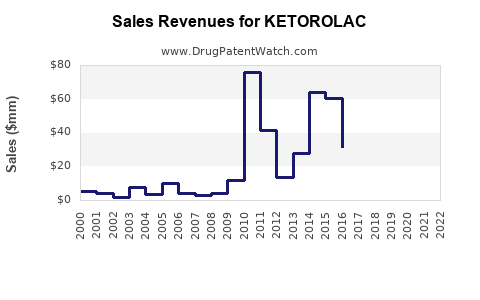
In 2022, the global NSAID market was valued at approximately $12.5 billion. Ketorolac accounts for a significant share within hospital and outpatient segments due to its potency and efficacy profile. The drug's annual sales are estimated at $500 million globally, with the U.S. contributing roughly 60% of revenue, driven by widespread clinical use.
Segmentation
- Formulation: Injectable (parenteral) forms dominate hospital use; oral forms are used in outpatient care.
- Application: Post-surgical pain management accounts for 70% of sales; musculoskeletal and other acute pain make up the remainder.
Regulatory Status
Ketorolac is approved by the FDA, EMA, and other agencies. The drug faces restrictions on duration of use (typically 5 days maximum) due to risks of gastrointestinal (GI) bleeding and renal impairment.
Competitive Landscape
Major competitors include traditional NSAIDs such as ibuprofen, diclofenac, and newer agents with improved safety profiles. Its high efficacy in pain control makes it preferred in acute settings but limits long-term use.
Key Market Drivers and Challenges
Drivers:
- Increasing surgical procedures and outpatient interventions elevate demand.
- Growing emphasis on rapid pain relief in emergency and surgical settings.
- Adoption in hospitals, anesthesia practices, and pain clinics.
Challenges:
- Safety concerns restrict prolonged use, limiting sales longevity.
- Competition from other NSAIDs and non-opioid analgesics with improved safety profiles.
- Regulatory restrictions on certain formulations (e.g., injectable form requiring hospital settings).
Sales Projections (2023-2027)
| Year |
Estimated Global Sales (USD million) |
Growth Rate |
Factors Influencing Growth |
| 2023 |
520 |
4.0% |
Continued hospital use, new indications |
| 2024 |
540 |
3.8% |
Incremental adoption, stable market |
| 2025 |
560 |
3.7% |
Expansion into emerging markets |
| 2026 |
580 |
3.6% |
Growing surgical volumes |
| 2027 |
600 |
3.4% |
Slight market saturation, safety-focused innovations |
Projection Rationale:
Sales growth remains modest due to market saturation, safety concerns, and competition. The aging population and rising surgical volumes in emerging markets could offer future growth opportunities, potentially increasing the CAGR slightly beyond 3.5%.
Potential Market Expansion and Innovation Opportunities
- New formulations: Extended-release or combination products may mitigate safety issues.
- Repositioning for chronic pain: Limited due to safety profile but could be explored with safety improvements.
- Regulatory approvals in emerging markets: Growth opportunities exist in Asia-Pacific, Latin America, and the Middle East.
Conclusion
The global market for ketorolac is stable but constrained by safety issues and competition. Sales are projected to grow at a compound annual rate of approximately 3.5% over the next five years, reaching around $600 million globally by 2027. Market expansion will depend on regulatory decisions, safety innovations, and the growth of surgical procedures.
Key Takeaways
- Current global annual sales approximate $500 million, primarily driven by hospital-based use.
- Growth rate forecast of 3.5% annually from 2023 to 2027.
- Market expansion prospects hinge on safety improvements and emerging market growth.
- Competition from other NSAIDs and analgesics limits rapid growth.
- Safety concerns restrict long-term or extended use, constraining revenue.
FAQs
1. What are the primary clinical applications of ketorolac?
Post-operative pain management, acute musculoskeletal pain, and other short-term pain control in hospital settings.
2. What limits the growth of ketorolac sales?
Safety profile restrictions on gastrointestinal and renal adverse events, competition from other analgesics, and regulatory constraints on duration of use.
3. Which markets present the most growth opportunity?
Emerging markets in Asia-Pacific, Latin America, and the Middle East, driven by increasing surgical procedures.
4. Are there any upcoming formulations or indications for ketorolac?
Research into safety-enhanced formulations is ongoing, but no new indications are currently approved.
5. How does ketorolac compare to other NSAIDs in the market?
It is more potent for short-term pain but has higher safety risks, limiting its use to short durations compared to other NSAIDs with more favorable safety profiles for long-term use.
References
[1] MarketsandMarkets. NSAID market report 2022.
[2] FDA prescribing information for ketorolac.
[3] GlobalData. NSAID market analysis, 2022.
[4] IQVIA. Pharmaceutical sales data, 2022.