Share This Page
Drug Sales Trends for HYDROXYZINE
✉ Email this page to a colleague
Payment Methods and Pharmacy Types for HYDROXYZINE (2003)
Revenues by Pharmacy Type
Units Sold by Pharmacy Type
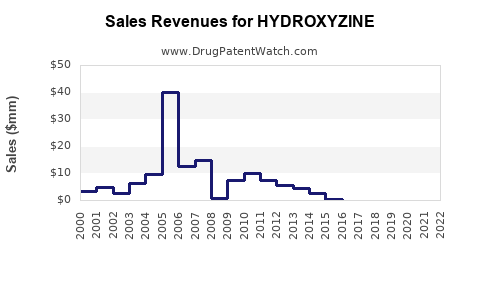
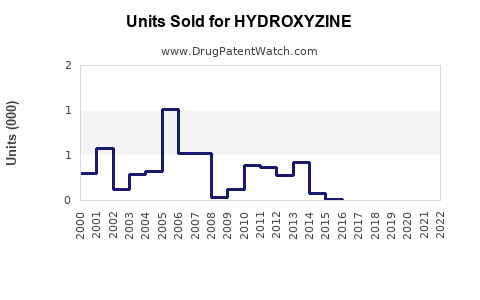
Annual Sales Revenues and Units Sold for HYDROXYZINE
| Drug Name | Revenues (USD) | Units | Year |
|---|---|---|---|
| HYDROXYZINE | ⤷ Start Trial | ⤷ Start Trial | 2022 |
| HYDROXYZINE | ⤷ Start Trial | ⤷ Start Trial | 2021 |
| HYDROXYZINE | ⤷ Start Trial | ⤷ Start Trial | 2020 |
| >Drug Name | >Revenues (USD) | >Units | >Year |
Hydroxyzine Market Analysis, Sales Projections, Patent Status, and Generic Competition
Hydroxyzine is a mature, low-cost generic antihistamine and anxiolytic with no meaningful U.S. exclusivity barrier. Market value is driven by prescription volume, not pricing power. The principal commercial risks are substitution by cetirizine, levocetirizine, diphenhydramine, buspirone, benzodiazepines, non sedating antihistamines, and newer insomnia or anxiety therapies.
A reasonable planning estimate places the global hydroxyzine market at approximately $500 million to $800 million in 2024 sales, with the United States representing a minority of volume but a disproportionately large share of revenue. A base-case forecast implies flat to low-single-digit annual growth through 2030. The product has limited attractiveness for premium branded investment, but it remains commercially viable for low-cost generic manufacturers with efficient sourcing, reliable supply, and broad channel access.
What is hydroxyzine and which products generate sales?
Hydroxyzine is a first-generation antihistamine available primarily as hydroxyzine hydrochloride and hydroxyzine pamoate. The pamoate salt is commonly marketed in capsules, while the hydrochloride salt is used in tablets, oral solutions, and intramuscular injection.
| Product | Common U.S. brand | Primary uses | Commercial status |
|---|---|---|---|
| Hydroxyzine pamoate capsules | Vistaril | Anxiety, pruritus, sedation | Generic |
| Hydroxyzine hydrochloride tablets | Atarax legacy brand | Pruritus, anxiety, sedation | Generic |
| Hydroxyzine hydrochloride oral solution | Generic | Pediatric and adult oral dosing | Generic |
| Hydroxyzine hydrochloride injection | Generic | Rapid parenteral administration | Generic |
The FDA-approved labeling identifies hydroxyzine hydrochloride for symptomatic relief of anxiety, as a preoperative sedative, and for pruritus caused by allergic conditions. Hydroxyzine pamoate is indicated for anxiety, pruritus, and preoperative sedation.[1,2]
Hydroxyzine is not approved by the FDA as a primary treatment for major depressive disorder, chronic insomnia, or generalized anxiety disorder under a modern disease-specific approval. Physicians may use it off label for short-term anxiety or sleep symptoms.
How large is the hydroxyzine market?
No public company reports hydroxyzine revenue as a separate line item. Generic manufacturers usually aggregate the product within broader U.S. generics, hospital products, or international pharmaceutical revenue. Market estimates therefore require triangulation from prescription volume, generic pricing, dosage forms, and geographic demand.
Estimated 2024 market by region
| Region | Estimated 2024 sales | Market characteristics |
|---|---|---|
| United States | $150 million-$250 million | High prescription visibility; intense generic competition |
| Europe | $120 million-$200 million | Strong use in allergy, pruritus, anxiety, and hospital care |
| Asia-Pacific | $120 million-$220 million | High volume, lower average selling prices |
| Latin America, Middle East, and Africa | $80 million-$130 million | Fragmented markets and local manufacturing |
| Global total | $500 million-$800 million | Broad range reflects limited product-level disclosure |
The market is larger by units than by revenue. Hydroxyzine tablets and capsules have very low generic prices, while injectable products, hospital contracts, and branded or semi-branded products can produce higher net prices.
The strongest demand comes from:
- Pruritus and allergic skin conditions.
- Short-term anxiety treatment.
- Sedation before medical procedures.
- Emergency department and inpatient use.
- Pediatric oral liquid prescriptions.
- Institutional and long-term-care settings.
What are the key hydroxyzine sales drivers?
Hydroxyzine demand is supported by a wide approved-use base and low acquisition cost. Its sedating effect makes it useful when clinicians want an antihistamine with central nervous system activity, although that same property limits use in older adults and patients at risk of falls or cognitive impairment.
Volume drivers
Prescription volume is likely to remain stable because hydroxyzine is inexpensive, widely stocked, and familiar to clinicians. Demand also benefits from:
- Continued treatment of allergic skin disorders and urticaria.
- Use as a short-term alternative to controlled substances for anxiety or insomnia symptoms.
- Availability in oral liquid and injectable formulations.
- Hospital and emergency department protocols.
- Generic formulary preference.
- Use in markets where newer antihistamines are less affordable.
Volume constraints
Hydroxyzine faces substitution from less sedating antihistamines and competing anxiety treatments. The FDA labeling warns about drowsiness and cautions against combining the drug with central nervous system depressants.[1,2] European regulators have also addressed QT prolongation and cardiac arrhythmia risk, limiting use in susceptible patients.[3]
Potential demand constraints include:
- Preference for second-generation antihistamines such as cetirizine and loratadine.
- Concern about anticholinergic burden.
- Restrictions in older adults.
- Avoidance in patients with prolonged QT intervals or cardiovascular risk.
- Increasing clinical preference for nonpharmacologic anxiety treatment.
- Competition from buspirone, selective serotonin reuptake inhibitors, and newer sleep medicines.
What are the hydroxyzine sales projections through 2030?
The following forecast is a planning model rather than reported company guidance. It assumes a 2024 global market midpoint of $650 million, with price erosion offset partly by prescription growth and expansion in emerging markets.
| Year | Bear case | Base case | Bull case |
|---|---|---|---|
| 2024 | $500 million | $650 million | $800 million |
| 2025 | $495 million | $670 million | $832 million |
| 2026 | $490 million | $690 million | $865 million |
| 2027 | $485 million | $711 million | $899 million |
| 2028 | $480 million | $732 million | $935 million |
| 2029 | $475 million | $754 million | $972 million |
| 2030 | $470 million | $777 million | $1.01 billion |
| 2024-2030 CAGR | -1.0% | 3.0% | 3.9% |
Forecast assumptions
The bear case assumes continuing price compression, declining use in older patients, and substitution by newer antihistamines. The base case assumes stable mature-market demand and mid-single-digit growth in lower-income countries, offset by generic price erosion. The bull case requires stronger international volume growth, stable injectable demand, and sustained use for short-term anxiety and pruritus.
The base case should be treated as a volume-stability scenario, not a high-growth pharmaceutical opportunity. Gross sales may remain stable while net revenue declines because of tender discounts, pharmacy benefit manager pressure, and generic competition.
When does hydroxyzine lose exclusivity?
Hydroxyzine lost meaningful U.S. market exclusivity decades ago. The original Atarax and Vistaril products are legacy brands, and hydroxyzine is now supplied primarily through multiple ANDA-approved generic products.
| Exclusivity category | Hydroxyzine status |
|---|---|
| New chemical entity exclusivity | Expired |
| Orphan exclusivity | None identified for core hydroxyzine products |
| Pediatric exclusivity | None relevant to the mature product |
| U.S. patent exclusivity | Expired or commercially immaterial |
| Generic approval pathway | ANDA |
| Current branded moat | None of material significance |
Hydroxyzine was introduced in the 1950s, before the modern Hatch-Waxman exclusivity framework. Any original composition or formulation patents would have expired many years ago. The product is not a biologic and does not qualify for biosimilar exclusivity.
What patents protect hydroxyzine products?
No active core composition-of-matter patent is expected to protect hydroxyzine in the United States, Europe, or other major markets. The active ingredients are hydroxyzine hydrochloride and hydroxyzine pamoate, both of which are established small-molecule compounds.
Formulation patents
Formulation-level patent risk is low. Hydroxyzine is marketed in conventional tablets, capsules, oral solutions, and injectable forms. These dosage forms generally do not require a proprietary delivery platform.
Potentially relevant rights could cover:
- A specific oral liquid vehicle.
- Taste masking.
- Modified-release delivery.
- Combination products.
- Device or packaging design.
- Manufacturing processes or crystallization methods.
Such rights would not ordinarily block standard immediate-release generic tablets or capsules unless they were listed in the FDA Orange Book and linked to a specific approved product. The FDA Orange Book is the relevant U.S. source for patents and regulatory exclusivity associated with approved drug products.[4]
What is the Orange Book status of hydroxyzine?
Hydroxyzine products are generally treated as mature generic products with no commercially important Orange Book patent barrier. The Orange Book may contain multiple approved reference and generic entries for hydroxyzine hydrochloride and hydroxyzine pamoate, but the presence or absence of a listing must be assessed by specific dosage form, strength, and reference product.[4]
For investment and litigation screening, the relevant conclusion is:
- No core hydroxyzine patent should be assumed to block ANDA approval.
- No standard 30-month stay strategy is expected to create a durable market barrier.
- Any patent review should focus on a particular branded formulation or combination product.
- Generic applicants can generally compete through ANDA pathways without a Paragraph IV campaign against a valuable core patent.
Are there Paragraph IV challenges to hydroxyzine?
Paragraph IV litigation is unlikely to be commercially significant for conventional hydroxyzine products because the core drug is already generic and the original patents have expired. A Paragraph IV filing could arise for a new formulation, combination, or delivery system, but it would concern the improvement product rather than hydroxyzine itself.
The absence of meaningful patent barriers changes the competitive model. Manufacturers compete through:
- Abbreviated approval timing.
- API cost.
- Manufacturing reliability.
- Product availability.
- Hospital and wholesaler contracts.
- Private-label arrangements.
- Regulatory compliance.
- Ability to supply multiple strengths and dosage forms.
Which companies compete in the hydroxyzine market?
The market is fragmented. Competition includes large generic manufacturers, specialty generics companies, hospital suppliers, regional pharmaceutical companies, and private-label distributors. Historical and current suppliers may vary by country and dosage form.
Potential competitors include companies with broad generic portfolios such as Teva Pharmaceutical Industries, Viatris, Sandoz, Hikma Pharmaceuticals, Amneal Pharmaceuticals, Cipla, Sun Pharmaceutical Industries, and regional manufacturers. The exact supplier set differs between U.S. tablets, capsules, oral solutions, and injectable products.
No single supplier is expected to control the global hydroxyzine market. The principal competitive advantage is operational rather than intellectual property based.
What hydroxyzine formulations are commercially attractive?
Capsules and tablets
Capsules and tablets have the largest unit demand and the lowest barriers to entry. They are suitable for retail pharmacy, mail order, long-term care, and institutional formularies. Price competition is severe.
Oral solution
Oral solution has a smaller market but can provide better differentiation because of pediatric dosing, flavor, packaging, and supply reliability. Manufacturing requires tighter controls for stability, microbial quality, preservative systems, and dose uniformity.
Injection
Injectable hydroxyzine has a narrower customer base but can generate higher revenue per unit. Hospital contracts, sterile manufacturing capacity, shortage risk, and regulatory compliance are the principal barriers. Sterile injectable supply interruptions can support temporary pricing improvement, but the opportunity is episodic.
What FDA regulatory issues affect hydroxyzine?
Hydroxyzine is an FDA-approved prescription drug. The main regulatory considerations are safety labeling, dosage-form quality, manufacturing compliance, and post-market pharmacovigilance.
The principal safety issues include sedation, impairment when combined with alcohol or other central nervous system depressants, anticholinergic effects, and potential QT prolongation. European regulators recommended restrictions related to cardiac risk, including use of the lowest effective dose and avoidance in patients with specific risk factors.[3]
FDA approval does not create a modern market exclusivity period for ordinary generic hydroxyzine. An ANDA applicant must demonstrate pharmaceutical equivalence and bioequivalence to the relevant reference product. Injectable products and oral solutions may face more complex chemistry, manufacturing, and controls requirements than standard tablets.
How strong is the hydroxyzine patent estate?
The hydroxyzine patent estate is weak from a commercial blocking perspective.
| Patent factor | Assessment |
|---|---|
| Core composition patent | Expired |
| Active U.S. exclusivity | None expected |
| Formulation protection | Limited and product-specific |
| Manufacturing patents | Possible but unlikely to block ordinary supply |
| Biosimilar protection | Not applicable |
| Paragraph IV leverage | Low |
| Generic entry risk | High |
| Freedom-to-operate for standard dosage forms | Generally favorable, subject to product-specific review |
The main risk is not patent litigation. It is regulatory or manufacturing disruption, including facility observations, recalls, API shortages, injectable capacity constraints, and failed product launches.
What generic entry risks exist for hydroxyzine?
Generic entry risk is already fully realized. Multiple manufacturers can compete in the same dosage forms, and pharmacy substitution is routine. A new entrant would face low legal barriers but difficult economics.
A successful launch would require at least one of the following:
- Lower API or conversion cost.
- A reliable oral solution supply.
- Injectable manufacturing capacity.
- A differentiated package or private-label agreement.
- Hospital contracting expertise.
- Entry into an underserved geographic market.
- Consistent supply during competitor shortages.
A standard tablet launch without a cost or supply advantage is unlikely to produce attractive margins.
How does hydroxyzine compare with competing drugs?
| Drug | Primary advantage over hydroxyzine | Primary disadvantage |
|---|---|---|
| Cetirizine | Less sedating for allergy treatment | Less useful when sedation is desired |
| Loratadine | Low sedation and broad OTC access | Limited role in anxiety or procedural sedation |
| Diphenhydramine | Broad availability and low cost | Greater sedation and anticholinergic burden |
| Buspirone | Non sedating anxiety treatment | Slower onset and narrower use |
| Benzodiazepines | Rapid anxiolytic effect | Dependence, abuse, and controlled-substance concerns |
| Doxylamine | Strong sedative effect | Significant next-day impairment and anticholinergic risk |
| Hydroxyzine | Low cost, rapid symptomatic effect, multiple dosage forms | Sedation, cardiac risk, and generic price erosion |
Hydroxyzine occupies a low-cost niche between antihistamines and short-term anxiolytic or sedative therapies. It is most defensible where clinicians value rapid symptomatic relief, low acquisition cost, and avoidance of controlled substances.
What licensing deals affect hydroxyzine?
No major global licensing transaction is central to the standard hydroxyzine market. The drug is widely available as a generic, and commercial arrangements are more likely to involve:
- Contract manufacturing.
- API supply agreements.
- Private-label distribution.
- Hospital purchasing contracts.
- Regional marketing rights.
- Technology transfer for sterile or liquid dosage forms.
A licensing deal for a conventional hydroxyzine tablet would have limited strategic value unless it included a differentiated formulation, a protected market, or a reliable low-cost supply platform.
What patent litigation affects hydroxyzine?
No major, durable U.S. patent litigation campaign is expected to affect conventional hydroxyzine tablets, capsules, oral solutions, or injections. Litigation exposure is more likely to arise from:
- Product liability claims.
- Manufacturing defects.
- Labeling disputes.
- Antitrust claims involving generic supply.
- Contract disputes with distributors.
- Patent disputes involving a new combination or delivery system.
The commercial litigation profile is therefore materially lower than for recent branded small molecules with active composition, method-of-use, and formulation patents.
Key Takeaways
- Hydroxyzine is a mature generic antihistamine and anxiolytic with no meaningful core patent protection.
- Estimated global 2024 sales are approximately $500 million to $800 million, but no audited product-level figure is publicly reported.
- A reasonable base-case forecast reaches about $777 million by 2030 from a $650 million 2024 midpoint, equal to roughly 3% CAGR.
- Tablets and capsules have high volume but severe price competition.
- Oral solution and injectable products offer better commercial differentiation.
- Paragraph IV, biosimilar, and Orange Book patent risks are low for conventional products.
- The main barriers are sterile manufacturing, supply reliability, regulatory compliance, and distribution access.
- Hydroxyzine has stable demand but limited pricing power and weak prospects for premium branded investment.
FAQs
Is hydroxyzine still commercially profitable for generic manufacturers?
Yes, but profitability depends on manufacturing cost, supply reliability, and product selection. Standard tablets and capsules have thin margins. Oral solutions and injectables can offer better economics when supply is constrained.
Can a new company obtain market exclusivity for hydroxyzine?
Not for the old active ingredient alone. Exclusivity could arise from a genuinely novel formulation, combination product, delivery system, or eligible regulatory pathway, but the conventional drug has no remaining composition-of-matter exclusivity.
Is hydroxyzine an attractive target for pharmaceutical licensing?
Only selectively. A conventional tablet or capsule is unlikely to justify a material licensing premium. A regional supply arrangement, sterile injectable platform, or differentiated pediatric formulation could support a more attractive transaction.
Does hydroxyzine have biosimilar competition?
No. Hydroxyzine is a chemically synthesized small molecule, not a biologic. Competition occurs through generic versions approved under ANDA or equivalent national pathways.
What is the biggest investment risk in the hydroxyzine market?
The biggest risk is margin compression from multiple generic suppliers. Secondary risks include API shortages, sterile manufacturing failures, recalls, cardiac-safety restrictions, and substitution by less sedating antihistamines or newer anxiety therapies.
References
- U.S. Food and Drug Administration. (n.d.). Hydroxyzine hydrochloride prescribing information.
- U.S. Food and Drug Administration. (n.d.). Hydroxyzine pamoate prescribing information.
- European Medicines Agency. (2015). Hydroxyzine-containing medicines: referral assessment report.
- U.S. Food and Drug Administration. (2024). Approved drug products with therapeutic equivalence evaluations: Orange Book.
- U.S. Food and Drug Administration. (1984). Drug Price Competition and Patent Term Restoration Act of 1984, as amended.
More… ↓
