Drug Sales Trends for HUMULIN
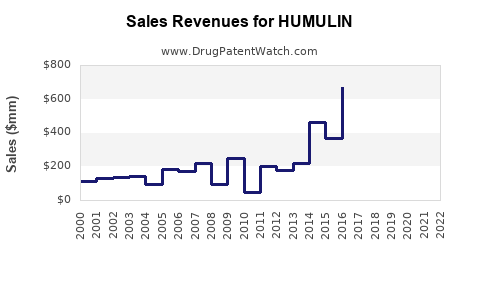
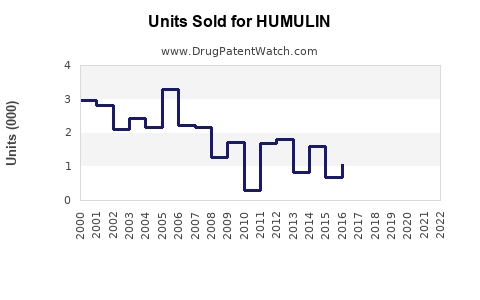
Annual Sales Revenues and Units Sold for HUMULIN
| Drug Name | Revenues (USD) | Units | Year |
|---|---|---|---|
| HUMULIN | ⤷ Start Trial | ⤷ Start Trial | 2022 |
| HUMULIN | ⤷ Start Trial | ⤷ Start Trial | 2021 |
| HUMULIN | ⤷ Start Trial | ⤷ Start Trial | 2020 |
| HUMULIN | ⤷ Start Trial | ⤷ Start Trial | 2019 |
| HUMULIN | ⤷ Start Trial | ⤷ Start Trial | 2018 |
| HUMULIN | ⤷ Start Trial | ⤷ Start Trial | 2017 |
| HUMULIN | ⤷ Start Trial | ⤷ Start Trial | 2016 |
| >Drug Name | >Revenues (USD) | >Units | >Year |
Humulin Market Analysis and Sales Projections: Revenue Outlook, Competition, and Exclusivity
Humulin is a mature Eli Lilly insulin franchise with estimated annual revenue near $1 billion. Its commercial profile is stable but declining because of biosimilar and follow-on insulin competition, lower U.S. insulin prices, payer substitution, and increased use of insulin analogs and non-insulin diabetes medicines. The strongest remaining segment is Humulin R U-500, which addresses severe insulin resistance and has fewer direct substitutes.
Base-case global Humulin revenue is projected to decline from approximately $1.0 billion in 2024 to $780 million-$850 million by 2029. A faster-decline case produces revenue below $700 million by 2029, while sustained demand for concentrated U-500 insulin could limit the decline to approximately 2% annually.
What is Humulin and which products generate revenue?
Humulin is Eli Lilly's brand family of recombinant human insulin products. The main formulations include regular insulin, NPH insulin, premixed insulin, and concentrated regular insulin.
| Humulin product | Insulin type | Common strength or presentation | Primary use |
|---|---|---|---|
| Humulin R | Regular human insulin | U-100 | Mealtime and basal coverage |
| Humulin R U-500 | Concentrated regular insulin | U-500 | Patients requiring high daily insulin doses |
| Humulin N | NPH insulin | U-100 | Intermediate-acting basal coverage |
| Humulin 70/30 | Premixed regular/NPH insulin | U-100 | Simplified basal-prandial treatment |
| Humulin R U-500 KwikPen | Concentrated regular insulin | U-500 | High-dose insulin delivery through a pen |
Humulin R U-500 is the most commercially differentiated product. It reduces injection volume for patients who require more than 200 units of insulin per day. Humulin R U-100, Humulin N, and Humulin 70/30 compete in older, lower-cost insulin segments with limited brand loyalty.
How much revenue does Humulin generate?
Eli Lilly reports Humulin as a product-level revenue line in its annual filings. Reported sales have been approximately $1 billion annually, with year-to-year variation caused by price reductions, foreign-exchange effects, channel inventory, and U.S. gross-to-net adjustments.
| Fiscal year | Estimated or reported Humulin revenue | Market interpretation |
|---|---|---|
| 2022 | Approximately $1.2 billion | High mature-brand base |
| 2023 | Approximately $1.1 billion | Early impact from price and access pressure |
| 2024 | Approximately $1.0-$1.1 billion | Continued erosion in U.S. and developed markets |
| 2025E | $950 million-$1.0 billion | Low-single-digit decline |
| 2026E | $890 million-$950 million | Greater payer substitution |
| 2027E | $840 million-$910 million | Mature-market contraction |
| 2028E | $800 million-$880 million | Continued price compression |
| 2029E | $780 million-$850 million | Stable residual demand, led by U-500 |
The figures for future years are scenario estimates rather than Eli Lilly guidance. Lilly's growth strategy is concentrated in newer products such as Mounjaro, Zepbound, Trulicity, and diabetes-related incretin therapies, while Humulin remains a mature cash-generating franchise.
What is the Humulin sales forecast through 2029?
The base-case forecast assumes annual revenue erosion of approximately 4%-6%, with U-500 growing slowly and legacy U-100 products declining more quickly.
| Scenario | 2024 base | 2029 projected revenue | Implied annual trend |
|---|---|---|---|
| Downside | $1.05 billion | $650 million-$720 million | Approximately -7% to -9% |
| Base case | $1.05 billion | $780 million-$850 million | Approximately -4% to -6% |
| Upside | $1.05 billion | $900 million-$950 million | Approximately -2% to -3% |
Base-case assumptions
The base case assumes:
- Continued price reductions in U.S. insulin.
- Increasing use of authorized generics and follow-on insulin products.
- Stable demand for concentrated U-500 insulin.
- Gradual conversion from human insulin to analog insulin in some markets.
- Continued demand in lower-income markets where human insulin has a cost advantage.
- No major manufacturing interruption affecting Lilly supply.
- No new exclusivity event that materially extends the Humulin franchise.
What is the U.S. market outlook for Humulin?
The U.S. market is the largest source of commercial pressure. Insulin access reforms, Medicare Part D changes, manufacturer price reductions, Medicaid rebate economics, and pharmacy benefit manager negotiations have reduced realized prices.
The Inflation Reduction Act limits Medicare insulin cost sharing to $35 per month for covered insulin products beginning with Part D and Part B changes implemented in 2023 and 2024. The cap improves patient affordability but can reduce the commercial value of high-list-price insulin products when net prices decline across the channel (Centers for Medicare & Medicaid Services, 2024).
Lilly also announced lower list prices for several insulin products and expanded access to lower-priced insulin. Those actions primarily affected insulin affordability and net pricing rather than clinical demand. Humulin remains commercially relevant because it is established, widely distributed, and available in multiple vial and pen formats.
U.S. volume should remain relatively stable among patients who require human insulin or U-500 insulin. Revenue will decline faster than unit volume because of:
- Lower list prices and rebates.
- Formulary preference for lower-cost insulin.
- Substitution by insulin analogs and follow-on products.
- Reduced out-of-pocket exposure under Medicare and commercial plans.
How does Humulin compare with competing insulin products?
Humulin competes across several distinct segments rather than against a single product.
| Competitor | Manufacturer | Main competitive position |
|---|---|---|
| Novolin R, Novolin N, Novolin 70/30 | Novo Nordisk | Direct human-insulin competition |
| Humalog | Eli Lilly | Rapid-acting analog alternative |
| NovoLog | Novo Nordisk | Rapid-acting analog alternative |
| Basaglar | Eli Lilly and Boehringer Ingelheim | Long-acting insulin alternative |
| Lantus and authorized follow-ons | Sanofi and other manufacturers | Long-acting basal competition |
| Rezvoglar | Lilly and partner | Interchangeable insulin glargine option |
| Semglee | Biocon Biologics and Viatris | Interchangeable insulin glargine option |
| ReliOn insulin products | Walmart and manufacturing partners | Low-price retail channel |
Humulin R U-500 has a stronger competitive position than standard Humulin products because it addresses high-dose insulin needs. Its closest alternatives include concentrated insulin analogs, insulin pump therapy, and multi-injection regimens using U-100 or U-200 products.
What is the FDA regulatory status of Humulin?
Humulin was among the first recombinant DNA-derived human insulin products approved in the United States. The FDA approved Humulin in 1982, establishing Lilly's human insulin franchise as a mature biologic product with decades of clinical and manufacturing history (U.S. Food and Drug Administration, 1982).
Humulin products are biologics regulated under the Public Health Service Act. Insulin products transitioned from the Federal Food, Drug, and Cosmetic Act to the biologics framework in 2020. Follow-on insulin products can use the abbreviated 351(k) pathway, although the commercial effect is closer to generic or biosimilar substitution than to traditional small-molecule generic substitution.
Orange Book and Purple Book status
Humulin is not protected by the type of active patent estate associated with newer branded drugs. Its relevant regulatory records are primarily connected to biologic licensing, labeling, manufacturing, and product-specific exclusivity history.
The Purple Book is more relevant than the Orange Book for biologic reference-product and biosimilar relationships. Humulin's commercial protection does not depend on a current, blocking composition-of-matter patent. Its market position rests on manufacturing scale, physician familiarity, supply reliability, distribution, and payer contracts.
What patents protect Humulin?
The original recombinant human insulin patents and early formulation patents have expired. Humulin therefore lacks a meaningful composition-of-matter patent barrier against competing human insulin.
Remaining intellectual-property value is more likely to arise from:
- Device and pen-delivery patents.
- Manufacturing processes.
- Cartridge and container systems.
- Dosing and administration technologies.
- Product-specific labeling and clinical-use rights.
- Trade secrets covering cell culture, purification, formulation, and quality control.
These rights may protect specific delivery systems or manufacturing processes, but they do not create broad market exclusivity for human insulin itself.
Are there formulation patents for Humulin?
Any surviving formulation or device rights are narrower than the original insulin molecule and generally do not prevent competitors from selling human insulin in alternative formulations or presentations. Formulation patents may affect a particular concentration, pen, cartridge, preservative system, or delivery configuration.
U-500 presents greater technical and regulatory complexity because dosing errors can create serious safety risks. Manufacturing controls, validated concentration, labeling, pen-device design, and clinical-use instructions create practical barriers even when broad patent protection is limited.
When does Humulin lose exclusivity?
Humulin's primary product exclusivity has already expired. The brand is commercially exposed to competition from other human insulin products and follow-on insulin products.
The relevant commercial question is not a single patent expiration date. It is whether a competitor can achieve:
- FDA approval;
- Reliable large-scale insulin manufacturing;
- Acceptable product stability;
- Distribution through wholesalers and pharmacies;
- Payer formulary access;
- Interchangeability or substitution advantages;
- A price low enough to overcome Lilly's scale and contracting position.
For Humulin R U-500, regulatory and manufacturing complexity may delay direct substitution even without blocking patents.
Are there Paragraph IV challenges to Humulin?
Paragraph IV litigation is generally associated with Hatch-Waxman abbreviated new drug applications for small-molecule drugs. Humulin is a biologic product, so direct Paragraph IV analysis is less applicable than it is for conventional Orange Book-listed medicines.
Potential competitors are more likely to use the 351(k) biosimilar pathway or other FDA insulin pathways. The practical litigation risks involve patent infringement, regulatory exclusivity, interchangeability, labeling, device rights, and manufacturing patents rather than a conventional Paragraph IV challenge to a small-molecule NDA.
What biosimilar and generic risks affect Humulin?
Humulin faces three categories of competition:
Follow-on human insulin
Novolin and other human insulin products provide direct competition in regular, NPH, and premixed insulin categories. These products limit Humulin's pricing power.
Insulin analog substitution
Rapid-acting and long-acting analogs can replace human insulin in clinical practice. Their use is influenced by hypoglycemia risk, dosing convenience, duration of action, formulary placement, and total treatment cost.
Biosimilar and interchangeable insulin
The FDA has approved interchangeable insulin products, particularly in the insulin glargine market. Those approvals demonstrate that payer-driven substitution can reduce branded insulin revenue even when patient volume remains stable (U.S. Food and Drug Administration, 2024).
The biosimilar threat to Humulin is strongest in standard U-100 segments and weaker for U-500. A competitor would need to replicate the concentrated product's manufacturing, device, labeling, and safety profile.
Which companies are challenging Humulin commercially?
The primary competitive companies are Novo Nordisk, Sanofi, Biocon Biologics, Viatris, Boehringer Ingelheim, and manufacturers supplying low-price retail channels.
Novo Nordisk is Lilly's closest global competitor in human insulin and insulin analogs. Sanofi competes more heavily in basal insulin but also influences payer expectations for insulin pricing. Biocon Biologics and Viatris have increased competition in follow-on and interchangeable insulin. Walmart's ReliOn channel increases consumer price pressure, particularly for patients paying cash or using lower-cost retail programs.
No single competitor is likely to displace the entire Humulin franchise. The principal risk is cumulative erosion across products and channels.
What licensing deals affect Humulin?
Humulin has no prominent recent licensing transaction that changes its core commercial outlook. Lilly's broader insulin portfolio has included collaborations, manufacturing relationships, authorized generics, and distribution agreements, but the Humulin franchise is primarily controlled and commercialized by Eli Lilly.
The more important strategic issue is internal portfolio allocation. Lilly is directing commercial resources toward Mounjaro, Zepbound, Trulicity, insulin analogs, and diabetes devices. Humulin is likely to remain a supply and access franchise rather than a major growth investment.
What litigation and settlement risks affect Humulin?
Humulin's litigation exposure is more likely to involve:
- Product liability and dosing-error claims.
- Device or delivery-system patent disputes.
- Manufacturing and supply disputes.
- Biosimilar or follow-on insulin patent litigation.
- Pricing and access investigations affecting insulin manufacturers.
- Competition disputes involving interchangeable products.
A major patent settlement governing generic entry is not the central risk for Humulin because the core product patents are long expired. Commercial entry risk depends more on approval, supply, contracting, and manufacturing economics.
What manufacturing barriers protect Humulin revenue?
Insulin manufacturing is technically demanding. Barriers include recombinant production, purification, formulation consistency, sterility, fill-finish capacity, cold-chain logistics, and strict batch-release controls.
For U-500 insulin, additional barriers include:
- Concentration accuracy.
- Pen-device calibration.
- Dose-conversion controls.
- Distinct labeling and packaging.
- Prevention of medication errors.
- Reliable supply of high-concentration product.
These barriers do not create legal exclusivity, but they can slow competitors and support residual pricing power.
What generic launch scenarios exist for Humulin?
| Scenario | Commercial event | Revenue effect |
|---|---|---|
| Limited substitution | Competitors remain concentrated in standard U-100 products | Humulin declines 2%-4% annually |
| Moderate substitution | Payers shift standard human insulin to lower-cost alternatives | Humulin declines 4%-6% annually |
| Aggressive substitution | Multiple follow-on products gain favorable formulary and substitution status | Humulin declines 7%-10% annually |
| U-500 resilience | Competitors enter standard products but not concentrated insulin | U-500 offsets part of the decline |
| Supply disruption | Competitor manufacturing interruption increases Lilly share | Temporary volume and revenue increase |
How strong is the Humulin commercial franchise?
Humulin has low patent strength but moderate commercial strength.
| Factor | Assessment |
|---|---|
| Composition-of-matter patents | Weak or expired |
| Formulation exclusivity | Limited and product-specific |
| Regulatory history | Strong |
| Manufacturing capability | Strong |
| Physician familiarity | Strong |
| U.S. pricing power | Weakening |
| U-500 differentiation | Moderate to strong |
| Biosimilar vulnerability | Moderate |
| Emerging-market relevance | Moderate |
| Long-term growth potential | Low |
What is the revenue exposure for Eli Lilly?
Humulin represents a small share of Eli Lilly's total revenue, which exceeded $30 billion annually in recent reporting periods. The franchise is strategically less important than Mounjaro, Zepbound, Trulicity, and other high-growth products.
A 20% decline in Humulin revenue would reduce Lilly's consolidated revenue by only a fraction of 1% to approximately 0.7%, depending on the company's total revenue base. The impact is more material at the product-segment level and for insulin manufacturing utilization than at the consolidated corporate level.
Humulin remains valuable because it generates cash flow, supports Lilly's diabetes portfolio, and maintains presence in lower-cost insulin markets. Its declining revenue is unlikely to materially affect Lilly's overall valuation unless the decline accelerates alongside broader insulin pricing pressure.
Key Takeaways
- Humulin is a mature recombinant human insulin franchise owned by Eli Lilly.
- Annual revenue is approximately $1 billion, with a base-case decline to $780 million-$850 million by 2029.
- The original product patents have expired, and current protection is primarily commercial and manufacturing-based.
- Humulin R U-500 is the strongest product because it serves patients requiring very high insulin doses.
- U.S. price reductions, Medicare affordability rules, formulary substitution, and follow-on insulin competition are the main revenue risks.
- Paragraph IV litigation is less relevant than 351(k) biosimilar, device, manufacturing, and product-liability disputes.
- Humulin has limited growth potential but should retain meaningful demand because of its low cost, established supply chain, and U-500 differentiation.
FAQs About Humulin Market Size and Sales Forecasts
Is Humulin still commercially important to Eli Lilly?
Yes. Humulin is no longer a major growth driver, but it remains a roughly $1 billion annual franchise with established demand and significant manufacturing scale.
Will Humulin be replaced by biosimilar insulin?
Standard Humulin products face follow-on and human-insulin competition. U-500 is less exposed because concentrated insulin requires specialized manufacturing, labeling, and delivery systems.
Does Humulin have active composition-of-matter patent protection?
No meaningful broad composition-of-matter protection remains for the original human insulin product. Any surviving rights are more likely to cover devices, formulations, processes, or specific presentations.
What is the largest risk to Humulin sales?
The largest risk is cumulative net-price erosion caused by payer contracting, Medicare pricing reforms, lower-cost insulin alternatives, and increasing use of follow-on products.
Can Humulin revenue grow again?
Sustained growth is unlikely. Revenue could temporarily increase through supply disruptions affecting competitors, greater demand for U-500 insulin, or stronger emerging-market volume, but the long-term trend is mature and declining.
References
-
Centers for Medicare & Medicaid Services. (2024). Medicare prescription drug benefit and insulin cost-sharing provisions. U.S. Department of Health and Human Services.
-
Eli Lilly and Company. (2023). Annual report for the year ended December 31, 2023. Eli Lilly and Company.
-
Eli Lilly and Company. (2024). Annual report for the year ended December 31, 2024. Eli Lilly and Company.
-
U.S. Food and Drug Administration. (1982). Humulin human insulin approval information. U.S. Department of Health and Human Services.
-
U.S. Food and Drug Administration. (2024). Purple Book: Database of licensed biological products. U.S. Department of Health and Human Services.
More… ↓
